
港珠澳大桥 Gǎngzhūào Dàqiáo, the Hong Kong-Zhuhai-Macao Bridge, crosses the 伶仃洋 Língdīngyáng, the Lingdingyang, and links the Hong Kong Special Administrative Region, that is Hong Kong, China, to the east with 珠海市 Zhūhǎi Shì, Zhuhai in Guangdong Province, and the Macao Special Administrative Region, that is Macao, China, to the west. About 55 kilometres long, it is the first major sea-crossing project jointly built by Guangdong, Hong Kong and Macao, and Chinese state media have described it as the world’s longest sea crossing. Those two facts, the length and the joint authorship, frame everything else. But the reason to look at this bridge closely is not its rank on a list. It is that the thing stops being a bridge twice: it goes down into the sea as a tunnel, comes back up onto an island, and only then continues. Seen from the Zhuhai shore on a clear day it reads as a line of pale towers stepping out into the haze until the water takes over; seen from above it is a single thread laid across the estuary, dipping beneath the surface at the middle and rising again onto two islands of its own making. A crossing that is bridge, then island, then tunnel, then island and bridge again is a different experience from driving over water.
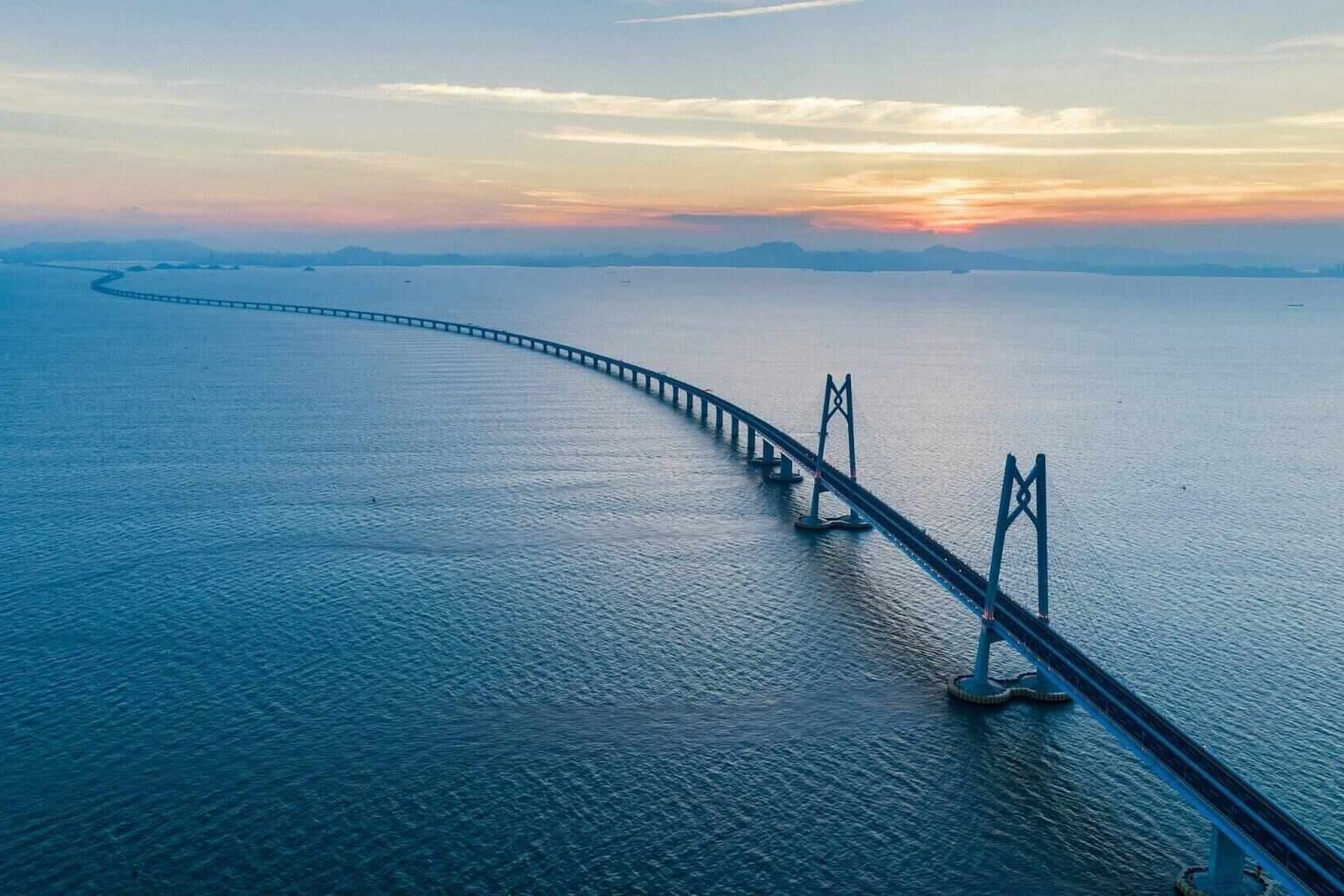
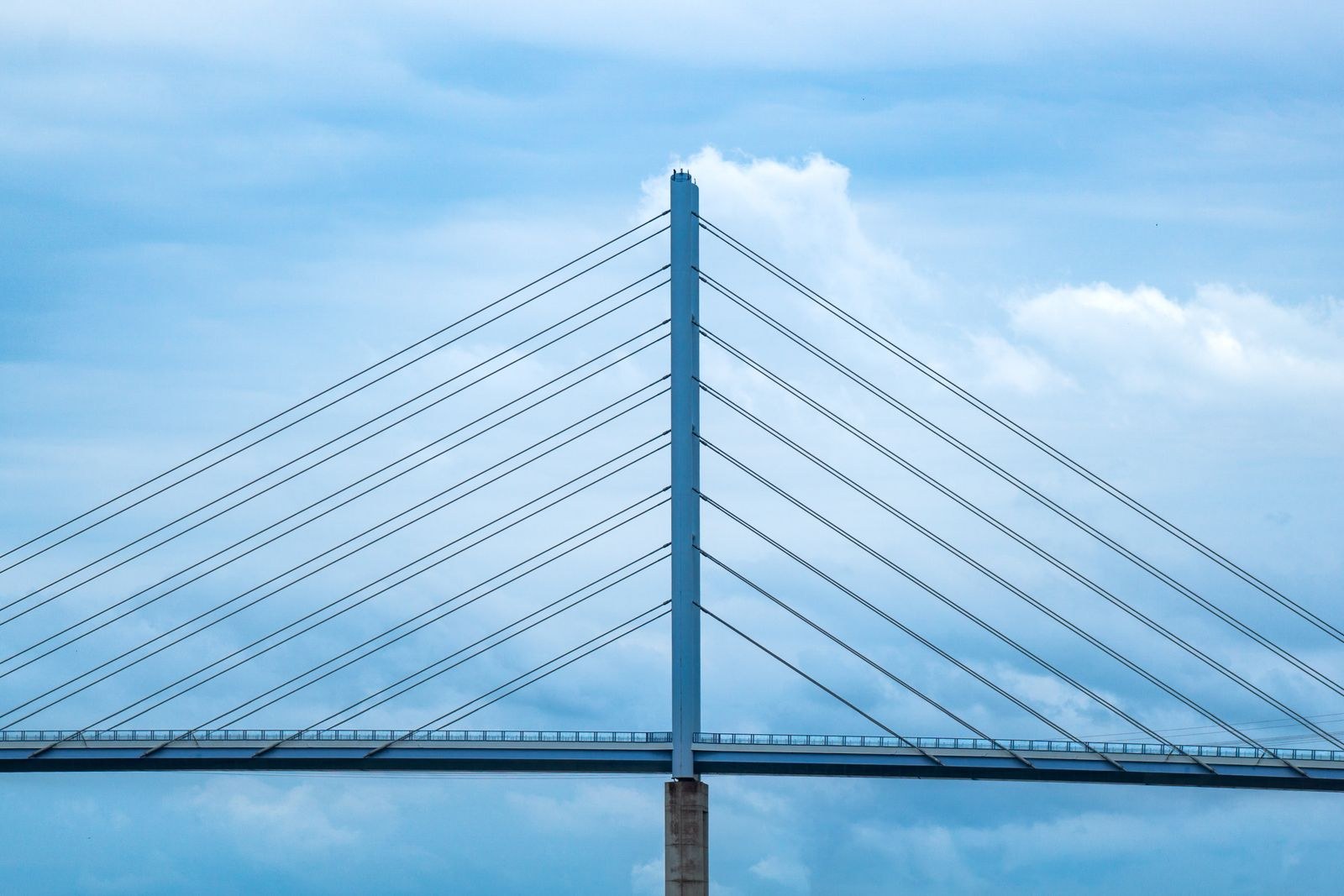
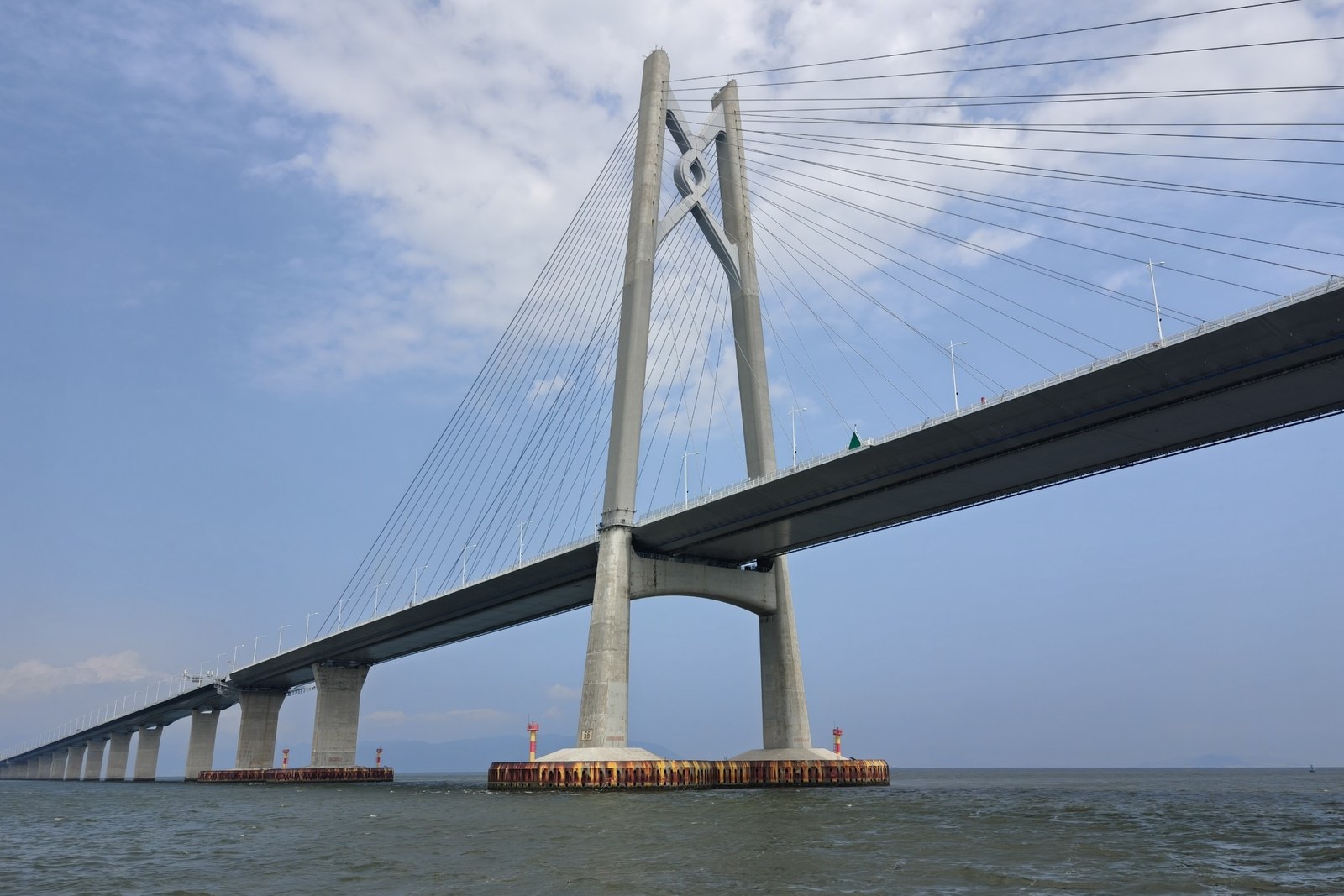
The numbers have to be kept in their own layers, because the usual mistake is to mix them. The main works of the project form a bridge-island-tunnel combination with a total length of about 29.6 kilometres, of which roughly 6.7 kilometres is an immersed undersea tunnel. At each end of the tunnel there is an artificial island in the open sea, the 东人工岛 Dōng Réngōngdǎo, the East Artificial Island, nicknamed 蓝海豚岛 Lán Hǎitún Dǎo, Blue Dolphin Island, and the 西人工岛 Xī Réngōngdǎo, the West Artificial Island, nicknamed 白海豚岛 Bái Hǎitún Dǎo, White Dolphin Island, which together the official accounts call the two shells of the Lingdingyang. The remaining roughly 22.9 kilometres of the main works is bridge. The sea-crossing section as a whole measures 42 kilometres, and the full length is 55. The three navigational-channel spans are cable-stayed: 青州桥 Qīngzhōu Qiáo, Qingzhou Bridge, whose towers are shaped as a Chinese knot; 江海桥 Jiānghǎi Qiáo, Jianghai Bridge, whose towers are shaped as dolphins; and 九洲桥 Jiǔzhōu Qiáo, Jiuzhou Bridge, whose towers are shaped as sails. The design service life is 120 years, the main girder uses 420,000 tonnes of steel plate, the equivalent of ten Bird’s Nest stadiums, and the speed limit is 100 km/h on the deck and 80 km/h in the tunnel, with goods vehicles and passenger cars kept in separate lanes.
The dates are worth knowing, because the project took a patient decade and a half. Construction began on 15 December 2009. The main works were joined through on 7 July 2017, accepted on 6 February 2018, and opened ceremonially in Zhuhai on 23 October 2018. Traffic began at nine in the morning on 24 October 2018. From design to completion the whole undertaking took about fourteen years. The point of it, for anyone who drives in the region, is the compression that followed: the drive from Hong Kong, China to Zhuhai and Macao, China fell to about thirty minutes, where the old route around the estuary via the Humen Bridge in Dongguan took roughly three hours. That change is the bridge’s real product, not a view but a distance removed.
The building of it produced three images worth carrying away. First, the islands. Rather than build out from the seabed with cofferdams, the engineers prefabricated giant steel cylinders, each about fifty metres tall and over five hundred tonnes, and drove 120 of them into the seabed like pins, so that the east and west islands rose out of the water and were reported to have been completed within the same year their construction began. Second, the tunnel. The immersed tube was built with what the engineers call a semi-rigid structure; the first element was joined on 2 May 2013 and the final joint was lowered in 2017, aligning to millimetre precision, and the result is described as the longest and the first deeply buried immersed highway tunnel of its kind. Third, the deck. Its surfacing covers about 700,000 square metres, of which 500,000 square metres is steel deck, making it, when built, the largest single steel-deck paving job of its time. None of these is a decoration on the story; they are the story.
The most important thing about the bridge may be what lives under it. Its alignment crosses the Pearl River Estuary Chinese White Dolphin National Nature Reserve, and the design was changed to reduce the damage: the number of piers was cut from 318 to 224 to open the water for the dolphins. Construction workers had to pass a dolphin-observer course so that they could recognise the animals and move vessels away from them. According to the bridge authority, the project met targets of zero marine pollution and zero dolphin casualties during construction, and the dolphin population in the Lingdingyang has risen from just over a thousand to more than two thousand. The Chinese white dolphin, 中华白海豚 Zhōnghuá Bái Hǎitún, turns pink as an adult, is nicknamed the giant panda of the water, and is a national first-class protected animal. That is a statement about policy and conservation, not a promise that a passenger will see one, because the animals are wild and a sighting is a matter of luck and season.
The bridge has not stood still since it opened. By 28 May 2024 the cumulative number of vehicles crossing the boundary had passed ten million. In 2024 alone, more than 27 million passenger crossings and 5.55 million vehicle crossings passed through the Zhuhai port of the bridge, up about seventy-two and seventy-one per cent respectively on the year before. On the mainland side the main bridge has a single toll station, in Zhuhai, with twenty lanes, and its system reads both the mainland ETC tag and Hong Kong’s Autotoll, a small detail that tells you what kind of crossing this is. Alongside the traffic, the bridge has become something to visit: from a designated point you can ride onto the deck and step ashore on Blue Dolphin Island, the one part of this engineering that an ordinary traveller can stand on.
Practicalities
Tickets. The Bridge Tour, a sightseeing bus that goes onto the deck and lands on Blue Dolphin Island, is about 188 yuan per adult in 2026 platform snapshots, with reduced tickets of about 128 yuan for students, for visitors aged sixty and over and for children between 1.2 and 1.5 metres; children under 1.2 metres go free but still need a free reservation. Sea sightseeing cruises run about 98 to 138 yuan. The Qinglu South Road waterfront and the viewing area outside the Zhuhai port are free. Private cars are not allowed onto the bridge deck, and any offer to drive you up for cash is a scam rather than a shortcut. As of October 2026, subject to change.
Opening hours. Bridge Tour departures run from about 08:30 to 17:00 through the day, and the whole trip takes about 140 minutes, of which roughly an hour is free time ashore on Blue Dolphin Island, since sources give anything from sixty to seventy-five minutes and a round hour is the honest figure. The bridge itself carries traffic around the clock.
Closing day. There is no fixed closing day, but the Bridge Tour is a reserved product and does not work as a walk-up. Book in your own name through the official WeChat account for the Bridge Tour, with only an identity document required and no separate travel document needed for the tour itself; in busy periods book one to seven days ahead, because same-day tickets on site are rare. The tour operates inside the customs-controlled port area, where checks are strict, and even free child places must be reserved.
Getting there. The assembly point is the Zhuhai Highway Port of the bridge, where the tour check-in hall is on the second floor of zone B of the port complex. By rail, reach Zhuhai Station at Gongbei and take a taxi for about fifteen to twenty minutes. By bus, routes 3, 12, 23 and 25 stop at the bridge port hub. By car, the P2 ground car park at the port is free for the first three hours on ordinary days and then charged by the half hour with a daily cap, though the free period is withdrawn on public holidays. The cross-boundary shuttle bus, HZMBUS, runs around the clock; when the bridge opened, its day fare was 58 yuan and its night fare, from midnight to 05:59, was 63 yuan, with half price for children and seniors, and those are 2018 figures rather than today’s.
flowcloud would say that the Hong Kong-Zhuhai-Macao Bridge is the one crossing that refuses to stay a bridge, diving and surfacing and diving again, and that an engineering project which moves 420,000 tonnes of steel and then counts how many dolphins are left underneath has measured its success twice over.
Getting there: The Hong Kong-Zhuhai-Macao Bridge crosses the Lingdingyang and links Hong Kong, China to the east with Zhuhai, Guangdong Province and Macao, China to the west, about 55 kilometres long, a bridge-island-tunnel project with a 6.7 km immersed tunnel between two artificial islands and the Pearl River Estuary Chinese White Dolphin National Nature Reserve along the line; it opened to traffic on 24 October 2018, the Bridge Tour to Blue Dolphin Island is about 188 yuan by platform snapshot, booked by real name through the official WeChat account and with no private cars allowed on the deck, there is no fixed closing day, and the zero pollution and zero casualty figures are the bridge authority’s construction-period statement rather than a promise of a dolphin sighting (checked October 2026, subject to change).