
The street is seven kilometres long if you count all of it, and it is paved in slabs of grey limestone worn into a shallow shine by three hundred years of feet. On both sides are 窨子屋 yìnziwū — courtyard houses wrapped in windowless brick — some still occupied, some with a 太平缸 tàipínggāng, a stone water tank for firefighting, standing in the entrance, and above the doors are stone lintels carved with the names of businesses that stopped trading when the river trade stopped. 洪江古商城 Hóngjiāng Gǔshāngchéng is described, without much exaggeration, as a living version of 清明上河图 Qīngmíng Shànghétú, the Song painting of a river market, and it is the most complete surviving merchant town in China.
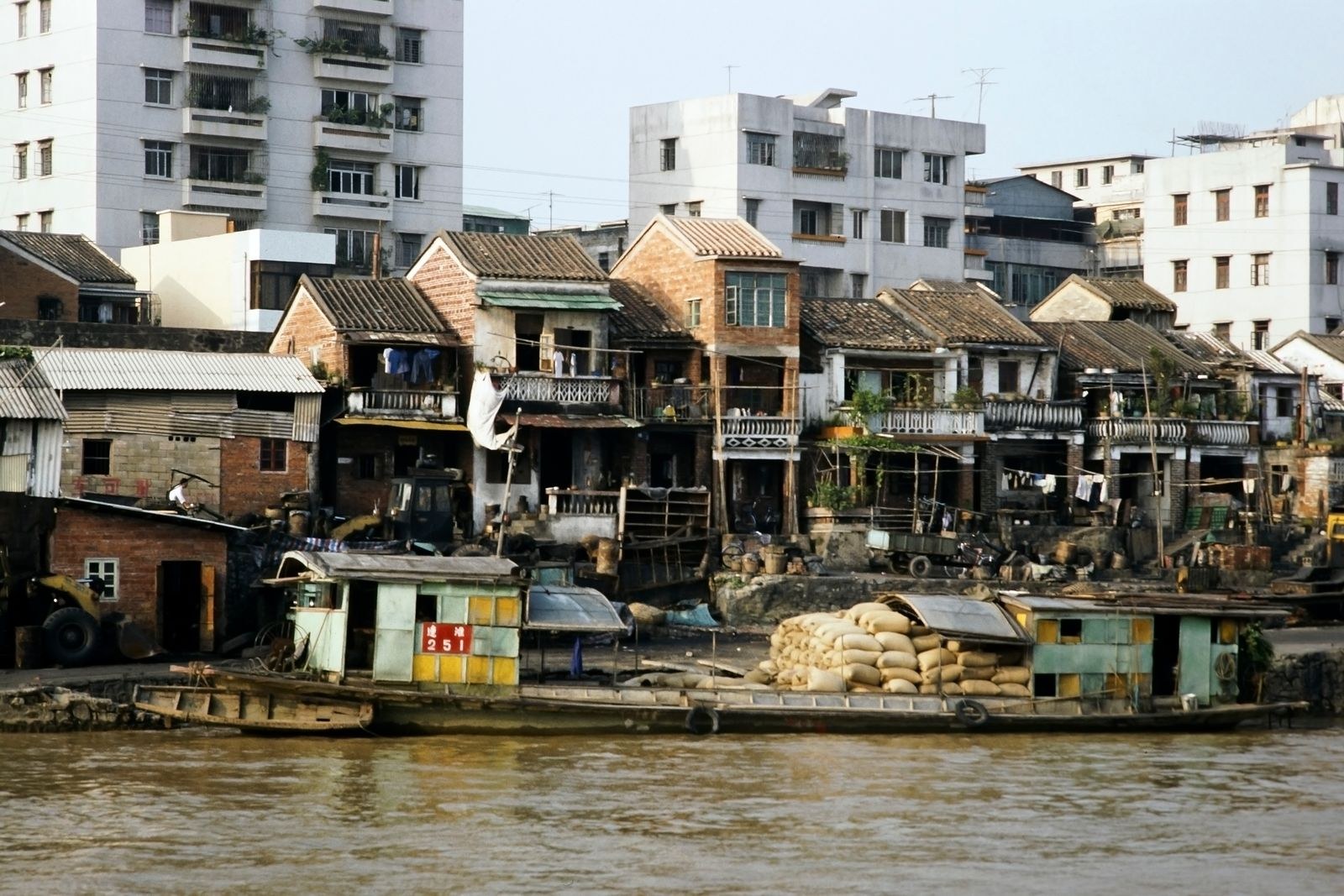
The trade was this. 沅水 Yuánshuǐ comes down out of Guizhou through deep gorges; at 洪江 Hóngjiāng it meets the 巫水 Wūshuǐ, and that confluence was the natural place to break bulk. Timber was rafted down from the mountains, tung oil was pressed in the surrounding hills and refined here into 洪油 hóngyóu, a varnish-grade oil that was exported by name, and cinnabar, white wax, opium, cloth, salt and paper all moved through. From the Song, when the court set up a tax office and called the place 洪江铺 Hóngjiāng Pù, through the Ming and Qing, it grew into a town of 18 provincial guild halls, 23 banks, 17 newspapers and, at the peak, something like 100,000 people — in a valley with no arable land worth speaking of, reachable only by boat.
What survives is the 七冲八巷九条街 qī chōng bā xiàng jiǔ tiáo jiē grid, with 380-odd protected buildings and about 20 hectares of it, and a set of institutions you can walk into and read. 苏州会馆 Sūzhōu Huìguǎn, the Suzhou guild hall, where merchants from the Yangtze delta kept a temple, a stage and a lodging house. 盛丰钱庄 Shèngfēng Qiánzhuāng, a bank with a counter, a strongroom and a system of remittance notes that settled debts across five provinces. 杨义斋木行 Yáng Yìzhāi Mùháng, a timber firm. 朱志大油号 Zhū Zhìdà Yóuhào, one of the 八大油号 bā dà yóuhào, the eight great oil houses, whose combined trade in the 1920s ran past 200,000 chests of oil a year. And 陈荣信商行 Chén Róngxìn Shāngháng, a merchant’s house where the wall carries a couplet in the hand of 郑板桥 Zhèng Bǎnqiáo, the Qing painter: 吃亏是福 chī kuī shì fú, “to take a loss is a blessing”, with an annotation explaining that the full gain and the empty loss are the mechanism, that losing on your own side profits the other, and that this is what keeps a market civil.
Practicalities
Tickets. The old market is ticketed as a scenic area; the combined ticket including the main houses runs around ¥90–120, and there are discounted rates for students and seniors. Walking the public lanes outside the ticketed houses is free.
Opening hours. Roughly 08:30–17:30, with the last entry around 16:30. The town stays open later — it is inhabited — but the interiors close.
Closing day. Open every day. It is quietest on weekday mornings and busiest at weekends and over 国庆.
Getting there. 怀化南站 Huáihuà Nán Zhàn on the 沪昆 high-speed line is about seventy minutes by road, and there is an intercity bus to 洪江 Hóngjiāng for ¥25–40. 洪江 Hóngjiāng also has a station on the old 焦柳 line. The station is on the new-town side of the river; the old town is a short taxi ride across the bridge.
What to Look For
The 太平缸 tàipínggāng. Forty-eight stone water tanks survive in the entrances of the houses; they were the fire service, and the carving on them is often better than on the buildings.
The 天井 tiānjǐng, the courtyards. Every 窨子屋 opens inward. Stand in one and note that the roof drains into a tank and the walls admit no direct light below the first floor — the whole building is a climate-control system and a safe.
The guild halls. Look for the regional names: 江西 Jiāngxī, 徽州 Huīzhōu, 福建 Fújiàn, 宝庆 Bǎoqìng, 贵州 Guìzhōu, 衡州 Héngzhōu. Each community ran its own and the architecture differs in small, deliberate ways.
The river. The 沅水 Yuánshuǐ is the reason for all of it. Twenty-eight named commercial wharves once lined the bank; the lights on the water after dark are the modern equivalent and, on a warm evening, the whole town is out there.
Getting Around
The old market is small enough to walk entirely and is best done that way, in about three hours, plus another hour if you stop for tea and a bowl of 米粉 mǐfěn. Combine it with 黔阳古城 Qiányáng Gǔchéng half an hour away — the two towns are the same history at different stages, one commercial and one administrative — and with the 雪峰山 Xuěfēng Shān escarpment to the east if you have a car. Stay overnight: the town in the evening, after the coaches leave, is the actual experience, and the 血粑鸭 xuèbā yā is best eaten in a courtyard at eight o’clock.
flowcloud would say that a town which got rich on oil and timber in a valley you cannot farm, built its own banks and newspapers and theatres, kept a couplet on the wall about the wisdom of losing money, and is now visited mostly by people who came for the architecture, has a claim on the phrase “commercial civilisation” that the big coastal cities do not quite earn.
Getting there: 洪江古商城 (Hóngjiāng Gǔshāngchéng), 洪江市 (Hóngjiāngshì), 怀化市 (Huáihuàshì), 湖南 (Húnán). Tickets around ¥90–120; open daily 08:30–17:30. About seventy minutes and ¥25–40 by bus from 怀化南站 (Huáihuà Nán Zhàn). Allow three hours in the old market, look for the 太平缸 (tàipínggāng) and the courtyards, and stay the night if you possibly can.