
The stone is the colour of rust and old brick, and it comes out of the ground in blades. Not the grey needles of the classic karst of 云南 Yúnnán or 桂林 Guìlín, but a close-packed forest of red rock ridges and slots and pillars, some of them two or three storeys high, separated by gaps you can walk through and, in places, barely squeeze through. 红石林 Hóngshílín — Red Stone Forest — is the only landscape of its kind in China and one of very few in the world, and what makes it strange is not just the shape but the colour: a karst in iron-oxide red, sitting in a green Hunan valley, looking like something that ought to be in a desert.
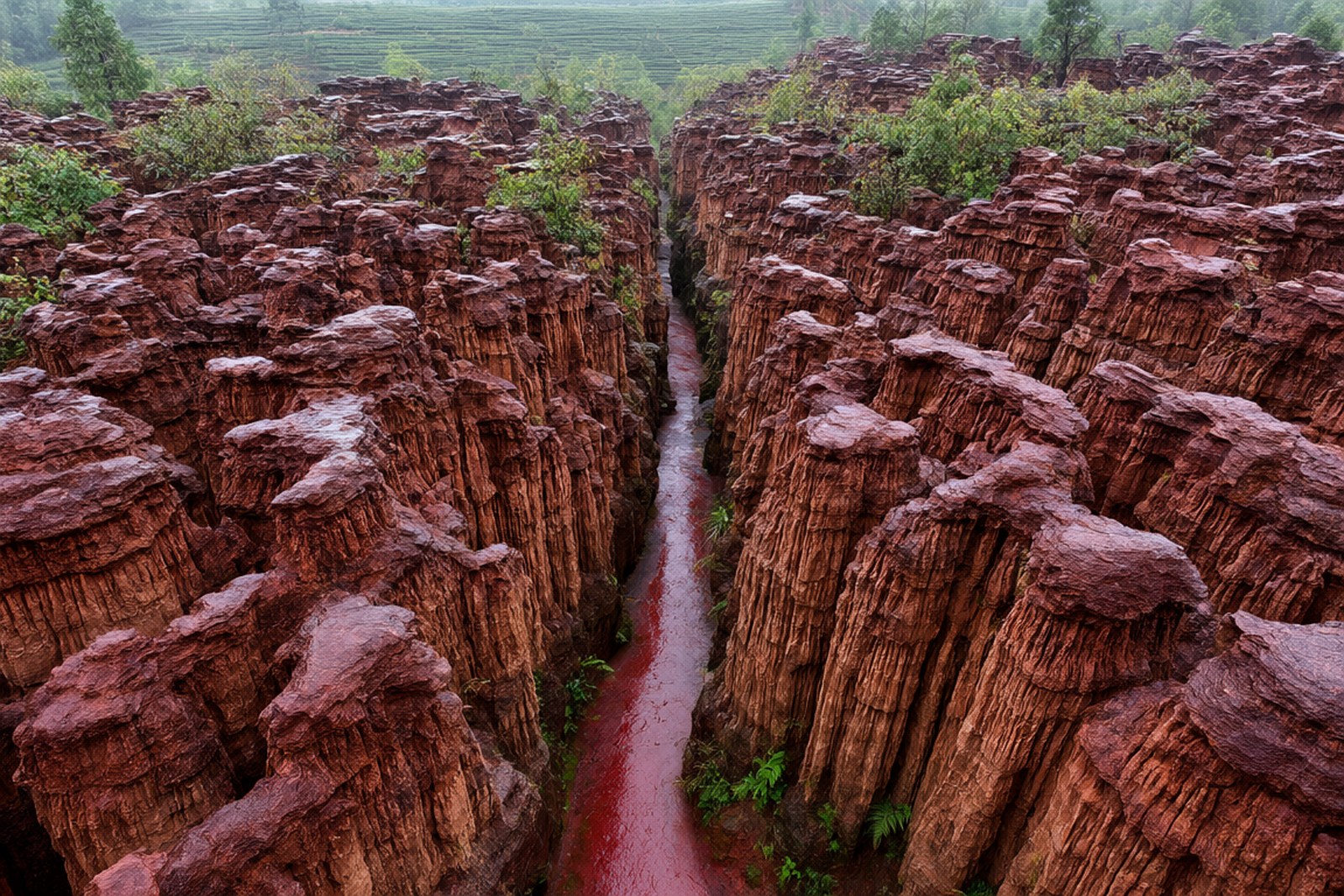
It is in 古丈县 Gǔzhàng Xiàn, in 湘西土家族苗族自治州 Xiāngxī, western 湖南 Húnán, on the terraces above the 酉水 Yǒushuǐ, about half an hour by road from 芙蓉镇 Fúróngzhèn and two hours from 吉首 Jíshǒu. The area was declared a national geopark, 红石林国家地质公园 Hóngshílín Guójiā Dìzhì Gōngyuán, and the reason a national geopark exists here rather than anywhere else is worth understanding before you go, because it turns a pretty walk into something considerably more interesting.
Four Hundred and Fifty Million Years of Rust
The rock is Ordovician marine limestone and dolomite, laid down on a shallow sea floor somewhere around 450 million years ago — long before the dinosaurs, in a period when this part of the world was under warm water near the equator, and when the first reefs and the first primitive fish were appearing in the geological record.
What gives it the colour is iron. The original sediment carried iron minerals, and as the limestone hardened and was later lifted and fractured, groundwater moving through the joints and bedding planes altered those minerals into iron oxides — haematite and related phases — which are red. Because the alteration happened along the same fractures that the later dissolution would follow, the red is not a surface stain: it goes into the rock with the shapes. Chip a piece and it is red inside.
Then came the water. Rain, made weakly acidic by dissolved carbon dioxide, worked its way down the fracture network and dissolved the limestone along it, widening cracks into slots, isolating blocks into pillars, and hollowing out the fluting and the small potholes that give the surfaces their texture. Two hundred million years of that produced the maze that is standing here now. The reason it is rare is that this combination — an iron-rich carbonate sequence, fractured in the right way, uplifted and then dissolved under a wet climate — does not happen often, and where it does, the exposure is usually small.
The Colour Changes
The thing guides here will tell you about first, and it is true rather than a boast: the surface colour shifts with the weather. In bright, dry conditions the iron oxides at the surface read as a strong brick red. After rain the rock darkens and the red goes toward purple-brown, and in the hour or two after a summer downpour, with the stone wet and the vegetation steaming, the whole place looks considerably more dramatic than the postcards. Go in the rain if you can stand it. Nobody does, and the site is empty.
The best light is the same as anywhere: early morning and the last two hours before sunset, when the sun is low enough to come in sideways along the slots and the red is at its warmest.
Walking It
The park is laid out as a set of connected loops with paved and stepped paths, and it is not a long walk — a couple of hours at a slow pace covers everything with plenty of stops. Three things to do:
Go into the slots rather than along the ridges. The paths on top give you the panorama; the slots between the pillars give you the scale, the cool air and the narrow views up to a strip of sky. 一线天 yīxiàntiān, “a line of sky”, is the local name for the narrowest of them, and there is exactly one place where the gap is tight enough to be memorable.
Look for the fluting. The vertical grooves and runnels on the pillars are dissolution features, not weathering scratches, and running a hand down one is the closest you will get to touching the process that made the landscape.
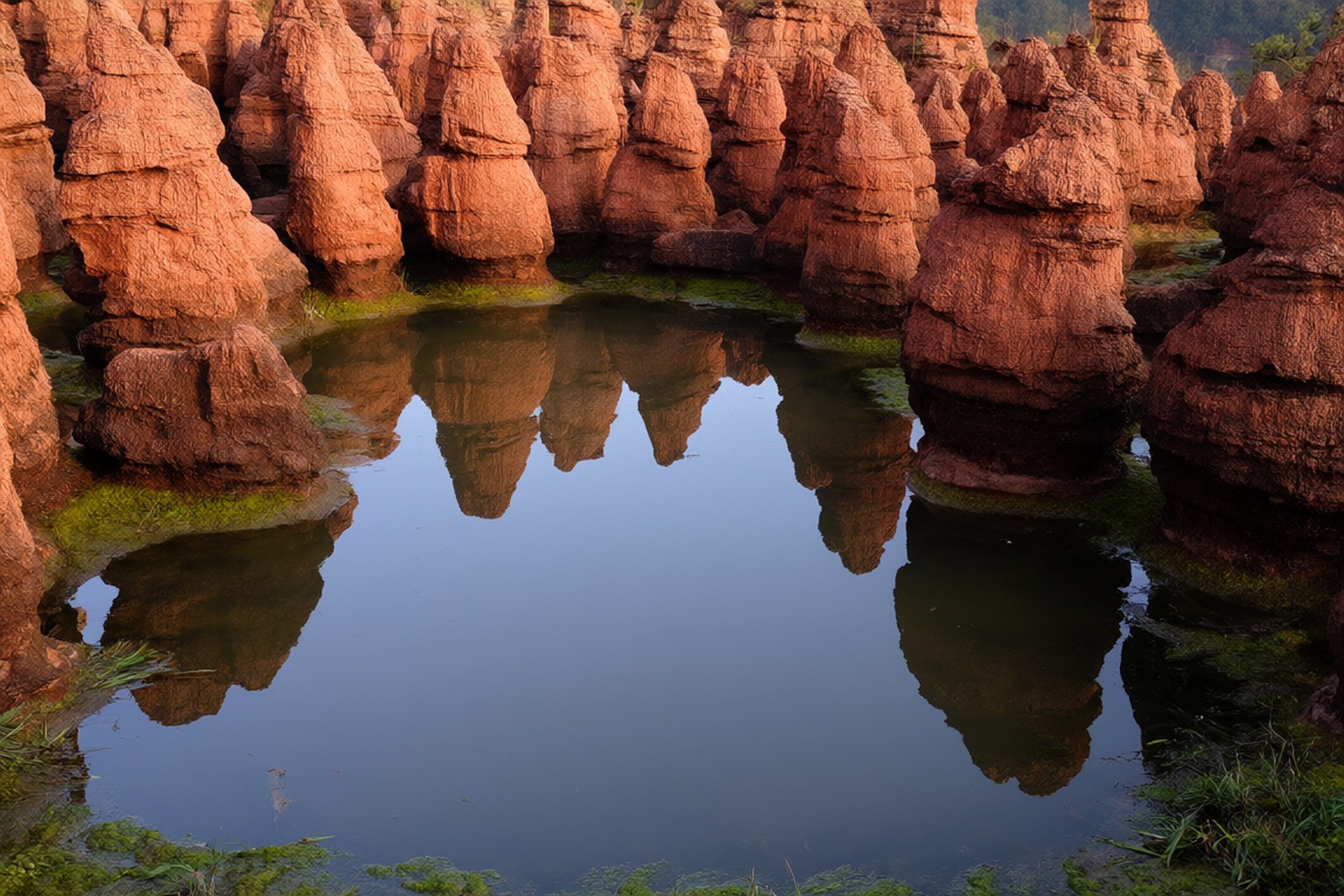
Find the water. There is a small pond basin in the middle of the stone forest — a 天池 tiānchí — where the pillars stand in water and reflect, and it is the one composition that makes the whole place look like the place it is.
Above the stone forest there are tea terraces, which are worth a mention because 古丈毛尖 Gǔzhàng máojiān, Guzhang Maojian, is one of the better green teas in Hunan — picked in spring, pan-fired by hand in the villages here, and sold in small quantities. Buy it in 古丈 or in 芙蓉镇 rather than in 长沙, and buy the spring picking.
Practicalities
Tickets: Around ¥80–100 for the geopark, with a discount for students and seniors; the price has moved a few times and there are occasional combination tickets with 芙蓉镇 (Fúróngzhèn) and the 坐龙峡 (Zuòlóngxiá) gorge nearby, so ask at the gate rather than assuming.
Opening hours: Roughly 08:00–17:30, with last entry about an hour before closing. The site is outdoors and entirely exposed; in July and August the rock radiates heat by mid-morning and the slots become an oven, so start at opening.
Closing day: Open daily. The park closes for heavy rain and for snow and ice, both of which happen here in winter, and the paths are steep enough that this is a genuine closure rather than a precaution.
Getting there: 红石林 (Hóngshílín) is in 古丈县 (Gǔzhàng Xiàn), 湘西土家族苗族自治州 (Xiāngxī), on the east side of the 酉水 (Yǒushuǐ), about 30 minutes by road from 芙蓉镇 (Fúróngzhèn) and roughly two hours from 吉首 (Jíshǒu). The nearest practical railhead is 古丈西 (Gǔzhàng Xī) on the high-speed line, from which it is a 40-minute taxi, or come by road from 吉首 via 芙蓉镇 with a detour to the gorge. Most people combine it with 芙蓉镇 in one day, which works well if you start early, or spread it over two if you want the tea terraces and the 坐龙峡 (Zuòlóngxiá) gorge as well. Bring grip — the red rock polished by feet and rain is slick — and a hat, because there is no shade on the ridges. flowcloud would say that a red stone forest is what happens when geology gets lucky twice, and that the correct response to a landscape four hundred and fifty million years in the making is to walk it slowly and then go and drink the local tea. Come after rain if you can, walk the slots rather than the ridges, and do not leave 古丈 without a packet of the spring Maojian.