
Nobody warns you about the noise. You come around the corner onto 沧白路 Cāngbái Lù — the road along the top of the cliff, which is also, and confusingly, the eleventh floor of a building — and the whole hillside below you is lit. Eleven terraces of timber shopfronts, balconies and upturned eaves stepping down the rock toward the river, every window gold. A man is frying something ten metres below your feet. Somewhere to the left a bamboo flute is being played badly.
And you are standing on a roof.
That is the thing about 洪崖洞 Hóngyá Dòng. It is not an attraction you look at from a distance, though nearly everyone does. It is a cliff with a city pressed into it, and the street you walked in on is the top of it.
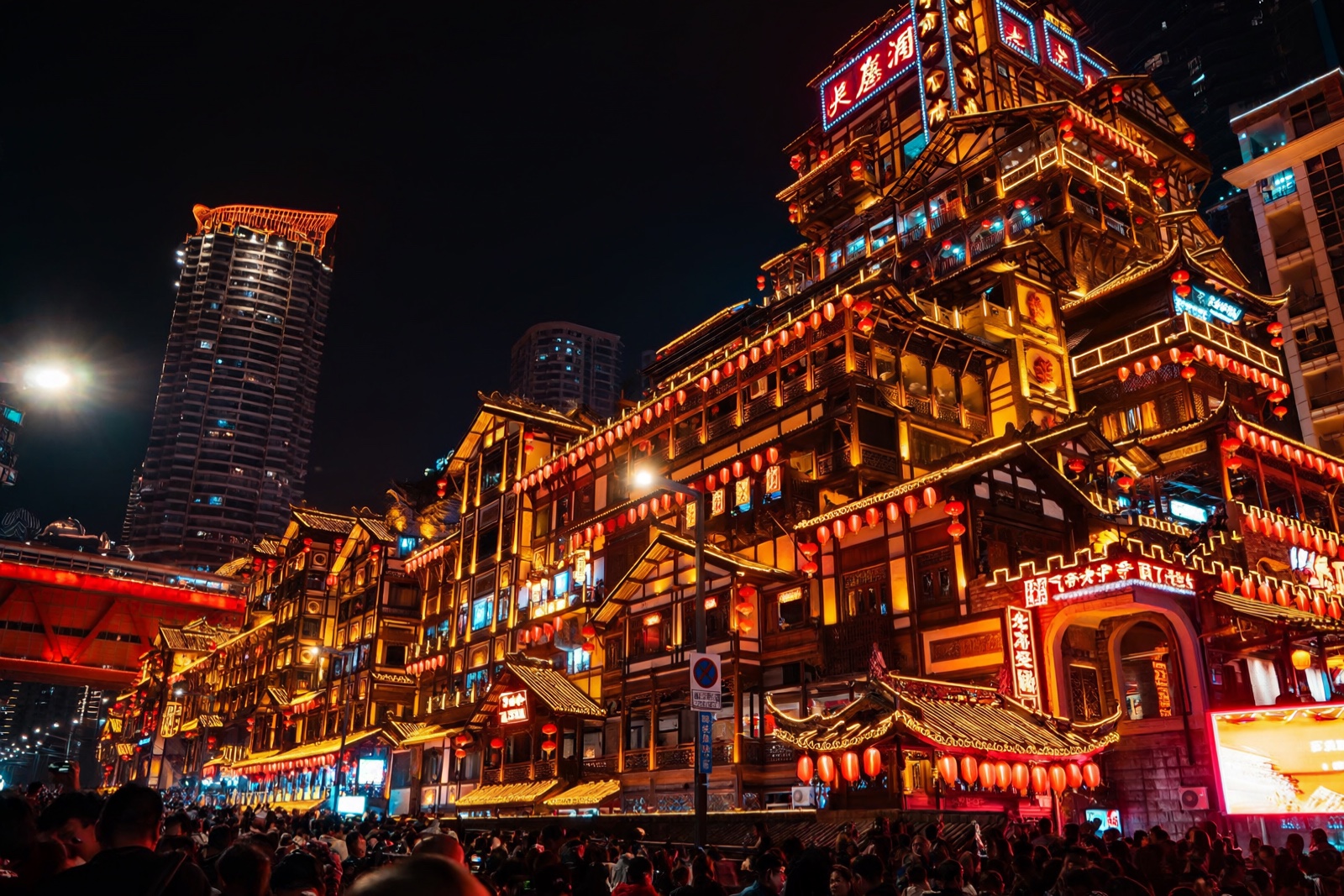
What It Actually Is
Eleven levels, about 79 metres from the river road at the bottom to 沧白路 at the top, on a footprint of roughly 31,500 square metres. Almost nothing sits flat. The complex is a ladder of terraces bolted to a rock face of some 75 metres, which is why it has no single front door, and why most visitors spend their first twenty minutes walking in the wrong direction.
The commercial core is on levels 4 and 9, both of which are market streets. Level 5 is 重逢1980, a reconstruction of Chongqing in the 1980s. Levels 6 to 8 hold a themed experience space and an arcade. Level 10 carries a bronze sculpture of the new 巴渝 twelve views. Level 11 — 沧白路 — is the city balcony, with a stele to the 1911 Revolution and the gilded bronze sculpture 记忆山城 Jìyì Shānchéng, “Memory of the Mountain City”, in which a hill, a stone stair, a cliff and a stilt house are arranged so that the whole thing reads as the character 山 — mountain.
Level 1 is the only place where the cliff is still visibly a cliff. Here are the stone 汉阙, the 滴翠广场, and the waterfall.
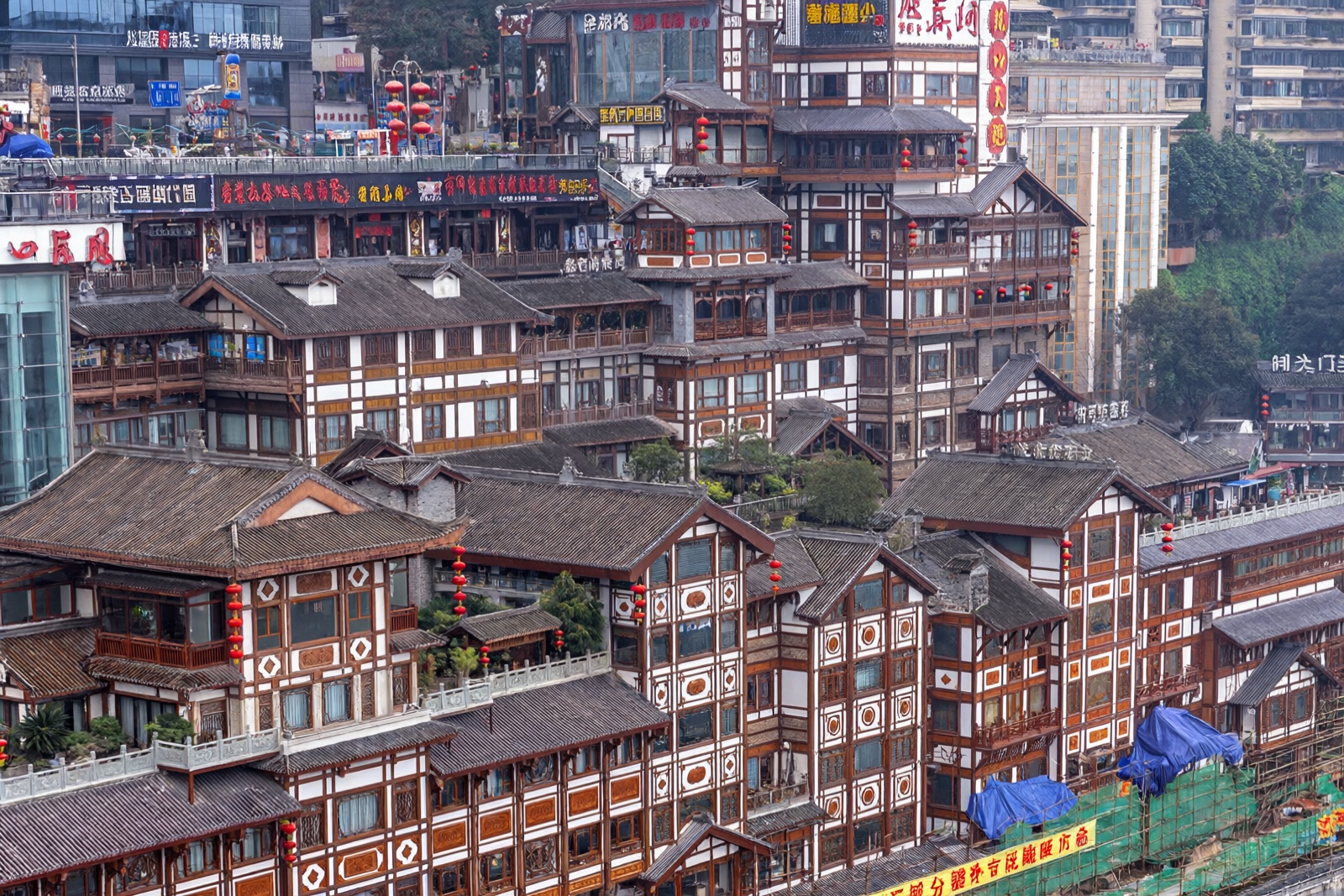
The Gate Underneath
Before any of this was here, there was a gate.
洪崖门 Hóngyá Mén is one of the old city gates of Chongqing, and the odd one out, because it was never really open. When 戴鼎 Dài Dǐng rebuilt the walls in 1371, in the fourth year of the Ming Hongwu reign, he laid the city out as 九开八闭十七门 — nine gates for traffic and eight closed ones, kept for the feng shui and named anyway. 洪崖门 was a closed one. The cave in the cliff below it took the same name, and 洪崖洞 has meant both ever since.
The site is older than the Ming wall. In the Warring States period, around 316 BC, this cliff was a military position. Under the Song it was a grotto temple. By the Ming the slope had become a commercial street, and by the Qing a working wharf — one of the busiest landing points on the Jialing, where goods came off the water and the tax was taken.
Why There Is a Building Here at All
The cliff is not a safe piece of rock.
There are more than six hundred metres of unstable face along this bank, and in 1948 a collapse here killed more than three hundred people. For most of the twentieth century the area was effectively a no-build zone. The hillside above it filled with improvised stilt houses — 吊脚楼 diǎojiǎolóu, timber frames on poles wedged into cracks in the stone — which were cheap, damp and, by the 1990s, a shantytown.
The rock was stabilised between 2002 and 2004, and has held since. The rebuilding of the hillside itself began in 2003 and opened on 29 September 2006, at a reported cost of ¥385 million, with 重庆小天鹅 as investor and a design led by 李向北 of Chongqing University. In November 2007 it was graded a national 4A scenic area.
What was built is not the old shantytown. It is a reconstruction of its forms: stilt construction, 古牌坊 gateways, 木垂花 carved timber pendants, 悬挑梁 cantilevered beams, carved galleries, mid-slope market streets, stone-flagged lanes — carried out in concrete and steel rather than timber and bamboo. The architect grew up beside the original houses; his stated aim was to keep the shape of them.
Not everyone thinks it worked. An earlier scheme would have kept the density very low and treated the cliff as a living museum of mountain dwellings; that proposal was dropped, and the built version is substantially larger and far more commercial. The criticism has been consistent ever since, and it is not wrong: this is a shopping centre wearing heritage clothes, and it is also, undeniably, the shape the city used to have.
Worth knowing: 洪崖洞 is not where Chongqing people go to eat. The restaurants inside are priced for the view. The serious hotpot is ten minutes away in the residential blocks around 解放碑, and costs half as much.
洪崖滴翠
At the bottom of the cliff, where the water comes out of the rock, is one of the oldest named sights in the city.
洪崖滴翠 Hóngyá Dīcuì — “the green dripping from Hong Cliff” — was recorded in the Ming as one of the 渝城八景, and someone had already had it engraved on a temple bell by 1458. It is the cliff as a water feature: in the wet season a fall more than ten metres wide, in the dry months a thread of water pattering down a rock face kept green by moss, the drops lit through so that they look like beads of jade.
In the 1750s the 巴县 magistrate 王尔鉴 compiled the county gazetteer and fixed the 巴渝十二景, the twelve views of Ba and Yu; 洪崖滴翠 was placed second, and he wrote a poem for it that is still quoted, ending: 珠飞高岸落,翠涌大江流 — pearls fly and drop from the high bank, green surges into the great river. What you see now is a modern reconstruction of the effect, designed into the base of the complex. It is not the same waterfall the Qing magistrate looked at. It is the same idea.
What the Locals Know
- Enter at the top, not the bottom. Come in at level 11 on 沧白路. Everything after that is downhill. Coming in at level 1 means climbing eleven storeys of stairs in a crowd, which is the single most common way to have a bad evening here.
- Every lift is free. If someone at the entrance offers you a “fast lane” for ¥10, they are selling you the ordinary lift. There is no fast lane.
- The lights go on around 19:30 and off at 23:00 sharp. Arrive at about 18:30 and you get the building in daylight, the blue hour, and the moment it switches on.
- The bridge goes dark before the building does. Guides give the 千厮门大桥 lighting as anything from 19:30–22:00 to 20:00–22:30, and one account says the schedule is seasonal — later in summer, earlier in winter. Nobody agrees. Shoot the bridge first, the building afterwards.
- Don’t eat a meal inside. A bowl of 酸辣粉 or 山城小汤圆 on the 4F food street is fine. For actual food walk ten minutes to 八一好吃街, where the same things cost half.
- Weekends and public holidays need a booking. Weekdays you walk in with your ID. The night slots go first.
- 戴家巷崖壁步道 gives you the side profile of the whole complex with a fraction of the crowd, and it is a five-minute walk.
- Wear real shoes. Chongqing has no flat ground, and this is the least flat part of it.
Practicalities
Tickets. The complex is free. There is no admission charge and no gate. What costs money is inside it: 重逢1980 on level 5, the wharf teahouses, the 川剧 theatre on level 4, and the 两江游 river cruises that leave from the wharf below.
Booking. On ordinary weekdays you turn up, show ID or passport, and walk in. On weekends and public holidays entry is by free, real-name, timed reservation through the official WeChat account — search 洪崖洞民俗风貌区. Reservations usually open about five days ahead, and the 18:00–22:00 night slots are the first to go. Book before you plan the evening around it.
Hours. The complex itself never closes. The shops run 09:00 to 23:00, and the lights go off at 23:00.
The lights. Officially about 19:30 to 23:00, following a change in April 2026; before that the switch-on was 19:00. This is the one thing here that genuinely moves — winter listings put the switch-on as early as 18:30 — and third-party guides contradict each other on it. Check the official account for the current month rather than trusting any list, including this one.
Crowds. The site is capped at 52,500 visitors a day and 8,750 at any one moment. A normal day brings about 15,000; a public holiday brings 30,000 to 40,000. The crush runs 15:00 to 23:00. If you want to see the architecture rather than the crowd, come on a weekday morning, when it is a completely different and much better place.
Getting there. The address is 渝中区嘉陵江滨江路 88 号, on the Jialing riverfront in 朝天门街道. Take metro line 1 or line 6 to 小什字 station, exit 9, and walk five to ten minutes to the top entrance — this is the route to use, because it delivers you to level 11. Line 2 to 临江门 is a workable alternative. Buses 111, 181 and 461 stop at 洪崖洞站.
Driving. Don’t. There is no large car park at the site, and the riverside road is jammed from mid-afternoon. If you insist, the underground car park at 解放碑 is about ¥6 an hour and ten minutes’ walk uphill to the level 11 entrance; 国泰艺术中心 is ¥5–6. Parking actually on 沧白路 is a fantasy.
Boats. 两江游 cruises leave from the 洪崖洞 wharf below the complex and from 朝天门: roughly ¥63 for a daytime sailing, ¥130–170 for the night circuit. The 嘉陵小渡 ferry upriver to 磁器口 is about ¥30 and is the better value of the two.
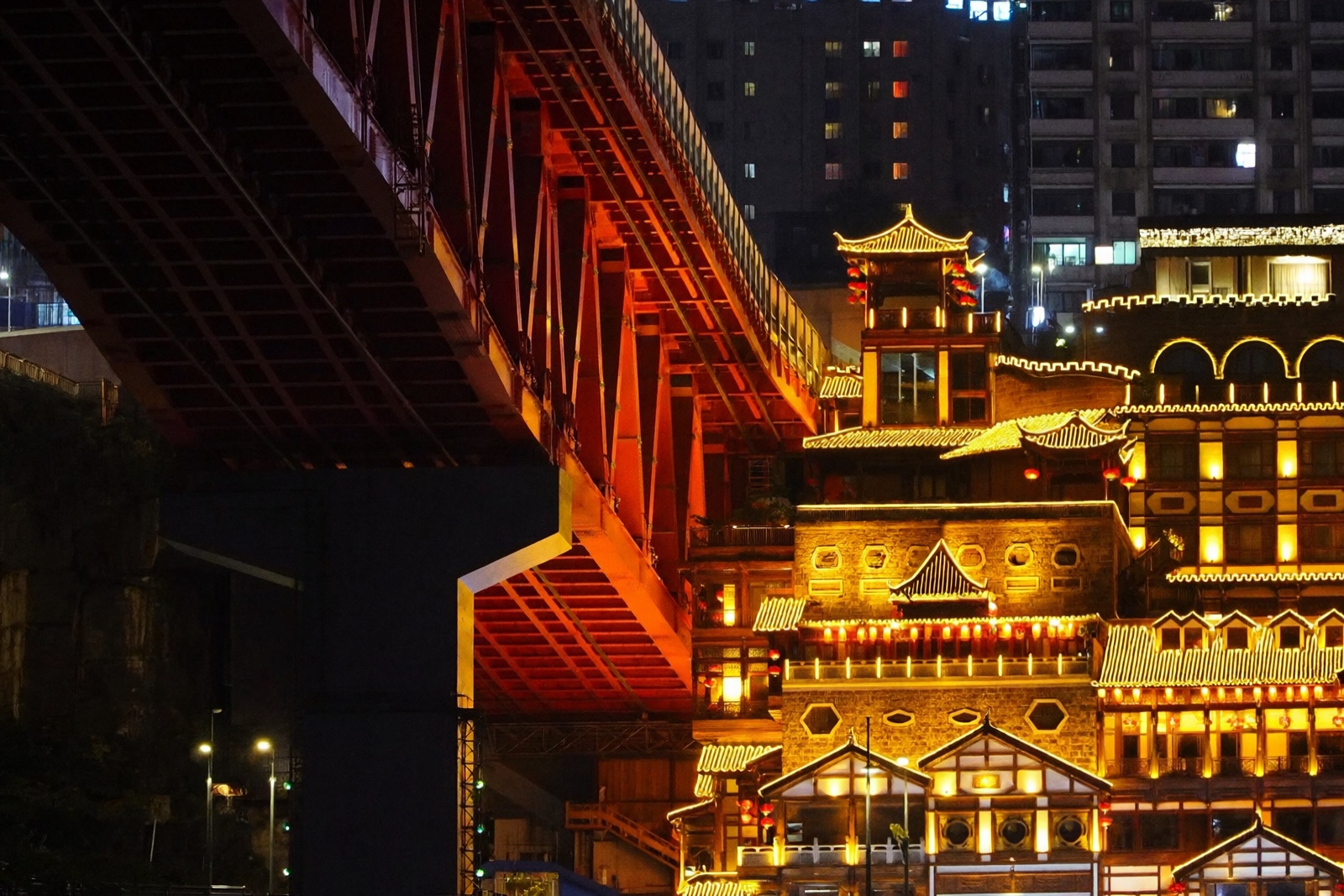
Where to Stand
The building is not at its best from inside it. These are the five positions that matter.
- 千厮门大桥. Walk up from the level 11 exit and onto the bridge. This is the wide shot: the entire tiered cliff, the river, the bridge itself, all in one frame. Windy, always. On major holidays the city closes the bridge to traffic so that people can walk it — which reroutes cars across half of 渝中区 and is a fair measure of how much of Chongqing’s civic life is now arranged around this one view.
- 江北嘴大剧院江滩, on the far bank. The cleanest composition and the fewest people. Do not go down to the water when the river is high — the beach floods and people get stranded on it every year.
- Level 1, on the river road. Stand underneath and look straight up at eleven storeys. This is the angle that makes the place look like an animation.
- 戴家巷崖壁步道. The side profile, seen along the cliff, close enough to read the carpentry — and almost empty.
- From the water. A 两江游 boat gives you everything at once, moving, which is how the building was meant to be seen from the beginning.
How to Walk It
Two to three hours, and it is all downhill if you do it in this order.
Start at the top at 18:30, at 沧白路 / level 11. Walk out onto the 城市阳台 and look at the bridge and the river while there is still daylight. Then work down: level 10 for the bronze relief, levels 9 and 8 through the market streets, level 4 for something to eat standing up. Reach 洪崖滴翠 and the cliff base at level 1, step out onto 滨江路 and look up at the whole thing. Then walk back and up onto 千厮门大桥 for the wide night shot, and leave from there.
If you only have an hour: enter at level 11, walk the 城市阳台, go straight down to level 1, take the upward shot, and walk onto the bridge. That is the one-hour version and it misses very little.
The Name of the Place
洪 hóng, vast water. 崖 yá, a cliff. 洞 dòng, a cave or grotto — the hollow in the rock beneath the cliff. The name is a description, and it was a description long before it was a brand.
The sound is a small argument. 崖 is read yá in Mandarin, but the old reading was ái, and older Chongqing people still say 洪ái洞. Elsewhere in the city, nearly every cliff is written 岩 and read ái — 鹅公岩, 曾家岩, 马家岩, 华岩. 洪崖洞 keeps the rarer character and, in local mouths, the old pronunciation; the Mandarin yá came in with the tourists.
And the resemblance to the bathhouse in Spirited Away is unavoidable, and is the reason the place is known outside China at all. It is also not a design source. The designers have never claimed it, there is no official connection, and what you are looking at is a Chongqing cliff rebuilt in Chongqing forms that happens to look like a Japanese animation. Both things are true at once, which is more or less the story of the place.
flowcloud would say that the stilt houses on this cliff were once held up by wooden poles wedged into cracks in the rock, that nothing standing here now is held up that way, and that a city which keeps the shape of its poor houses and rents them out as restaurants is doing something more honest than a city which knocks them down and puts up a car park. And he would say to get there at half past six, take the lift to the eleventh floor, and look down.
Getting there: 洪崖洞民俗风貌区, 渝中区嘉陵江滨江路 88 号, Chongqing. Metro line 1 or line 6 to 小什字, exit 9, then 5–10 minutes on foot to the level 11 entrance on 沧白路 — enter at the top, not the bottom. Free; shops 09:00–23:00, lights on about 19:30 and off at 23:00 (times shift with the season — check the official WeChat account, 洪崖洞民俗风貌区). Weekends and public holidays need a free timed booking; weekdays just bring your ID. Peak crowd 15:00–23:00, with 52,500 visitors a day at the cap. Don’t drive. Best views are from 千厮门大桥, the far bank at 江北嘴, the river road at level 1, and the 戴家巷崖壁步道.