
You walk into a hillside and the air changes at once — cool, wet, still, ten degrees down from outside — and then the stairs keep going and the ceilings keep opening out until you are standing in a chamber the size of a cathedral with a lake in the middle of it and a forest of stone columns rising out of the water into the dark. The lighting is deliberate and theatrical, throwing the shapes into relief and leaving the spaces between them black. Somewhere ahead of you, though you cannot see it yet, is a single stalagmite nineteen metres tall, thinner in the middle than a dinner plate, that has been growing for two hundred thousand years. 黄龙洞 Huánglóng Dòng, the Yellow Dragon Cave, is the piece of 张家界 Zhāngjiājiè that has nothing to do with the mountains on the postcards.
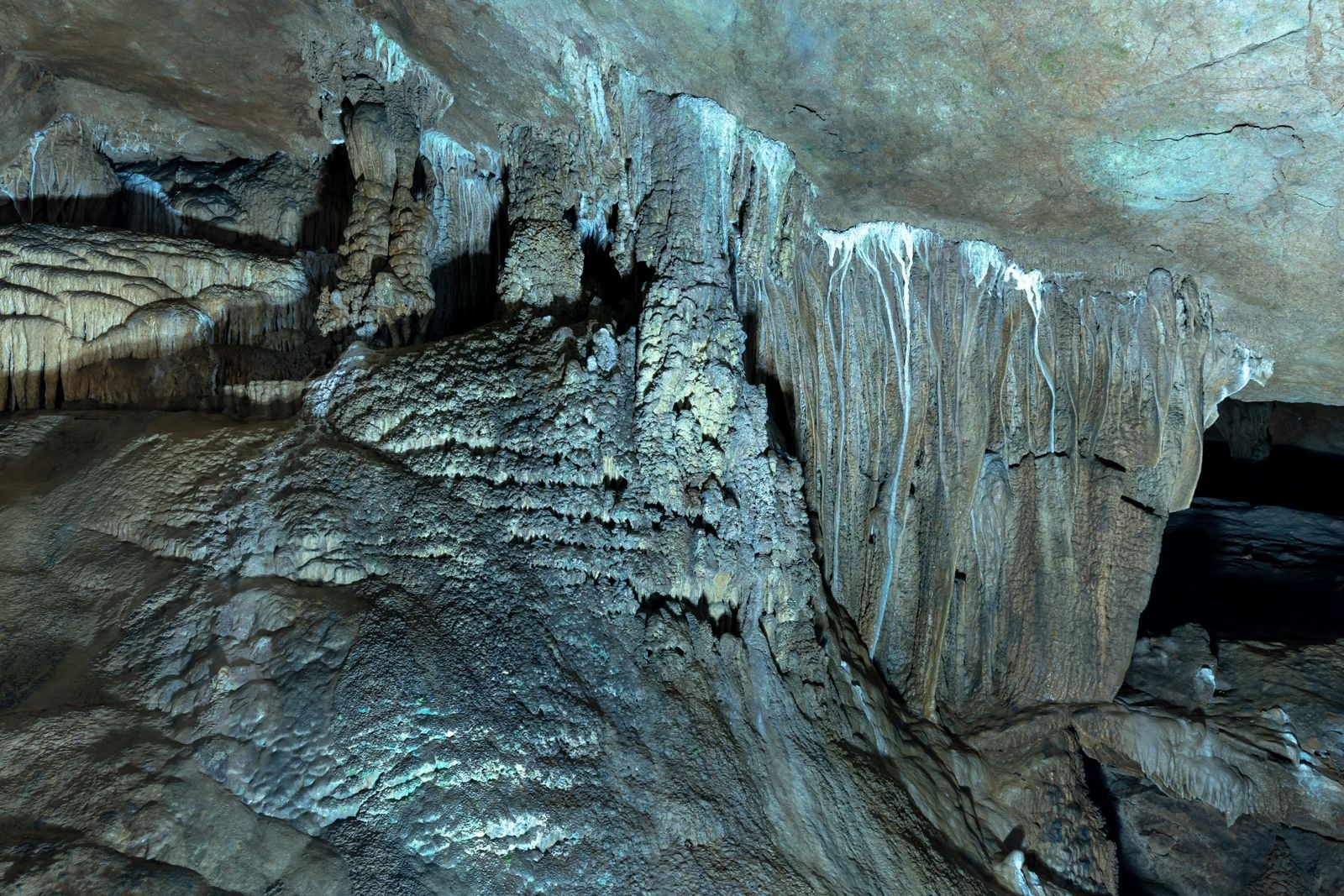
It sits in the 索溪峪 Suǒxīyù valley of 武陵源 Wǔlíngyuán, in the north-west of 湖南 Húnán, about eight kilometres from 宝峰湖 Bǎofēng Hú and within the same UNESCO World Heritage landscape as the sandstone pillars — though the cave is a geology of an entirely different kind. The mountains here are quartz sandstone, hard and insoluble. The cave is cut into limestone, which dissolves, and that difference is the whole reason there is a cave.
Three Hundred and Eighty Million Years in a Hillside
The story starts with a sea. Around 380 million years ago this region was under warm shallow water, and what settled on the floor was a thick sequence of limestone and dolomite — soluble carbonate rock. The rock sat there for a very long time. Then, about 65 million years ago, the crust was uplifted and the water drained away, leaving the limestone high and dry and cracked, and rainwater with carbon dioxide dissolved in it began working its way down through the fractures. Weak carbonic acid does not dissolve limestone quickly, but it does it relentlessly, and over tens of millions of years the cracks became passages, the passages became chambers, and the chambers became the system that is now open to the public.
Surveyed, 黄龙洞 Huánglóng Dòng runs some seven and a half kilometres of passages, with a total floor area of about 100,000 square metres and a vertical range of 140 metres. It is layered — two dry levels and two wet ones — and because the water table has dropped repeatedly over geological time, the system has developed on several storeys, with the modern river running through the lowest of them. Inside there is a reservoir, two rivers, three pools, four waterfalls, thirteen large halls and around a hundred corridors, and a great deal of the floor is covered with actively growing calcite: stalactites from the ceilings, stalagmites from the floor, columns where the two have met, plus flowstone, helictites, cave pearls and a wall of white 石花 shíhuā, stone flowers, that look like coral.
The scale is the thing. Chinese cave specialists who have surveyed the site describe it as containing essentially the whole syllabus of cave science, and the local pride-phrase is that it is the 全能冠军 quánnéng guànjūn, the all-round champion of the world’s show caves. That is a boast, but standing in the 龙宫 Lónggōng, the Dragon Palace hall, with the lake and the columns around you, it is not an embarrassing one.
The Needle and the nine Militiamen
The cave has been known about for a long time and then forgotten about repeatedly. A Tang-dynasty inscription inside records people coming in to harvest stalactites as tribute during the Tianbao era, twelve hundred years ago. After that the entrances silted or were lost, and by the twentieth century the cave was local legend rather than local knowledge.
It was rediscovered in 1983 by a group of young militiamen from the nearby villages, led by a local veteran, who forced their way in over several expeditions and mapped what they found. The accounts of that first descent are good reading: passages too tight to stand in, the tracks of animals nobody could identify, rats of improbable size, and the moment they came to a face of rock with the old Tang inscription on it and understood that the place had been visited before. The cave was opened to the public in October 1984.
The centrepiece, and the reason the cave is famous rather than merely large, is 定海神针 Dìnghǎi Shénzhēn, the Sea-Stabilising Needle. It is a stalagmite standing 19.2 metres tall on a slope of collapsed rock in the Dragon Palace hall — the tallest in the cave — and it is remarkable for its profile, thick at the base and the tip and narrow in the middle, with a thinnest diameter of about ten centimetres. Speleologists estimate it has taken roughly two hundred thousand years to reach its present height; its tip is still six metres short of the ceiling and still wet, with water visibly beading and falling from it, and at the current rate of deposition it would need another sixty thousand years to reach the roof. In 1998 the scenic area took out an insurance policy on it, valued at one hundred million yuan — the first time anybody had insured a natural formation in China, and a story that was reported around the world at the time.
Two other formations share the hall with it and are usually described together with it as the three wonders of the Dragon Palace: the 龙王宝座 Lóngwáng Bǎozuò, the Dragon King’s Throne, a twelve-metre mass in the middle of the chamber, and the 万年雪松 Wànnián Xuěsōng, the Ten-Thousand-Year Cedar, a stalagmite whose surface has developed a fronded, palm-like texture rather than the usual smooth drip pattern.
How to Do the Visit
The tour is a fixed circuit and you go round it with everyone else, so the practical aim is to be in front of the crowd rather than inside it.
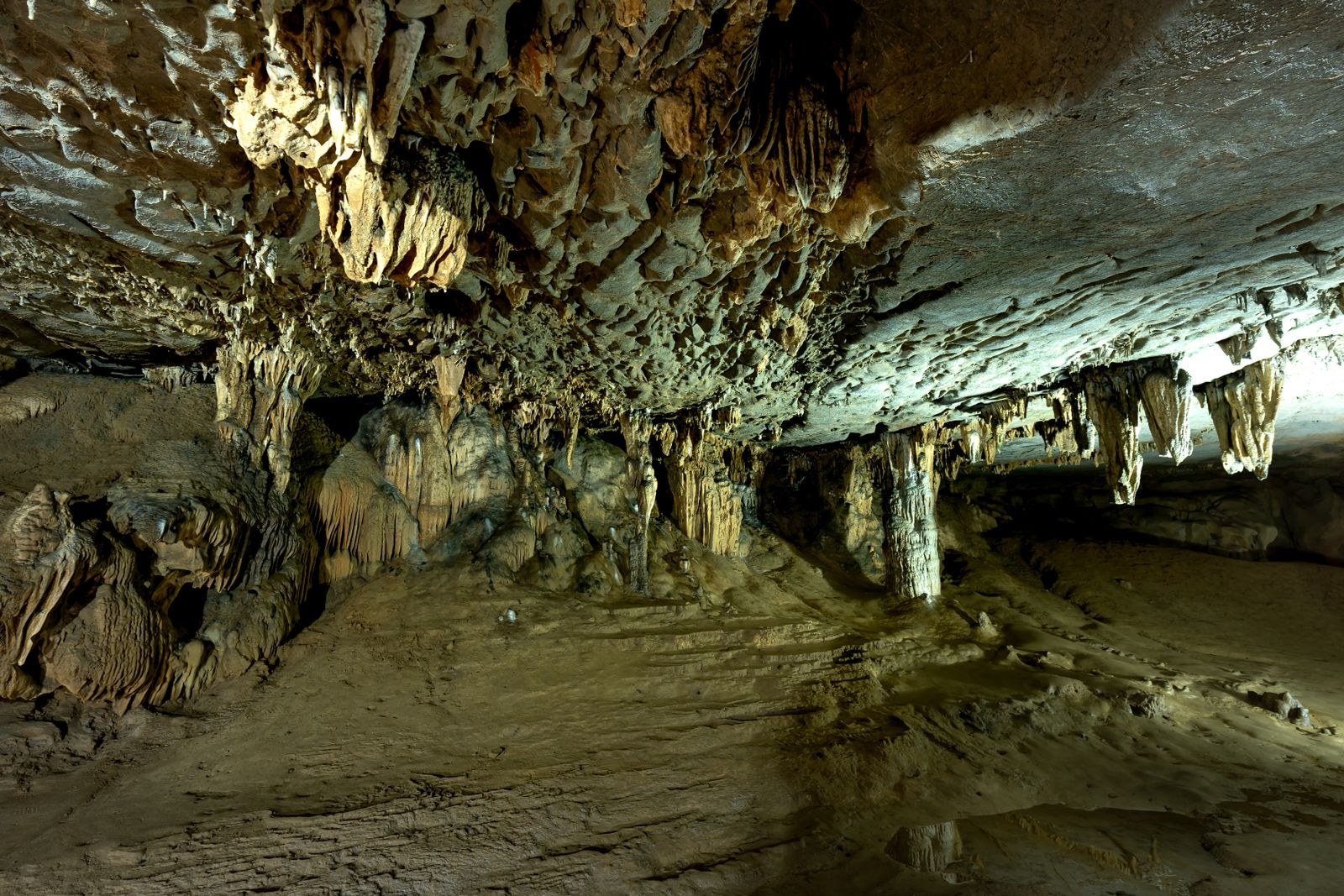
There is a river, and you go on it. Part of the route is a short boat trip along the underground 响水河 Xiǎngshuǐ Hé, and this is the part people remember: a low passage, water so still it doubles every formation above it, and the boatman poling along in the dark. The boat is included in the ticket.
Stairs. A lot of stairs. The route climbs and descends through several levels, with a long staircase section in the middle and frequent wet patches. This is not a cave you can see from a wheelchair or with a pushchair, and it is not a good idea if you have knee problems.
It is cold and it drips. Bring a light jacket and expect to be rained on gently from the ceiling for the whole visit. Non-slip shoes are genuinely important on the wet stone steps.
Photography needs patience. The lighting is theatrical and low, so hand-held shots come out muddy. A tripod is impractical on a guided circuit, but a modern phone in night mode will manage. If you want the classic pictures, use the wide end and put something in the frame to convey the scale, because the cave defeats any attempt to photograph its size.
Go early or late in the day. The cave is one of the two or three most-visited sites in the region and tour groups arrive in convoys from mid-morning. First entry in the morning and the last entry of the afternoon are much calmer.
Practicalities
Tickets: About ¥94 for the standard adult ticket including the underground boat trip. Combined tickets are available, and the most useful pairing is with 宝峰湖 (Bǎofēng Hú), eight kilometres away, at roughly ¥218 for the two attractions together. There are discounted rates for some foreign-passport holders on the cave-and-boat ticket, and concessions for children, students and seniors.
Opening hours: Roughly 08:00–17:30, with the last admission around an hour before closing. Allow 90 minutes for the circuit at a walking pace.
Closing day: Open every day of the year, including public holidays, which are the busiest times and the days to avoid if you possibly can.
Getting there: 黄龙洞 (Huánglóng Dòng) is in 武陵源 (Wǔlíngyuán), 张家界 (Zhāngjiājiè), north-western 湖南 (Húnán), in the 索溪峪 (Suǒxīyù) valley about 8 km from 宝峰湖 (Bǎofēng Hú) and a short drive from the 武陵源 (Wǔlíngyuán) town centre and the forest park entrances. 张家界 (Zhāngjiājiè) has a station on the high-speed rail line and an airport, and from either it is roughly 40 minutes by car to the cave; local buses and taxis run from 武陵源 (Wǔlíngyuán) town. Wear shoes with grip, carry a light waterproof layer, and expect to be cold for ninety minutes in the middle of a subtropical summer. flowcloud would say that a mountain range is what a landscape looks like from outside and a cave is what it looks like from within, and that the two hundred thousand years standing in that hall are easier to feel than any of the peaks above it. Enter at opening time, take the boat slowly, and stand beside the 定海神针 (Dìnghǎi Shénzhēn) long enough to stop thinking about the photographs.