
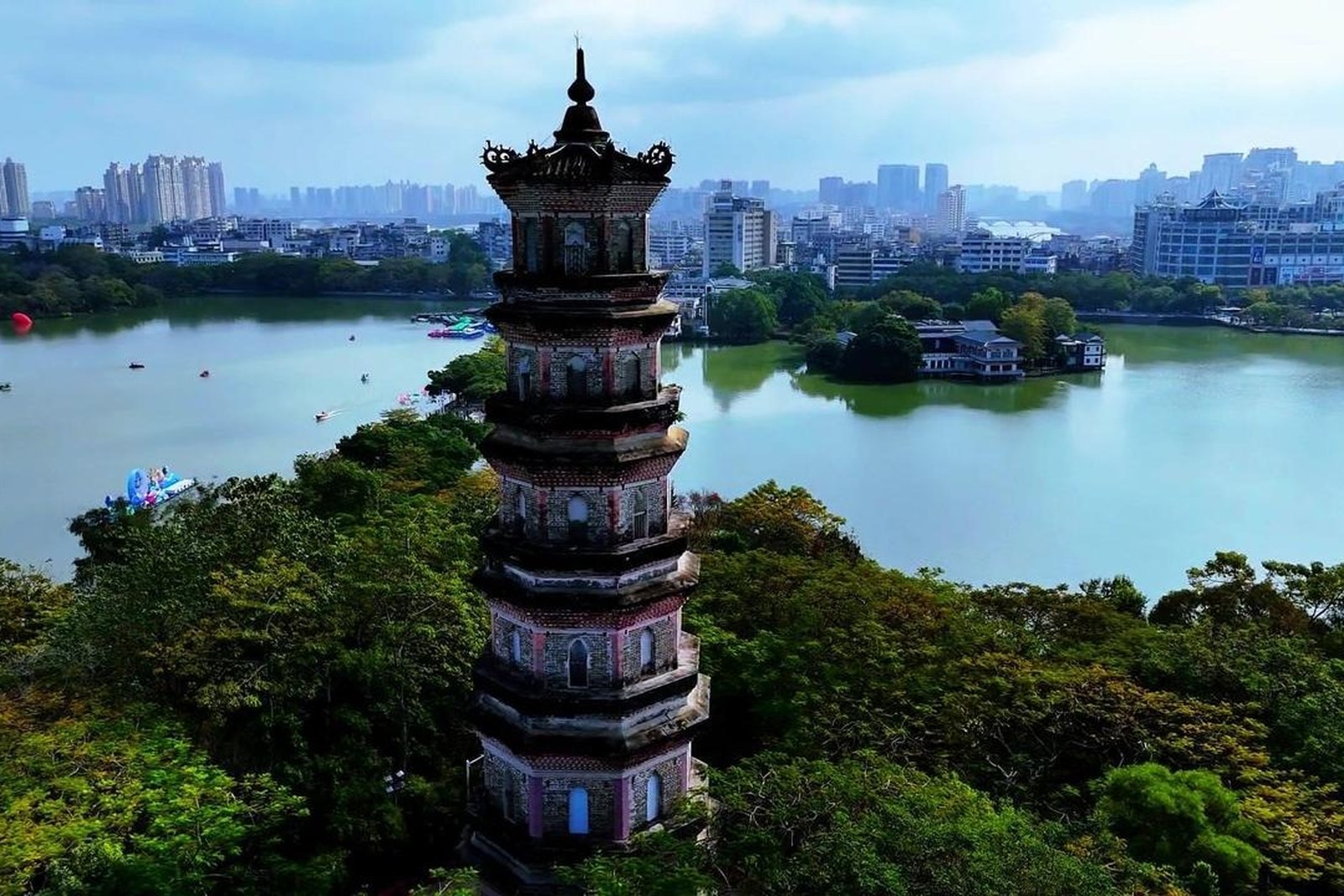
The lake is not one lake. You come to it from the east gate at 平湖门 PíngHú Mén and what you see is water, a long causeway running out across it under a row of willows, and beyond that another sheet of water, and beyond that another — five separate basins lying end to end through the middle of the city, joined by causeways and stone bridges so that you can walk out over the water for a kilometre without ever being on the shore. Above the western basin a seven-storey brick pagoda stands on the hill. The whole thing is a public park, it costs nothing to enter, and on a weekday morning the only people on the causeway are a few men with fishing rods and somebody practising a flute. This is 惠州西湖 Huìzhōu Xīhú, West Lake, the national 5A scenic area that sits in the centre of 惠州市 Huìzhōu Shì and is the reason the city’s own description of itself is 半城山色半城湖 bàn chéng shān sè bàn chéng hú, half the city mountain, half the city lake.
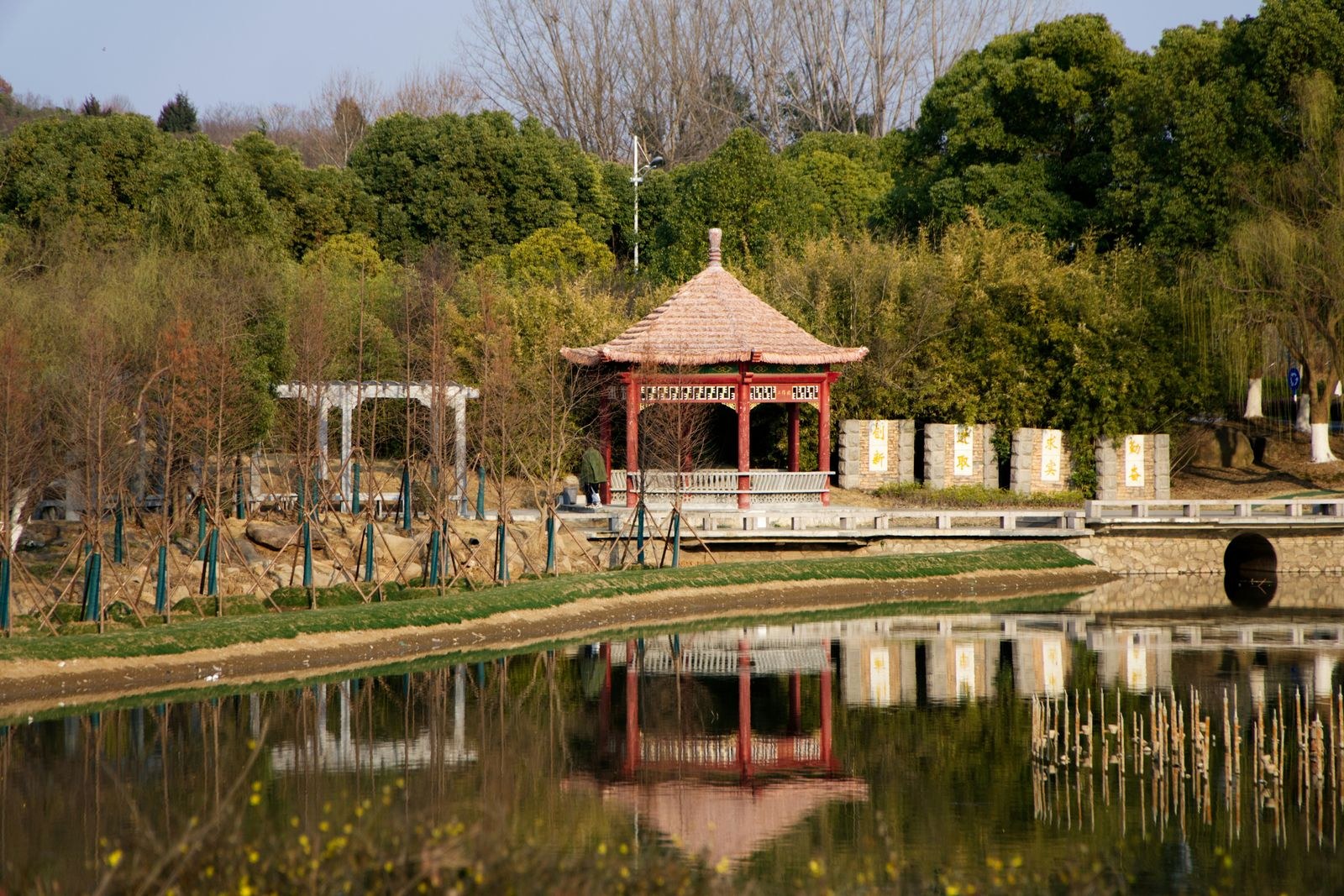
The five historic basins are 平湖 Pínghú, 丰湖 Fēnghú, 南湖 Nánhú, 菱湖 Línghú and 鳄湖 Èhú; 红花湖 Hónghuā Hú was later added to the complex, which is why the city counts six lakes now, and the bridges that tie them together are counted as nine, giving the phrase 六湖九桥十八景 liù hú jiǔ qiáo shíbā jǐng, six lakes, nine bridges, eighteen views. The lake was originally called 丰湖 Fēnghú, the abundant lake, and it took the name West Lake because of 苏东坡 Sū Dōngpō. Exiled south in 1094 at the age of fifty-nine, he lived in Huizhou for two and a half years, and the comparison between this water and the lake he had known at Hangzhou was immediate. He helped pay for the causeway and a bridge across the water so that people on the two sides could walk between them, and the 苏堤 Sū dī, the Su causeway, still carries his name. The line most often quoted here is his description of the pagoda’s reflection on a moonlit night — 一更山吐月,玉塔卧微澜 yī gēng shān tǔ yuè, yù tǎ wò wēilián, at the first watch the hill gives up the moon, and the jade pagoda lies on the ripples.
What to See
The 泗洲塔 Sìzhōu Tǎ is the oldest structure in the park — first built in the Tang, rebuilt in the Ming, seven storeys of brick on the hill above the western basin, and the view from the top takes in all the water at once. South of it the 孤山 Gūshān, the lone hill, holds the traces of Su Dongpo that matter most: a memorial hall, and the grave of 王朝云 Wáng Zhāoyún, the companion who came south with him and died here, with the 六如亭 Liùrú Tíng beside it. The 苏堤 crosses between the two largest basins and is the best walk in the park. 九曲桥 Jiǔqū Qiáo, the bridge of nine turns, zigzags a hundred metres out to the island of 点翠洲 Diǎncùi Zhōu. 丰湖书院 Fēnghú Shūyuàn, founded in the Southern Song, was one of the four great academies of Lingnan and its halls and steles are still there. 丰渚园 Fēngzhǔ Yuán is the classical garden, and its lotus pond is at its best in June and July. 朝京门 Cháojīng Mén, the old north gate of the walled city, survives rebuilt and looks straight down the lake.
Practicalities
Tickets. The main scenic area is free and needs no booking, which is unusual for a 5A site and is the thing visitors most often fail to believe. Individual extras are charged separately: a pleasure boat on the lake is around ¥50 a person, the boat-and-ride packages rather more, and a short holographic show about Su Dongpo in Huizhou around ¥22 to ¥44. The 红花湖 Hónghuā Hú section and its greenway are free too.
Opening hours. The lake and its paths are open from early morning until about 22:00, and this is genuinely a place people use at night — the pavilions are lit and the reflection on the water is the point. The indoor sights keep shorter hours, roughly 08:00 to 18:00, and the Su Dongpo memorial hall on the island closes on Mondays. Early morning and the hour before dusk are the best light and the fewest people.
Closing day. There is no closing day. The park is open every day of the year and free every day of the year, and closes or partly closes only in typhoon weather, which affects this coast between July and September.
Getting there. 惠州西湖 is in the centre of the city at 环城西路 Huánchéng Xī Lù in 惠城区 Huìchéng Qū, and buses 2, 5, 7 and 10 stop at 平湖门 PíngHú Mén, the east gate. Shenzhen–Huizhou intercity trains call at 西湖东站 Xīhú Dōng Zhàn, five minutes’ walk from the park, and high-speed services arrive at 惠州北 Huìzhōu Běi or 惠州站 Huìzhōu Zhàn, about 20 minutes away by taxi. By road it is roughly 1.5 hours from either 广州 Guǎngzhōu or 深圳 Shēnzhèn.
flowcloud would say that Huizhou West Lake is what Hangzhou’s West Lake was a century ago — the same causeways, the same pagoda, the same poet, and none of the crowds — and that the only thing it is missing is a ticket office.
Getting there: walk it rather than ride it, entering at 平湖门 PíngHú Mén and following the causeways west so that the pagoda stays in front of you; allow three to four hours for the lakes and the old town together. Bring water and mosquito repellent, wear flat shoes, and leave the boat until late afternoon when the light is low and the lake is at its best. Afterwards, walk ten minutes to 水东街 Shuǐdōng Jiē and 祝屋巷 Zhùwū Xiàng for 梅菜扣肉 méicài kòuròu, 酿豆腐 niàng dòufu and a bowl of 横沥汤粉 Hénglì tāngfěn, which is the local breakfast.