
Jade Buddha Temple: Two Burmese White Jade Buddhas in a Working City Monastery at Anyuan Road 170 on the Putuo–Jing’an Border in Putuo District, Shanghai
两尊白玉安尘世,一炷清香静市声。Liǎng zūn báiyù ān chénshì, yī zhù qīngxiāng jìng shìshēng – Two statues of white jade calm the dusty world; a single stick of incense quiets the noise of the streets.
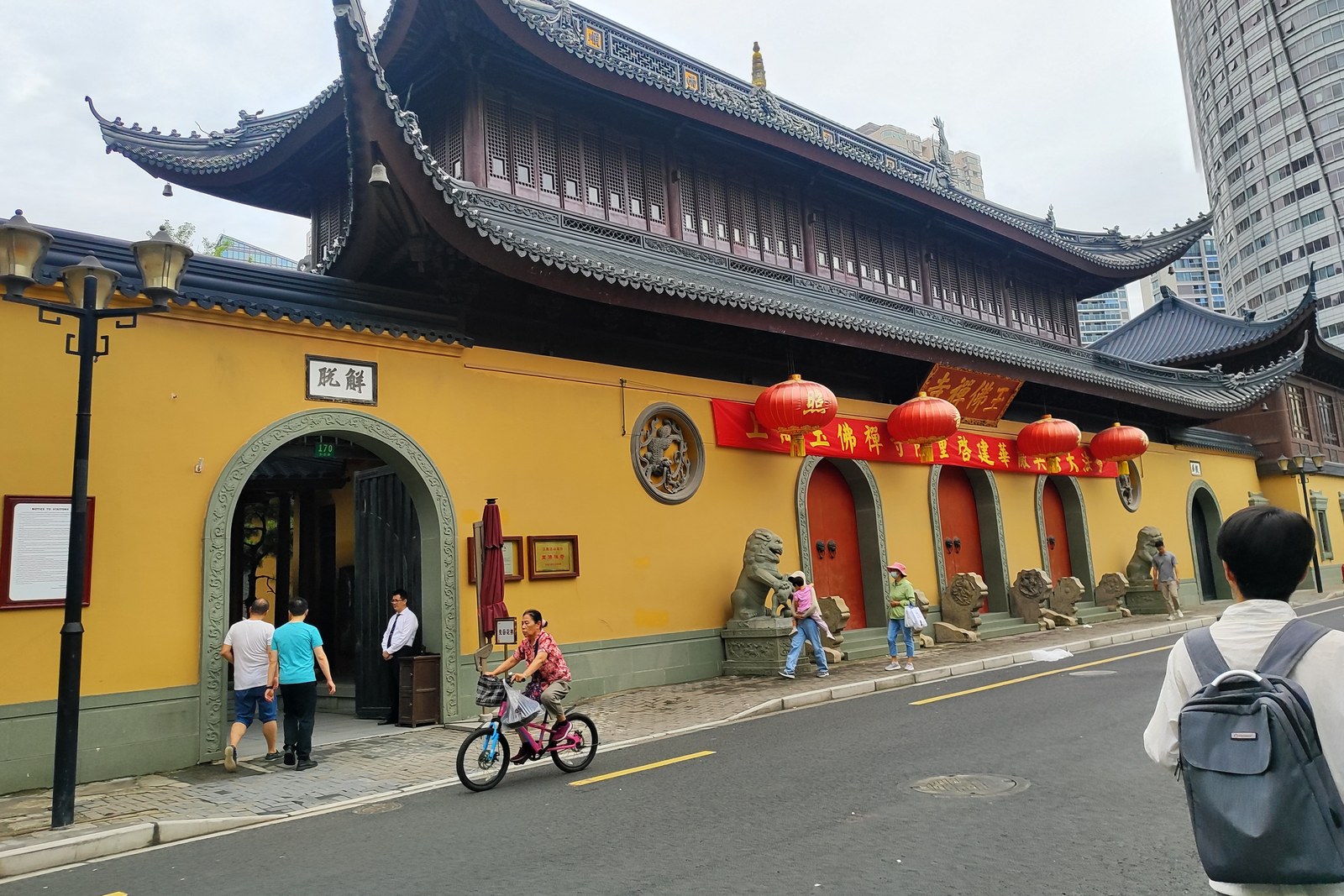
玉佛寺 Yùfó Sì Jade Buddha Temple is not a hillside retreat set apart from the city — it is, plainly put, a working Buddhist monastery folded into the ordinary roar of Shanghai’s inner north-west: the complex fills its block at 安远路 Ānyuǎn Lù Anyuan Road 170 in 普陀区 Pǔtuó Qū Putuo District, on the border where Putuo meets 静安区 Jìng’ān Qū Jing’an District, ringed by shops, wet markets and apartment blocks rather than gardens. The temple’s story begins in 1882, in the 光绪 Guāngxù Guangxu reign of the Qing dynasty, when a monk returning from a pilgrimage to Burma brought back white jade Buddhas and the city built a home to house them; the monastery that grew around the stone took its very name from it — “Jade Buddha Temple” — and was rebuilt on the present site after the early twentieth century’s troubles. The two statues survive from that first founding: a seated Buddha, carved from a single block of Burmese white jade and jewelled in later decades, and a reclining Buddha showing the deathbed serenity of the scripture. What you actually visit is a fully functioning monastery whose fame rests, honestly, on two pieces of stone — and whose daily life of chanting, incense and offerings carries on around them.
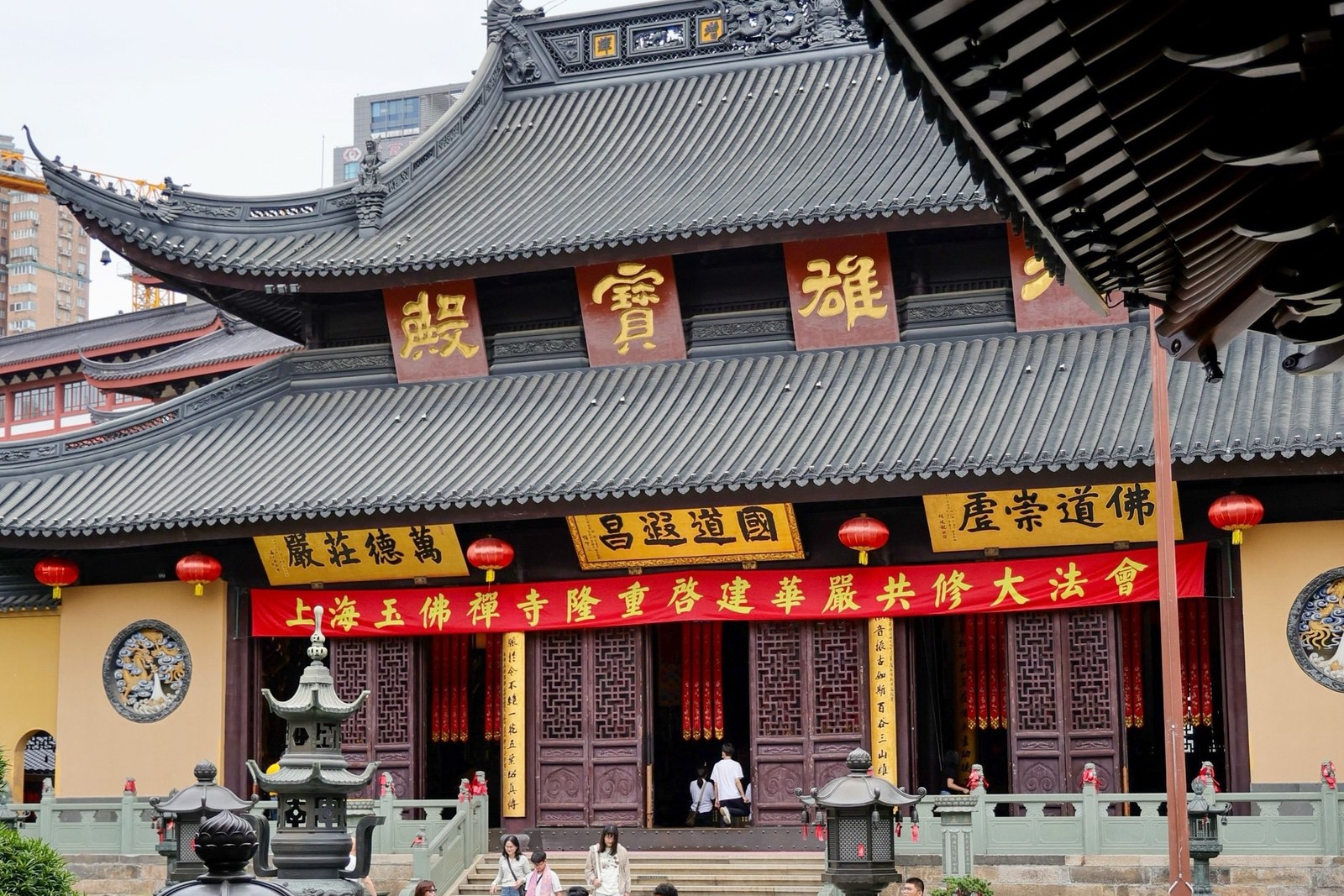
Call it honestly: admission is by a 香花券 xiāng huā quàn incense-and-flower ticket, the traditional upkeep arrangement of Chinese temples, rather than a plain museum fee (worth confirming the details for the current price and opening hours), and 江宁路站 Jiāngníng Lù Zhàn Jiangning Road station on Metro Line 13 sets you down within an easy walk of the gate. The honest warning is context, not cost: this is a busy-corner temple in a working neighbourhood, so you arrive through errand-running crowds and bicycle bells before the gate swallows the noise — the switch is the whole experience in one moment. Weekday mornings keep the courtyards to worshippers and unhurried visitors; weekends and Buddhist holidays fill the forecourt with tour groups and queues for the jade halls. Give it forty-five minutes to an hour, longer if you stay for the chanting.
The honest star is the seated jade Buddha itself — a pale, calm figure in the 观佛 guānfó hall upstairs, lit by lamps rather than daylight, the one object in Shanghai that the whole temple was built to hold. What gets oversold is the photography: visitors arrive expecting portrait sessions with the jade figures, but photography is generally not permitted inside the Buddha halls, and the statue rewards standing still far more than framing (worth confirming the details for the current photography rules). What repays the effort is everything the queue rushes past: the reclining Buddha in its own hall, the layered eaves and newly painted bracket sets, the great incense cauldron smoked hollow by decades of offerings, and the plain fact of a monastery keeping its schedule in the middle of a shopping street. Come for the layering of the place: street, then gate, then the jade behind the lamps.
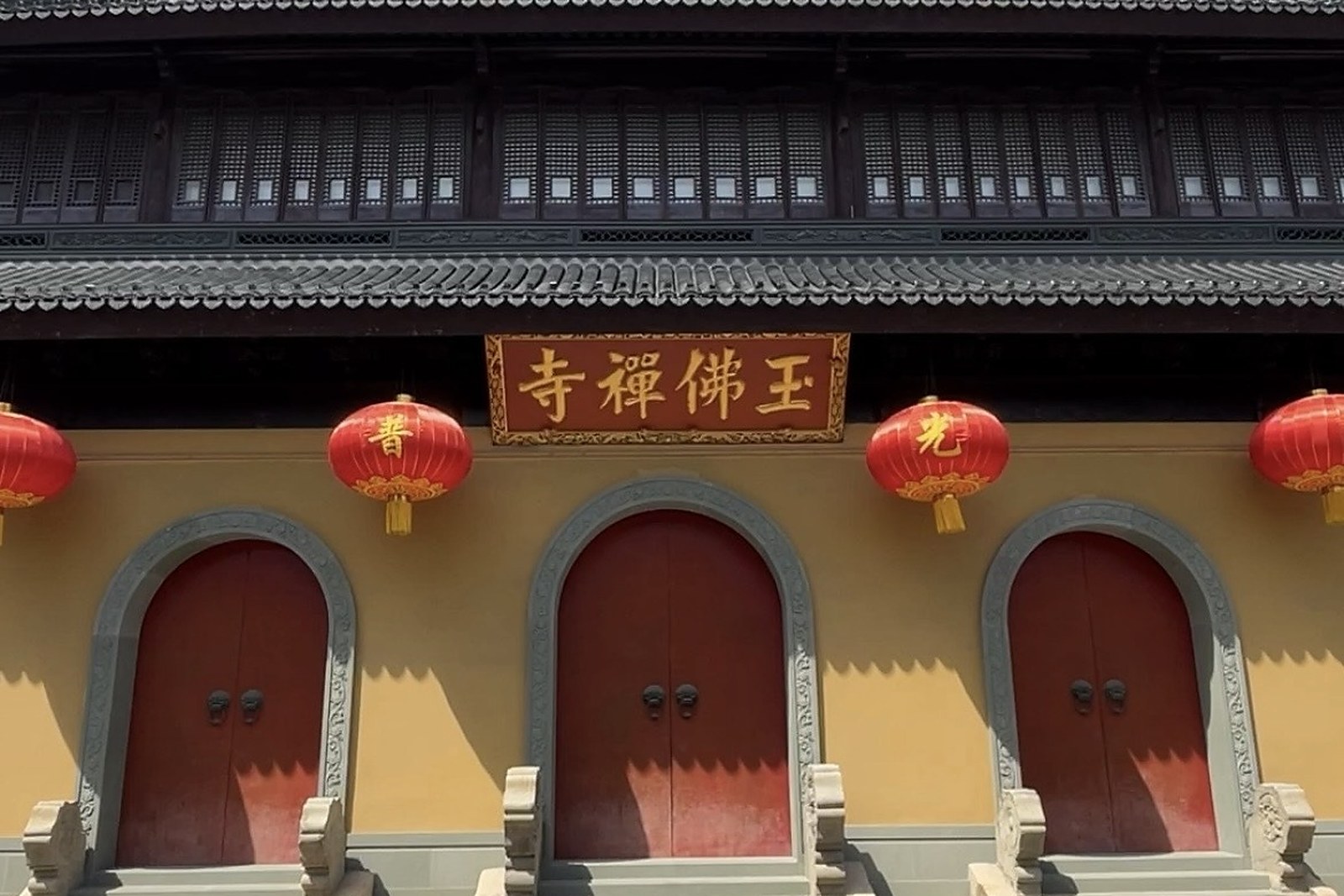
The self-aware postscript: I stood in the courtyard one weekday morning beside a grandmother who had clearly been coming for decades, feeding thin bundles of incense into the great cauldron. “People come from every country to look at the jade for five minutes,” she said, patting the ash down, “but I have looked at the same courtyard for thirty years, and it is never the same twice — the jade does not change; we do”. That is the visit in miniature. From the shade of the western gallery, watching smoke drift up past the eaves toward the towers, the temple holds a village rhythm inside the city, the angle no gate poster offers. 玉佛寺 Yùfó Sì suits whoever treats it as a living place of worship with two extraordinary statues at its heart first and a photo landmark second, and disappoints anyone expecting a quiet heritage compound with room to roam.
Nearly everything else on this Putuo list lies within a short ride or an easy walk: the galleries and graffiti walls of M50创意园 M50 Creative Park wait a short ride west along the 苏州河 Sūzhōu Hé Suzhou Creek bank, the old mill halls of 上海纺织博物馆 Shànghǎi Fǎngzhī Bówùguǎn the Shanghai Textile Museum sit just east along 澳门路 Àomén Lù Aomen Road, the lake and boating lawns of 长风公园 Chángfēng Gōngyuán Changfeng Park open in the district’s west, and the Yuan-dynasty hall of 真如寺 Zhēnrú Sì Zhenru Temple waits in the north-west at 真如古镇 Zhēnrú Gǔzhèn Zhenru Old Town — all inside the same 普陀区 Pǔtuó Qū Putuo District whose most visited shrine this temple remains.
Practicalities
- Rating: ★★★★☆ — a genuinely working monastery with two of the finest jade carvings in China, in an ordinary street rather than a scenic setting; go weekday morning before the tour buses.
- Tickets: Admission by incense-and-flower ticket (worth confirming the details for the current price and opening hours).
- Address: 玉佛寺 Yùfó Sì, 安远路 Ānyuǎn Lù Anyuan Road 170, 普陀区 Pǔtuó Qū Putuo District, Shanghai — a short walk from Jiangning Road station on Metro Line 13.
- Time needed: Forty-five minutes to an hour for the two jade halls and courtyards; longer if you time a visit to morning chanting.
Words and Names
玉佛寺 Yùfó Sì Jade Buddha Temple · 光绪 Guāngxù the Guangxu reign of the Qing, in which the temple was founded in 1882 · 白玉 báiyù white jade, the Burmese stone of the two Buddhas · 坐佛 zuòfó the seated Buddha · 卧佛 wòfó the reclining Buddha · 香花券 xiāng huā quàn incense-and-flower admission ticket · 安远路 Ānyuǎn Lù Anyuan Road · 江宁路站 Jiāngníng Lù Zhàn Jiangning Road station · 苏州河 Sūzhōu Hé Suzhou Creek · 普陀区 Pǔtuó Qū Putuo District
flowcloud would say that 玉佛寺 Yùfó Sì is the rare temple named after its own treasure — founded in 1882 in the 光绪 Guāngxù Guangxu reign to house white jade Buddhas carried back from Burma, rebuilt at 安远路 Ānyuǎn Lù Anyuan Road 170 on the Putuo–Jing’an border, and keeping a full monastic schedule today around the seated and reclining figures that made its name (worth confirming the details for the current incense-ticket price and hours) — and that the honest move is a weekday-morning visit entered through 江宁路站 Jiāngníng Lù Zhàn Jiangning Road station on Metro Line 13, because the photo-of-the-jade expectation is the poster half and the incense, eaves and ordinary-street monastery are the real half, and the temple repays whoever stands still long enough to let the cauldron’s smoke mark the hour. All checked October 2026.
Getting there: Metro Line 13 to 江宁路 Jiāngníng Lù Jiangning Road station, exit 2, then a short walk north along 安远路 Ānyuǎn Lù Anyuan Road to the temple gate at 170 (worth confirming the details for incense-ticket hours and holiday queues); the temple sits tucked in the lane blocks between the towers. All checked October 2026.