
Under the Egongyan bridge the hillside is not a hillside so much as a wall with holes in it. Walk the riverside path below the span in 谢家湾 Xièjiāwān, Xiejiawan, and the rock face above you is punctured at intervals by dark mouths cut back into the stone, wide enough to drive into, arranged along the slope in a line that follows the geology rather than any plan. Those are 兵工洞 Bīnggōng Dòng, the arsenal caves, and since 18 June 2018 they have held 建川博物馆 Jiànchuān Bówùguǎn, the Jianchuan Museum: eight themed museums built inside a war-production site, and by the museum’s own count the first such cave anti-war museum cluster in the country. The district is 九龙坡区 Jiǔlóngpō Qū, Jiulongpo District, Chongqing, a municipality of southwest China.
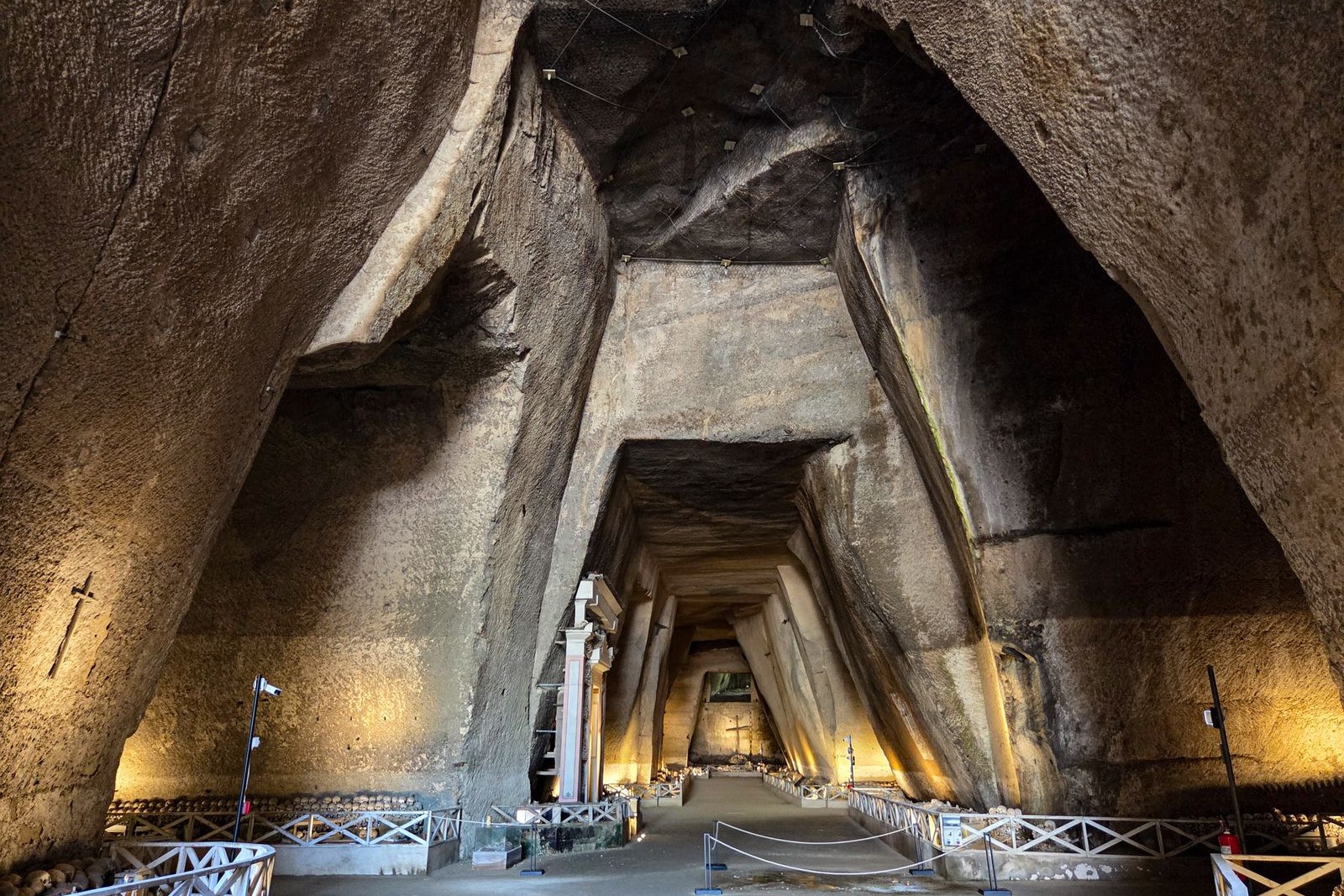
The caves are an answer to a bombing problem. When the war moved China’s heavy industry inland, the 汉阳兵工厂 Hànyáng Bīnggōngchǎng, the Hanyang Arsenal of Hubei, was brought west and re-founded here as the First Arsenal of the ordnance directorate, and its machinists put their workshops inside the hillside above the river where the bombers could not reach them. After the war the plant grew into one of the country’s larger light-weapon producers, and the working arrangement that made sense to engineers in one decade was quietly kept by administrators in the next: the caves went to the construction-machinery works that inherited the site, and turned out motorcycles and vehicle compressors instead.
The industrial chapter ends and the museum chapter begins with a move. The works became 建设工业集团 Jiànshè Gōngyè Jítuán, the Jianshe Industrial Group, in 1991; it began moving out in 2003, and the last machine left the site in July 2009. What it left was a cleared mountain works with holes in it – halls in the open, galleries in the rock, workshops with nothing in them – and by then the ground had already been recognised for what it was. In 2013 the state listed the site among the Major Historical and Cultural Sites Protected at the National Level, as part of the 重庆抗战兵器工业旧址群, the Chongqing wartime arms-industry site group, which made a national obligation out of a former factory; it was rated a national 4A scenic area in July 2019.
What the museum does with that inheritance is a matter of register rather than spectacle. Eight themed halls run through the site’s own history – the arsenal moved inland, the caves and the bombing, the light-weapon production, the postwar machinery works, the move out – and the tone is the memorial one: dates, workshops, documents, machines and names, told in the register the official Chinese sources use for wartime industry and production. Its stated motto is the collection policy in six characters, collect the war for peace.
Practicalities
Tickets. The site is rated a national 4A scenic area and is run as a museum with an admission charge, so a ticket is involved – but the rate, the concession categories and any difference between buying at the gate and booking online are set by the museum and the booking platforms and are not printed here, because they change with each season’s programme and with each temporary exhibition. Buy through the museum’s official account or the main booking platforms before travelling, and check whether any of the themed halls you want are running temporarily closed.
Opening hours. The museum publishes its daily opening and closing times, and any hall-level or seasonal closure, through its own official channels – its WeChat account and its booking listings – and those are the current authority rather than any hour printed on this page. Groups of schoolchildren and delegations occupy parts of the day that a casual visitor should know about, and the cave galleries hold their own temperature, so an early visit is the comfortable one. Confirm the same morning if it matters to you.
Closing day. There is no fixed weekly closing day in the published arrangement, so nothing on this page should be read as one. The exceptions that do happen are school-calendar and public-holiday adjustments, and any of them are announced in advance on the museum’s official account; the eight halls are treated as one site in that respect rather than closing one at a time.
Getting there. Metro Line 2 reaches Xiejiawan at 谢家湾 Xièjiāwān Station, which now interchanges in-station with the Loop Line, and the museum lies in the former works at 付家沟 Fùjiāgōu, Fujiagou, below and beside the Egongyan crossings on the riverside – the road bridge finished in 2000 and the rail bridge that followed in 2019, both of which stand over the caves. From the station it is a short walk or a local bus down to the site, and the two crossings make the same trip from the south bank straightforward, so plan the half-day rather than the stop. Confirm the current walking route, shuttle and coach arrangements with the museum before a large group travels (checked October 2026, subject to change).
flowcloud would say that Jianchuan’s distinction is that it is not a museum about a war but a museum inside one – workshops cut into a hillside because bombers owned the sky above the river – and that a factory which spent ten years emptying itself out of its own tunnels is what finally made the tunnels worth keeping.
Getting there: the Jianchuan Museum stands in the former arsenal works at 付家沟 Fùjiāgōu, Fujiagou, below the Egongyan bridge in 谢家湾 Xièjiāwān, Xiejiawan, 九龙坡区 Jiǔlóngpō Qū, Jiulongpo District, Chongqing, a municipality of southwest China – the Hanyang arsenal moved inland from Hubei during the war, its workshops cut into the riverside rock, later the construction-machinery works that left in 2003-2009, protected as part of the 重庆抗战兵器工业旧址群 in 2013 and opened on 18 June 2018 as eight themed museums, rated a national 4A scenic area in July 2019. Admission is ticketed and the rates, concessions and any temporary-exhibition charges are set by the museum and the booking platforms rather than printed here; opening times and any hall closure are published on the museum’s official account, and there is no fixed weekly closing day beyond school-calendar and public-holiday adjustments announced in advance. Metro Line 2’s Xiejiawan Station, interchanging with the Loop Line, is the nearest stop, a short walk or bus from the site under both Egongyan crossings (checked October 2026, subject to change).