
玄武山 Xuán wǔ shān is not a mountain in the climbing sense: it is a low coastal hill, once 圭山 Guī shān, above 碣石湾 Jié shí wān at 碣石镇 Jié shí zhèn in 陆丰市 Lù fēng shì, and its value is entirely in what stands on it. The temple complex of 元山寺 Yuán shān sì began in 1127 as a small shrine to the Dark Warrior of the North; a Ming naval garrison rebuilt it and Qing admirals paid for it, which is how it became the largest temple group in eastern Guangdong. The State Council listed it nationally on 25 June 2001, in the fifth batch, numbered Ⅳ-178, after the province listed it in 1994. This is old 海陆丰, and it is not administratively part of 潮汕.
The hill was chosen for the garrison rather than the garrison for the hill. Zhu Yuanzhang sent officers to plan the fort, and they settled on Gui hill, held to be the range’s ancestral mountain, where a tomb on the slope was cleared and a shrine to the True Warrior brought in. In 1394 the Jieshi garrison rebuilt the shrine as the Dark Warrior temple, and in 1577 the commander Hou Jigao Hóu Jì gāo enlarged it to its present scale. One encyclopaedia prints 1394 and 1577 together as though the rebuilding happened in the later year, which is the commonest error about this place; after the Kangxi emperor took the throne the character 玄 became 元 to avoid his name, and the complex now has ninety-nine halls and chambers, 15 hectares of temple inside a 20-hectare tourism zone.
The reason visitors come is the hall where two religions share the altar. It holds the Dark Emperor and a statue of Sakyamuni at once, an arrangement explained by the Qing court’s hostility to Daoism: a decree under the Xianfeng emperor ordered offending shrines destroyed, and this one, protected by its remote garrison, put the Buddha and two bodhisattvas above the Taoist god and had monks chant before them instead. More than forty plaques hang inside, and the two famous ones are Lin Zexu’s 水德灵长, dated 1839 when he was imperial commissioner, and the Black Flag leader Liu Yongfu’s 灵声满道; the city government counts three of the plaques as famous Chinese cultural plaques and the district’s political consultative conference counts two.
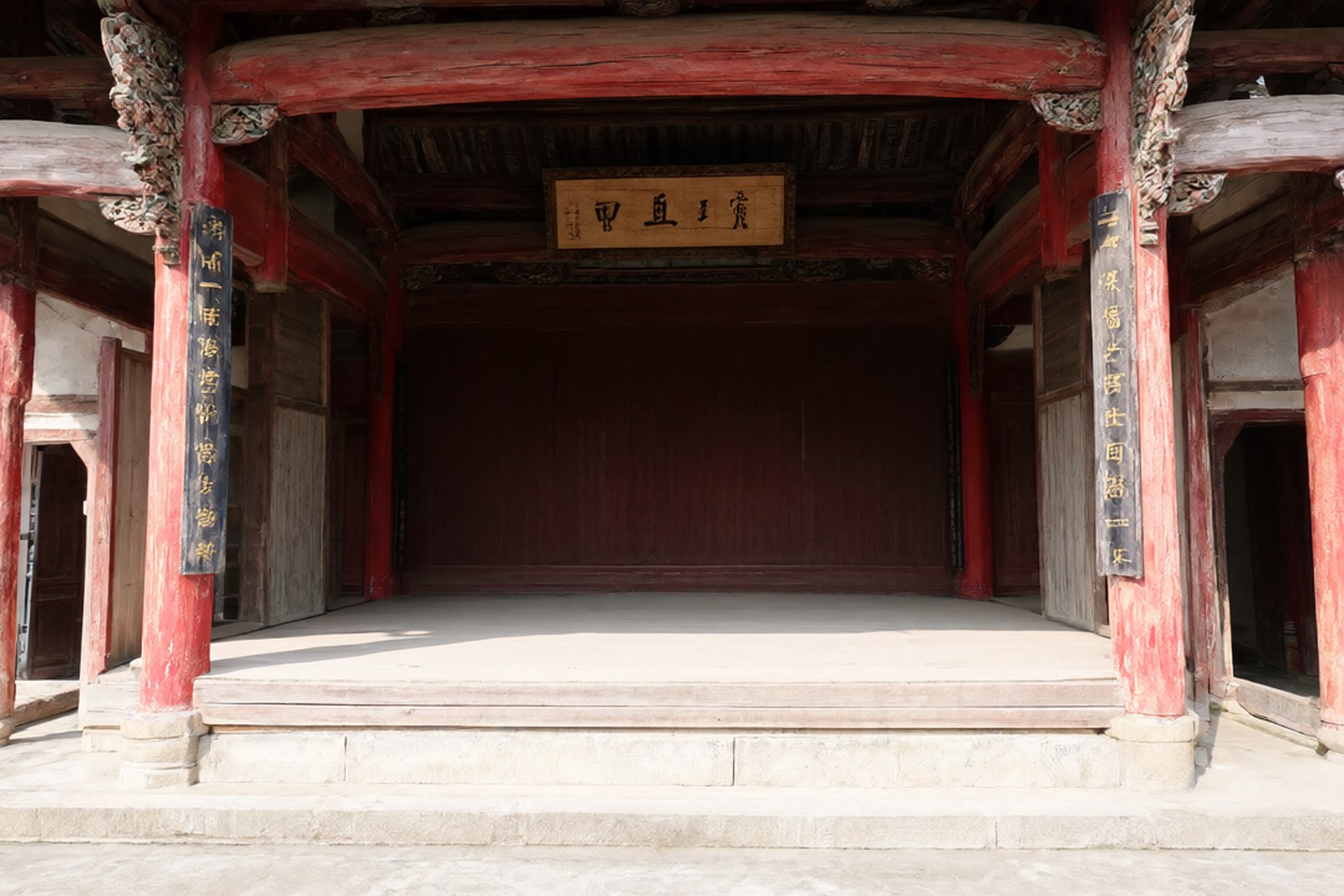
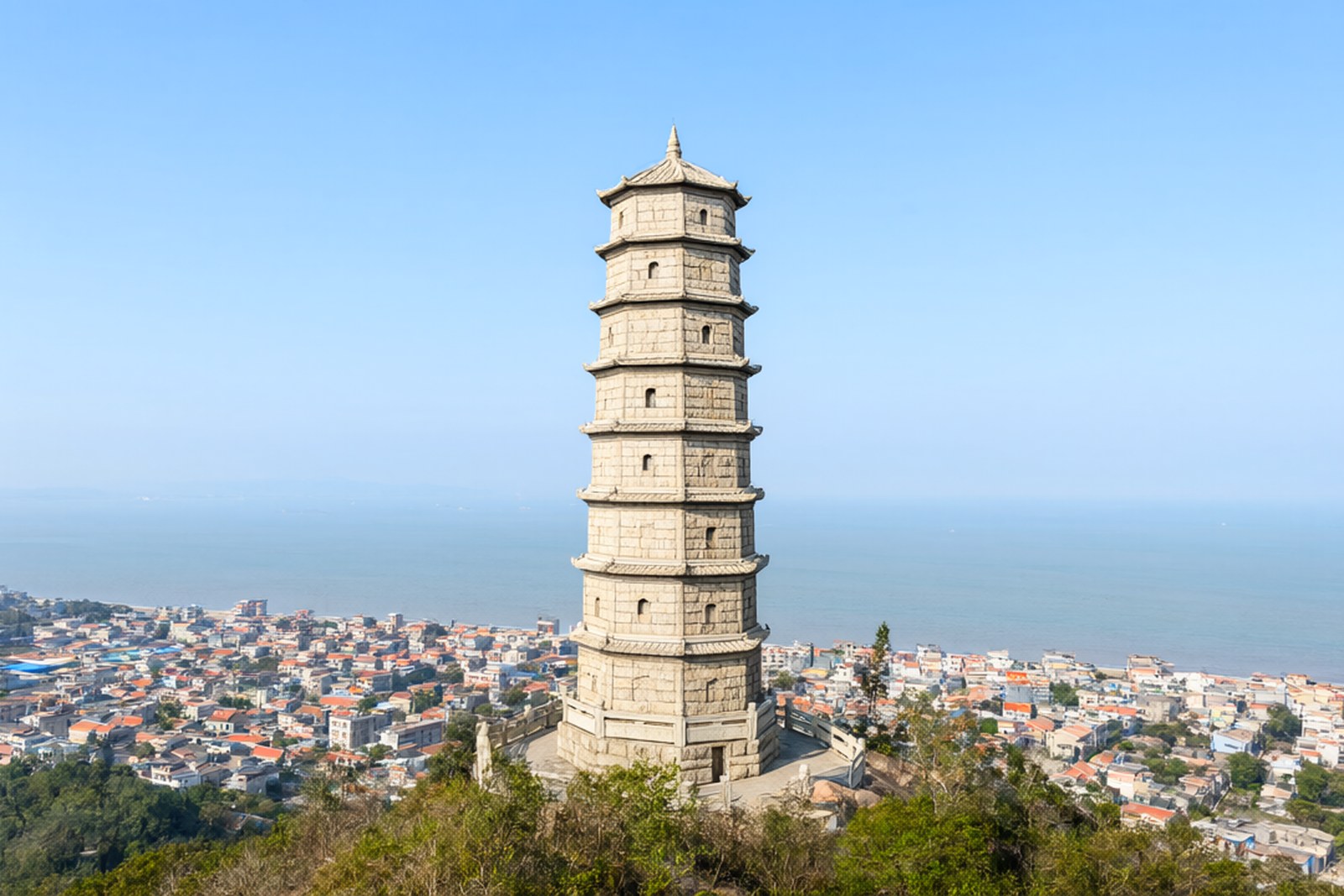
The tower above the temple has been rebuilt more often than the temple beneath it. A tower was first raised on the spot in 1578 in mud and lime, rebuilt in 1865 as an octagonal three-storey stone pavilion, destroyed in 1969 and put back in 1981; it stands 18.8 metres high on a base 24 metres around, 5,340 granite blocks went into it, and it once served the garrison as a lookout over the sea. Below it, the stage is claimed as the oldest and largest temple theatre in Guangdong: built in the Wanli years and rebuilt in 1750, 1.5 metres high and 22 metres wide, its central plaque 台阁文章 credited to Li Wentian, third in the imperial examination of 1895. This is where the local opera companies played for the god, and still do.
The town below the hill is the other half of the visit and most people skip it. A garrison was petitioned for in 1384 by the Guangdong military commissioner Hua Mao, formally established in 1389 and walled from 1394. Jieshi became one of the four great garrisons of the Ming, with Tianjin, Shenyang and Weihai. The fort was wrecked after 1664, and in 1669 the commander Miao Zhixiu built a new brick town to the west. What survives is the wall from the north gate through the east to the south gate, about 1,750 metres long, seven metres high and six thick; the men posted here left behind a garrison dialect called 军话 jūn huà and the Jieshi five-colour lion, whose origin rests on a single encyclopaedia entry.
Practicalities
Tickets. No official notice of a ticket price or an opening time exists for 玄武山 or 元山寺, so the following is third-party. The travel platforms list an adult ticket at 24 to 25 yuan, a two-person ticket at 48 and a three-person ticket at 72, with parking at 10; one encyclopaedia gives 20 yuan for groups and 25 for individuals with a further 10 to climb the tower. A claim that entry through the south gate is free while the east and north gates charge has no official backing at all.
Opening hours. As with the tickets, nothing official is published. The versions in circulation are 08:30 to 17:00 all year, and 08:00 to 18:00 with 07:30 to 18:30 on public holidays. The honest position is that the shrine area is normally open through the day and hours may lengthen in festival periods, so arrive in the morning and plan to be out by late afternoon.
Closing day. No closing day is reported and none is published, which for a temple in daily religious use means there is none. What does change the timetable is the fair, held once every ten years in the years of the 丙 bǐng stem from its first recorded outing in 1896, with a halt in 1956 and a revival in 1991 over seven days from the ninth of the ninth lunar month.
Getting there. From the Lufeng bus station, take a minibus to Jieshi town for about 5 yuan and then the number 9 minibus, which passes the temple, for about 2; from Shanwei city there is a direct service every hour. The high-speed railway stops at Lufeng station, about 80 km from Shanwei, so a car is the practical choice. Half a day is enough for the temple, the tower, the stage and the wall.
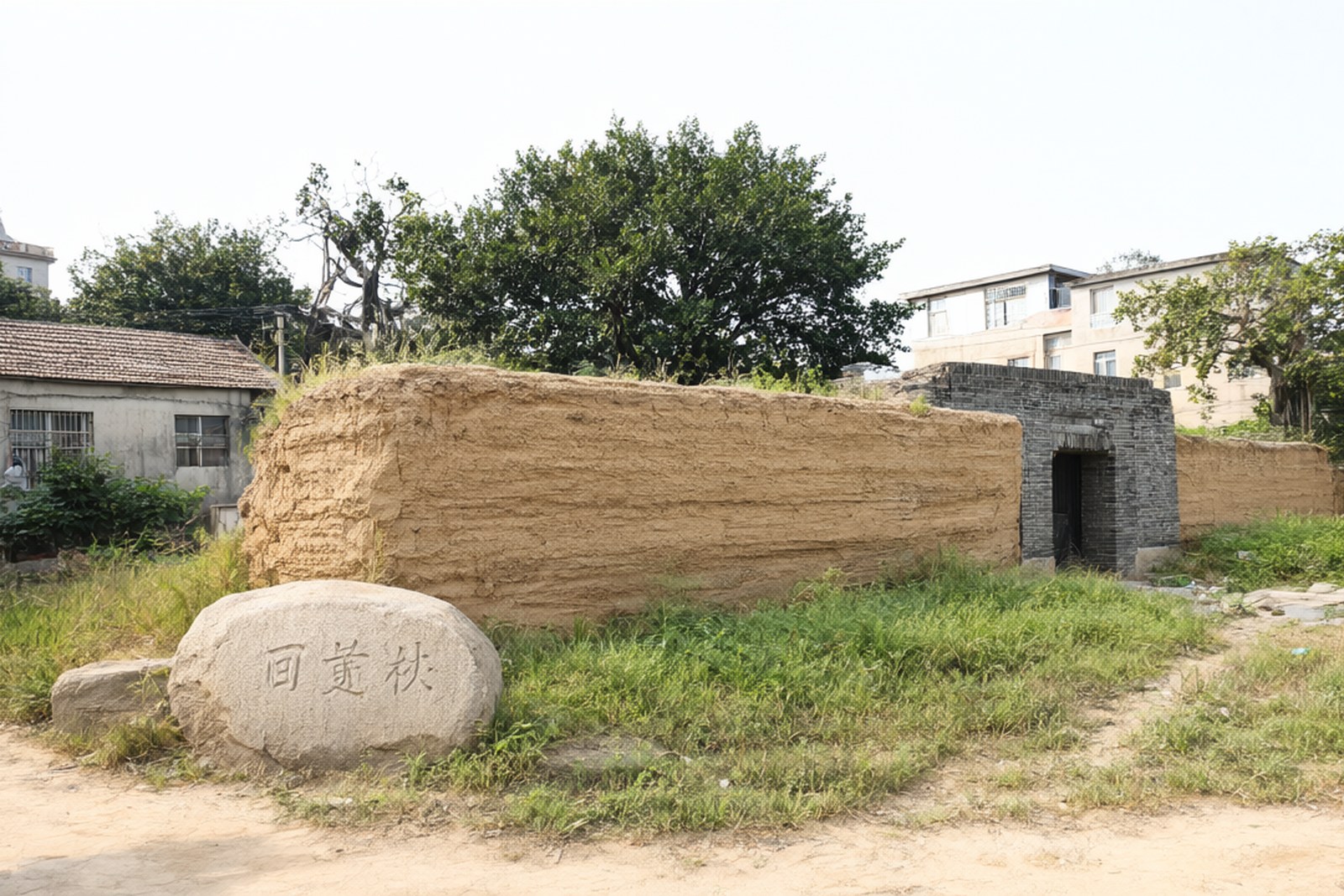
Come for the layers rather than the scenery, and read the temple as a document of the coast. A shrine to a northern god was carried south by soldiers posted to the edge of the empire and survived a Qing campaign against its own religion by setting the Buddha on its altar. Outside, the walls they defended are a grassy line between a fishing town and its bay, with a battery at Qian’ao, built in 1717, inspected and reinforced by Lin Zexu in 1839, whose gunners drove off a British warship in 1840. Two details to carry away: the 元 in the temple’s name is not original but a taboo substitution, and the town’s 40.3 km of coastline and first-class fishing port sit on 118.36 square km of land against 15 hectares of temple.
Getting there: 玄武山元山寺 stands at 碣石镇 in 陆丰市, about 80 km from Shanwei by road, reached by minibus from the Lufeng bus station and the number 9 service, or by car from the high-speed station; no official ticket price or hours are published, the third-party figures being 24 to 25 yuan and 08:30 to 17:00, there is no closing day, the tower costs extra to climb, and the town below holds the garrison walls and the surviving wall line of about 1,750 m.