
Jing’an Temple: The Golden-Roofed Working Monastery That Named a District, Standing at Nanjing West Road 1686 in Jing’an District, Shanghai
金顶辉映千年刹,闹市独存一炷香。Jīndǐng huīyìng qiānnián chà, nàoshì dú cún yī zhù xiāng – Golden roofs gleam over a thousand-year temple; in the busy streets a single stick of incense keeps alone.
静安寺 Jìng’ān Sì Jing’an Temple is not a hillside retreat set apart from the city — it is, plainly put, a working Buddhist monastery planted in the exact middle of one of the world’s most expensive shopping streets: the complex fills its block at 南京西路 Nánjīng Xīlù Nanjing West Road 1686 in 静安区 Jìng’ān Qū Jing’an District, a district that takes its very name from the temple, whose two characters mean “peace and tranquillity”. The history underneath the gold leaf is remarkably deep: the temple was first founded in AD 247, in the 赤乌 Chìwū Chiwu era of the Wu kingdom during the Three Kingdoms period, at a site by the old creek north of today’s location, and in 1216, the ninth year of the 嘉定 Jiādìng Jiading reign of the Southern Song, it moved to the ground it still occupies. The temple gave the neighbourhood its 静安八景 Jìng’ān bā jǐng Eight Views of Jing’an, the scenic associations old residents once ranked and named around it. What you actually visit is a fully functioning monastery whose present buildings — a proud stack of halls under brilliant golden roofs, with a copper hall among them — rise straight out of the retail city.
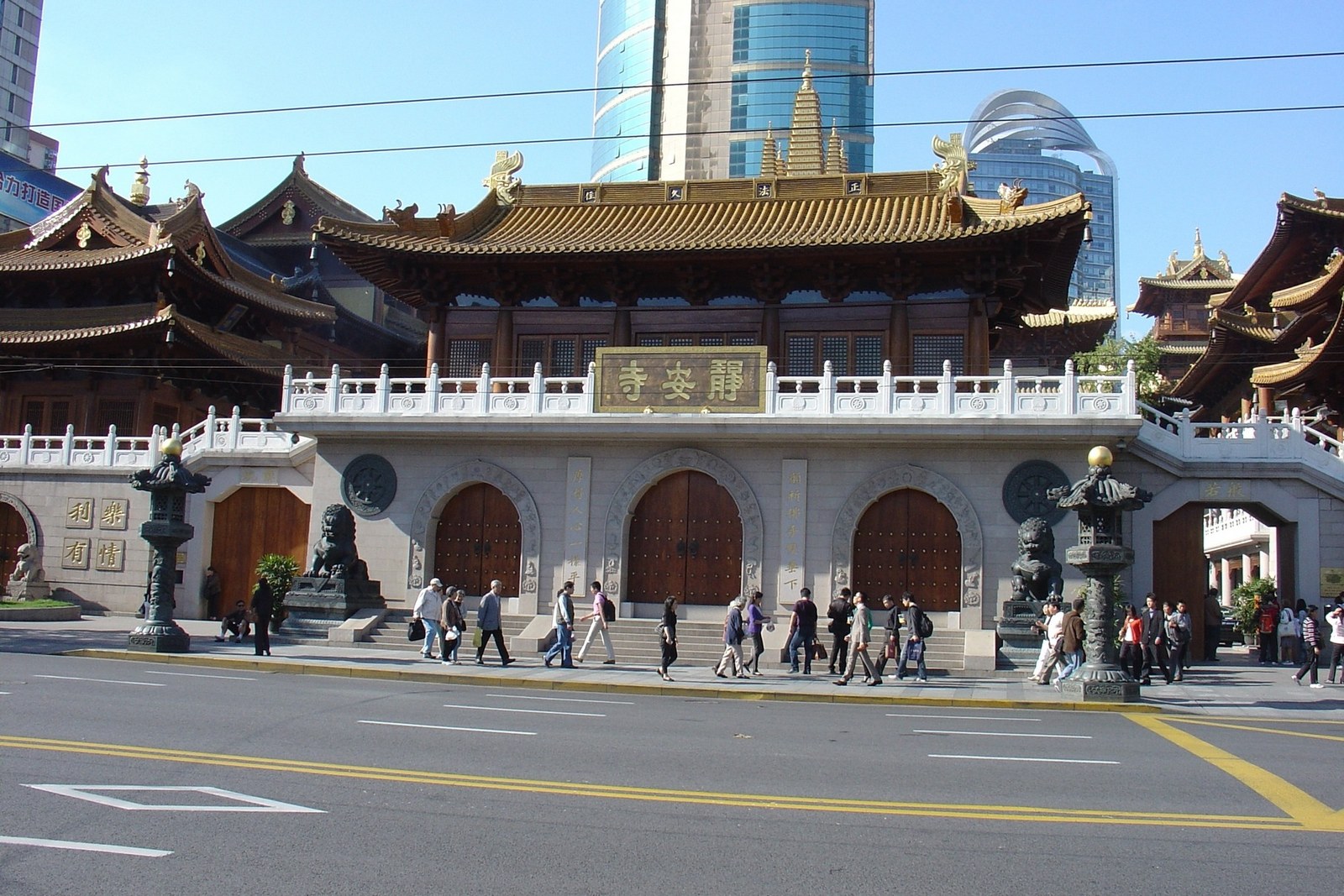
Call it honestly: admission is by a 香花券 xiāng huā quàn incense-and-flower ticket, the traditional way temples in China cover their upkeep, rather than a plain museum-style entry fee (worth confirming the details for the current price and opening hours), and 静安寺站 Jìng’ān Sì Zhàn Jing’an Temple station on Metro Lines 2 and 7 sets you down directly at the temple’s corner. The honest warning is contrast, not cost: you step out of a mall underpass into incense smoke, and the switch from escalator music to wooden fish drums is the whole experience in one moment. Weekday mornings keep the halls to worshippers and unhurried visitors; weekends fill the forecourt with tour groups. Give it forty-five minutes to an hour, longer if you stay for the rooftop views over the intersection.
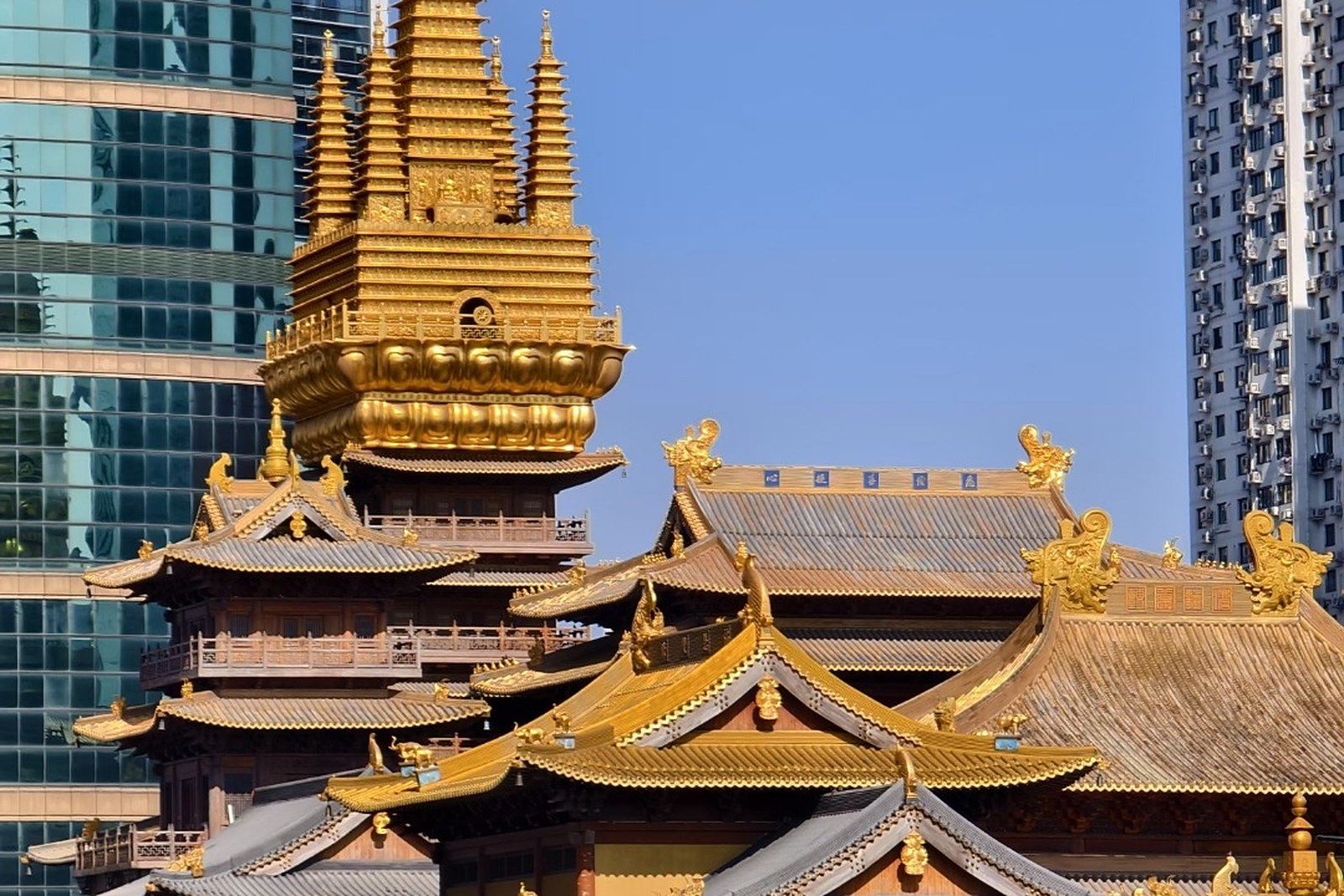
The honest star is the golden roofline itself — tier after tier of gilt eaves and copperwork, unusual for a Chinese temple in this palette, reading against the glass towers behind it as a deliberate, cheerful act of standing its ground. What gets oversold is the word “ancient”: the site’s history runs back to AD 247, but the halls now standing are handsome reconstructions of recent decades, and visitors expecting untouched Song-dynasty timber meet gilded newness instead (worth confirming the details for which halls date from which rebuilding). What repays the effort is the detail work the gold distracts you from: the 铜殿 tóng diàn copper hall, the carved bracket sets, the plaque boards over the gateways, and the quiet way the temple’s layout still organises the entire district around it. Come for the layering of the place: street, then gold, then the incense behind the doors.
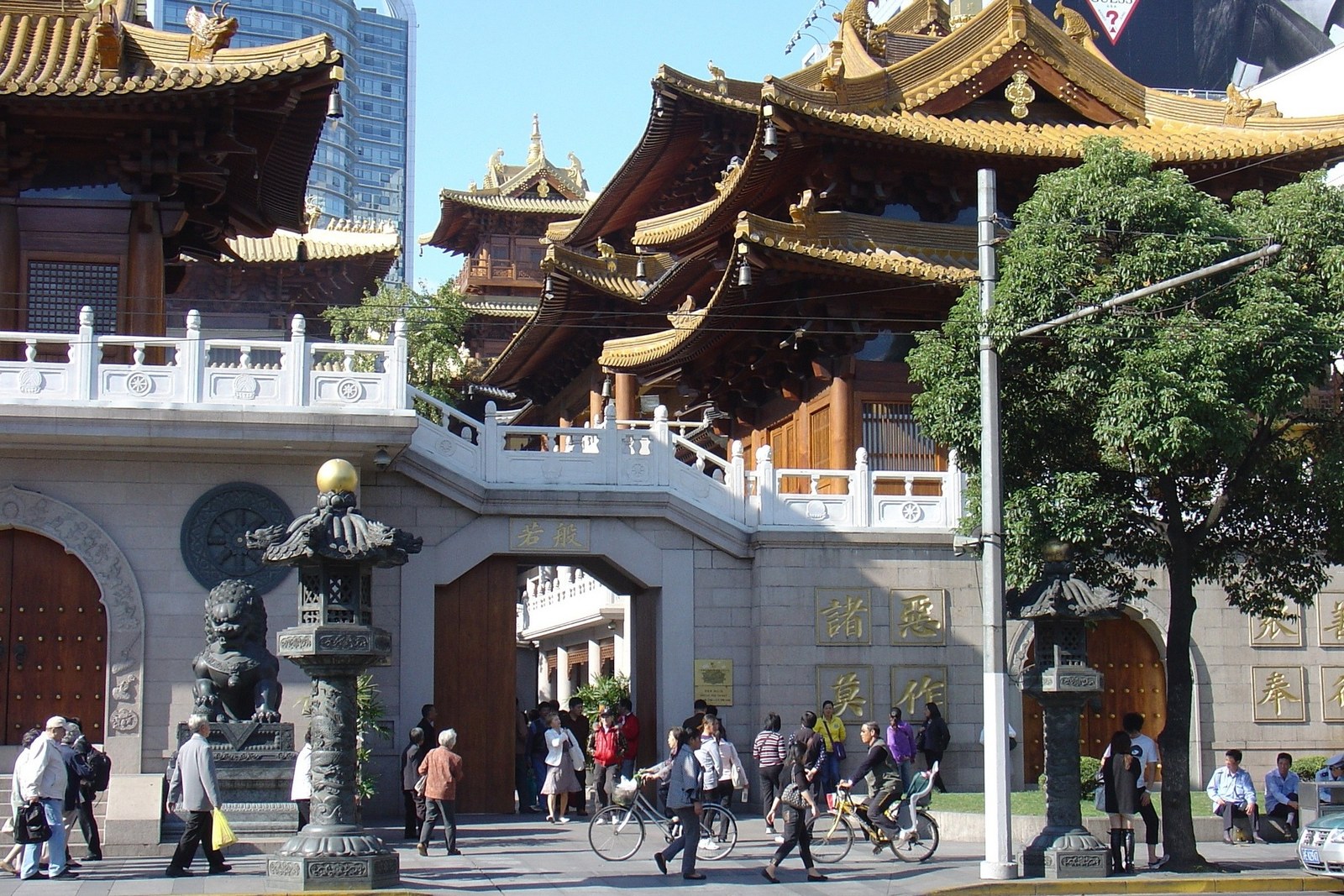
The self-aware postscript: I stood under the eaves one weekday morning beside a woman who works in one of the malls across the street and comes in before her shift. “Ten years I walked past the gate,” she said, as the great cauldron smoked between us, “then one day I came in at seven, and now I cannot start a day without this ten minutes — the temple is the only thing here that does not change seasons”. That is the visit in miniature. From the upper hall, looking down, the intersection’s crowds stream past the walls and the temple holds still inside them, the angle no shop window offers. 静安寺 Jìng’ān Sì suits whoever treats it as a living place of worship wearing spectacular new gold first and a photo stop second, and disappoints anyone expecting a hushed heritage compound sealed off from the city.
Nearly everything else on this Jing’an list lies within an easy walk or one metro ride: the restored shikumen lanes of 张园 Zhāng Yuán Zhangyuan Garden wait a short stroll southeast along Nanjing West Road toward 茂名北路 Màomíng Běilù Maoming North Road, the lawns and standing sculptures of 静安雕塑公园 Jìng’ān Diāosù Gōngyuán Jing’an Sculpture Park lie east along 北京西路 Běijīng Xīlù Beijing West Road, the dinosaur halls of 上海自然博物馆 Shànghǎi Zìrán Bówùguǎn the Shanghai Natural History Museum sit immediately beside that park, and the lake and spring tulip beds of 大宁公园 Dàníng Gōngyuán Daning Park wait in the district’s north along 共和新路 Gònghé Xīnlù Gonghexin Road — all inside the same 静安区 Jìng’ān Qū Jing’an District that this temple has named and anchored since 1216.
Practicalities
- Rating: ★★★★☆ — a spectacular golden-roofed working monastery in the heart of the shopping district; go weekday morning before the tour groups, and expect new buildings on a very old site.
- Tickets: Admission by incense-and-flower ticket (worth confirming the details for the current price and hours).
- Address: 静安寺 Jìng’ān Sì, 南京西路 Nánjīng Xīlù Nanjing West Road 1686, 静安区 Jìng’ān Qū, Shanghai — directly at Jing’an Temple station on Metro Lines 2 and 7.
- Time needed: Forty-five minutes to an hour for the halls and roofline views; longer if you time a visit to morning chanting.
Words and Names
静安寺 Jìng’ān Sì Jing’an Temple · 赤乌 Chìwū the Chiwu era of the Wu kingdom, when the temple was founded in AD 247 · 嘉定 Jiādìng the Jiading reign of the Southern Song, in whose ninth year, 1216, the temple moved to its present site · 香花券 xiāng huā quàn incense-and-flower admission ticket · 铜殿 tóng diàn copper hall · 金顶 jīndǐng golden roof · 静安八景 Jìng’ān bā jǐng the Eight Views of Jing’an · 南京西路 Nánjīng Xīlù Nanjing West Road · 静安寺站 Jìng’ān Sì Zhàn Jing’an Temple station · 静安区 Jìng’ān Qū Jing’an District
flowcloud would say that 静安寺 Jìng’ān Sì is a monastery that outlived everything built around it — founded in AD 247 in the 赤乌 Chìwū Chiwu era, moved to 南京西路 Nánjīng Xīlù Nanjing West Road 1686 in 1216 during the 嘉定 Jiādìng Jiading reign, and standing today as a stack of golden-roofed halls with a 铜殿 tóng diàn copper hall at the very heart of the shopping district that took its name (worth confirming the details for the current incense-ticket price) — and that the honest move is a weekday-morning visit entered through Metro Lines 2 or 7, because the ancient-site expectation is the poster half and the working monastery holding still amid the malls is the real half, and the temple repays whoever stays past the photograph to the incense, the eaves and the 静安八景 Jìng’ān bā jǐng stories it seeded across the neighbourhood. All checked October 2026.
Getting there: Metro Lines 2 or 7 to 静安寺 Jìng’ān Sì Jing’an Temple station, exit 1 or 2, which lands directly at the golden roofs on 南京西路 Nánjīng Xī Lù Nanjing West Road (worth confirming the details for incense-ticket hours, which still run on temple time); the main hall faces the street gate across the plaza. All checked October 2026.