
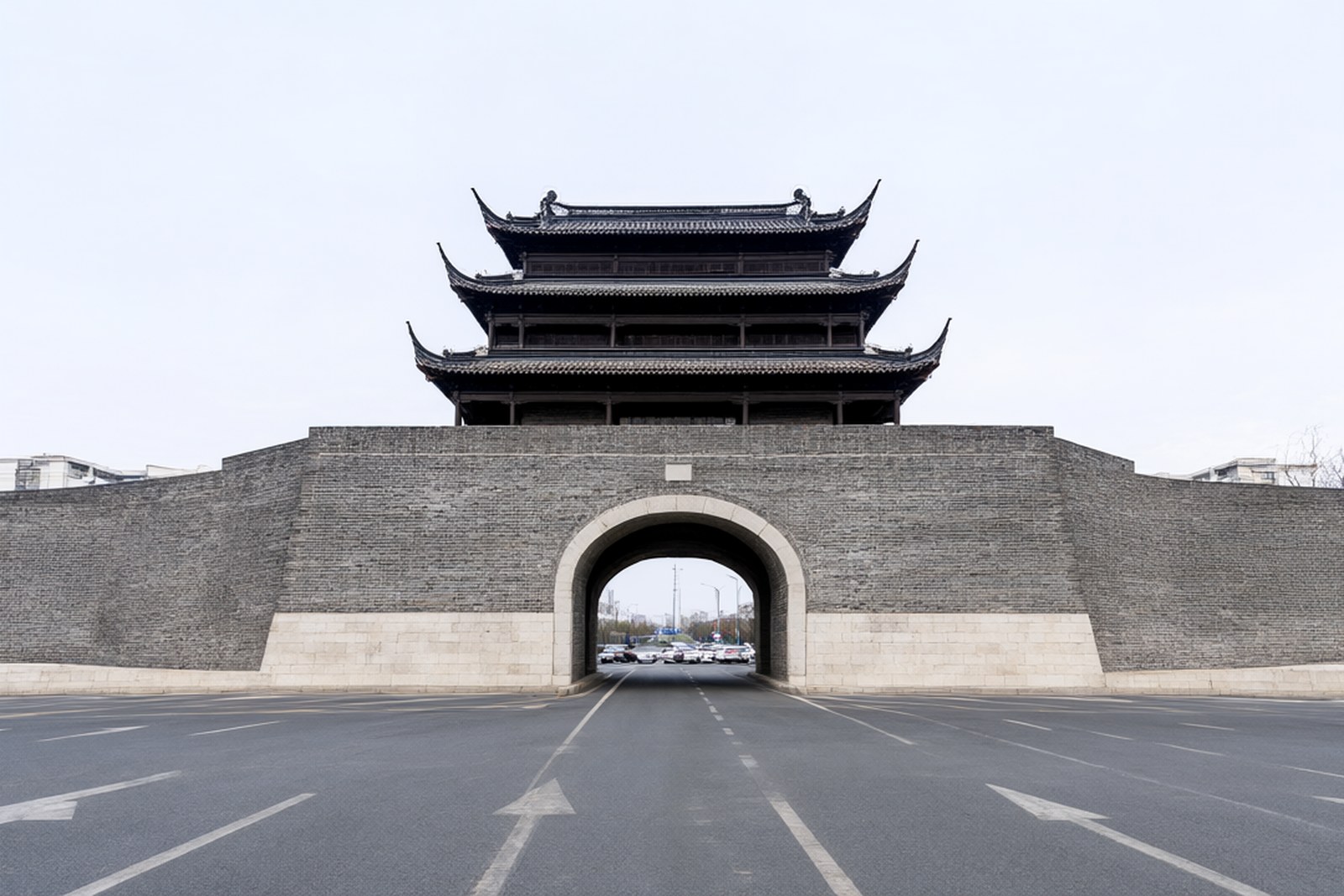
进贤门 Jìn xián mén is a gate with no wall around it, and that is the whole of its story. It stands at the western end of 进贤门大道 jìn xián mén dà dào in 榕城区 Róng chéng qū, 揭阳市 Jiē yáng shì, on the inland edge of the old walled town, and it is the only one of the city’s gates still standing: the wall and the other four gates were pulled down in the 1940s, and this one was kept. It was built in the first years of the 天启 Tiān qǐ reign of the Ming, in 1621 or 1622 depending on which account you read, and it was not one of the four cardinal gates of the city at all – it sits between the east gate and the north gate, which makes it a fifth gate in a plan that was only meant to have four, a thing almost no walled city in the country did. The reason is the 学宫 xué gōng. The gate opens onto the road to the Confucian temple, so the name was chosen to mean the place by which 贤士 xián shì, worthy scholars, come forward into the district.
The naming has a second, better story, and the local tradition says it goes like this. In the Tang and Song there were seven worthies born in this quarter, and the geomancers of the time judged the spot fit for a city gate and had a stone lintel carved with the three characters 进贤门 buried in the ground against the day somebody built one. Several hundred years later, in the Ming, seven more notable men came out of the same quarter, a gate was decided on, and the workmen digging the foundation turned up the buried stone. The plaque over the gate now is that stone, the tradition says, and it carries no signature of any kind – no reign, no official’s name, no date – so who carved it and when has never been settled. Nobody can prove the story and nobody in 揭阳 disbelieves it either; it is the reason the gate is treated with a certain amount of affection rather than as a piece of municipal furniture.
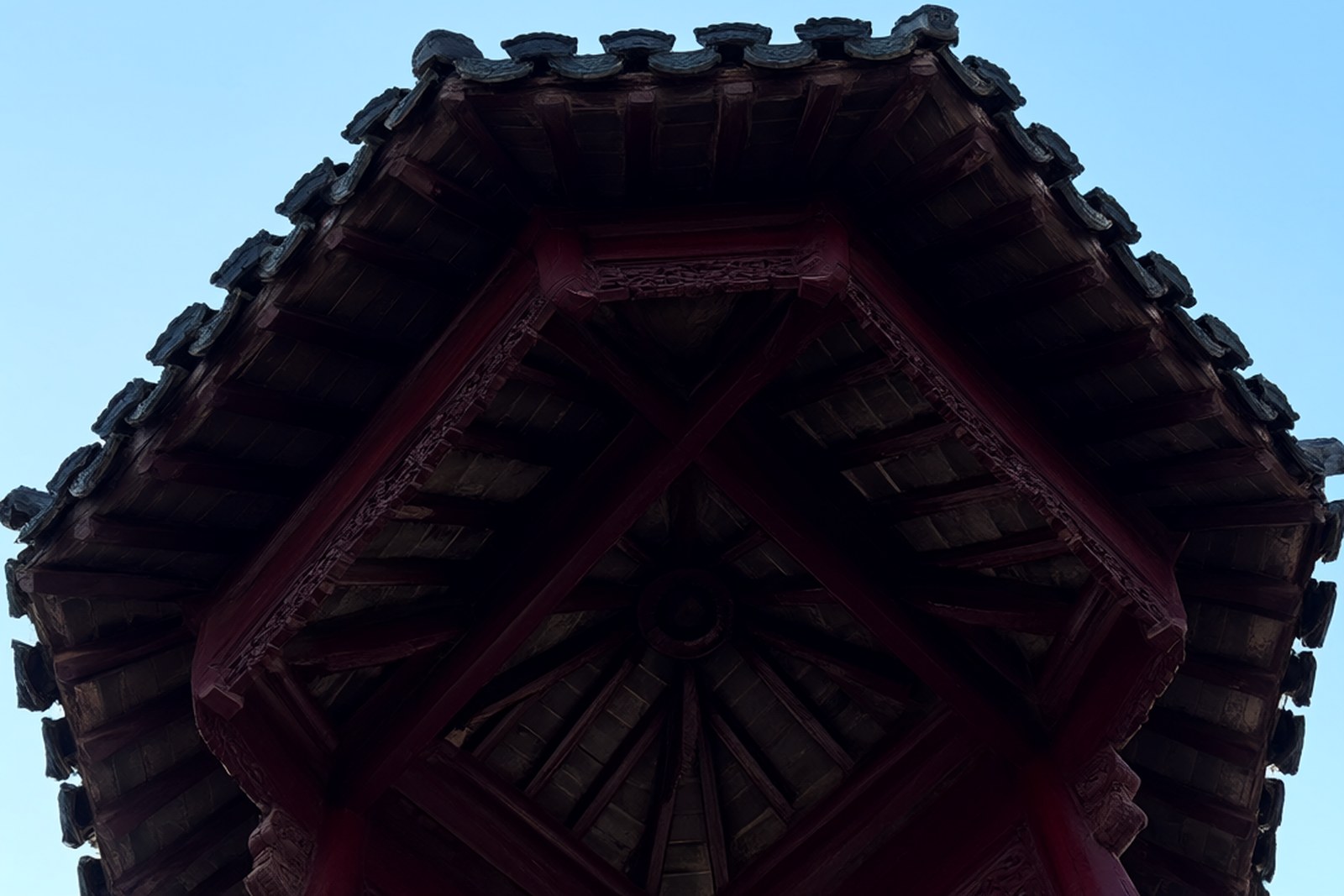
The structure itself is a hybrid and the county describes it as one: a 明代单体建筑 míng dài dān tǐ jiàn zhù, a single Ming building that is a gate, a tower and a pavilion at once, which is rare. The lower part is the 石筑城门 shí zhù chéng mén, a stone gate built of square blocks laid in overlapping courses into an arch, with an inner and an outer door so that the passage between them formed a 瓮门 wèng mén, a small killing ground that could be shut at both ends. Above it stands a three-storey 门楼 mén lóu, a gatehouse 16.77 metres high from the ground, framed entirely in 杉木 shān mù, China fir, with no other timber in it. The first storey is 三进 5 间, three bays deep and five wide, with carved lattice windows and 花窗活牖 huā chuāng huó yǒu on all four sides and a small 门亭 mén tíng, a door pavilion, on the north and the south. The top storey is an 八角亭阁 bā jiǎo tíng gé, an octagonal pavilion, roofed with an 八角攒尖琉璃顶 bā jiǎo cuán jiān liú lí dǐng, an eight-sided hipped spire of glazed tile. The four corners of the eaves turn up and flick out, which is what gave the gate its nickname, 凤楼 fèng lóu, the phoenix tower – four upswept corners like the tail of a bird in flight.
The name the gate made for itself, though, was made before dawn. In the Ming and Qing the gatehouse kept 更夫 gēng fū, watchmen, whose job through the night was to strike the hours on a wooden clapper; at first light, as the sky came up over the roofs, they sounded a horn from the tower, and the sound went out over the whole walled town on the morning air and woke it. That is the origin of 谯楼晓角 qiáo lóu xiǎo jiǎo, the horn at dawn from the watchtower, one of the eight scenic sights of old 揭阳 jiē yáng. The gate’s other function in local life is less official and still current. Local custom held that an incoming magistrate should walk through 进贤门 on his way into office, for the luck of it, and that a man about to marry and a student about to sit the examinations should do the same – a bridegroom through the gate brings a virtuous wife, and a candidate through it brings a pass. The marriage part has faded; the examination part has not, and families still bring a child on the way to university to walk through the arch, or to circle the tower a few turns, in the weeks before the papers are sat. The gate’s own survival was a decision made in the middle of the twentieth century. 揭阳’s wall went up in the fourth year of 天顺 Tiān shùn in the Ming, which is 1460, with a gate on each of the four sides; in the 1940s, in one account as early as 1937, the city remodelled itself and pulled the wall down to lay 环城马路 huán chéng mǎ lù, the ring road, and the four gates came down with it. 进贤门 was the exception, kept for the tower on top of it. In 1985 the 榕城镇 government raised money to repair it, and in 1993 the 揭阳市 government listed it as a protected unit. It now stands in the middle of a traffic roundabout with 进贤门大道 running east off it towards the new city and the shopping district, and the old town behind it to the west: walk that way and the 学宫, the 城隍庙, the 双峰寺 and the arcaded shophouse streets of 中山路 and 西马路 follow one after another within a few minutes on foot. It is the one place in 揭阳 where the old city’s outline is still legible, and it is legible from a single arch.
Practicalities
Tickets. Free. The gate is a standing monument on a public avenue rather than an attraction with a booth, and there is nothing to pay to walk under the arch or to look at the tower from the pavement; the only tickets involved are the ones for whatever you eat in the old town afterwards.
Opening hours. Open all hours, since it never closes and was never roofed in for visitors. The good light on the tile is in the morning, when the sun comes up on the eastern face, and in the last hour of the afternoon, when it rakes along the arcades of 中山路 behind it; midday flattens the carving and the roundabout at the front fills with traffic, so an early start is worth more here than it usually is.
Getting there. The gate is at the west end of 进贤门大道 jìn xiān mén dà dào in 榕城区 Róng chéng qū, in the middle of the roundabout where the avenue meets the ring road, which is a ten-minute walk from the city-centre shopping district and about the same from the 榕江 Róng jiāng embankment. City buses stop on the avenue beside it, taxis will drop you at the kerb, and the 揭阳站 and the 厦深 Xià shēn high-speed stations are south-east of the centre with 揭阳潮汕国际机场 Jiē yáng cháo shàn guó jì jī chǎng about forty minutes out at 登岗镇.
Closing day. There is no closing day, because there is no door to shut – the arch is a road, the pavements are open and the tower is looked at from outside. The site has been shut only twice in living memory, both times for its own repair work rather than for a calendar: the 1985 restoration funded by the town government and the more recent cleaning and relighting of the timber, and on those occasions the arch itself stayed open while the scaffolding went up.
flowcloud would say that a city which knocked down its own wall and then kept one gate has been honest about which of the two it actually loved, and that a building whose whole legend is a stone somebody buried three hundred years before there was anything to put it over is a good argument for doing the groundwork properly.
Getting there: 进贤门 is at the west end of 进贤门大道 jìn xiān mén dà dào in 榕城区, the old town of 揭阳市, standing alone in the roundabout where the avenue meets the ring road; it is a short walk from the shopping district and from the 榕江 Róng jiāng embankment, and the 学宫, the 城隍庙 and the 双峰寺 are all within a few minutes west of it, which is best done on foot. 揭阳站 and the 厦深 Xià shēn high-speed stations lie south-east of the centre and 揭阳潮汕国际机场 Jiē yáng cháo shàn guó jì jī chǎng is about forty minutes away at 登岗镇, with the last stretch a taxi or a city bus along the avenue.