
Every road into Baisha’s north ends the same way: climbing. The S310 from Bangxi runs about fifty kilometres through rubber country before the hills steepen and the bends multiply into the Jiujialing pass, the county’s self-styled north gate a few kilometres short of Yacha town. The pass is more than a road problem. Stand at the top and the island splits in two: southeast of the ridge the land folds into the thousand-valley interior of the Wuzhi mountains, northwest of it lie the rolling hill country and plains of Hainan’s dry west – and the winds change character across the same line, making the pass a climatic as well as a topographic border.
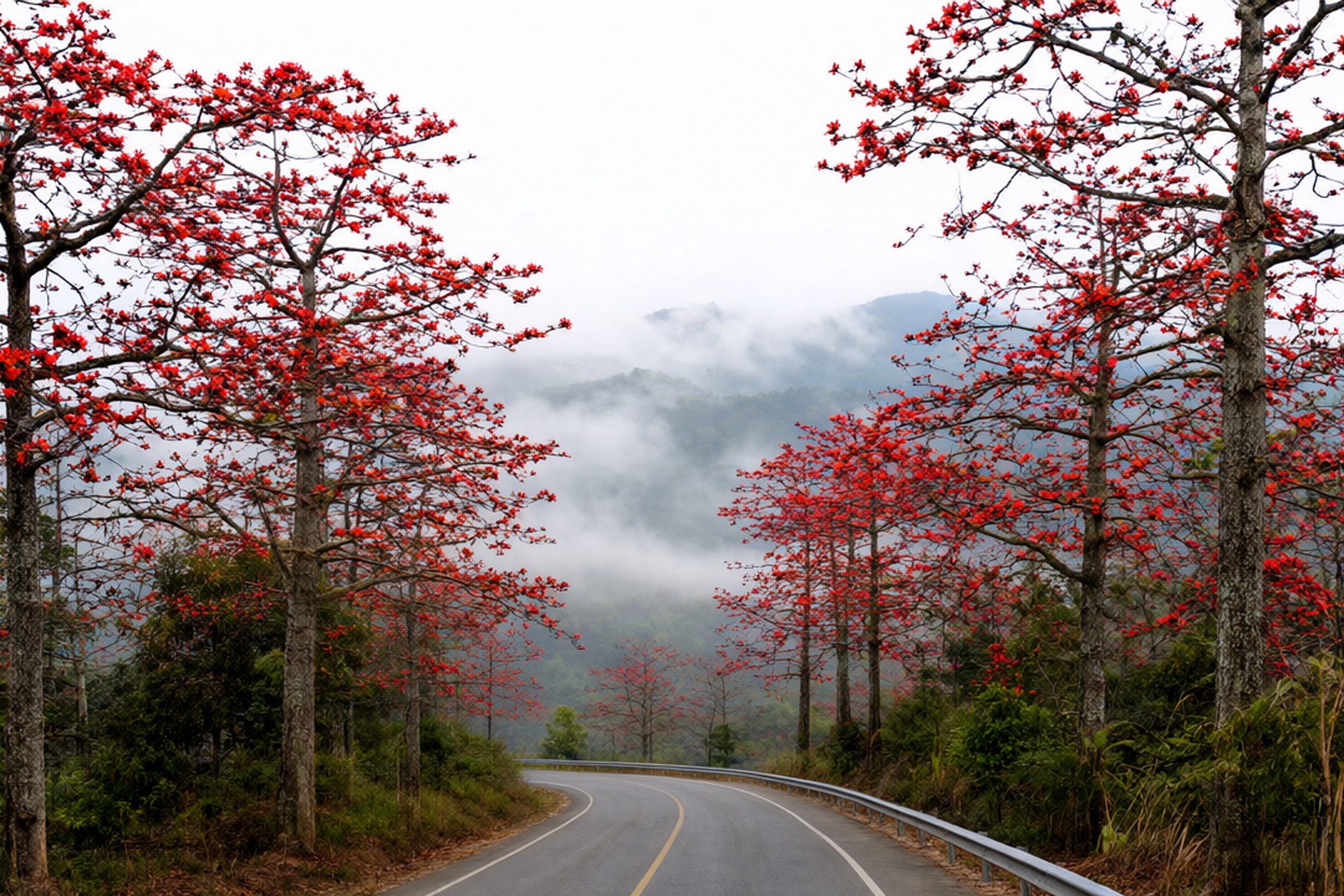
The kapok trees make the border visible every spring. The red silk-cotton trees lining both sides of the climb were left standing when the road was cut – the county forestry office’s deputy head, Pan Xianjing, says plainly that nobody can date them any more – and they grew into giants, trunks seventy to eighty centimetres across with some reaching a metre, crowns spreading ten metres and more above the asphalt. From February into March they flower in unison, dense and continuous, a red line running from the valley fields up to the summit bends. Unlike Changjiang’s riverside and terraced kapok landscapes, the ones the province’s February photo crowds flock to, Baisha’s kapok is a driving route: the flower show is designed, by accident, for a car window.
The pass’s second act plays at dawn. One side of the road is high mountain, the other an open basin, and the height difference pulls fog into the basin most mornings – locals call the scene Jiujia guanwu, watching the fog from the nine ridges – and the county’s spring slogan, Jiujia kapok red, is really two shows in one: red flowers on the mountain, white fog below, green areca and rubber and bamboo filling the layers between. Several viewing platforms and rest stops line the pass for exactly this, with parking so you are never tempted to stop in the bends – which, with the fog and the frequency of the curves, is the one rule of the drive.
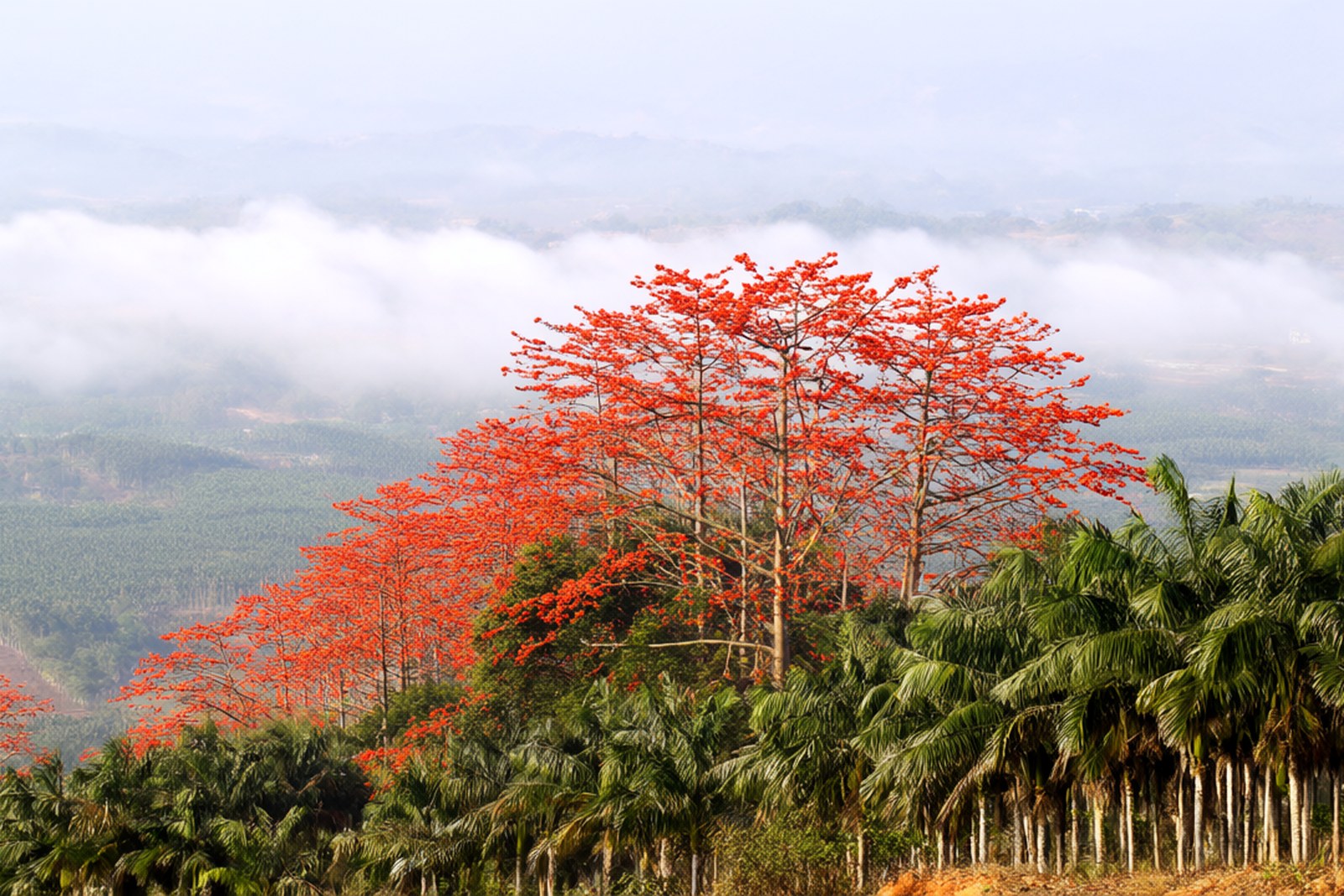
The pass has credentials beyond the flowers. Hainan’s media count it among the island’s representative road-trip lines, in the company of Wanning’s coastal tourism highway and Changjiang’s Bawangling-to-Wangxia mountain road; the county’s own tourism pages describe kapok running from the valley fields, village edges and riverbanks up the road to the summit, hillfoot to hilltop; and drone photographers come for the second-storey view, red crowns floating in cloud. The best single window for photographs is the hour or two after sunrise, when the fog is still in the basin and the side light catches the flowers – the guidance of local photo trips rather than any official notice – and the county’s spring campaign, Jiujia kapok red, packages exactly that pairing for the February weekends.
The botanical list along the climb runs longer than the kapok: original forest bands and rubber estates on the upper slopes, areca groves in the valleys, tree ferns and rosewood in the shadier folds. Planning documents for the national geopark fold the pass’s granite scenery and cloud landscape into the park’s six zones, which makes a drive here a drive through the same park system as the meteorite crater. Budget thirty to sixty minutes for the pass itself – slower in the flower season, when every platform fills – and set out at or just after sunrise for the fog, the side light and the empty road. The full western loop then writes itself: Bangxi’s deer-reserve outer grounds and Bajiao village, the Jiujialing climb, down into Yacha for the tea town, and on to the crater across town.
Practicalities
Tickets. Free – this is a public provincial highway with a scenic habit, and there are no gates, tickets or parking fees on the pass. Checked October 2026, subject to change.
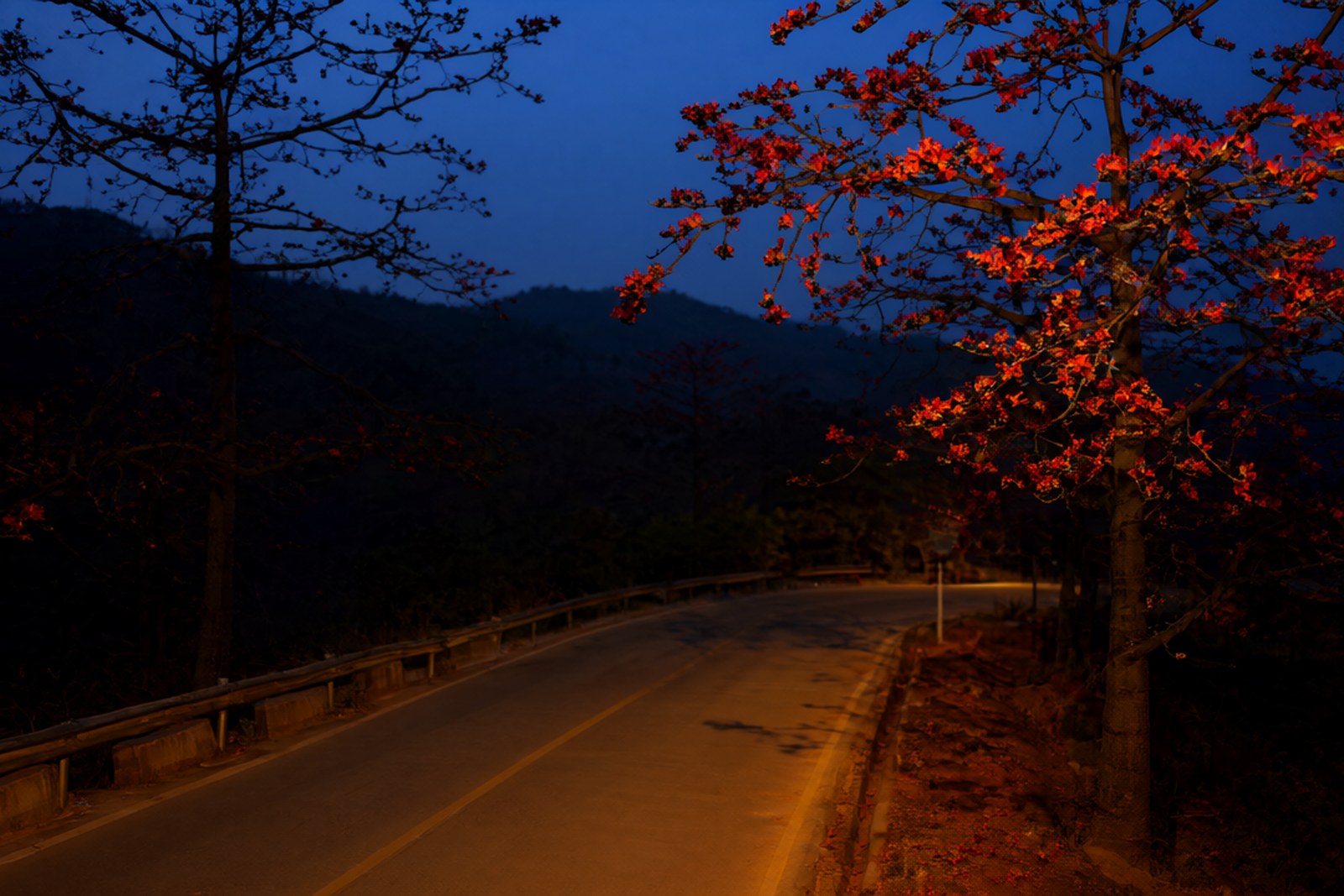
Opening hours. Open at all hours as a public road, but the honest window is daylight: the bends are many, fog makes the surface slippery, and night stopping is not advised – best light runs from just after sunrise through late morning.
Closing day. No closing day – the road runs all year, and the real calendar is botanical: the kapok window is February into March, with rain and fog days best driven slowly or not at all.
Getting there. From the Dan-Bai expressway’s Yacha interchange, take the S310 toward Bangxi; the climb begins within about fifteen minutes of town. From Bangxi, drive the S310 roughly fifty kilometres toward Yacha and the pass arrives on its own. There is no public transport onto the pass – hire a car in Yacha or come with your own; stop only at the platforms, never in the bends.
flowcloud would say that the pass is the county’s front door painted red every February – and that of all Hainan’s kapok shows, this is the one best watched from a slowly moving window with the fog still in the basin.
Getting there: Jiujialing pass lies on the S310 between Bangxi and Yacha, Baisha Li Autonomous County, Hainan – about fifteen minutes up the road from the Dan-Bai expressway’s Yacha interchange toward Bangxi, or fifty kilometres from Bangxi toward town; the road is free, open at all hours with no closing day, best driven in daylight and at its reddest February into March, and stopping is for the platforms only, never the bends (checked October 2026, subject to change).