
Kaiping Diaolou
You turn off the main road into a village of rice fields and banana trees, and there, standing in the middle of the paddies like something dropped out of a dream, is a tower — a five-storey concrete fantasy with Roman columns, a Chinese roof, wrought-iron balconies and gun slits, built a century ago by a man who came home from America with money and an idea.
开平碉楼 (Kāipíng diāolóu, “Kaiping watchtowers”) are the strangest and most moving buildings in Guangdong. They are the work of the 华侨 (huáqiáo) — the overseas Chinese of Kaiping, who went out to North America and Southeast Asia in the late nineteenth century, made money, and sent it home. Between roughly 1900 and 1930 they built hundreds of fortified towers across these villages, to defend against bandits and floods, and the results are unlike anything else in China: Chinese villages crowned with a wild, homespun cocktail of Western architecture.
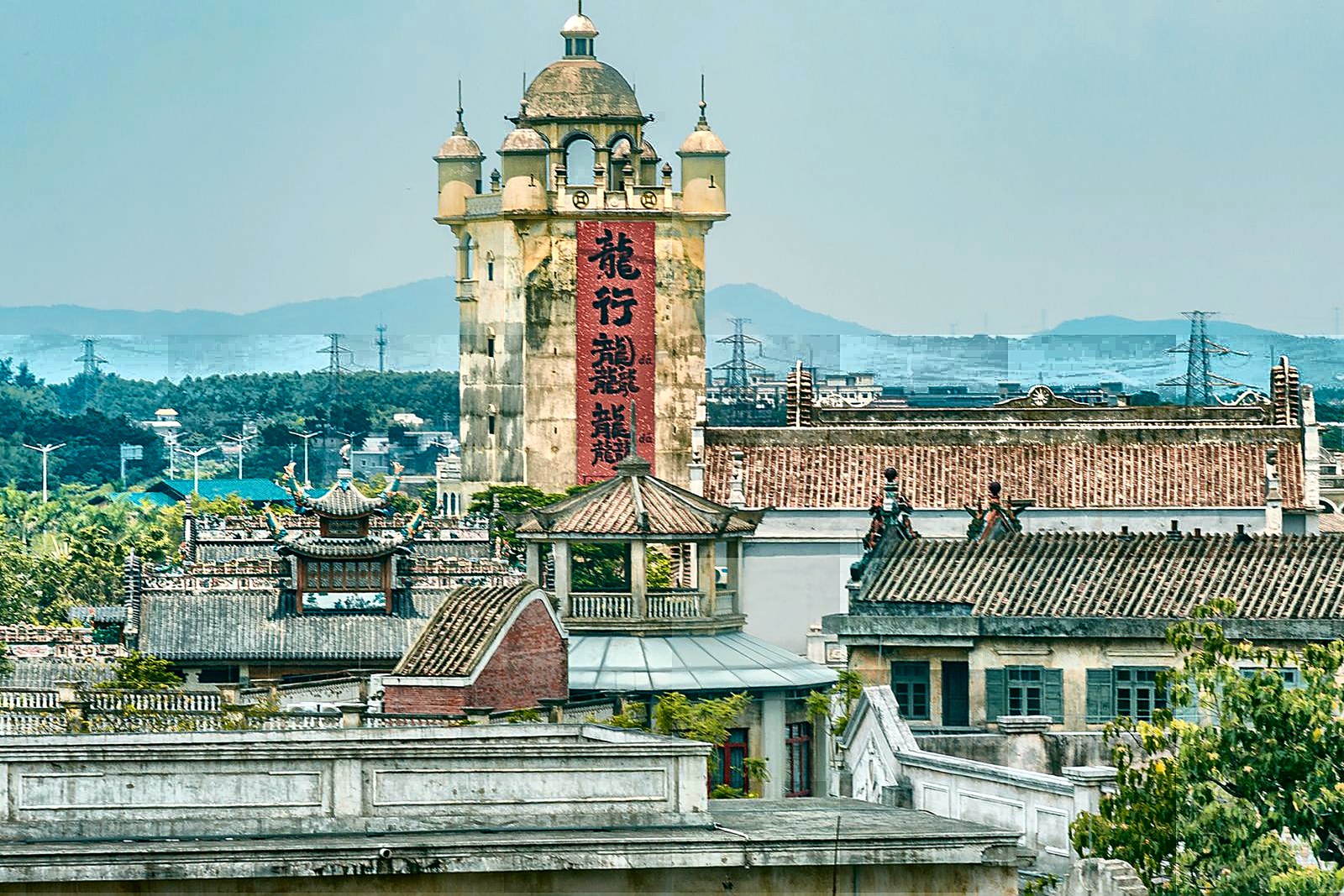
The Towers
There are said to be more than 1,800 diaolou in Kaiping alone, and the reason you have heard of them is that in 2007 the Kaiping Diaolou and its villages became Guangdong’s first UNESCO World Heritage Site.
The towers come in three moods. Some are simple defensive watchtowers, little more than reinforced concrete and loopholes. Some are communal jūlóu (居楼) where several families took refuge together. And then there are the showpieces — the ones built by individual families purely to be admired, with a columned loggia on top, a walled garden below, and every Western detail the returning builder could remember or order from a pattern book.
The four inscribed village clusters are 自力村 (Zìlì Cūn), 马降龙 (Mǎjiànglóng), 锦江里 (Jǐnjiānglǐ) and 三门里 (Sānménlǐ), and the separate private garden of 立园 (Lì Yuán) is a site in its own right. If you only have time for one, make it 自力村 — the towers standing among flooded rice paddies, which is how everyone photographs them. If you want the tallest and the most outrageous, go to 锦江里 and find 瑞石楼 (Ruìshí Lóu), the “Swiss Stone Tower,” all nine storeys of it.
Practicalities
Tickets. Each main site is ticketed separately: roughly ¥50 for 自力村, ¥50 for 马降龙, ¥50 for 锦江里, and around ¥60 for 立园. A combined pass for several sites runs about ¥180 and is the better value if you are doing a whole day. Discounts for children, students and seniors with ID.
Do you need to book? No. Buy at the gate, or online for the multi-site pass. Guides can be hired at the main villages and are worth it — without one, the towers are beautiful but silent.
Opening hours. The sites run roughly 08:30–17:30, last entry around 17:00. Allow a full day to see three or four clusters; a half-day gets you 自力村 and 立园 comfortably.
Getting there. Kaiping is in 江门 (Jiāngmén), roughly 130 km southwest of Guangzhou.
- By high-speed rail: Guangzhou South to 开平南站 (Kaiping South), about 1 h 20, then taxi or local bus to the villages (自力村 is about 20 minutes away).
- By car: about 2 hours from Guangzhou via the 沈海 expressway — the easiest way if you want to move between clusters, which are spread out.
- Local: the clusters are 10–30 minutes apart by road and not walkable between; hire a driver for the day or use the local tourist shuttle between the main sites.
One warning. The villages are lived in, not museums — people still farm these fields and dry their grain on the squares. Do not walk into private courtyards or through occupied houses. And the towers can only be climbed at the sites where they have been fitted out for visitors, so check which ones are open before you plan a day around a particular tower.
flowcloud would say that a homesick man building a Roman column in a rice paddy is not confused — he is telling you, in the only vocabulary he had, exactly where he had been.
Getting there: 开平碉楼 (Kaiping Diaolou), 江门 (Jiangmen), Guangdong — UNESCO World Heritage. Guangzhou South to 开平南站 (Kaiping South) about 1 h 20 by high-speed rail, or about 2 h by car. Tickets roughly ¥50 per village (自力村 / 马降龙 / 锦江里), ¥60 立园, or about ¥180 for a multi-site pass. Open 08:30–17:30. Allow a full day; do not miss 自力村 at sunrise and 瑞石楼 at 锦江里.