
木棉花 mù mián huā, Bombax ceiba, the tree Chinese call the hero tree, flowers before it leafs: bare dark branches crowned in scarlet for a few weeks of late winter, and along the 昌化江 Chāng huà jiāng in 昌江黎族自治县 those weeks are the county’s season. On 22 April 2014, at a ceremony in the golden hall of the CPPCC auditorium in Beijing, the China Forestry Industry Association – an industry body under the then State Forestry Administration, not a ministry – named Changjiang a China Kapok Hometown. 七叉镇 Qī chā zhèn keeps the island’s largest wild kapok landscape: about 17,000 wild trees along the river terraces and, planted since, more than 260,000 young ones.
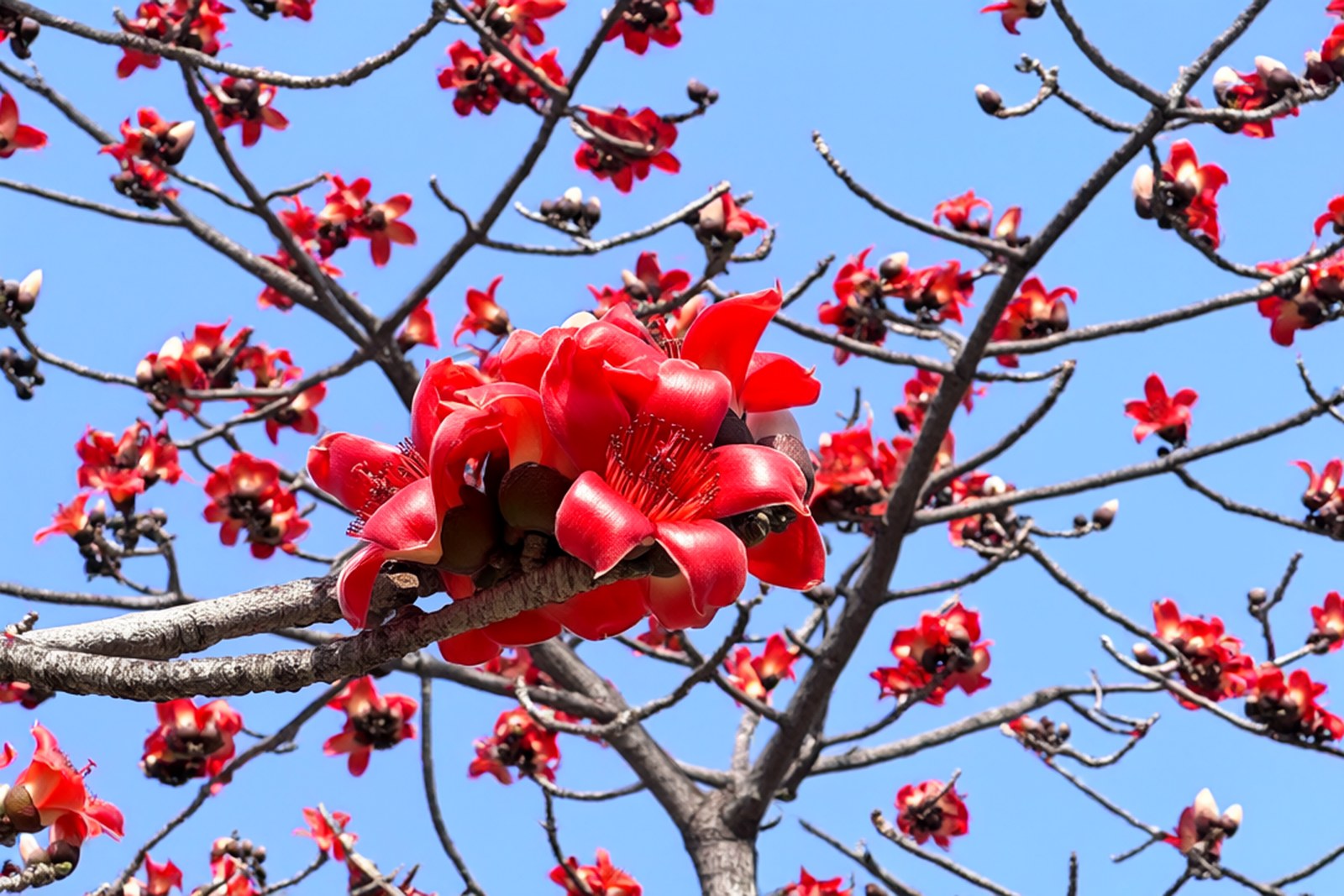
The title set off planting rather than resting. In 2015 the county put 750,000 yuan into raising 100,000 saplings for farmers to set out. The custom that explains the enthusiasm is a Li one, old enough that nobody dates it: when a child is born the parents plant a kapok tree on open ground and let the two grow up together. Tree and island go back further in writing than the custom – the Book of Later Han records the governor of Zhuya, the old name for Hainan, sending tribute of wide-width cloth, the Li weaving that kapok fibre fed. Botanically the kapok is built for this dry west coast, light-loving, drought-hardy and wind-firm; trees over a hundred years old still stand in ordinary fields, and the flowers dry into tea, soup and medicine.
The festival has two birthdays and both are official. The county’s own investment text says the first 昌化江畔木棉红 culture tour ran in 2012; People’s Daily’s overseas edition says the event was already on in 2011; neither gives way, so the honest phrasing is that the event has run since the early 2010s. From 2015 it grew into a full tourism month, and after ten-odd years it is the county’s leading card. The 2026 season opened on 6 February at the Changjiang culture park; a kapok new-year gathering runs 20 February to 3 March at the flower-viewing dock; and the eleventh national photography contest on the theme, with a bird-photography sister event, fills February and March.
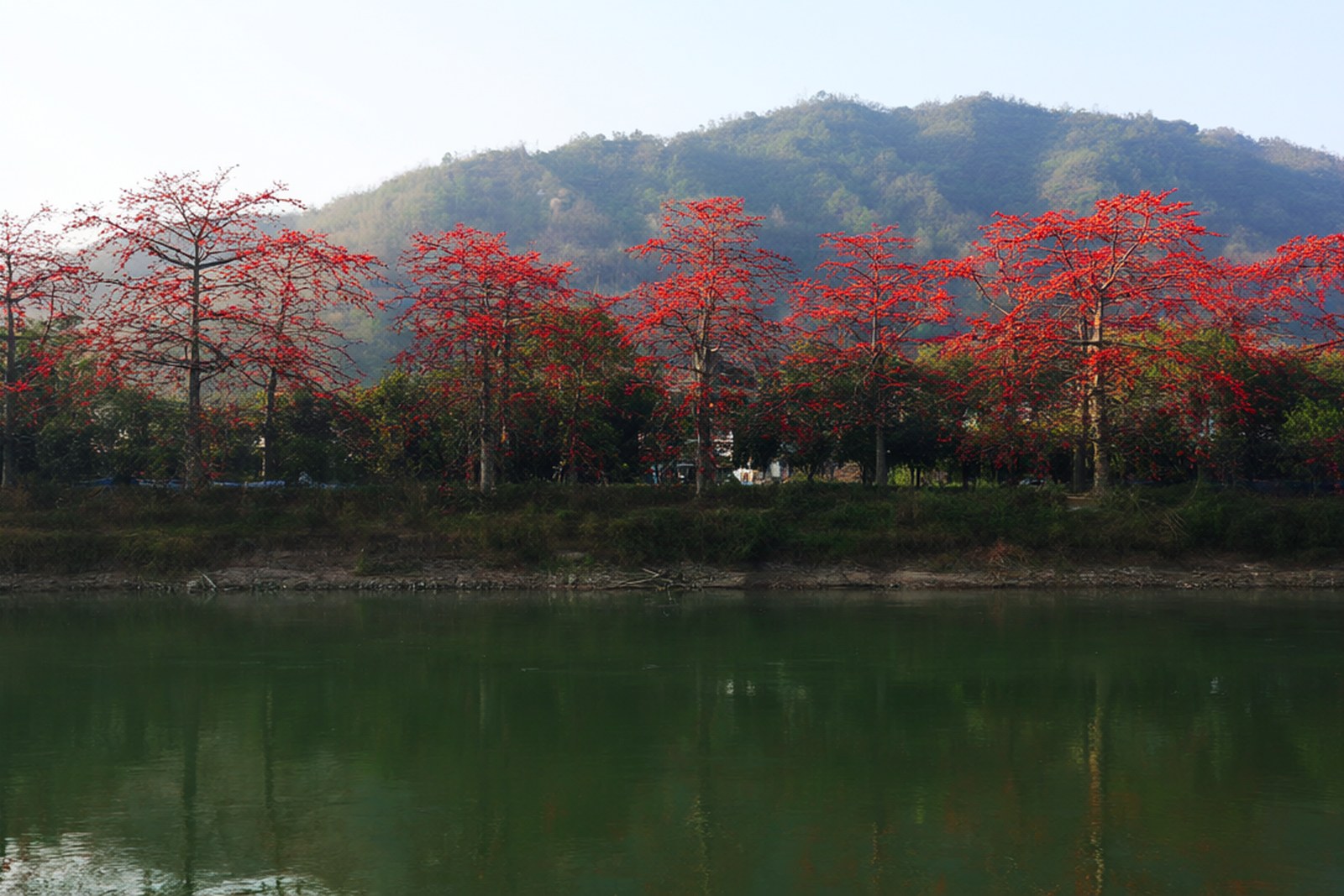
The county’s 2026 viewing map has an order to it. Wangxia blooms first, its trees opening from late January to mid-February – dozens of old kapok around the Emperor’s Cave, flowering against the karst, best photographed between seven and nine in the morning while the mist holds. The Changhua riverside flower-viewing dock at Qicha town, in the hamlet of 尼下村, opened for the season on 5 February 2026 with four sightseeing boats, three carrying twenty-six and one carrying fourteen, at 50 yuan a head, and three more boats planned; the official phrase for what they sell is red kapok against green hills. Baoshan’s terraces photograph best at dawn and dusk, when the red flowers stack against the green field-lines, and the Dazhang reservoir does the red-and-green pair at water level.
叉河镇排岸村 Pái àn cūn supplies the picture everyone wants: a train running through the flower sea. Mid-February is the window, the services cluster between ten and eleven in the morning, and the village has built a viewing platform with a marked safety zone – photograph the railway only from inside it, which is the one hard rule of the season. In 乌烈镇 the village roads at Egang, Baishi and Wulie itself are lined with nearly 60,000 kapok, a red corridor in full bloom in the second half of February. The season leaks across the county: kapok art installations stand at the Qizi Bay resort strip and at the mine park, the two high-speed stations run their flower give-away desks for arrivals, and the flower-sea homestays at Qicha village, Yaying village and the mining-town courtyard house are the county’s own 2026 pick of beds.
Practicalities
Tickets. The riverbank, the village viewpoints and the Wulie corridor are free and unstaffed. The one ticketed thing is the Qicha flower-viewing dock: 50 yuan a person for the river cruise in the 2026 season, on the county’s own February report, with the boat fleet set to grow. Checked on 30 September 2026; boats and fares are seasonal and will move.
Opening hours. Flower viewing keeps daylight hours, and the two best ones are early: the misted 07:00 to 09:00 window at Wangxia and the dusk light on the Baoshan terraces. The dock’s boats run through the season, and at Paian the train window is 10:00 to 11:00 in the morning – plan the day backwards from it.
Closing day. No closing day applies to any of the viewpoints; the riverbank is open ground. What closes is the season itself: the bloom runs January to March and the dock operates with it, so a June visit finds green trees and empty moorings.
Getting there. The viewing points are scattered across four towns, so self-drive is the practical answer: Qicha town for the dock and the terraces, Chahé town for the railway view at Paian, Wulie for the corridor, Wangxia for the earliest bloom, with the high-speed railway arriving at Qiziwan and Changjiang stations. In February the county’s own suggestion is one day that does Wangxia at dawn, the Bawangling forest at noon and the county town by dark.
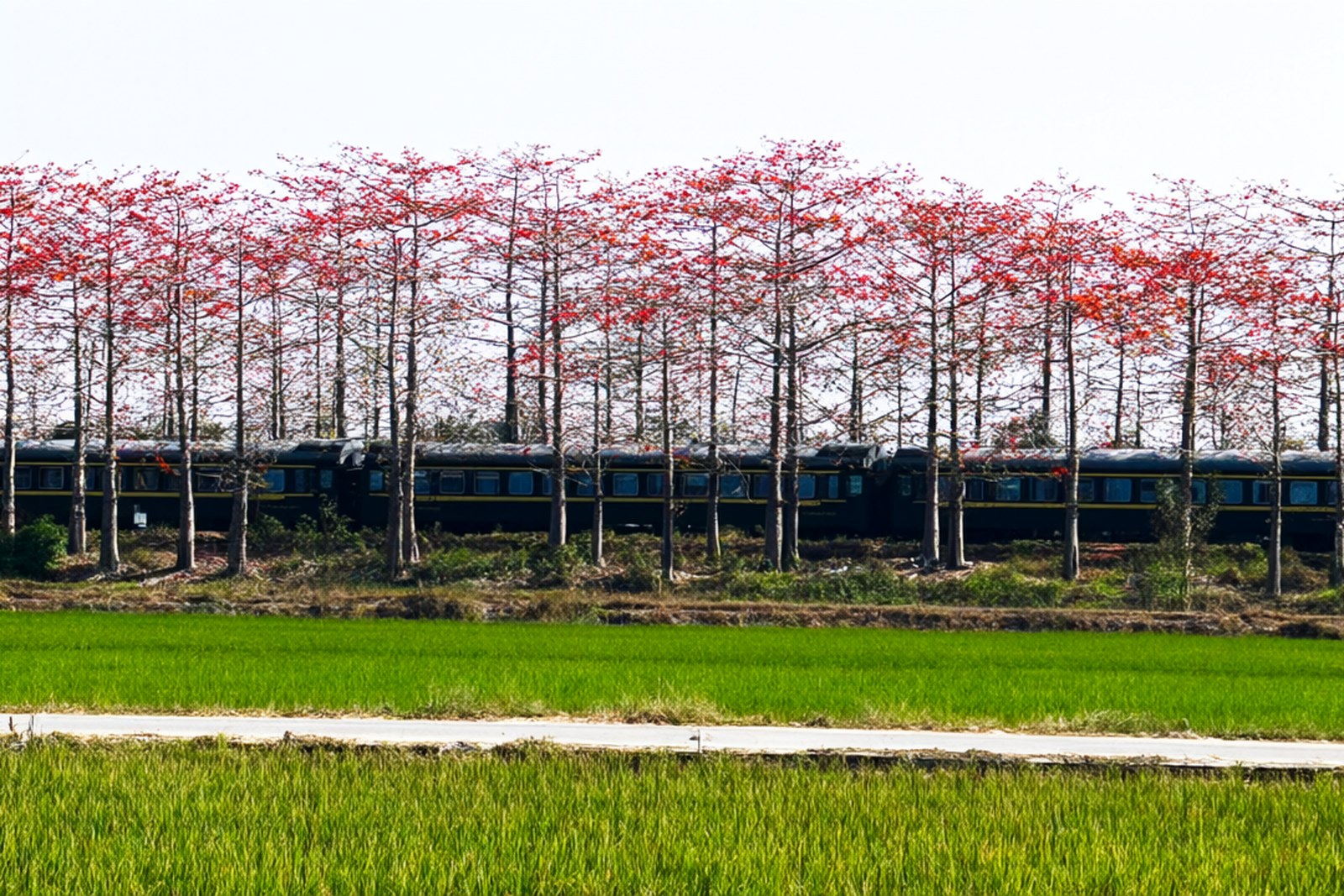
flowcloud would say that a flower season run on wild trees, planted trees and a train timetable is a rare kind of tourism – the spectacle is scheduled by the tree and the railway rather than by a marketing department, the best seat costs nothing but an early alarm, and the one thing the county really asks of you is to stand inside the painted safety line.
Getting there: the kapok season runs January to March along the 昌化江 in 昌江黎族自治县, centred on 七叉镇 – the flower-viewing dock at 尼下村 with 50-yuan boat trips checked on 30 September 2026, the Baoshan terraces, and the earliest bloom at Wangxia – with the rail-side flower sea at 排岸村 in 叉河镇 photographable in mid-February from the marked safety zone, the Wulie corridor of nearly 60,000 trees in late February, and access by car from Qiziwan or Changjiang station; the riverbank itself is free, open, and has no closing day.