
Six Hundred Years of Doorways: Getting Lost in the Lanes of Kashgar Old Town
土墙巷陌深,木门岁月长 Tǔqiáng xiàngmò shēn, mùmén suìyuè cháng – Earthen walls deepen the lanes; wooden doors hold the long years
正文:喀什古城 Kāshí Gǔchéng Kashgar Old Town spreads over the high ground east of the Id Kah square – several square kilometres of earthen lanes, overhanging balconies and carved doors where families have traded, baked bread and raised children for six centuries. This is the largest surviving mud-brick city in the world still fully inhabited, and the renovation of the 2010s – new foundations and utilities threaded beneath the old walls – left the street life intact. Turn off the main bazaar streets and within twenty metres the modern city disappears: only ochre walls, blue or green doors, the smell of bread from a tandoor, and a bicycle bell somewhere behind you.
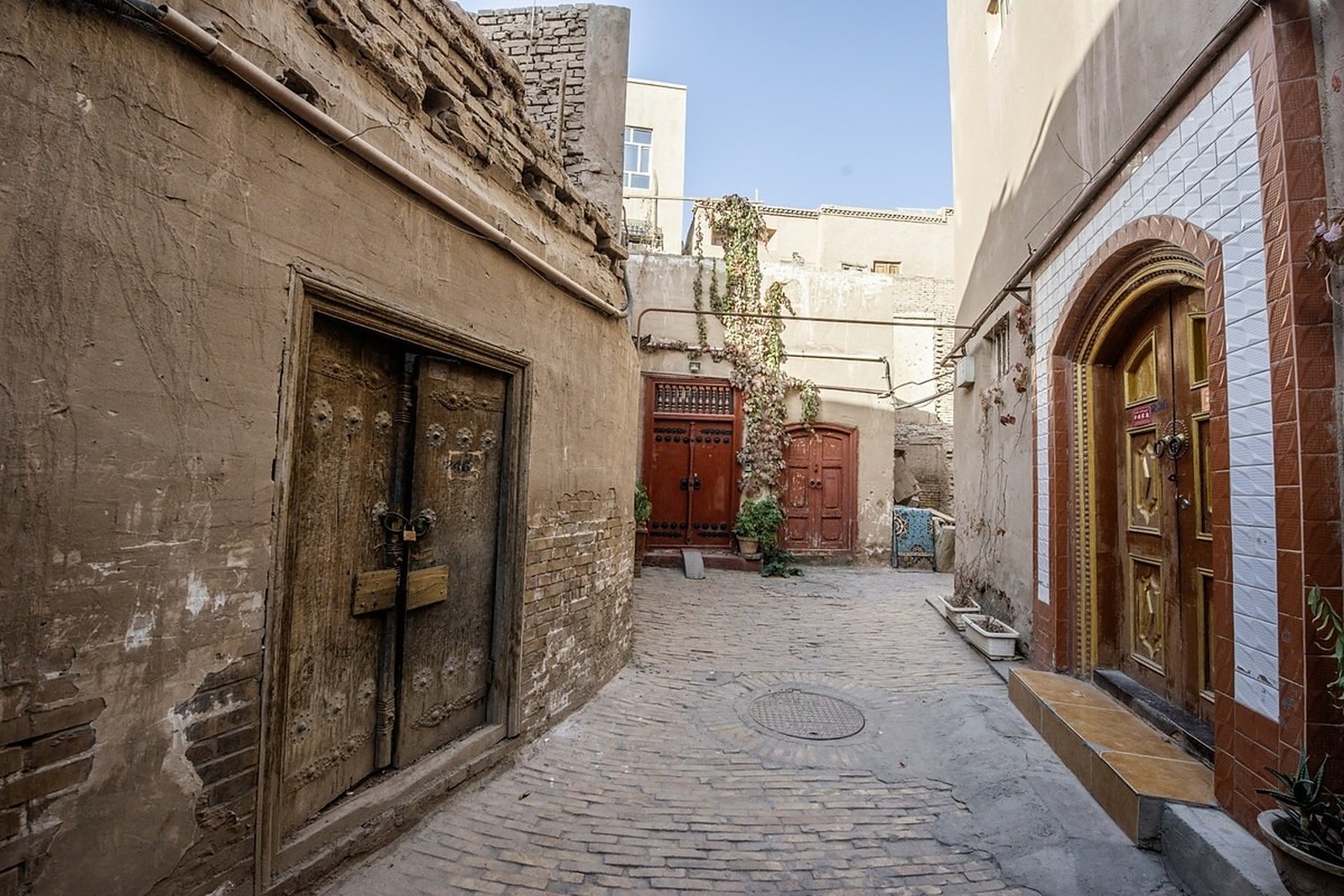
The lanes reward aimlessness. Some end at family courtyards where pomegranate trees lean over the walls; some climb stairs to hidden rooftop terraces; some pass workshops where a sixth-generation coppersmith works exactly as his ancestors did. The doors themselves are the museum – carved with grape leaves, painted mint-green or indigo, brass knockers worn silver by a century of hands. Locals say a Kashgar door tells the family’s trade and taste at a glance, and a slow walk becomes a reading exercise: the saddler’s door with a horse-head knocker, the musician’s with strings painted above the lintel.
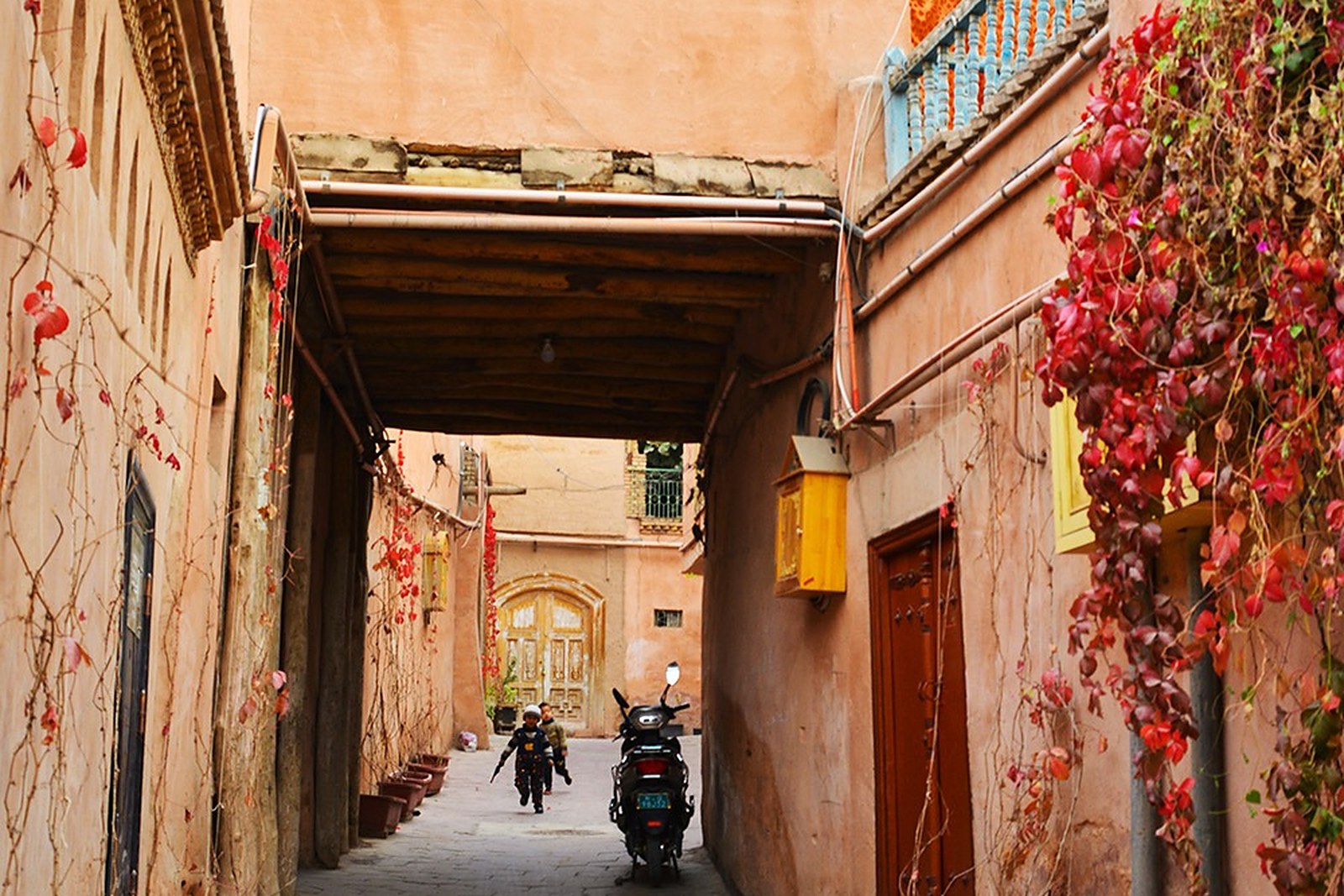
Morning is the old town’s best performance. Bread shops pull loaves from wall ovens at dawn; men carry brass ewers to the street taps for the ritual wash; children in school uniforms race the alley corners past doors that have opened to their grandparents’ footsteps. By mid-morning the craftsmen are at full volume – hammer on copper, saw on mulberry wood, the knife-grinder’s wheel singing – and the tea houses fill with an audience that treats conversation as the day’s main work.
The old town’s craft streets deserve a route of their own. The coppersmiths’ lane rings with hammers all day; the woodcarvers’ row shows the mulberry panels destined for new doors and balcony rails; the milliner and the bootmaker keep shops their great-grandfathers opened. A few workshops sell direct, most will show you the work unpriced, and the polite rule is the Kashgar rule everywhere: tea first, business later, no hurry. Prices are honest by market standards, and buying where the making happens is the surest way to carry home the real thing.
Children give the lanes their soundtrack. Kashgar’s old town remains a dense village pretending to be a city – grandmothers call cross-alley, neighbours borrow from neighbours, and a lost visitor is redirected in three languages by whoever’s doorway they stopped at. The community willed its own restoration: when the state rebuilt the quarter’s foundations, families chose their own facades and door carvings, which is why no two adjacent doors match and why the place still looks like itself.
Practicalities are few. Entry to the lanes is free – the ticketed points are individual sights such as the mosque and the high-platform houses on the eastern edge. Wear shoes with grip for the polished stone lips at doorways, keep a map app handy for the first hour, and accept one tea invitation at least. Morning and late afternoon give the best light on the ochre walls; noon belongs to bread ovens and shade.
Give the old town two half-days at minimum – one for the craft streets and one for pure wandering – and add an evening: after dark the lanes empty, the rooftop restaurants glow, and the quarter becomes the quietest big-city centre in Asia. This is the Kashgar that travellers describe for years afterwards.
What stays with most visitors is not any single building but the continuity: doors opened by hands, ovens fed every dawn, a city that rebuilt itself from its foundations without pausing its daily life. The old town is not preserved; it is practised – and you are welcome to watch.
Practicalities
Beyond the old town, the same 喀什地区 Kāshí Dìqū Kashgar Prefecture keeps more places worth the detour: 艾提尕尔清真寺 Ātígǎ’ěr Qīngzhēnsì the Id Kah Mosque at the centre, 香妃园 Xiāngfēi Yuán the Fragrant Concubine Garden to the northeast, 喀拉库勒湖 Kālākùlè Hú Karakul Lake on the high highway, or 牛羊大巴扎 Niúyáng Dàbāzhā the Livestock Bazaar on Sunday – four more doors into the same 喀什地区 Kāshí Dìqū Kashgar Prefecture. Once the lanes are seen, our Kashgar food map fills the day.
Practicalities
Words and Names
flowcloud would say Kashgar Old Town is a city that never stopped being itself: ochre lanes, carved doors and six centuries of neighbours who rebuilt their foundations without missing a morning’s bread – get lost early, and stay lost. All checked November 2026.
Getting there: The main visitor gate sits just east of the Id Kah square, reachable on foot from the centre or by any bus bound for Jiefang North Road; taxis from the railway station take about fifteen minutes. Enter in the morning when the light is low and the lanes are at their liveliest, and wander without a fixed route. All checked November 2026.