
可园 Kě yuán – the Keyuan Garden – stands at 32 Keyuan Road in 莞城 Guānchéng, the old core of Dongguan, a short walk from the shore of 可湖 Kě hú. It belongs to a famous quartet: with 清晖园 Qīnghuì yuán in Shunde, 余荫山房 Yúyìn shānfáng in Panyu and 梁园 Liáng yuán in Foshan it forms what the garden’s own museum prints as the four great classical gardens of Qing-dynasty Guangdong, better known in travel writing as the four great Lingnan gardens – a grouping this site has already met from the Foshan and Panyu ends, and their stories stay theirs. Keyuan is the smallest of the four, and the argument of this piece is that the smallness is the point: on three mu and three fen of ground – 2,204 square metres, the exact figure the official pages print – its builder fitted pavilions and terraces, halls and verandas, ponds, bridges, rockery and courtyards, and made them feel like a world.
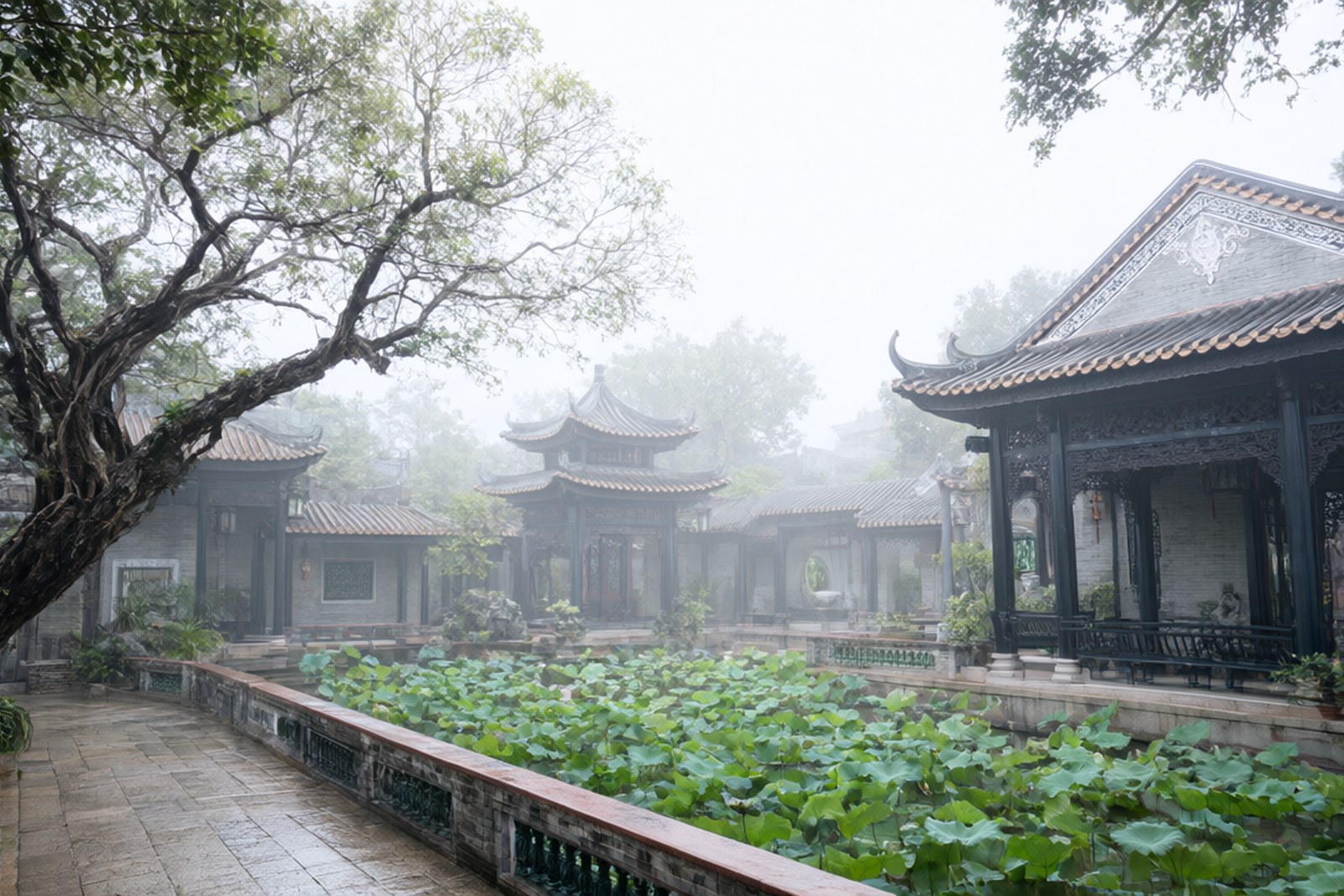
The builder explains the compactness. 张敬修 Zhāng Jìngxiū was a Dongguan man of the Buxia quarter and a soldier by trade, thrown up and down by a career the local histories summarise as three rises and three falls, ending with his posting as acting provincial administration commissioner of Jiangxi; he was also a practised hand at calligraphy, painting, the qin and verse, and the two characters over the main gate are his own brushwork, one stroke to each character. He began the garden in 1850, the thirtieth year of the Daoguang reign, and kept refining it for more than a decade. In June 2001 the State Council listed it in the fifth batch of national key cultural relics protection sites; the museum that now guards it – established in September 1998, its new hall opened in 2008 – holds a national second-grade museum rating and, in the city government’s 2017 register of scenic areas, a national 4A label.
The garden’s claim on art history runs through two guests. 居巢 Jū Cháo and 居廉 Jū Lián, counted as the precursors of the Lingnan school of painting, lived at Keyuan for some ten years, and here they developed their boneless wet method of charged water and charged powder – zhuàng shuǐ zhuàng fěn – for flower-and-bird painting; their students 高剑父 Gāo Jiànfù, 高奇峰 Gāo Qífēng and 陈树人 Chén Shùrén, the “two Gaoes and one Chen”, carried the method into the Lingnan school proper. The poets 张维屏 Zhāng Wéipíng and 郑献甫 Zhèng Xiànfǔ came to sing here in their day, and the seal carver 徐三庚 Xú Sāngēng taught in the garden – which is why a visit reads less like a stroll and more like opening a sketchbook that several generations never quite put down.
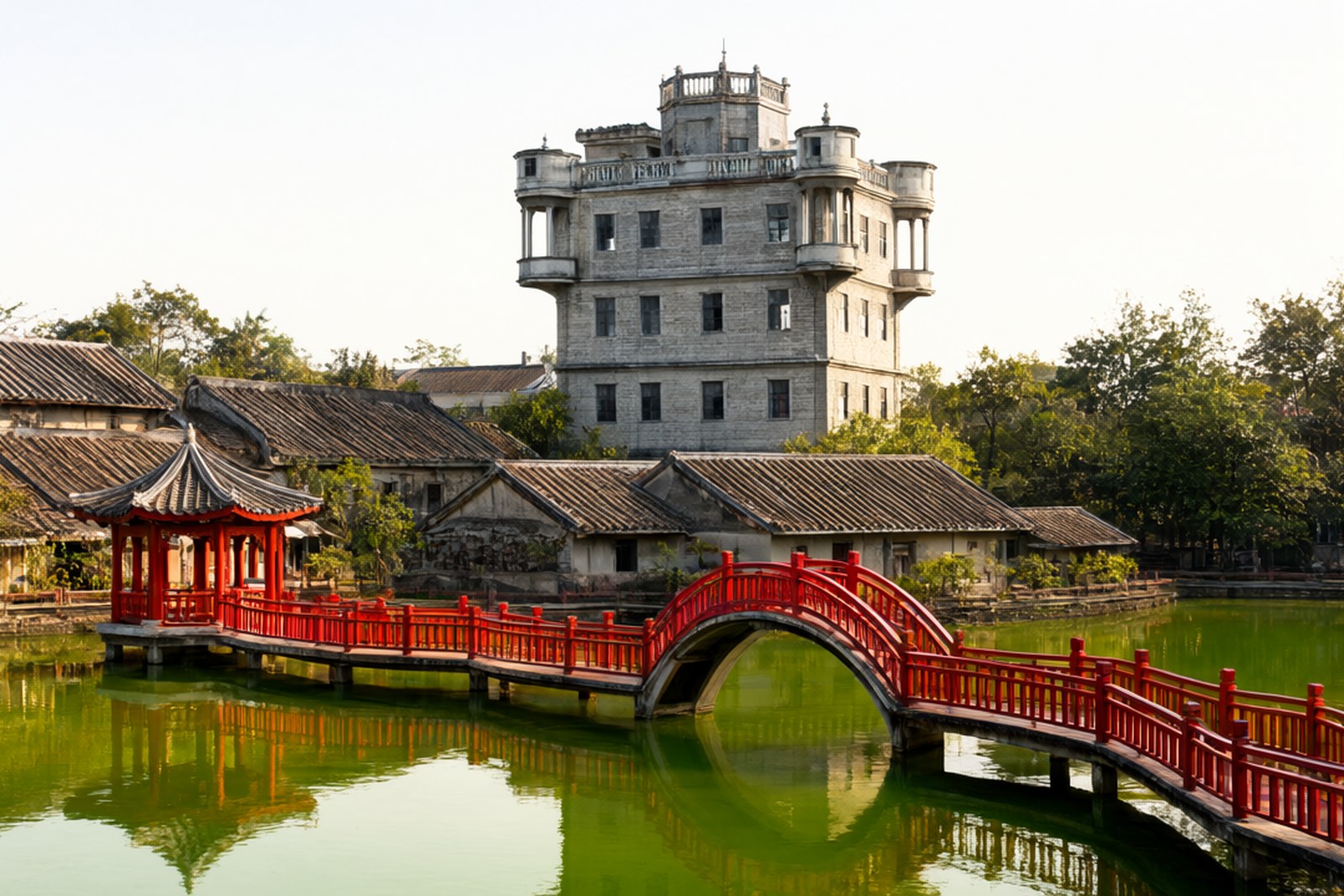
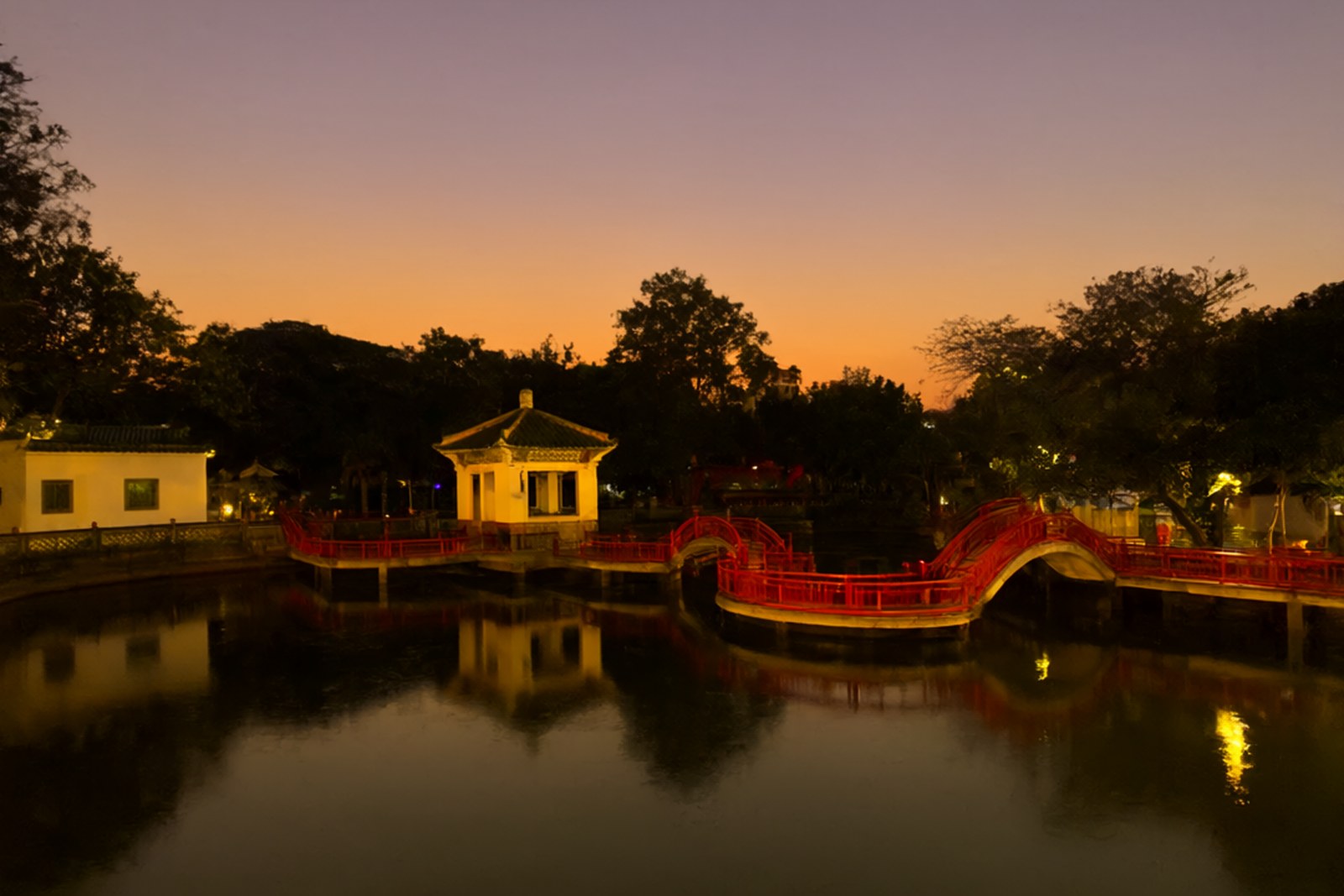
Inside the old garden the sights stack neatly. 邀山阁 Yāoshān gé, the tallest building, rises about 17.5 metres over four storeys, a fortlike tower named for inviting the hills in and the best vantage over the roofs; 可亭 Kě tíng waits on an islet reached by a zigzag bridge over the lake; 雏月池馆 Chúyuè chíguǎn, built against the water in the shape of a moored boat, is the local “ship hall”, its middle and upper window sashes made to fold upward; and 擘红小榭 Bòhóng xiǎoxiè keeps the gentlest story on the site – “bòhóng” means peeling a lychee, and the pavilion stood beside lychee trees where the host peeled ripe fruit for his guests under the August cicadas. 双清室 Shuāngqīng shì takes its name from the lotus-and-bamboo clarity of its setting; the 环碧廊 Huánbì láng covered walk links the compound; 可堂 Kě táng is the main hall; and the plainly named 草草草堂 Cǎocǎo cǎotáng was where the master painted and slept.
The new museum hall, on its 17,900-square-metre site, holds a collection of more than 10,000 objects and sets out three permanent exhibitions: Lingnan traditional gardens and dwellings, Ju Chao and Ju Lian and Keyuan, and Mo Bozhi and Lingnan architecture, honouring the Lingnan modernist architect. Its original shows took a provincial top-exhibition prize in 2025, and in 2022 a Mid-Autumn spectacle staged live in the old garden drew a reported five million online viewers – which tells you where this small garden sits in the city’s affection. Give the whole site an hour and a half to two hours. The sensible order runs the free museum hall first, then the ticketed old garden: the lychee pavilion, the green corridor, the Double Clarity Room, the main hall, up the Yaoshan tower, and out by the lake pavilion. The old town rewards the leftover time – the Senhui natural-history museum stands on the same road, and the arcade streets and the old Ying’en gate make an easy half-day of old Dongguan on foot.
Practicalities
Tickets. The two-zone split is the feature: the old garden costs RMB 8 and the museum’s comprehensive-hall zone is free all year; on statutory public holidays the old garden opens free as well – check the day’s notice. Minors aged 6 to 18 and full-time students pay half; small children, serving military and disabled visitors enter free, and seniors are covered by the official concession policy. Checked October 2026, subject to change.
Opening hours. 09:00 to 17:30 on ordinary days, 08:30 to 17:30 on statutory holidays and through the summer and winter school breaks, with last admission at 17:00. Older museum filings print different hours, so treat the garden’s current notice as final.
Closing day. Closed on Tuesdays – not Mondays – except on statutory public holidays. The museum’s own notice is unambiguous, and the contrast with the national habit of museum Mondays is the single most useful fact on this page: Keyuan opens on Mondays and rests on Tuesdays.
Getting there. Take metro line 2 to Tianbao station, exit D, and walk about ten minutes to the north gate; buses 4, 7, 22, L5A and X5 stop at the Keyuan stop, two minutes from the main gate. Drivers should navigate to the north gate and expect narrow old-town streets and tight weekend parking at about RMB 5 an hour. From the Guangzhou-Shenzhen-Hong Kong high-speed line, alight at Humen station and ride metro line 2 into town; Keyuan is the most transit-friendly of Dongguan’s headline sights.
flowcloud would say that Keyuan is the proof that a garden is measured by what fits inside it and not by how much ground it claims – 2,204 square metres, four storeys of tower, ten years of two painters, one Tuesday a week of rest – and that the smallest of the four great Lingnan gardens is the one that makes the other three feel spacious.
Getting there: 可园 Kě yuán stands at 32 Keyuan Road, Guancheng, Dongguan, Guangdong, about ten minutes on foot from Tianbao station on metro line 2 (exit D), with buses 4, 7, 22, L5A and X5 at the Keyuan stop; the old garden is RMB 8 and the museum zone free, hours 09:00-17:30 with last admission 17:00 (08:30 opening on holidays and school breaks), closed on Tuesdays except public holidays (checked October 2026, subject to change); from the high-speed rail, change at Humen station to metro line 2.