
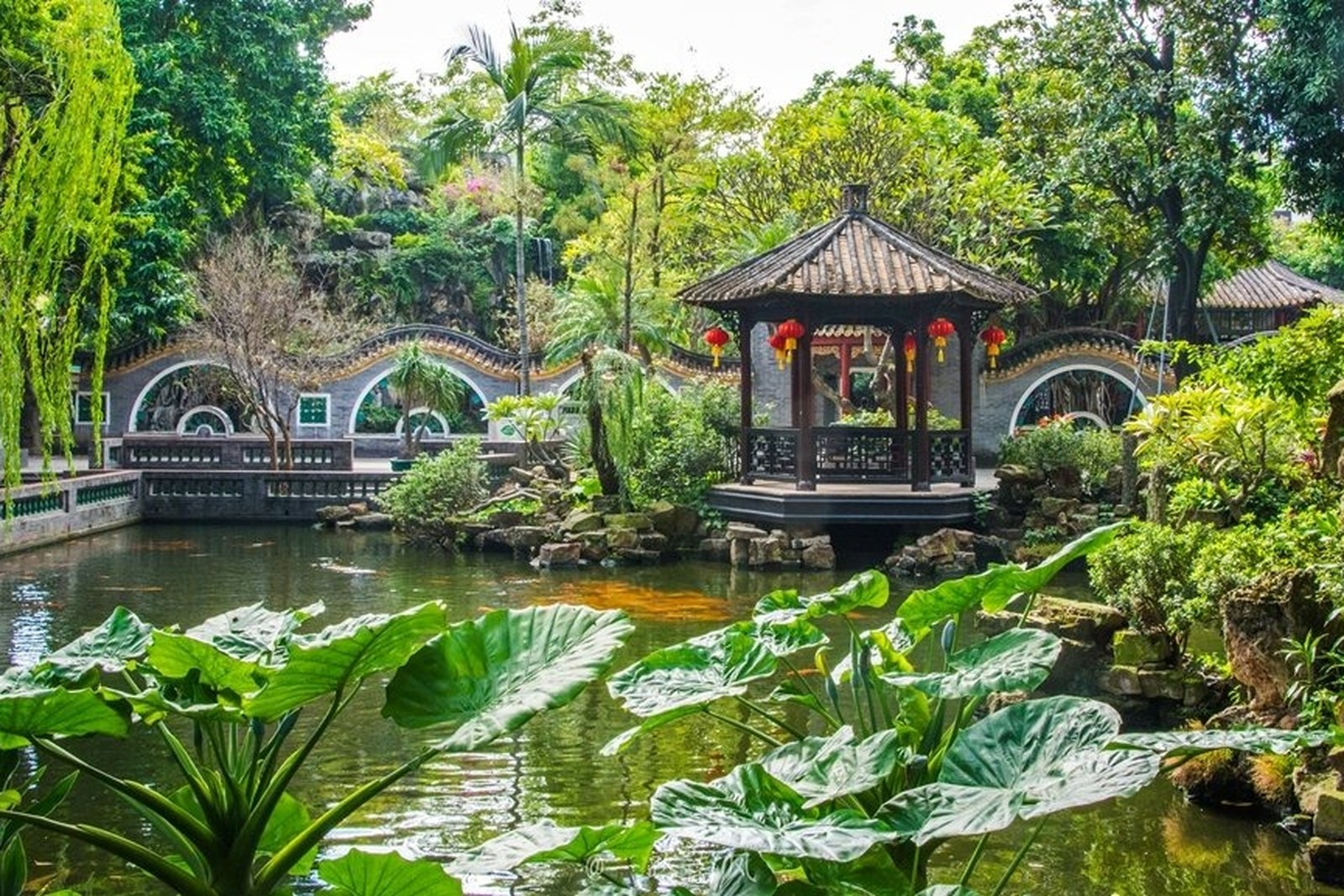
The pond comes first and everything else is arranged around it. 梁园 Liáng Yuán, the Liang Garden, is the smallest and least visited of the four great gardens of Lingnan, and it is the one that most rewards a slow hour. A Qing scholar’s garden in the middle of 佛山 Fóshān, it was laid out by the Liang family of calligraphers and painters in the early nineteenth century, and the plan is a compact sequence of courts and corridors around a central water surface: a hall for receiving guests, a library, a study for painting, a pavilion over the water, a rockery of local stone, and covered walkways threading between them so that the whole garden can be crossed without stepping into the rain or the sun. The scale is domestic. Nothing is grandiose, and almost every surface has an inscription on it.
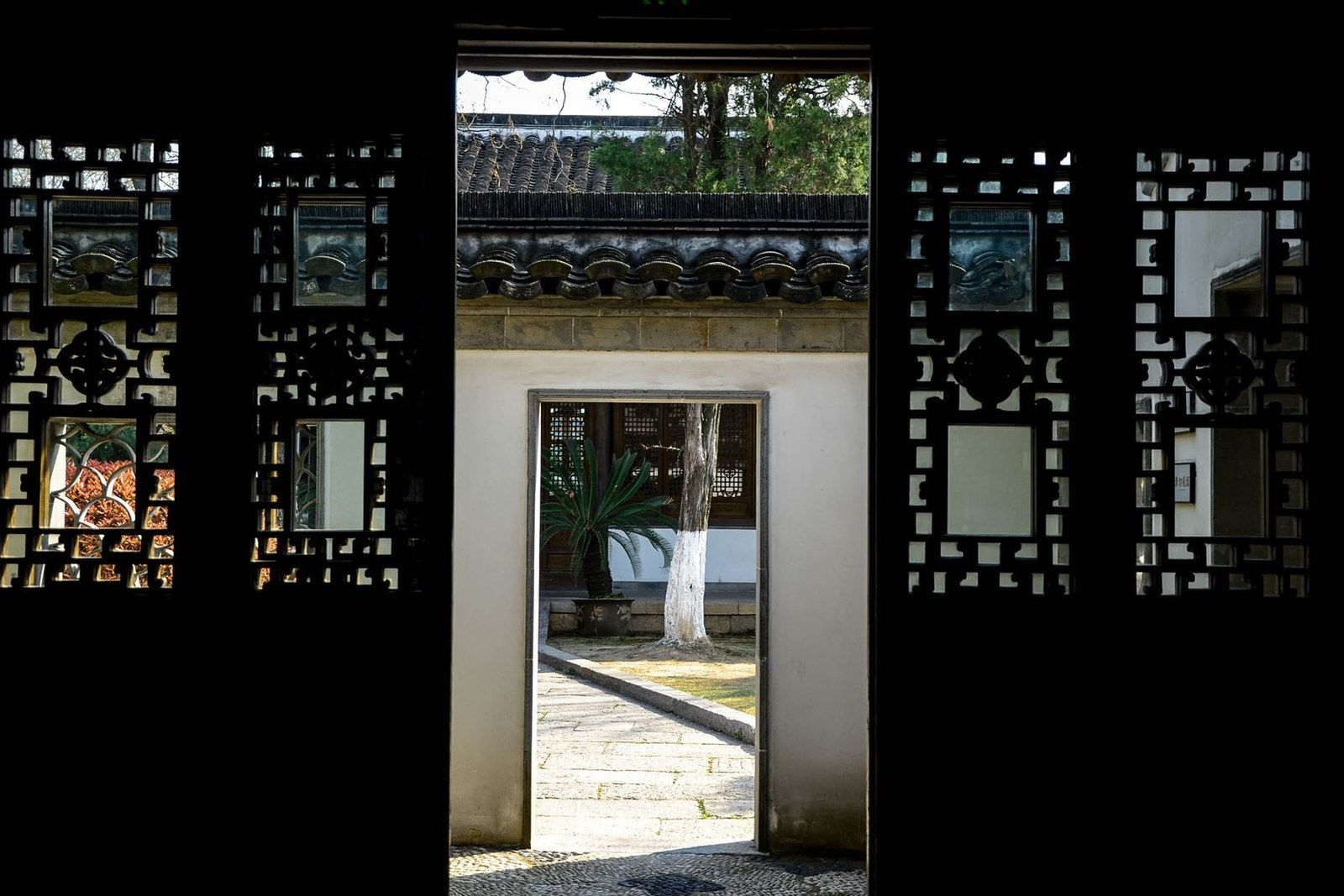
The garden’s interest is divided between its space and its surfaces. As space it is a textbook of Lingnan garden practice: the use of borrowed scenery, tight framing through doorways and lattice windows, changes of level disguised as natural, and the deliberate setting of the water so that a single pond reads as several. As surface it is a gallery, since the Liang family and its successors filled the halls with stone inscriptions, calligraphy, wood carvings and pieces of local ceramic. Much of the collection is displayed in the rooms around the garden, and the 十二石斋 Shí’èr Shí Zhāi, the twelve-stone studio named for a set of ornamental stones, is the most quoted of the spaces. The garden is small enough that a visitor who hurries will see nothing at all.
What You Actually See
The route is a loop rather than an axis, and the pleasure is in the alternation: a dark corridor opening onto the pond, a pavilion giving a different view of the same water, a window framing a single rock. Look for the windows and the doorways as compositions in themselves, since the Lingnan garden is built as a series of pictures and the frames are as deliberate as what they frame. The rockery uses local stone in a way that differs from the Taihu rocks of Suzhou, and the planting is southern: banana, bamboo, orchids and old trees rather than northern pine.
The other half of the visit is the collection, which is bigger than the garden suggests and includes stone and wood inscriptions, calligraphy by the Liang family, and examples of the region’s woodblock prints and ceramics. Because the house was a scholar’s, the arrangement is domestic rather than museological, and the rooms are furnished as studies and reception halls. Allow an hour and a half for the garden and the halls together, and rather less if the weather is bad and the garden courts are too wet to linger in.
Practicalities
Tickets. Admission is modest, generally around ¥10 to ¥20, with reductions for students, children and the elderly and free entry for young children. The price is set locally, so confirm at the gate. There is nothing further to pay inside.
Opening hours. The garden is generally open from about 09:00 to 17:00, with last admission in the afternoon. Because it is small and largely unlit, the interior rooms are best seen in the middle of the day, and the garden courts are best in the early morning before the light goes flat.
Closing day. The garden generally closes on Mondays, which is worth checking before making a special trip, and it is open daily during public holidays. It is one of the quietest sights in the city and rarely crowded except during 春节 Chūnjié and the 国庆 Guóqìng week.
Getting there. The garden is in 禅城 Chánchéng, the old core of 佛山 Fóshān, about ten minutes on foot from 祖庙 Zǔmiào and the same metro station, which puts it on the Guangzhou-Foshan line and makes it easy to combine with the temple and the old lanes in a single day. 佛山站 Fóshān Zhàn is about twenty minutes away by taxi, and 广州南站 Guǎngzhōu Nán Zhàn around forty minutes by metro and taxi. Parking in the old streets is limited.
flowcloud would say that the Liang Garden is the clearest argument that a garden is a way of arranging views rather than a collection of plants, since half of what you see from any point in it is another part of the same small pond.
Getting there: early, on a weekday, and with an hour and a half rather than half an hour. Take the loop in one direction and then reverse it, because the garden is designed so that the same water looks different from the other side, and read the inscriptions on the walls of the halls rather than only the ones on the garden stones, because the scholar’s collections are half the visit.