
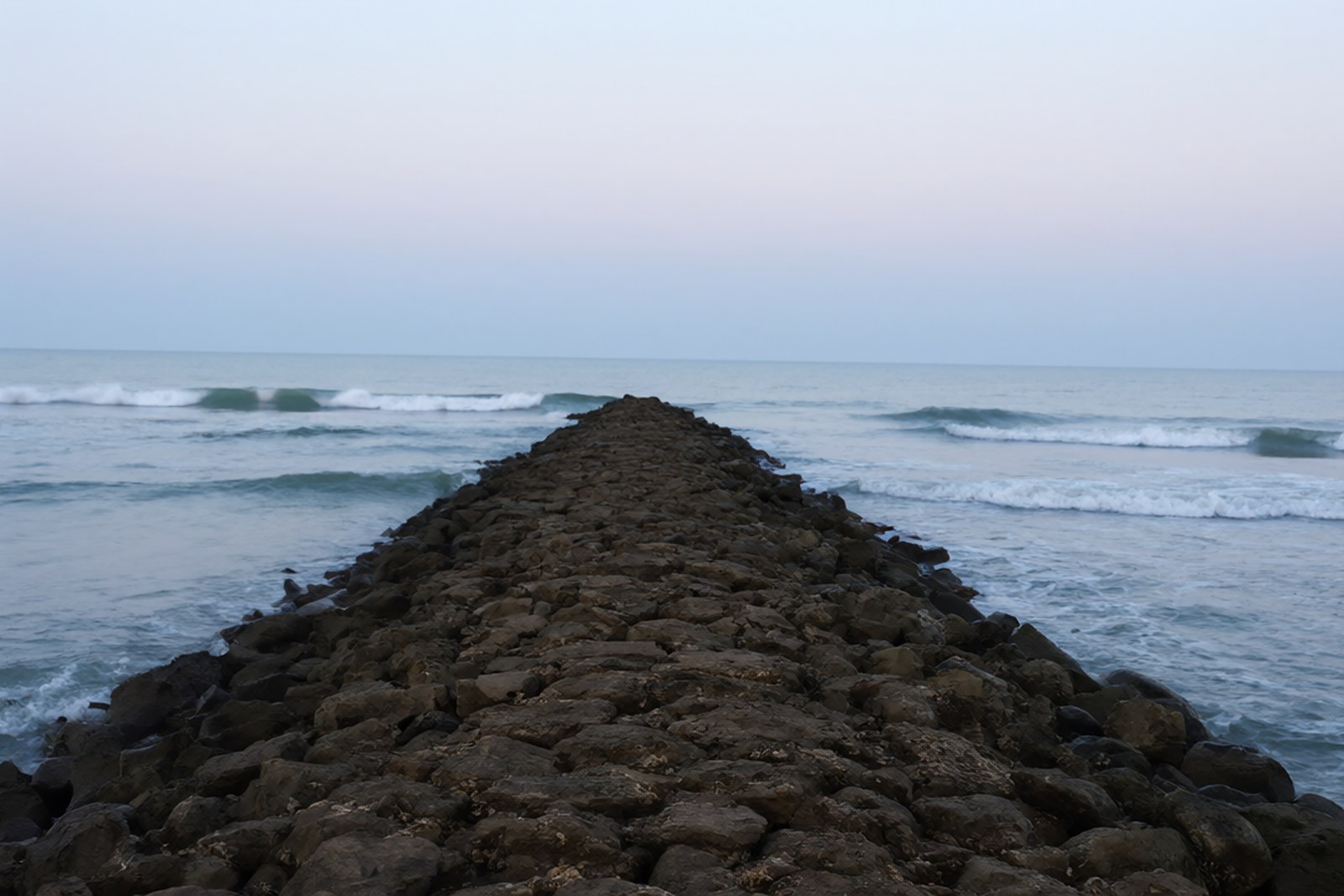
Lingao Cape Lín gāo jiǎo is the blunt northwestern corner of Hainan, a promontory pushed out into the Qiongzhou Strait Qióng zhōu hǎi xiá where the island faces the Leizhou Peninsula Léi zhōu bàn dǎo across the water and the Beibu Gulf Běi bù wān opens away to the west. It sits at the northern end of Lingao county Lín gāo xiàn, ten kilometres from the county town by the shortest road, and it is the one place in the county where the land is surrounded by sea on three sides. Seven kilometres of coast wrap the point. At the tip a natural rock dike runs 250 metres straight out into deep water, a low grey spine of stone laid by the tide; locals have called it 仙人指路 Xiān rén zhǐ lù, the immortal pointing the way, for as long as anyone has been writing things down, and the classic thing to do here is walk out along it at dawn and watch the sun come up out of the strait. Behind the dike a kilometre of beach runs east and west, and its two halves behave as though they belonged to different islands: the eastern side is flat-bottomed, calm and clear over white sand, the western side rolls and breaks in long white strings of surf. The old name for that western water is 南海秋涛 Nán hǎi qiū tāo, the autumn swell of the South Sea, one of the eight classical views of Lingao, and it is the phrase generations of local poets reached for when they wanted to describe home.
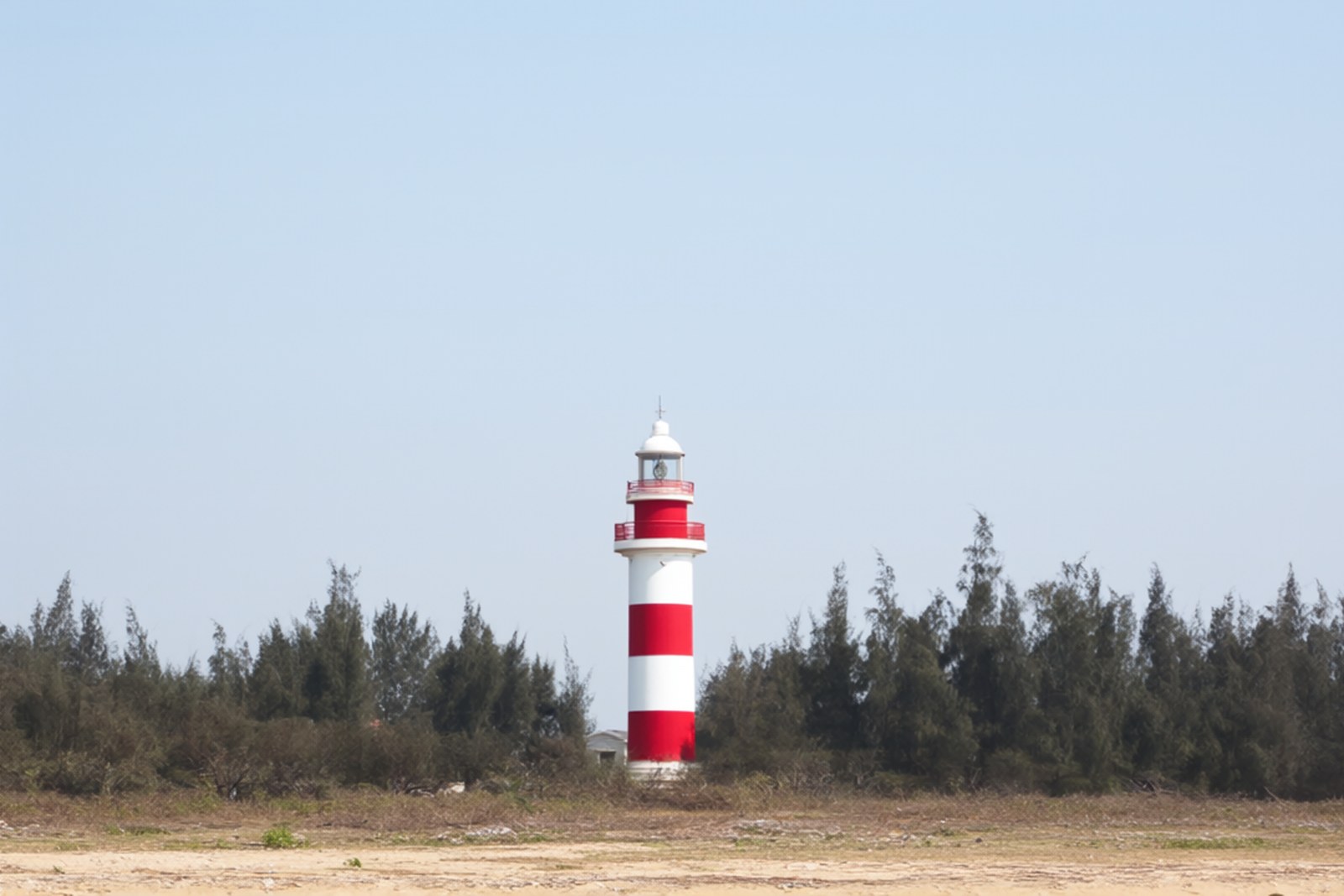
The lighthouse that gives the cape its silhouette is a tapered iron tower in broad red and white bands, the old scheme that lets a watch read a tower against a hillside at distance. Its date is not quite settled. The standard Hainan gazetteer and several Hainan Daily pieces put the tower at 1893, in the nineteenth year of the Guangxu reign Guāng xù, when the Qiong Customs Qióng hǎi guān built a 22-metre steel tower on the point. National broadcasters, the Xinhua English service and People’s Daily’s Hainan desk all say 1894, and call it the earliest modern lighthouse surviving on the island. The compromise recorded in the national protection listing, announced by the State Council, is that the site was surveyed and enclosed in 1893 and the tower was finished in 1894, and that is the version this piece leans on while naming both. The builder is disputed the same way. Hainan sources credit the Qiong Customs; People’s Daily’s Hainan desk and China Water Transport credit a French designer; a note in the provincial cultural relics record describes foreign powers using the customs house as cover, with a British national, F.S. Uwin, serving as customs commissioner and 6.8 hectares at the cape enclosed on 21 May 1895 for the tower and three office buildings. The safe reading is that the tower was put up by the customs service, which was then in foreign hands, to control the Qiongzhou Strait, and that British and French interests were both in it. The height is given variously too: 22 metres is the figure used most often, 20.6 metres appears in the protection listing, 21 metres in the relics record and 28 metres in a 2003 county document. The optic throws 18 nautical miles, which is the figure the mainstream sources agree on, though one encyclopaedia entry claims nine and no other source supports it, so treat that as an error rather than a variant. The inside is a spiral of 82 steps no wider than one person, carried on 350 steel rods.
The tower’s paper trail is unusually dense for a building this far from anywhere. After 1912 it stayed in customs hands, was taken by the Japanese occupation in 1939, and passed in 1950 to the Ministry of Transport, in 1953 to the navy, in 1980 back to the ministry, in 1988 to Hainan’s maritime safety administration and today to the navigation guarantee centre of the South China Sea, whose Haikou aids office keeps it lit. In May 1997 the International Association of Marine Aids to Navigation and Lighthouse Authorities, IALA guó jì háng biāo xié huì, listed it among one hundred historic lighthouses of the world; a picture album followed in 1998, and in May 2002 the state post office put it on a set of stamps devoted to historic lighthouse relics. Restoration on the principle of repairing the old as old began in 2009 from the original photographs; in November 2011 eight engineers from a Shanghai lighthouse factory moved the 500 mm bull’s-eye rotating optic that had been in the Xiuying tower into this one and replaced the sheet-metal lamp housing with the original glass. A small museum opened in the European-style keeper’s house in December 2012, and on 1 December 2023 the tower itself was opened to the public free of charge. The highest honour came later: in December 2024 the IALA transitional council, meeting in Paris, approved Lingao as its heritage lighthouse of the year for 2025, and on 8 July 2025 the association’s secretary general, Francis Zachariae, came to the cape to hand over the designation in person, with a seminar on lighthouse conservation following in Haikou and more than thirty delegates from Singapore, Malaysia, Japan and Korea in the room. It was the first Chinese lighthouse to take the award since it was created in 2019. On the protection ladder the tower was listed by the county in 1999, by the province in 2009 and by the State Council in May 2013 in the seventh batch of national key cultural relics; promotional writing that says 2010 does not match the State Council’s own announcement and is best treated as an error. Two keepers belong to the story. Wang Guangmin Wáng Guāng mín, a fisherman who took the job after 1949, kept the light for 33 years and retired in 2003; his son Wang Jian Wáng Jiàn took over that year, and between them the family has held the tower for more than fifty years, a span People’s Daily’s Hainan desk rounded to 52 in 2021. Wang Jian washes the tower inside and out with fresh water, wipes the bull’s-eye lens with soft leather, and climbs the 82 steps two or three times a day to do it.
The reason the cape is a place of pilgrimage and not only a viewpoint is what happened off it on 17 April 1950. On 18 December 1949 Mao Zedong ordered the Fourth Field Army to prepare the 43rd and 40th Armies for the crossing to Hainan. The island was held by Nationalist forces under Xue Yue Xuē Yuè, about a hundred thousand men with more than fifty vessels, twenty-five combat aircraft and twenty transports, arranged as a land, sea and air defence line that the general named the Bailing Line Bó líng fáng xiàn after his own courtesy name. Between 5 and 26 March 1950 the assault force made four night crossings in two waves and put more than 8,500 men ashore, though a county account gives seven thousand-odd for the same two waves. The main crossing left at dusk on 16 April: the 40th and 43rd Armies together, more than twenty-five thousand men in over 380 sailboats, rowing south from the southern tip of the Leizhou Peninsula. A Xuwen county account is more precise about the western group, putting 18,700 men of the 40th Army under Han Xianchu Hán Xiān chǔ into 245 wooden sailboats at Jiaowei Cape Jiào wěi jiǎo, also called Dengloujiao, at seven in the evening. In the small hours of 17 April the landing began along the coast from west of Haikou to the cape itself. Six regiments of the 40th Army, more than 18,700 men, came ashore around Lingao Cape while two regiments of the 43rd Army landed at Yubao harbour in Chengmai county, and by about six in the morning both wings were on the island. Hainan was declared liberated on 1 May. The crossing distance is sometimes given in visitor material as twelve nautical miles, but no authoritative source for that number could be found, and it is best treated as local telling rather than record. What is documented is the last hundred metres: a veteran of the 354th Regiment recalled that the lead boats grounded fifty or sixty metres out, that the men dropped into chest-deep water and pushed for the beach, and that where the wire was not yet cut they lay down as a human ramp so the next man could cross over their backs.
Casualty figures need the same care. The county’s own tourism pages say that more than 880 men of the 40th Army died in the fighting and that the army’s 119th Division lost its deputy commander, Huang Changxuan Huáng Cháng xuān, who is buried in Lingao. The provincial government, quoting a regimental commissar who was there, says more than 400 officers and men died at the cape alone. The two numbers are not in conflict so much as differently scoped: one is the army’s loss across the whole campaign, the other is a single morning on a single beach. What stands on the ground now is mostly modern, and it is arranged along one axis. The sculpture known as the Monument of Blood and Fire Rè xuè fēng bēi was begun on 17 April 1995, the forty-fifth anniversary, after a provincial fundraising drive launched that February raised more than 5.2 million yuan. It is a granite group eighteen metres high, a PLA soldier with his rifle raised beside a fighter of the Qiongya Column Qióng yá zòng duì holding up a red flag, the flag standing for the twenty-three years the column kept its colours flying, 1926 to 1950. On the front of the base is an inscription by Jiang Zemin and on the back a short account of the campaign. The memorial garden broke ground in September 1995 and was finished in October 1996, with 6,660 square metres of ground and 1,580 of buildings, and was named a provincial patriotism education base in 1997. A stele to the fallen of the 40th Army cost 360,000 yuan and was unveiled in May 2008, and there is a second one to the 40th and 43rd Armies together. The county built an 86-mu park here in 2006, and at the end of 2020 the complex was renamed Hainan Liberation Park Hǎi nán jiě fàng gōng yuán; the sources give November, December and 31 December of that year, so the safe formulation is the end of 2020, and it is the only liberation park in the province. A push to grade the site began in 2020 and the national AAAA plaque was unveiled on 1 July 2022, making it Hainan’s second four-A red scenic area after Muruishan and the first four-A site of any kind in Lingao. Inside, the museum runs to about 3,000 square metres over five sections from the southward march to the victory, with more than 260 objects and 300 photographs, bronze casts of the hands and feet of surviving soldiers and boatmen, and a reconstruction of the seasickness training on the north shore of the strait where visitors can try the swing, the raised platform, the deck and the oar. An earlier 2019 description lists 21 scenes, five multimedia presentations, 72 photographs and 330 objects, which reflects the galleries before the upgrade. Archaeology on the site has recovered and restored a watchtower and bunkers. Between 2021 and 2022 the park received 573,724 visitors, 2023 passed 480,000, more than ten thousand came on a single day during the 2024 Spring Festival, and local tourism figures put the recent annual figure above 500,000, with the cape generating close to twenty million yuan of extra income for nearby guesthouses and farm restaurants in 2024. Visitors sometimes call it China’s Normandy, which is a tourist’s phrase rather than an official one.
Practicalities
Tickets. There is no charge. The cape and the park are one continuous site and admission is free, with no ticket office on the gate and parking laid on; several Chinese travel platforms list the whole area explicitly as free to enter. The lighthouse has been open to visitors free of charge since 1 December 2023. The museum inside the park is also free, which is worth saying out loud, because it is a national AAAA site with a 3,000 square metre gallery.
Opening hours. This is the one place where the sources disagree and it matters. Travel platforms describe the park and the cape as open around the clock, every day of the year. Visitor write-ups describe the park and its museum as opening from 09:00 to 17:00 Tuesday to Sunday, with the last admission at 16:30 and the whole thing shut on Mondays except public holidays. The honest way to plan is to assume the sea wall, the beach and the monuments are always open and to treat the museum as a separate building on its own posted schedule; check the museum’s notice board or ask at the gate on the day rather than trusting either version. No official telephone number or booking channel is published for the park, so there is nobody to ring in advance.
Closing day. No closing day is reported for the cape, the sea wall or the memorial grounds, which are open every day of the year including public holidays. The museum, if it follows the hours in the visitor accounts rather than the round-the-clock listing, is the only part of the site that closes, and then only on Mondays outside holiday periods.
Getting there. The cape is about ten kilometres from Lingao county town, and eleven by the slightly longer road some sources measure. One travel guide sends bus route 6 to a stop at the liberation park, another sends route 3 to a Lingao Cape stop for two yuan and about twenty minutes, and no official route announcement could be found for either, so check the number locally before you set out. Driving from the county government offices takes about 13.3 kilometres and twenty-two minutes, and a 2,452 metre access road along the coast, built between August 2019 and May 2020 for 36.35 million yuan, now links the park to the seafront road, which makes the last stretch simple. Links by road to the west-line liaison headquarters at Duoxian village in Bolian town, the martyrs’ monument in front of Lingao Middle School, and the cemeteries at Lanchenpo and Toubaipo make a half-day circuit by car.
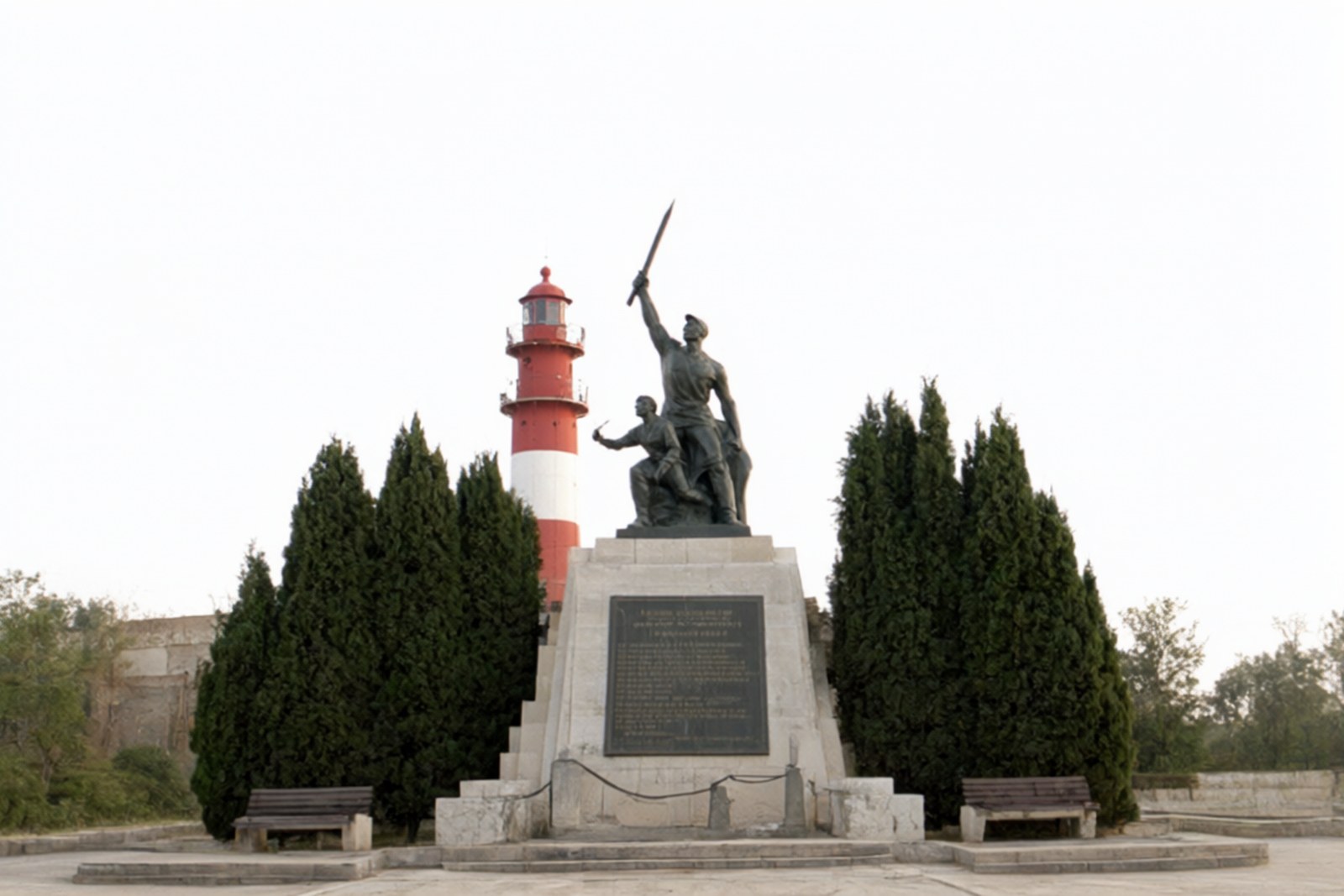
Walk the cape in the right order and the two halves of its story face each other. From the dike the tower is a red and white exclamation mark against the strait, with the pockmarks people read as shell holes in its ironwork; a hundred metres back the granite carries two figures upward, one with a rifle and one with a flag raised. The county’s own description calls the alignment of beacon, monument and martyrs’ stele a conversation across a century, and the staging earns the phrase. The best hour is early, when the tide is low, the eastern beach is a mirror and the light comes up behind the strait rather than over the water. Bring water and a hat, because the point has almost no shade, and give the museum an hour if it is open, if only to stand in front of the bronze hand and foot casts of the boatmen who rowed into that surf.
Getting there: Lingao Cape is roughly 10 to 11 km north of Lingao county town, reached by the coastal access road built in 2020; buses have been reported on routes 3 and 6 but no official route notice exists, self-driving takes about twenty minutes, and the grounds stay open when the museum does not.