
The Lingao Confucian Temple, the Island’s Oldest Hall of Letters
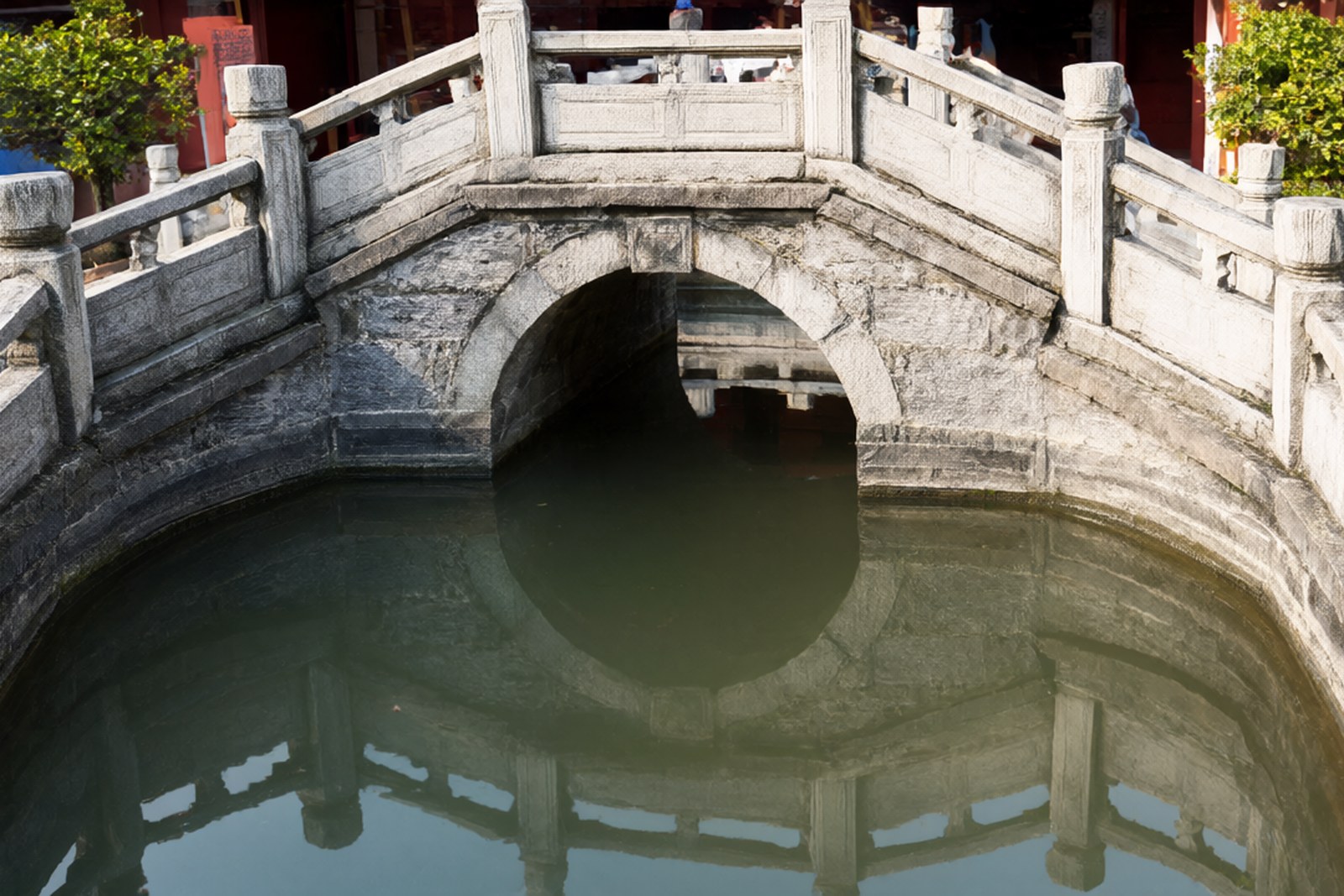
The Confucian temple of Lingao stands a hundred metres back from the north bank of the Wenlan River Wén lán jiāng, in the middle of the county town of 临城 Lín chéng, behind a plain white walkway that gives nothing away. Then the wall arrives: red plaster under grey-green roof tiles, and inside it the whole apparatus of a Chinese academy, in the wrong place and the right one. Its full name is 临高大成至圣先师文宣王庙 Lín gāo dà chéng zhì shèng xiān shī wén xuān wáng miào, which translates as the Lingao Temple of the Great Accomplishment, the Perfect Sage and First Teacher, the King of Literary Display, and almost nobody uses it. In Chinese the place answers to four different names depending on which century you are standing in: 孔庙 Kǒng miào, the temple of Confucius; 圣殿 shèng diàn, the sage’s hall; 儒学 rú xué, the Confucian school; and 学宫 xué gōng, the hall of learning, which is what it was called once the Ming and Qing merged the shrine and the academy into one compound. That drift of names is the building’s real biography. County sources and the provincial media call it the most complete, largest and oldest surviving complex of its kind in Hainan, and on the evidence of the dates that claim is not hard to defend. You come in through the ceremonial gate, cross a stone bridge over a semicircular pond, and there are ten coconut palms standing in two rows, straight as columns, which sounds like a detail until you notice how much they do for the proportions.
The founding date is where the records start to disagree, and the disagreement is interesting rather than annoying. One line of sourcing says the temple was built by imperial order in the Qingli period of the Northern Song Běi sòng, roughly 1041 to 1048, which would make it more than nine hundred years old and the earliest such foundation on the island. Another says it was first built at the present site on the Wenlan in the second year of Shaoxing in the Southern Song Nán sòng, which is 1132, and destroyed under the Yuan. A third says it was moved to the present site during the Shaoxing era without fixing a year. The national encyclopaedia entry manages to hold the first two at once, listing the Qingli foundation and the 1132 move in the same article, and that layering is probably the truth of it: an academy first, a temple on this bank later, one building carrying two origins. What is not disputed is the reconstruction. Destroyed in the Yuan, it was rebuilt on the old footprint in 1370, the third year of Hongwu in the Ming Míng hóng wǔ, and from then on magistrates in both dynasties kept raising money to repair it. The most vivid episode is the Republican-era rebuild, when a local gentleman named Tan Mingluan Tán Míng luán took a few dozen men through the villages and market towns to collect subscriptions; a stone tablet in the compound records 1,468 donors and 8,768 silver dollars, with the largest single gift at eighty. That ledger survives as the building’s most human document, a county temple paid for a dollar at a time. The Japanese occupation did heavy damage, systematic restoration with central and provincial money began in 1992, the complex was listed as a provincial protected site in 1996, and further conservation works were licensed in 2023. The size of the thing depends on which part is being measured: the provincial gazetteer gives the Great Accomplishment Hall 4,600 square metres, the same encyclopaedia entry gives 3,188 square metres for the restored compound and 1,320 square metres of floor area elsewhere in its own text. Treat the range rather than the number, and read 4,600 as the hall and its platform rather than the whole site.
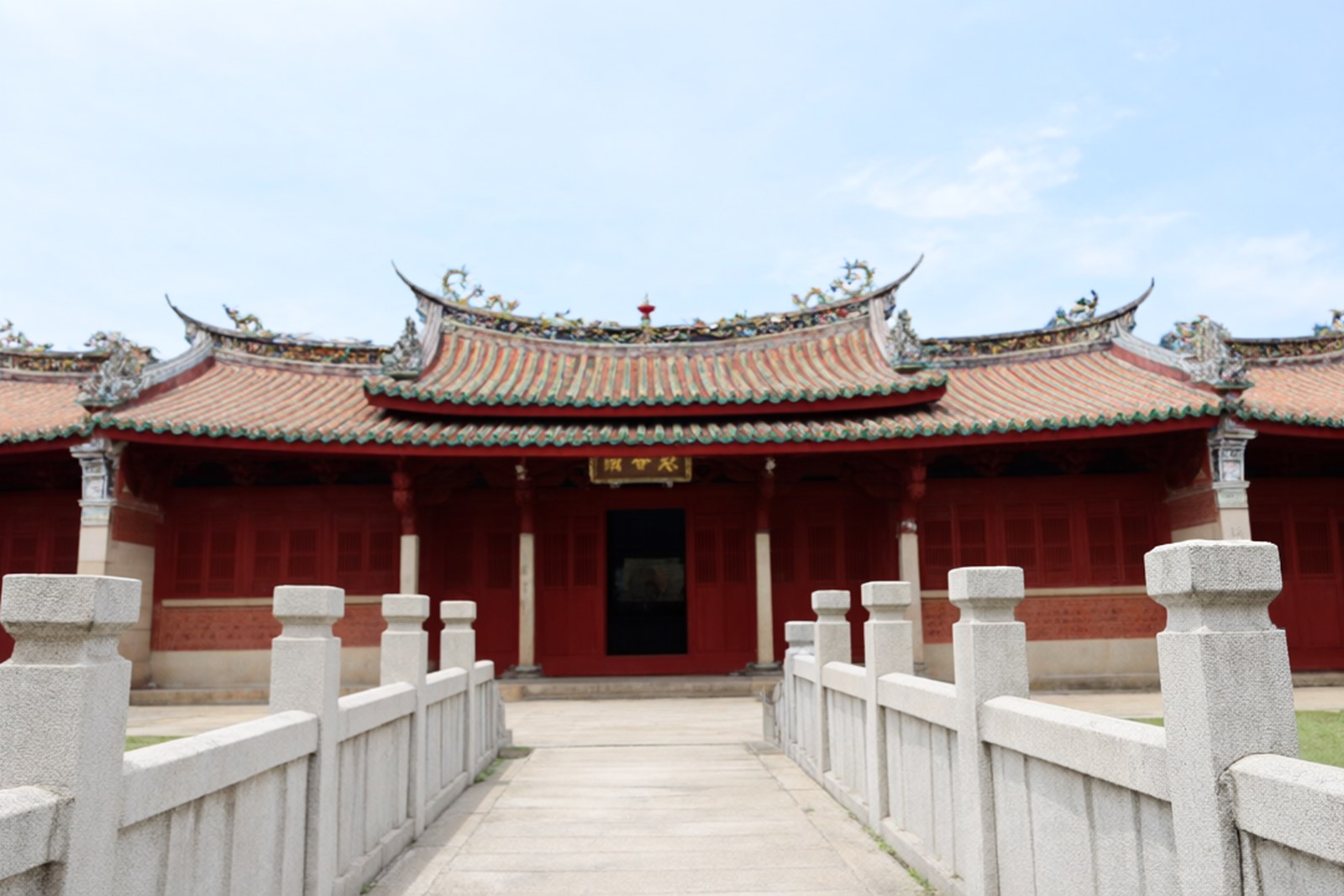
The plan is the textbook one, only tropical. The main buildings are the Great Accomplishment Hall dà chéng diàn, the great east gate, the east and west side halls, the Hall of Famous Officials and the Hall of Local Worthies; historically the compound also carried the Star Gate líng xīng mén, the semicircular pond, a stone bridge, an east and west study, the Hall of the Exalted Sage, the Hall of Enlightened Ethics, shrines to chastity and to loyalty, and rooms for ritual vessels and instruments, with gates of propriety and of righteousness on the flanks. It faces south, symmetrical about its axis, and it is built in a distinctly Hainanese manner: saddle and hip-and-gable roofs, interlocking brackets under the eaves, beams and columns of good hardwood, and every exposed surface of beam, board, window and door carved and painted with dragons and phoenixes, flowers and birds, lions and auspicious beasts. The Great Accomplishment Hall has red doors under green tiles, a red plaque with gold characters over the centre, and murals on either side of the stone doorway showing Jiang Shang Jiāng Shàng fishing with a straight hook and Liu Bei’s three visits to the thatched cottage, which is a compact summary of the two things a Confucian school wanted its students to admire, patience and the willingness to go and ask twice more. Up the steps, past stone lions worn smooth enough to have done service as handrails, stands a bronze incense burner big enough to hide behind. Inside, a large figure of Confucius sits square in the middle of the hall, and the corridor order visitors are given runs from the gate to the pond, over the bridge, through the lecture hall and the hall of ethics, and up into the main hall, with the side halls and the two study rooms off to left and right.
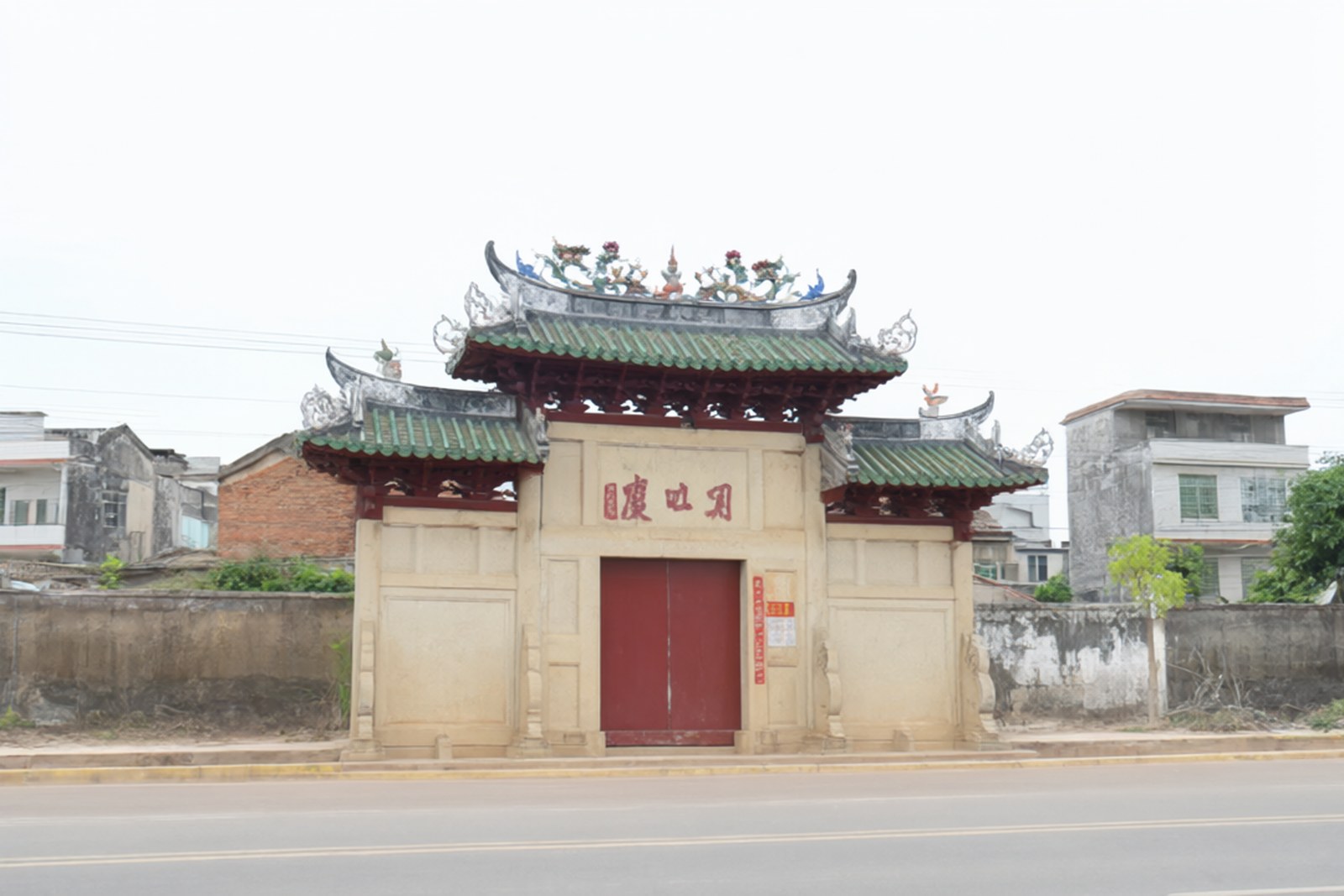
For most of its life this was not a monument but a school, and the county’s record of what the school produced is the reason the building is worth an hour of anybody’s afternoon. From its foundation until the end of the imperial system the temple and its academy were the highest institution in Lingao, and the place where the county’s officials, teachers and writers were made. In the middle of the Republic, as modern schools spread, it became a rural simple normal school, which makes it the direct ancestor of both Lingao Middle School and Lingao Normal School. And on the days of the spring and autumn sacrifices to Confucius, the accounts say, the whole town emptied: 临城万人空巷, a phrase that means every lane in Lincheng was left empty because everyone had gone to the temple to burn incense to the Master. Two men carry the academic record. Liu Dalin Liú Dà lín was born in 1596 at Cixiang village in Lincheng, took the provincial examination in 1615 at nineteen, and passed the metropolitan examination in 1619 at twenty-three, which made him the first and the only jinshi, the highest degree, in the entire examination history of Lingao. He was appointed to the post of judicial reviewer, seventh rank, went paralysed in the legs, came home and never held office again, and died in 1635 at thirty-nine. An arch of the successful candidate was put up in front of the county offices by order of the county at the end of the Ming; in 1661 the magistrate Cai Jiazhen Cài Jiā zhēn moved it outside the Star Gate of the temple; in the sixth year of Yongzheng, which is 1728, the magistrate Lu Xialing Lǔ Xiá líng moved it again to the middle street; in 1937, with the arch crumbling, the Liu clan moved it to stand in front of their ancestral hall. The centre of the span is carved with the two characters for jinshi and the sides carry a couplet by Wang Liangbi. One county web page prints that Yongzheng date as 1628, which cannot be right, since the reign began in 1723; the year is 1728 and the page is simply wrong. The other name is Wang Zuo Wáng Zuǒ, born in 1428 and dead in 1512, who came first in the provincial examination of 1447 at twenty, failed the metropolitan examination the next year, and then sat in the Imperial College in Beijing for nineteen years without ever taking the highest degree. He is remembered as one of the four great talents of Hainan, the poet among them, the others being the essayist Qiu Jun, the loyalist Hai Rui and the calligrapher Zhang Yuesong, and his 琼台外纪 Qióng tái wài jì was the first local history written by a son of the island. In 1455 the emperor ordered an arch to his examination success built at his home village, and it still gives its name to the lane. Local sources disagree over whether that village belongs to Bohou town or Huangtong town, so take the village name and leave the township aside.
The intellectual line behind all this runs back to a rainy afternoon in 1148. Hu Quan Hú Quán, a Southern Song official exiled to the far south for memorialising the throne about the minister Qin Hui, passed through Lingao on his way to Sanya, and the magistrate of the county, Xie Wo Xiè Wò, invited him to stay in a small academy he had built and named the Jasmine Hall Mò lì xuān for the jasmine planted in its courtyard, had him write the name board, and gathered the county’s scholars to hear him lecture on the Spring and Autumn Annals. It is not a famous event in Chinese history. It is the founding event in Lingao’s. One of the pupils who took the lecture to heart was Dai Dingshi Dài Dìng shí of Bodun village, who went on to become the county’s first provincial graduate; his son Dai Xiongfei passed the same examination in the Jiading era and commissioned a calligrapher to cut the characters of the Quiet Cottage Spring dàn ān quán on a stone, with a scholar-official’s account of the spring carved alongside the well. Hu Quan himself, riding through a village then called Buying Sorrow Mǎi chóu cūn, produced the four lines that every local history quotes: northward he thought always of Wenxi county, southward he dreaded entering the village that sold sorrow, and the road to the world’s edge, ten thousand li of it, was wild grass and cold smoke and a soul coming loose. The temple’s Hall of Local Worthies is the late harvest of that planting. It holds three figures, and they are a deliberate set: Dai Dingshi the first provincial graduate, Liu Dalin the only metropolitan graduate, and Wang Zuo the poet who never got the degree at all. The Hall of Famous Officials beside it honours Xie Wo, the magistrate who lent his courtyard to a man on his way into exile. A county that puts a poet and a failed candidate on the same altar as its highest scorer has understood something about learning that is worth the walk across the bridge.
Practicalities
Tickets. Entry is free and the temple is open to the public at no charge, which is the position of the official encyclopaedia entry and of the county’s cultural material. One non-official travel guide quotes a ten yuan ticket, which conflicts with every other source and appears to be either stale or simply wrong; if a fee is ever introduced it will be announced at the gate, and until then plan on nothing. There is no published booking system and no official telephone number, so no advance arrangement is possible or needed.
Opening hours. The recorded hours are 08:00 to 17:00, with a second variant of 08:00 to 18:00 printed in the same reference work, so the closing time is genuinely uncertain by an hour. Treat 17:00 as the safe assumption and arrive by four in the afternoon to see the hall properly. The temple also hosts lectures on Confucian topics, guqin recitals and calligraphy events from time to time, and students come to pray for examination success, particularly in the weeks before the school and university entrance tests, which is the liveliest time to visit if you can time it.
Closing day. No closing day is reported. Unlike the museum at the cape, the temple has no weekly rest day in any of the sources, and it is treated as open daily through the year. Two caveats worth having in your pocket: the 17:00 or 18:00 closing hour, and the possibility of a private ceremony on a festival day.
Getting there. The temple is on the north bank of the Wenlan in the county town and is a walk from the centre of Lincheng, across the new bridge and immediately over the water from Xinqiao South Road; on foot from the town’s main streets it is ten to twenty minutes. Sources give three different addresses, on Wenlan Jiang East Road, on Jiangbei Road and behind a hospital on Baohui Road, and they describe the same bank of the same river from different directions, so navigate to the river and the red wall rather than to a street name. No bus route is documented and no official parking or guide service is published; a car can be left on the town streets nearby.
If you have time for one more thing here, walk the water’s edge after you leave. The temple is the oldest building in Lingao and one of the oldest in Hainan, and it sits inside a working county town rather than behind a ticket gate, which means the contrast that makes it interesting is right there in front of you: pupils crossing the bridge on their way home, the smell of frying from the food street behind the wall, and a hall full of carved dragons that has been standing on this bank since before any European power had a lighthouse in these waters. Go in the late afternoon, when the light comes in low along the palm trunks, and give the Hall of Local Worthies two minutes of your attention. A poet, a first-place provincial graduate and the only metropolitan graduate in nine hundred years, sharing a wall, is a better comment on what a temple is for than anything on the information board.
Getting there: On the north bank of the Wenlan River in Lingao county town, one bridge across from Xinqiao South Road and walkable from the centre of Lincheng; the street addresses vary between sources, so aim for the river bank and the red wall, and there is no documented bus or booking channel.