
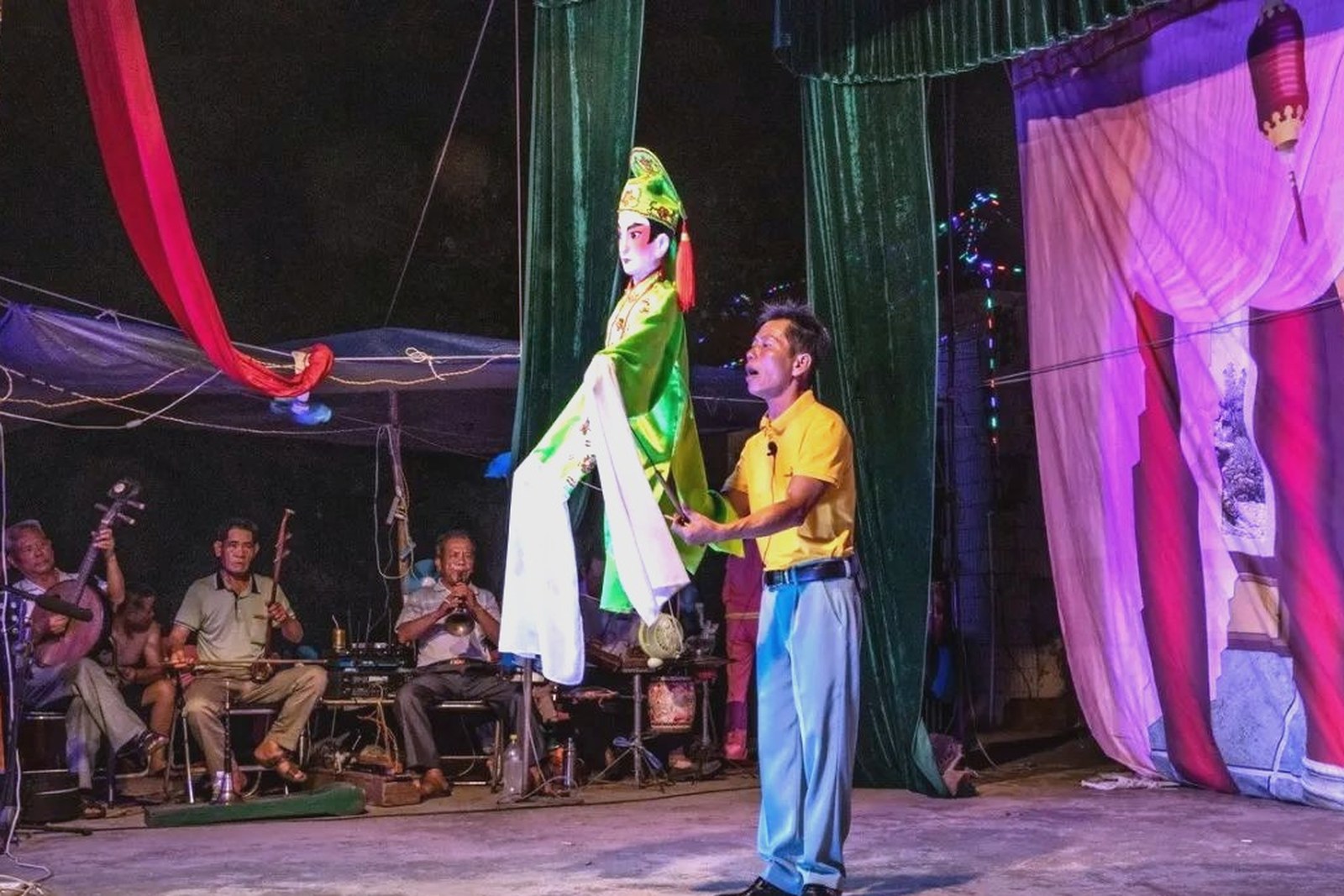
The curtain is the thing that is missing. Everywhere else in the world of puppet theatre, the audience agrees to forget the people holding the puppets: a screen, a bridge, a black hood, a tradition of pretending that the figure moves itself. Lingao does the opposite. Here the puppeteer walks onto the stage in costume, holds the puppet up in front of the same body it is playing, and performs the role twice at once, as wood and as flesh, in the same costume, at the same moment, in full view. The local description of the form says it plainly: the stage has no screen, the performers hold the puppets and appear made up, and the person and the puppet share one character, the human performance making up for what the puppet cannot express. The consequence for the audience is something between theatre and conjuring, because your eye keeps flipping between the face of the character and the face of the person playing it. This is 临高人偶戏 Lín gāo rén ǒu xì, the puppet-actor opera of Lingao, and its official listing is specific: puppet play, Lingao variety, item number 236, project code IV-92, category traditional drama, proclaimed in 2006 in the first batch of the national intangible cultural heritage list, with Lingao county as the applicant and the county culture centre as the protecting unit. The national heritage database calls it a rare genre unique to Hainan in all of China and seldom seen anywhere on earth, while local promotional writing prefers the shorter boast that it is rare in the world and a wonder of China. Those are two different sentences from two different sources and should be kept separate, but neither is puffery: nothing quite like this survives elsewhere in the Chinese theatre. One source does claim the form was listed in both 2006 and 2008, which is not supported by the national list and is almost certainly a conflation with another project.
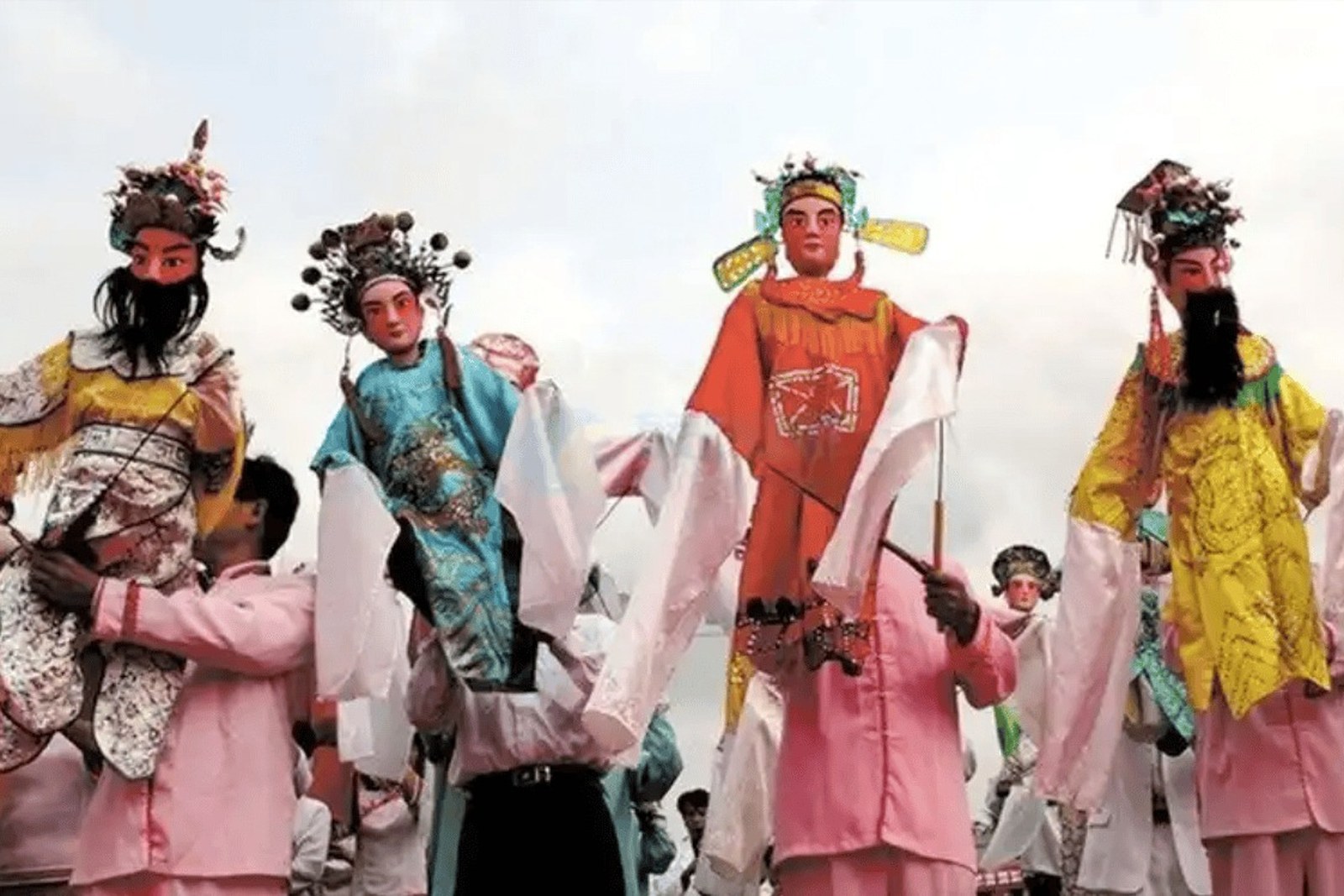
The origin story has two versions and a physical exhibit. By the account of the old performers, the form comes from the very end of the Southern Song, in the thirteenth century; a second version has it arriving from the mainland during the Southern Song rather than being invented here. Either way the earliest form was not entertainment. It was a rod puppet carried by exorcists and spirit mediums, used when a household needed a god moved or a ghost seen off, and the Guangdong gazetteer of the county, revised in the seventeenth year of Guangxu, that is 1891, describes the local habit in unflattering terms: the people of Lingao put their faith in the way of the spirits and not in medicine, and at every festival they would set a wooden figure on a shoulder while male and female mediums sang in alternation as though playing a scene. Performers took that ritual and turned it into theatre, and the form is judged to have existed by the Kangxi reign at the latest. The exhibit that settles the date is wood. In 1979 an old actor named Chen Hecheng Chén Hé chéng, then in his eighties, handed over ten puppets that his family had kept for seven generations, and four of the heads carry the reign mark of the Kangxi emperor cut into them. The same records list thirty troupes working in the county under Kangxi, with named leaders such as Wu Silong, Cao Daluo, Wang Xiangfa and Liu Caifeng. A full set of puppets for the repertoire runs to twenty-four characters, and before each performance the head of the troupe goes along the row adjusting headdresses, beards and costumes one figure at a time. The figures themselves are carved from camphor wood, chosen because the grain is fine, the density is right for a knife and the wood resists insects, with locust and paulownia used as alternatives. The carver picks a block to match the size of the head he has in mind, lays out the positions of the features, roughs out the shape, smooths and fixes it, and paints it in, and a single head takes something over ten days. A Qing-dynasty puppet in the county museum stands about 35 centimetres tall with a head roughly 13 centimetres long, 10 wide and 10 deep, which gives a sense of the scale the performers are working at: this is a figure you can hold in one hand for four hours. In the 1980s, on advice from puppetry specialists in Beijing and Guangdong, the makers abandoned carved heads for a lighter method, pasting paper over plaster moulds and painting the result, which allowed heads that can frown and close their eyes, roll their pupils, open their mouths, move the nose and twitch a beard, and hands that can grip, hold, pick up and set down. There are five role types, sheng, dan, jing, mo and chou, and four face schemes: red for loyalty and courage, white for cunning, black for a straight and hard nature, and a multi-coloured face for bandits or foreigners. The clown shares the white face with the young lead and the heroine but is marked out by white around the eye sockets, the centre of the brow and the bridge of the nose. Curiously, the performers themselves did not wear make-up at all in the early period, since the puppet was the character; from the 1960s and 1970s they began using light, flattering make-up, without painted face patterns.
The sound is as specific as the staging. The two principal vocal modes come from a local folk tune called 阿罗哈 Ā luó hā and a Daoist chant called 朗叹 Lǎng tàn, and on top of these sit more than a dozen other metres, from quick board and 哩哩美 to the moonlight tune, the white lotus and the weeping board, with borrowings from Qiong opera. Lyrics run mostly in four lines of five, six or seven characters, and they are not required to rhyme but are required to keep their tonal pattern, which is a stricter rule than it sounds. The band began as five to seven players with a bamboo flute, a coconut-shell fiddle, a three-string or a zither, small and large shawms and percussion; later it grew to twelve or fifteen, adding a second flute, a moon lute, an erhu, a dulcimer and even clarinet and cello, while the percussion section shifted its centre of gravity from a medium drum to large and small wooden fish. All of that is the apparatus. The point of it is the performance, which is a village business on a village timetable. By custom the play starts at half past eight in the evening and runs about four hours, and if the audience is enjoying itself the troupe will stretch by another half hour before packing up. The performers leave the county town at five or six in the afternoon and travel to whichever village has booked them, set up the stage like ants moving house, hang the cloth, place the props, rig the lights and open the sound system, and as the light goes the villagers come drifting in along the music, carrying their own chairs and their own household torches, arguing about which play is being staged tonight. A professional troupe in Lingao performs for about twenty nights a month.
The repertoire runs past a hundred pieces, from Zhuge Liang laying out the eight-fold formation and King Wu’s campaign against the Shang to Wang Zhaojun going north to the frontier and a long list of more modern stories, and the form has had its moments of official recognition. Between 1981 and 1993 it went to Beijing twice and came back with awards for performance and for music, and one of its productions was recorded and broadcast by CCTV. Its present health is best described as variable. A retired director of the county’s cultural centre said in 2020 that the county once supported dozens of troupes and that thirteen were still working that year, while a Xinhua report in 2017 described one company, the Xinfeng puppet troupe, as one of seven still operating, sixteen people in all, five men, five women and six musicians. The figure has plainly moved year by year, so quote it as somewhere between seven and thirteen depending on the year rather than as a fact. The officially named national inheritors are Wang Chunrong Wáng Chūn róng, born in May 1961, and Chen Shaojin Chén Shǎo jīn, born in August 1960, both registered under project IV-92; Lin Xiang Lín Xiáng, who appears often in coverage of the form, is described as a leading figure and playwright of the Lingao troupe rather than as a national-level inheritor, and the distinction matters when you are writing about him. Two other voices belong in any account of the theatre. The old troupe leader Xu Yuwen, in his late sixties when a reporter spoke to him, summed up the trade with a proverb that translates as gold is not worth as much as black gold, meaning that knowledge and skill are the only property a person carries with him. And in 1962 the playwright Tian Han watched a performance and gave it the sentence the county has used ever since, that it is a rare variety, out of the ordinary, with a lively performance and a beautiful voice, and then wrote a poem about coconut groves, a few songs, the Wenlan river carrying new ripples, and a singer in Lingao who could out-sing the famous Liu Sanjie, with the note that the river’s name should be written Wenlan and not with the variant character some texts use.
The second national heritage item in the county is a song, and it began as a sales pitch. 临高渔歌 Lín gāo yú gē, the fishing songs of Lingao, is listed as item 1074, project code II-144, category traditional music, proclaimed in 2011 in the third batch of the national list, again with the county as applicant and the county culture centre as protecting unit. That date is the single most fought-over fact in this article: a great many Chinese outlets, including provincial ones, print 2010, some print the second batch, and one prints 2006, which is plainly wrong. The national heritage database says 2011 and the third batch, and the difference is worth explaining rather than fudging: 2010 was the year the candidacy was publicised, 2011 the year the list was proclaimed, and the earlier batch number belongs to a period when the province hoped to enter it a round sooner than it did. The song itself has a longer history than its paperwork. Its seeds go back to the Han dynasty, when fishermen migrating from the mainland settled the coast of what is now Lingao and their shouts while casting and rowing, together with the cadence of the fisherwomen hawking the catch, became the raw material. It took its shape in the Shaoxing period of the Southern Song, between 1131 and 1162, when the county magistrate Xie Wo Xiè Wò governed well enough for the fisheries to flourish and the harbour filled with girls crying their fish for sale, and that cry, an invitation to come and buy, sung across the water, was repeated through hauling, net-mending, weddings and funerals until it hardened into a melody. The refrain carries the name 哩哩美 lī lī měi, and the county culture centre’s director gives its three main forms as follows: lilimei means a beautiful girl; naimalei praises a boy for being clever and brave, though another reading has it that the other person is as lovely as jasmine; meileiai expresses love for someone, or by another account that the woman loves the man. The variants are worth printing alongside the main reading, because the words have been interpreted differently in different villages. Refrains and repeated syllables make up as much as half of any song. Five families of tune carry the form: songs of good fortune, love songs, riddle songs, satirical songs and laments, and because the love songs are the ones that get performed, outsiders tend to assume the whole tradition is cheerful, which is exactly what it is not.
The singing is improvised in the words and fixed in the tune, solo or choral or in alternation, and in a paired improvisation the winner is whoever invents the sharpest answer fastest. Two samples survive that show how it went. A young man opened with a challenge: girl, if we are going to sing, let us sing tonight while the neighbours listen, and if we are going to pair, let us pair tonight while the neighbours chip in silver medals. A young woman answered: brother, they say you used to be the best singer around, and now tonight you cannot manage a single verse. And he came back: girl, my songs are stacked one on another like books in a chest, and piled one on another like characters on a page. The refrain also contains a piece of local geography, a line about the wave-dike named Zhumi north of Xinying harbour and the safe white sand named Jiuwei to its south, which is a way of saying that the song knows where the boats can lie. Before the 1970s the coast around Xinying and Diaolou kept what were called girls’ houses, where three or five fisher daughters lived together and which, after dark, became the place where the young men came to talk and court, with lilimei as the language of it; older still, unmarried men and women lived in separate communal houses and on bright moonlit nights gathered on the sand to compete in song, so that the beach itself was a song ground. Musicians outside the county noticed early. In 1977 the composer Huang Zhun, who wrote the song of the Red Detachment of Women, came to the fishing village at Xinying and called what she heard one of the best fishing songs in China; another composer later borrowed the tune for a film song that became far better known than its source, the melody was approved for the junior middle school music textbook, and in November 2007 it took first prize at a national fishing song competition in the Zhoushan islands. The county was named a hometown of Chinese folk art by the Ministry of Culture in 2003, and some later sources add the characters for culture to the title, which looks like a change of naming between years rather than a second award. Preservation work has been unusually concrete since: a research association was founded in 2010, a lifelong education programme launched in 2018 has visited thirteen fishing villages, interviewed thirty-two old singers and collected more than a hundred and twenty traditional pieces and two hundred lyric manuscripts into a digital archive, a three-year plan for 2022 to 2024 was issued in 2021, a mass singing event that December drew more than two thousand people, a youth choir meets weekly with a named inheritor teaching, and one singer has written over a hundred new lilimei songs and stretched the lyric line from five characters to seven. The county’s heritage list runs deeper than its two national items, and it is worth knowing what else is here: 临剧 Lín jù, a spoken opera grown out of the puppet theatre and sung in the Lingao dialect, proclaimed a provincial item in the sixth batch on 28 December 2023 under code IV-5 and now supporting eight companies, some two thousand performances a year and nearly three hundred performers; the eight-instrument cup-and-plate dance, a Southern Song form in which the dancers hold porcelain cups and dishes as they move to the melody; and the county-level list adjusted on 14 November 2016, which also carries the mountain song of Lingao, the widow’s lament known as Pang Peiyan Mourns Her Husband, the fishing family dress of Xinying and the local fishermen’s proverbs. Two of those names are printed with three different sets of characters in the county’s own documents, so quote the widow’s lament and the mountain song with the variant noted rather than picking one spelling and calling it correct.
Practicalities
Tickets. No ticket price is published for any of this, because neither the puppet theatre nor the fishing songs are sold as a product in the ordinary sense. Puppet opera in Lingao is performed by troupes that are booked by a village for an evening, and the audience does not pay at the door; the county culture centre, which is the protecting unit for both national items, runs public performances and workshops, and no admission charge is published for those either. If you are offered a paid tourist performance by an intermediary, treat it as a commercial arrangement rather than an official one.
Opening hours. There is no opening time, because there is no building with a door to open. The reliable rhythm is the performance customs: puppet opera starts at half past eight in the evening and runs about four hours, sometimes four and a half, the troupes leave the county town around five or six in the afternoon to travel to the village that booked them, and Linju, the spoken-opera offshoot, is performed about twenty times a month by each of its eight companies, mostly at festivals, ancestral rites and village events. If you want to see something without a booking, the single most dependable window in the year is the opening-of-fishing-season festival in August, when the county stages a mass programme of fishing songs and puppet opera in the Wenlan Culture Park; the second edition, on 17 August 2024, ran fifteen acts across three sections in a single evening. The AAAA plaque unveiling at Hainan Liberation Park on 1 July 2022 also opened with puppet opera and lilimei, which is a fair sign of how the county uses both.
Closing day. No closing day is reported, and in this case the question almost answers itself: with no fixed venue, no box office and no resident company performing nightly to the public, there is no schedule to rest from. The practical version of a closing day is the reverse one: most weeknights in most villages there is no performance at all, and the way to find one is to ask at the county culture centre in the county town, or in the towns of Xinying and Diaolou on the coast, where the fishing-song tradition is strongest and the community education school runs its inheritance class.
Getting there. Both traditions belong to Lingao county rather than to one address, so plan by town. The county culture centre in Lingao county town is the protecting unit for both national items and the obvious first enquiry, but no street address, opening hours or current performance schedule is published for it, so ask locally rather than setting out for it. The most concrete teaching site is the community education school at Xinying town on the coast, founded in September 2019 with 1,200 square metres of ground, 1,800 of buildings, 200 students and three teachers, where the lilimei inheritance class is a core course; its address is given as the Newying community in Xinying town and nothing more precise is published, and there is no published visiting policy. The Lilimei Art Troupe of Hainan, formed from 2010 and formally approved in 2011, has toured as far as the United States and Singapore, but it publishes no fixed public performance calendar. Getting to Lingao itself is straightforward by coach from Haikou; getting to a performance is a matter of asking in the right town on the right week.
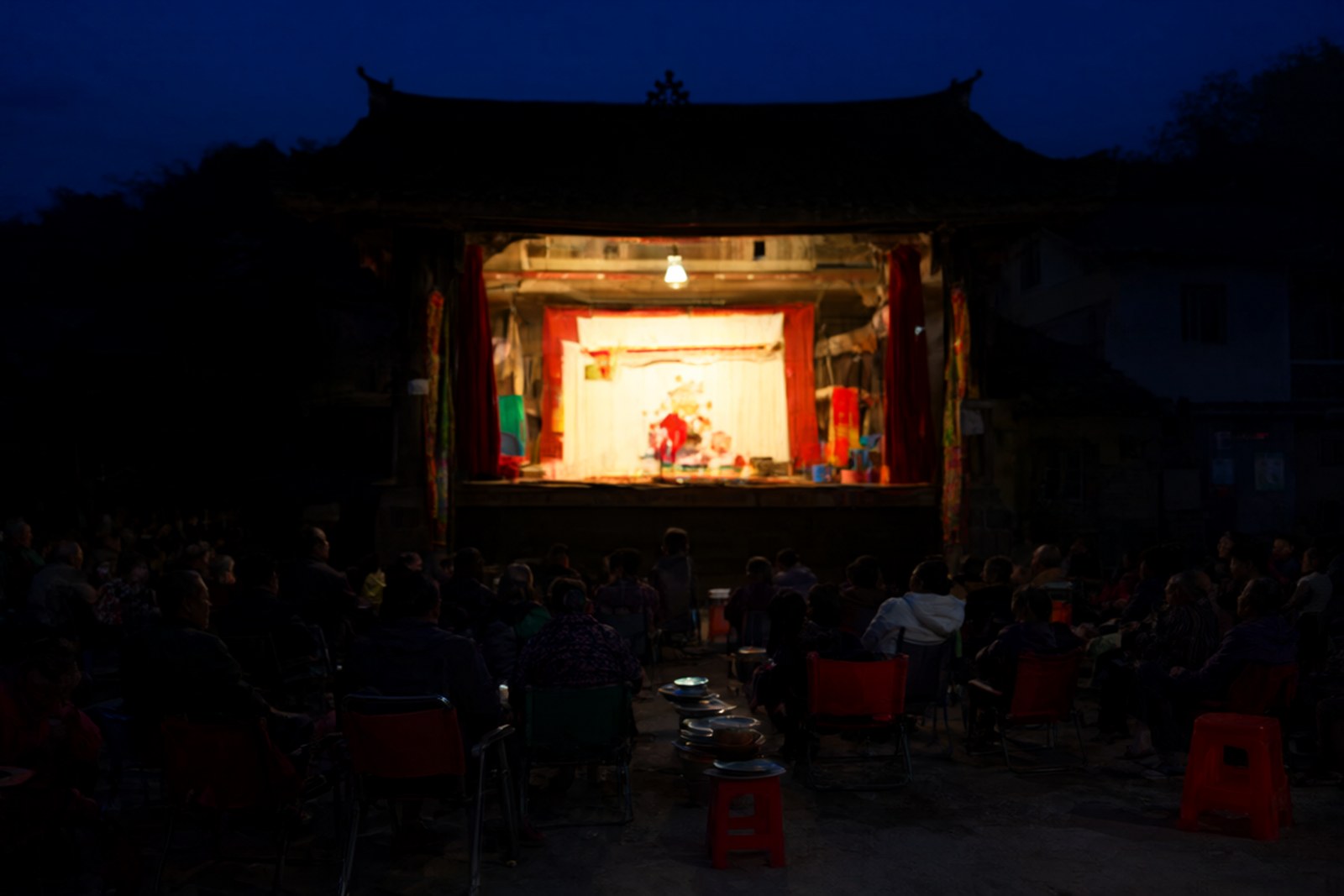
If you only do one thing with an evening in Lingao, do this: find out whether anyone is playing. Ask at the culture centre, ask at a guesthouse in Xinying, ask about the August festival, and then go and sit at the back of a village audience with a torch in your pocket like everybody else. What you will see is a stage with no curtain, a handful of performers carrying two versions of the same character up and down the boards, a band of a dozen, and four hours of a story that most of the people in front of you know by heart. What you will hear, if it is the coast rather than the county town, is a melody improvised from a line that a fishwife sang at a harbour eight hundred years ago, in which the words are made up on the spot and the refrain is not. Both of these things are national-level heritage, both are free at the point of use, and both are still, on the right night, simply what people in this county do after dinner. That is a better reason to travel than a plaque.
Getting there: Both traditions are county-wide rather than sited, so ask at the county culture centre in Lingao county town or at the community education school in Xinying town on the coast; no address, opening hours or performance calendar is published for either, puppet opera starts about 20:30 in whichever village has booked the troupe, and the dependable public window is the August opening-of-fishing-season festival.