
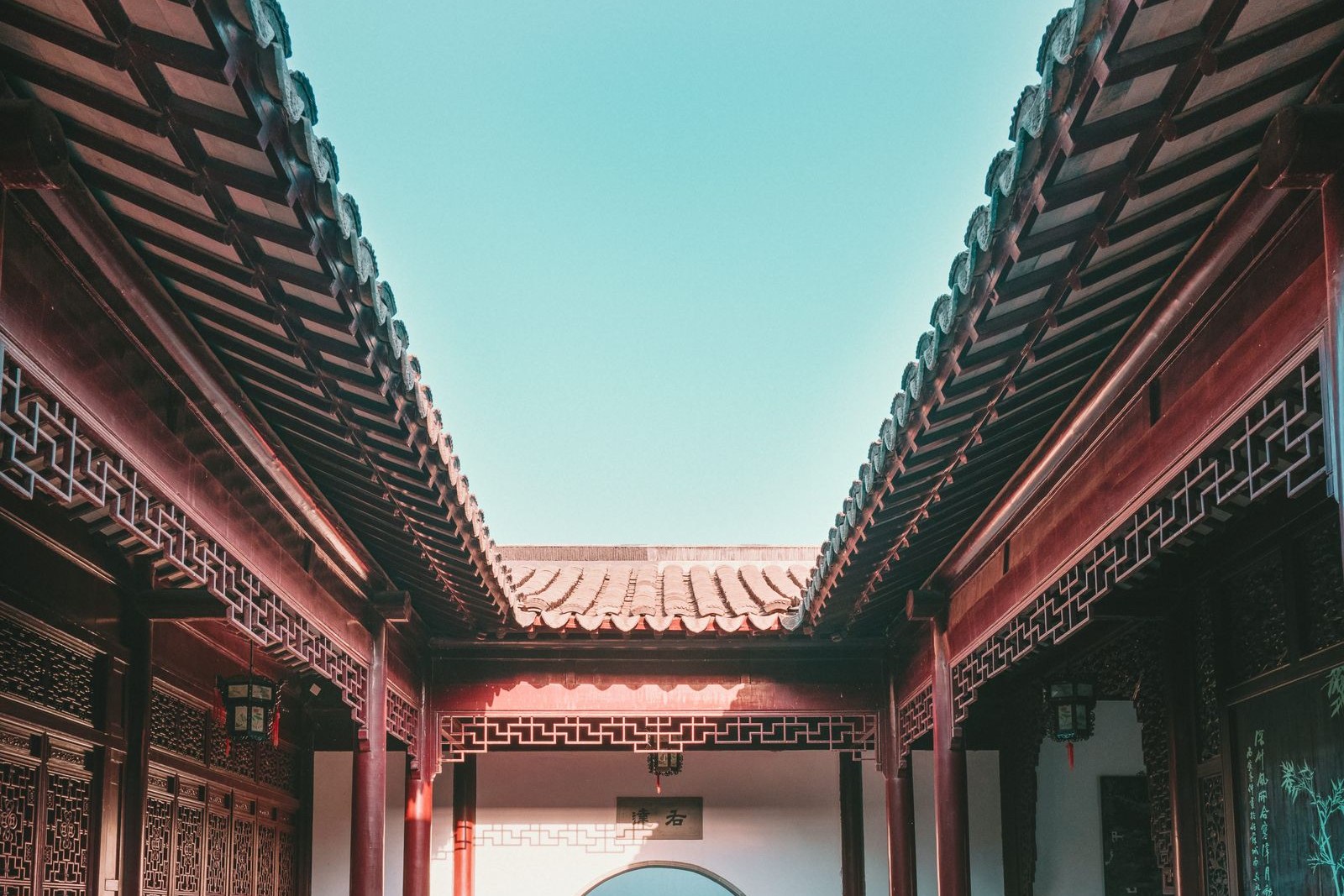
The hall is plain, the courtyard is small, and the object of veneration is a man who was sent here as a punishment. 柳子庙 Liǔzi Miào, the Temple of Master Liu, stands at the top of 柳子街 Liǔzi Jiē in 零陵 Línglíng, the old city of Yongzhou, on the bank of the 愚溪 Yúxī — the Fool’s Stream — which he renamed himself. It was first built in the Northern Song, in 1056, and rebuilt in the Qing; the present structure is a modest three-hall complex with a stage, a courtyard, and a statue of 柳宗元 Liǔ Zōngyuán seated in the manner of a scholar rather than a god. People come to it not as a religious site but as the address of a body of writing.
柳宗元 Liǔ Zōngyuán was one of the most brilliant men of his generation and, in 805, one of the losers of a political purge. Exiled to Yongzhou as a 司马 sīmǎ, a nominal military aide with no duties, he spent ten years here in what was then a malarial frontier town, and during those ten years wrote the prose that made him immortal. The 永州八记 Yǒngzhōu bā jì, the Eight Records of Yongzhou, are short essays describing walks to particular pools, hills and streams around the city, and they invented a way of writing about landscape in Chinese that everyone after him used. The most famous, 小石潭记 Xiǎo shí tán jì, the Record of the Little Stone Pool, is a set text in every Chinese school, and the pool is a twenty-minute walk from the temple.
He also wrote 捕蛇者说 Bǔ shé zhě shuō, the Snake-Catcher, whose opening sentence is probably the single most quoted line in Chinese about this region: that the wilds of Yongzhou produce a strange snake, black with white markings, which dies if it touches a plant that will then cure every disease. The essay is about tax: the snake-catchers’ families are exempted from land tax in exchange for delivering the snakes, and they prefer the snakes. It is a piece of argument disguised as natural history and it is the reason 异蛇 yìshé became a byword for Yongzhou. The city has since rather embraced this, and the local liquor industry has named a brand of snake wine after it.
The temple itself is not grand. What it has is the setting: the 愚溪 Yúxī running past the front wall, the stone bridge, the old lane, and the low hills behind — which is, more or less, the landscape of the essays, still legible after twelve hundred years. On the temple’s walls are stele inscriptions, including a Qing set of the Eight Records, and the courtyard stage is still used occasionally for 祁剧 Qíjù, the hard-voiced local opera.
Practicalities
Tickets. Around ¥20–30 for 柳子庙 Liǔzi Miào. The 柳子街 Liǔzi Jiē neighbourhood around it is free and is the better part of the visit.
Opening hours. Roughly 08:30–17:00. Sundays and holidays bring school groups in the morning; weekday afternoons are quiet.
Closing day. No fixed closing day, though the site occasionally shuts for maintenance and the temple’s own calendar is not published anywhere reliable. Assume it is open.
Getting there. 永州站 Yǒngzhōu Zhàn is 25 minutes and ¥25–35 by taxi. The temple is at the western end of 柳子街 Liǔzi Jiē, a five-minute walk from the old town’s main lane.
What People Get Wrong
They visit the temple and skip the walk. The reason to be here is the geography of the essays, and that means following the 愚溪 Yúxī upstream to the stone pools, up the low hill behind the town for the view the essays describe, and along the riverfront at dusk when the 潇水 Xiāoshuǐ and the 湘江 Xiāngjiāng meet. None of that requires a ticket.
Getting there
Two hours by high-speed rail from 长沙 Chángshā, or an hour from 桂林 Guìlín in Guangxi. The old town, the temple and the stream make a comfortable half-day on foot; add 蘋岛 Píngdǎo and the riverside park and it is a full one. Stay in a courtyard guesthouse on 柳子街 Liǔzi Jiē if you can, and eat 永州血鸭 Yǒngzhōu xuèyā for dinner.
flowcloud would say that the Chinese habit of building a shrine to a man who was sent somewhere as a punishment is one of the more endearing things about the culture — that the sentence was ten years in Yongzhou, and the sentence turned out to be the thing the city is now proudest of, and both sides have decided to call it a gift.
Getting there: 柳子庙 (Liǔzi Miào), 柳子街 (Liǔzi Jiē), 零陵区 (Línglíng Qū), 永州市 (Yǒngzhōushì), 湖南 (Húnán). Open roughly 08:30–17:00, entry ¥20–30; the old town and the 愚溪 (Yúxī) are free. 25 minutes and ¥25–35 by taxi from 永州站 (Yǒngzhōu Zhàn). See the temple, then walk the stream and the riverbank, which is where the essays actually live.