
The Sixth Patriarch’s Country Around Longshan
六祖故里 Liù zǔ gù lǐ means “the sixth patriarch’s home country”, and it is the name the county gives to the ground around 龙山 Lóng shān in 六祖镇 Liù zǔ zhèn, 新兴县 Xīn xīng xiàn, in the south-east of 云浮市 Yún fú shì. The name covers two things that are usually described as one. The first is the actual place: 夏卢村 Xià lú cūn, the village where 惠能 Huì néng was born in 638, three kilometres or so from the monastery he later built at his own birthplace, and the hills and lanes between the two. The second is the 六祖故里旅游度假区 Liù zǔ gù lǐ lǚ yóu dù jià qū, a managed resort of some four square kilometres along 276 省道 276 shěng dào, rated 4A and working towards 5A, whose stated purpose is to hold the monastery, the springs, the lakes and the surrounding villages in one frame. The county’s own title for the whole area is 中国禅文化的发祥地 Zhōng guó chán wén huà de fā xiáng dì, the birthplace of Chinese Chan culture, and its awards list – 中国天然氧吧 Zhōng guó tiān rán yǎng bā, a natural oxygen bar, 世界禅意养生温泉 shì jiè chán yì yǎng shēng wēn quán, a world Chan-therapy hot spring, and 中国温泉之乡 Zhōng guó wēn quán zhī xiāng, a home of hot springs – is the language of destination marketing and should be read as such. What is not marketing is the biography. A person was born in 夏卢村 in 638, and it is on the strength of that single fact that a county with one monastery has built a resort, a lake system, a hot-spring industry and a tourist economy of 149.63 million visits in the first half of 2025, worth 8.98 billion yuan in that half-year alone – the figures the county publishes, and the reason the 5A application is being made.
The biography is worth setting out because the landscape is the biography’s furniture, and because the report’s dating is very specific about it. 惠能 was born in the twelfth year of 贞观 Zhēn guān, 638, in 新州 Xīn zhōu, which is today’s 新兴县, in 夏卢村. His father died when he was three, and his mother, the report notes, 守志鞠养 shǒu zhì jū yǎng, kept her widowhood and raised him herself, which is the sort of line a county records because it explains why a boy with no schooling and no patron ended up as the sixth patriarch of a school that has always claimed to be the one that does not need them. He was a woodcutter and a pedlar of firewood; the story that he became a patriarch has no scholarly credentials at all in the usual sense, since a poor illiterate man from a frontier county could not in the ordinary way have entered the lineage, and that is exactly what the Platform Sutra is about. In 661 he went north to 黄梅 Huáng méi to find 弘忍 Hóng rěn, the fifth patriarch, and the verse exchange that followed is the founding text of the school. The line that carries the biography forward through this landscape is the one this article began with: he came back. In 676 he was ordained at 法性寺 in 广州 Guǎng zhōu, and he spent the next thirty-odd years teaching at 曹溪 Cáo xī in 韶关 Sháo guān. The report notes that the sources give the length of that period as thirty-six years on the Chinese side and thirty-five in an English account, so the honest phrasing is “thirty-five to thirty-six years”, or “the greater part of four decades”, and the same caution applies to the death date: 713 is undisputed, but the era name changed in that year and accounts divide between 先天二年 xiān tiān èr nián and 开元元年 kāi yuán yuán nián, which are the same twelve months. He died on the third day of the eighth month of 713 at the monastery he had built over his own house, and the local tradition has one more thing to say about the journey: that after his death his disciples hid his body in the ravine that is now the 藏佛坑 Cáng fó kēng, and that the name means “the pit where the buddha was hidden”. The report is clear that this is tradition rather than record, and it is written here in the same register. What is measurable about the landscape is much smaller and more convincing. The county calls the area around the monastery 龙山 Lóng shān, the dragon hill, and the hill is where the springs are that give the resort its hot water: the 龙山温泉 Lóng shān wēn quán, with a main wellhead temperature of 72.8 Celsius. A spring that hot in a wooded valley is why people were building things here long before anybody needed a 5A rating, and it is also why the resort’s own therapy claims – the 世界禅意养生温泉 title – are at least anchored to something physical.
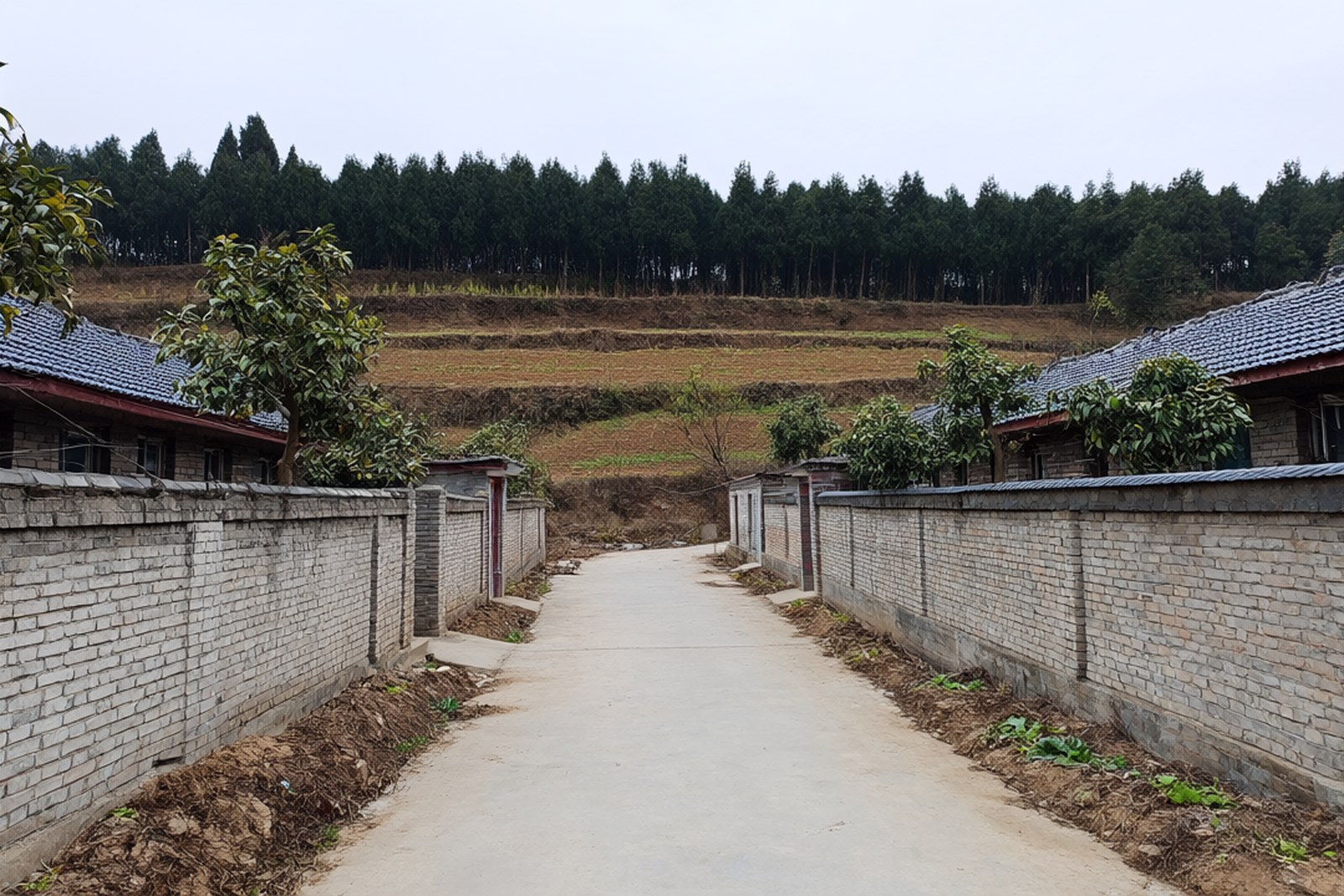
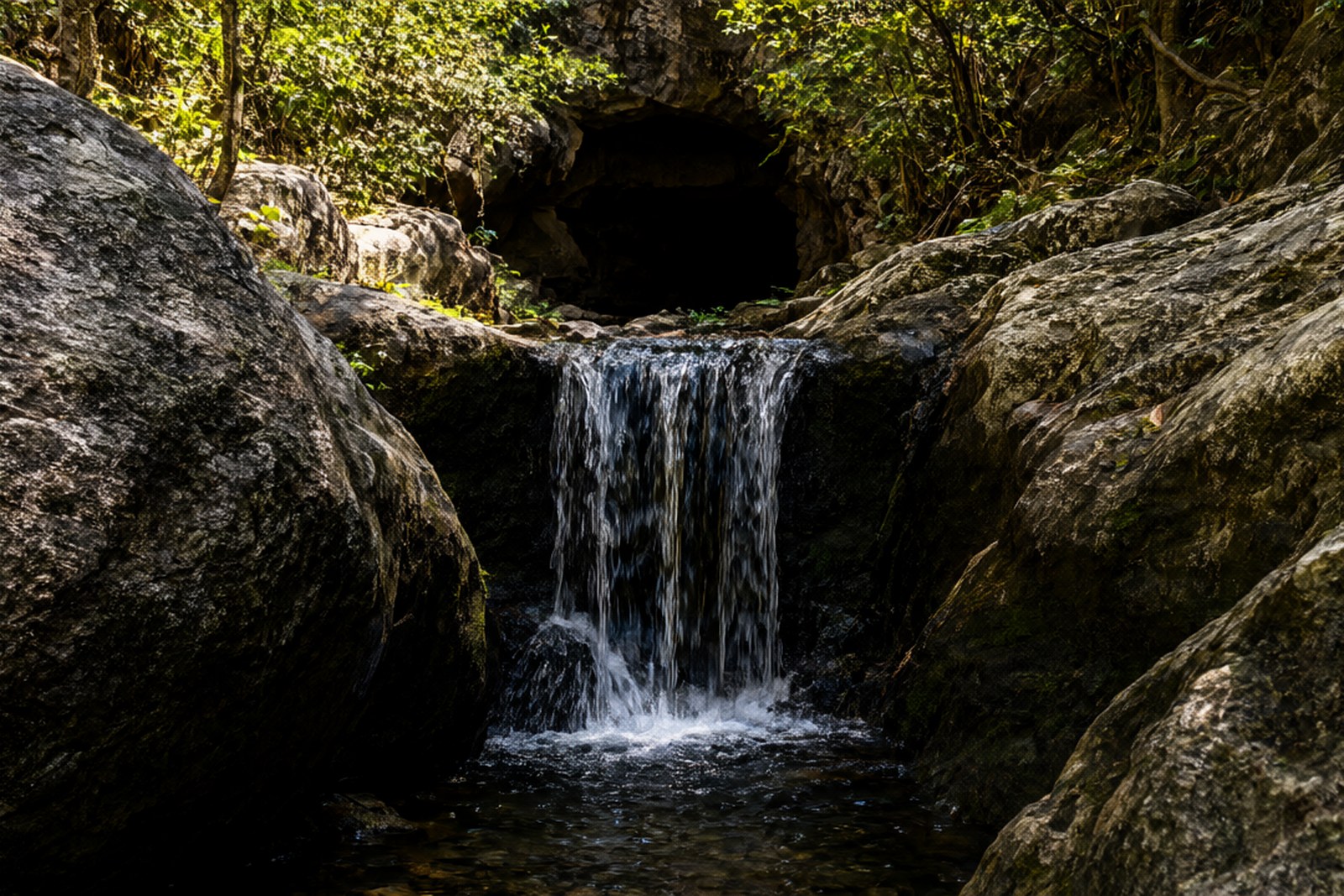
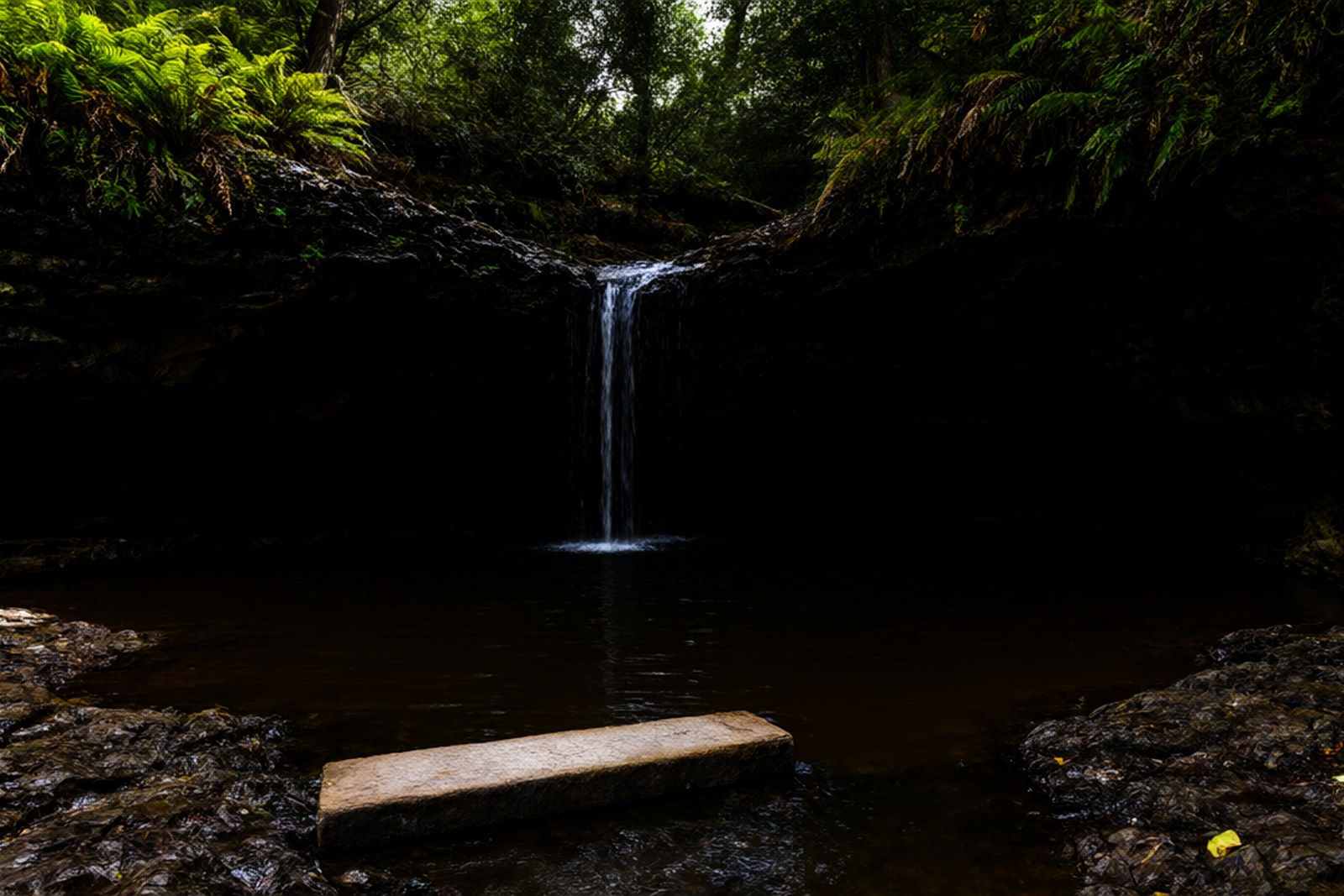
The village itself is the part of the resort that has the least to prove. 夏卢村 is a few minutes’ drive from the monastery, near 夏卢小学 Xià lú xiǎo xué, and it is described as the birthplace; the 六祖故居 Liù zǔ gù jū, the old residence, is what the site is called. It is a small village in the hills with the ordinary furnishings of one – grey brick, tile, fruit trees, a lane that ends in green – and the interest of it for a visitor is not architectural but topographic: you can see why the monastery was built where it was and the village stands where it does, because both are on the same shelf of ground with the same water below and the ridge above, and the three kilometres between them are a walk through the actual country rather than a transfer between two gates. It is also why the report’s advice to be careful with the legends applies most sharply here. The 藏佛坑, a couple of kilometres further on at 寺田村 Sì tián cūn, is a two-kilometre ravine between two hills, kept deliberately undeveloped, with shallow falls and strange rocks in it; the 化身潭 Huà shēn tán, the pool of the transformed body, has a waterfall dropping into it from a cliff and a rock chamber inside, which is the pool the tradition says held the hidden remains. A little downstream, in the stream at the mouth of the ravine, is a flat stone called the 求雨石 Qiú yǔ shí, the rain-praying stone, and the tradition attached to it is unusually well formed: it says that 惠能 once prayed here for rain on behalf of the people of 新州 and that the rain came, and that afterwards, in dry years, the villagers would carry the 金身 jīn shēn, the gilt bronze image of him, out and set it on the stone while monks from 国恩寺 chanted, and the rain came then too. There is a 韦陀石 Wéi tuó shí, the Veda stone, on the hill opposite, a block several tens of metres high that reads as the image of the guardian 韦陀 Wéi tuó; there are four more boulders lower down that the tradition calls the 金钢石 jīn gāng shí, the diamond stones, standing like the four heavenly kings; and there is a very large carved 佛 fó, the character for buddha, cut into the rock by somebody whose name the site keeps. Every one of those is a rock on a hillside with a story attached, and the site’s own development plan – a provincial Chan culture project with a budget of about 1.2 billion yuan, of which the core is to be built over five years, including a 76-metre 禅灯 chán dēng, a Chan lamp, intended as the county’s new landmark – is a plan to give the stories more furniture. The 藏佛坑 is free to enter and open at all hours.
The rest of the resort is lakes, walkways and beds, and it is fair to say what it is. The 龙潭湖湿地公园 Lóng tán hú shī dì gōng yuán keeps its original bamboo and threads a ring path and a wooden boardwalk through it; the 禅源湖 Chán yuán hú is the lotus-and-pavilion water, built with a pool, a viewing platform and a pavilion in a deliberately plain style; and the 芦溪芳甸 Lú xī fāng diàn is the stretch of the 集成河 Jí chéng hé at 龙山, given east and west bank boardwalks, a 禅缘广场 chán yuán guǎng chǎng, a 静之平台 jìng zhī píng tái, a platform of stillness, and a 悟之平台 wù zhī píng tái, a platform of awakening. There is a 坛经桥 tán jīng qiáo, a bridge named for the Platform Sutra; a 禅域小镇 chán yù xiǎo zhèn, a Chan-themed town with a budget given as two billion yuan, for shops, studios and hotels; 龙潭寺 Lóng tán sì, a temple with a vegetarian hall; and the 龙山菩提谷 Lóng shān pú tí gǔ. The resort has also built what resorts build – a fitness trail on the hill, a smart car park, a waiting pavilion, and a repaint of the main street’s facades with Chan and Lingnan motifs – and there is a genuinely good piece of local data in the middle of it, which is 龙山塘村 Lóng shān táng cūn, the village beside the monastery, which won the 国际花园社区全球大奖 guó jì huā yuán shè qū quán qiú dà jiǎng, the international garden community world award, at the 2013 international garden cities final. That is a real award from a real body and it was given for the village, which is the sort of thing a hundred million yuan of landscaping does not buy. Two other places in the county are worth knowing about for anyone building more than a day here: 金水台温泉度假村 Jīn shuǐ tái wēn quán dù jià cūn, a 4A resort at 水台镇 Shuǐ tái zhèn on the four-county corner between 开平 Kāi píng, 新兴, 鹤山 Hè shān and 高明 Gāo míng, with a self-flowing geothermal well 280 metres deep at 72 Celsius and twenty-seven trace elements in the water, opened in 2006 and renovated in 2021; and 天露山旅游度假区 Tiān lù shān lǚ yóu dù jià qū, rated 4A in January 2015, whose 1,251 metres make it the highest mountain in the Pearl River delta’s surroundings, with azalea, plum, sparrow-orchid, pomegranate, camellia and tree-fern on its slopes and air the local materials measure at a hundred thousand negative ions per cubic centimetre – a figure to attribute rather than assert, since it is a tourism number and not a monitoring record.
Practicalities
Tickets. The resort as a whole has no gate and no ticket; the individual pieces do. 国恩寺 is free. 藏佛坑 is free and open at all hours. The lakes, the boardwalks and the villages are free. The springs are the paid item, as they always are: the 龙山温泉 and the lodges that draw on it sell day admission and rooms, and the water’s 72.8 Celsius wellhead temperature is the reason. Themed-town shops and the temples with vegetarian halls charge small amounts for small things. The whole economy of the place is built on people staying a night and eating two meals, so the honest budget question is the bed rather than the entry.
Opening hours. The resort is a place rather than a building and has no hours; the monastery keeps its own, roughly 08:30 to 11:00 and 14:30 to 17:30, and the springs run late into the evening, which is when they are worth it. A sensible shape for one day is the monastery early, the village and the birthplace on foot in the later morning, the lake and boardwalk systems in the middle of the day, the 藏佛坑 in the afternoon when the ravine is in shade and the walk is cool, and the water in the evening. The county’s busiest days are the first and fifteenth of the lunar month and the spring festival, when the numbers are large: in the 2025 Spring Festival holiday the resort took over 100,000 visitors, and in the Spring Festival week of 2019 the county as a whole recorded 2.0213 million visits against 2018, an increase of 108.98 per cent, with 462 million yuan of tourism income, up 129.93 per cent. Those are county and resort figures and they are worth quoting with their years attached, as they are here.
Getting there. 276 省道 276 shěng dào runs through the resort, and 六祖镇 Liù zǔ zhèn is a short drive south of 新城 Xīn chéng, the county town of 新兴县 Xīn xīng xiàn; the county is on the 三茂 Sān mào railway with 新兴县站 Xīn xīng xiàn zhàn, and coach services run in from 云浮 Yún fú, 肇庆 Zhào qìng and 广州 Guǎng zhōu. The three places inside the resort – the monastery, the village and the ravine – are close enough to link on foot or by a short car ride, which is the great advantage of basing yourself at 龙山 rather than in the county town; 金水台 at 水台镇 is in the east of the county near the 开平 Kāi píng road, and 天露山 is further out again, so either of those is a second day rather than an afternoon.
Closing day. Nothing in the resort closes on a weekly cycle, and the free parts – the village, the ravine, the lakes, the boardwalks – are open whenever the light is. What changes the day is the calendar: the lunar first and fifteenth, the Buddha’s birthday, and the festivals around the 六祖’s commemorations bring the crowds, while an ordinary Tuesday in the wet season will leave you alone in the ravine. The springs and the themed town are the two that carry seasonal opening adjustments, and the 藏佛坑’s stony stream bed is the one place worth avoiding after very heavy rain, since the walking is over wet rock.
flowcloud would say that the real subject of a visit to 龙山 is not a monastery or a spring but a distance – three kilometres between a village and a temple, walked in both directions by one man, out as a boy and back as an old one – and that a county which has spent billions on lakes, boardwalks and a 76-metre lamp has got the landscape right for a much simpler reason: it left the ravine, the village and the lane between them mostly alone, which is the only part of the story that could not be built.
Getting there: 六祖故里 Liù zǔ gù lǐ is in 六祖镇 Liù zǔ zhèn, 新兴县 Xīn xīng xiàn, 云浮市 Yún fú shì, on 276 省道 276 shěng dào in the south-east of the prefecture, with 夏卢村 Xià lú cūn, the 六祖故居 Liù zǔ gù jū and 国恩寺 within three kilometres of each other, the 藏佛坑 Cáng fó kēng at 寺田村 Sì tián cūn a few minutes beyond, and the 龙山温泉 Lóng shān wēn quán springs at the centre of the resort; 新兴县站 Xīn xīng xiàn zhàn on the 三茂 Sān mào railway and coaches from 云浮 Yún fú, 肇庆 Zhào qìng and 广州 Guǎng zhōu reach the county town, from where it is a short drive south, and 金水台温泉度假村 Jīn shuǐ tái wēn quán dù jià cūn at 水台镇 Shuǐ tái zhèn and 天露山旅游度假区 Tiān lù shān lǚ yóu dù jià qū are the county’s two other full days.