
陆河县 Lù hé xiàn was created in January 1988 out of eight towns and a state forestry farm taken from Lufeng county, and it is the odd one out in this prefecture. 汕尾市 Shàn wěi shì is old 海陆丰, and its coast and county towns speak a Teochew-related tongue; Luhe, in the hills behind, is Hakka to the bone, with Hakka making up 99 per cent of the population. It covers 986 square kilometres and had 249,242 residents at the 2020 census. Its land belonged to Haifeng from 331, and its villages were built by people who came south and expected trouble, which explains the rammed-earth walls and the plum trees alike.
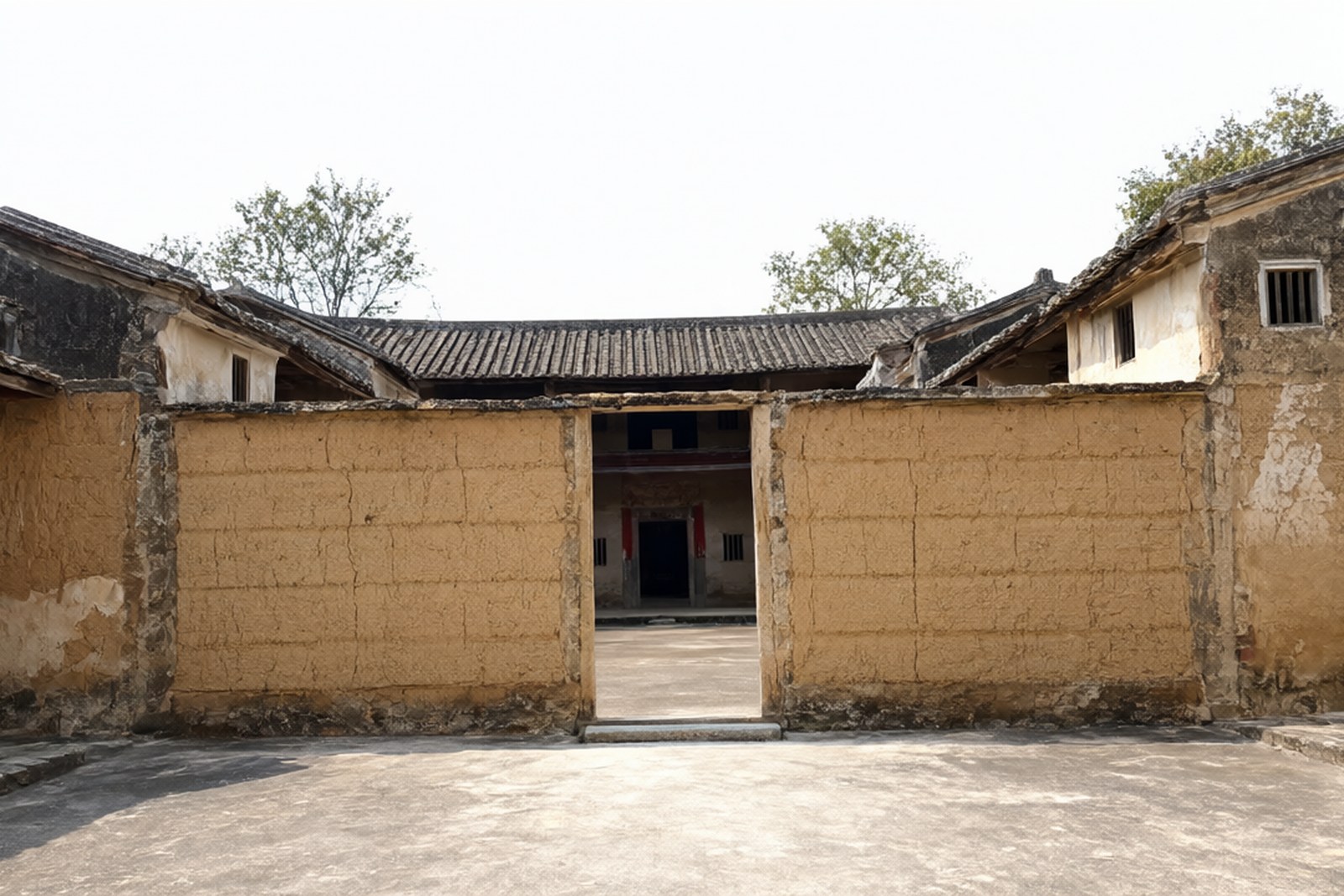
The two showpiece houses are a fortified round-dragon house and a nine-hall mansion. Dunzizhai Dūn zǐ zhài was begun in 1660 and has stood more than 350 years at Duntang village in Shuichun town. The 九厅十八井 jiǔ tīng shí bā jǐng, the nine-hall eighteen-courtyard house, is Dehui House in Tongshuxia village, Hetian town, built for the Peng clan in the Daoguang period; one encyclopaedia dates the start to 1825, and in 2019 it entered the ninth batch of Guangdong’s protected relics. Nine and eighteen are conventions for grandeur, not counts: the house was built for defence in clan feuds.
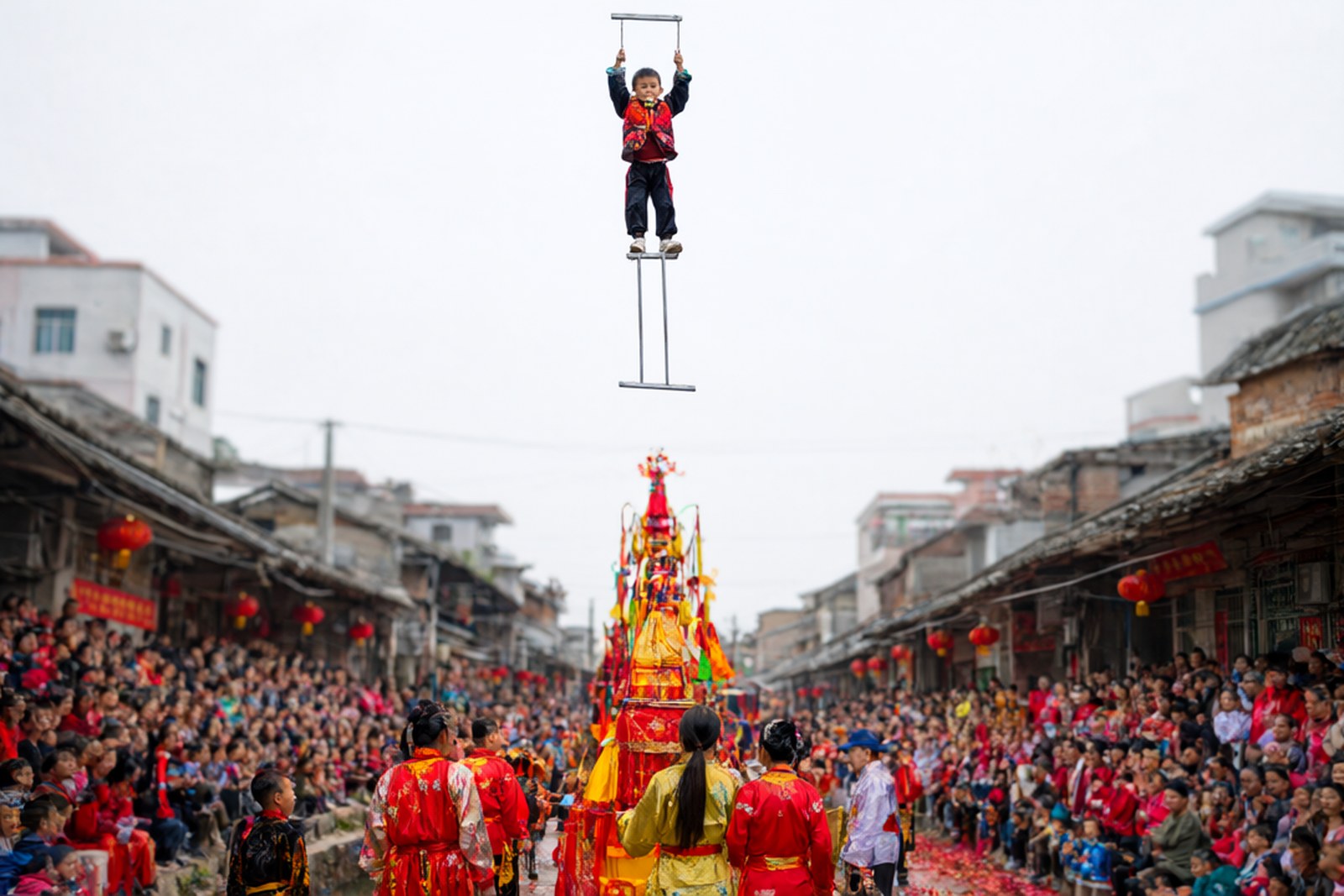
The houses are also a lesson in what time does. Only the central hall survives in reasonable condition, repaired as the Peng ancestral hall of Tongshuxia village; the wings on either side have mostly lost their roofs, so trees show through them, while the thick rammed-earth walls and the west gate are still sound. Near them the county keeps a festival more fragile than the buildings. 河田高景 Hé tián gāo jǐng, the high pole display of Hetian, became national intangible heritage in 2008, and its performers are children: a 景旦 jǐng dàn is five or six years old and hangs seven to eight metres up on a single steel bar six to eight metres long. Its origin has two versions, one placing it at a temple fair more than six hundred years ago, the other at the Guangfu temple fair of 1388 to 1392.
The hills matter as much as the houses, and the county has two that visitors constantly confuse. 火山嶂 Huǒ shān zhàng stands in Hetian town at 763 metres; a two-lane road climbs to a microwave station, and an iron ladder runs from it to the true summit 28 metres away. One township page gives 786 metres instead, which is worth noting rather than adopting. 观天嶂 Guān tiān zhàng, in Shuichun town, is the county’s highest at about 860 metres, with three temples on its flanks: Qingxia cave of the Daoguang period, Shichuan temple on the west, and Guantian temple on the north, rebuilt in 2009. The Nanwan red-bark oak reserve is the largest in China, with a single tree 1.68 metres across at the trunk.
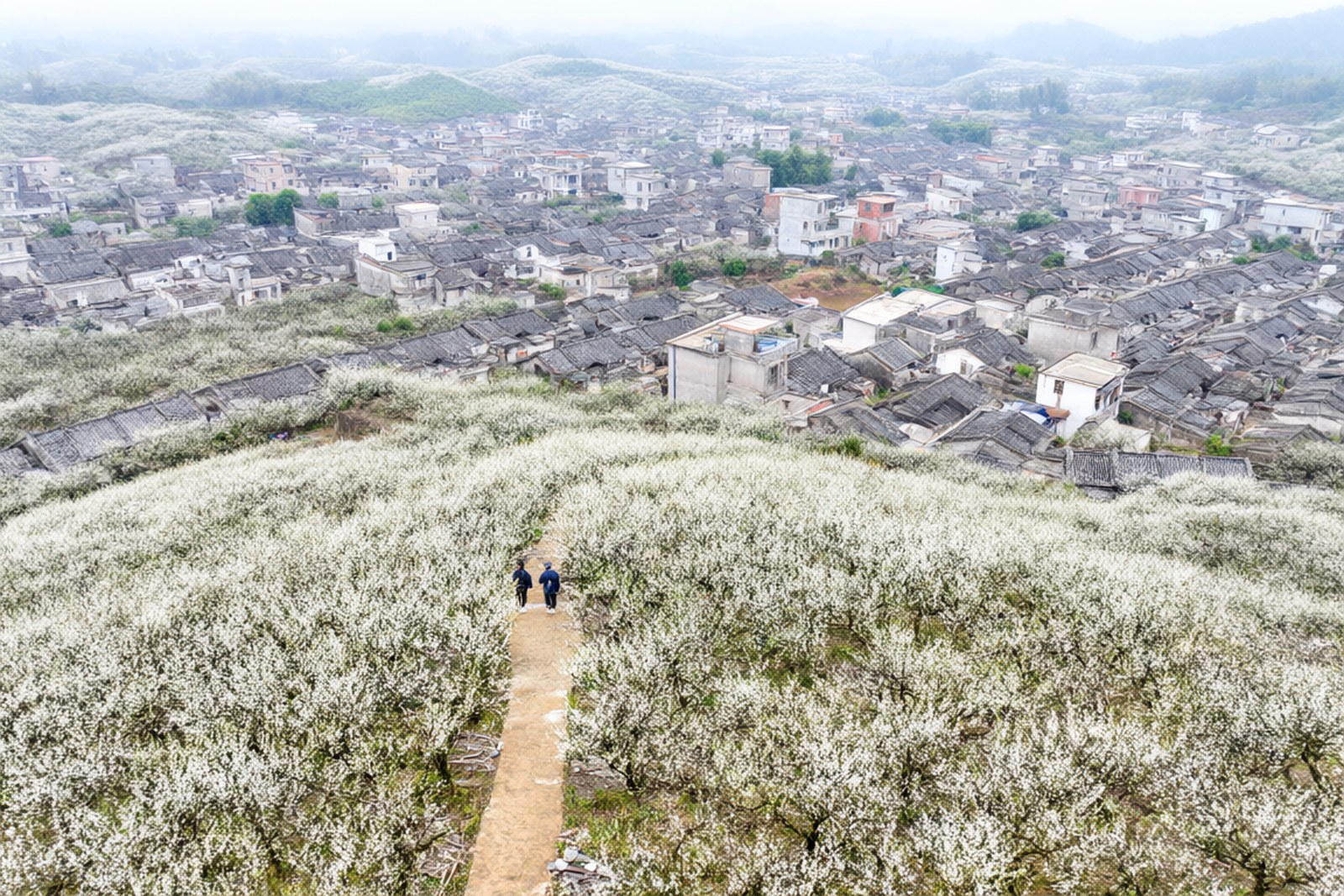
But the plum is what the county is known for, and the figures are worth stating carefully. The planted area is given as more than 100,000 mu in one encyclopaedia entry and more than 120,000 mu with an annual crop of about 20,000 tonnes by the provincial gazetteer office, the two numbers sitting on adjacent pages of the record. The Luhe plum was granted geographical indication protection on 21 December 2005. The blossom concentrates at two villages that back onto the same hill, Gongguang in Dongkeng and Luodong in Shuichun, which between them hold more than 20,000 mu. It opens around 6 January and lasts fifteen to twenty days, so a February visitor sees orchards.
Practicalities
Tickets. The only price with a traceable source is the one for the Luodong plum garden, and it is seasonal: entry is 20 yuan per person during the blossom festival from 1 January to 1 March, with tickets sold from 08:00 to 17:00, students at 10 yuan, and free entry for serving soldiers, disabled visitors, children under 1.1 metres and anyone over 60. A third-party guide claims 30 yuan in season and free at other times, which contradicts the operator’s own notice.
Opening hours. The blossom garden sells tickets from 08:00 to 17:00 in season, the only officially sourced time here. For the hills, a third-party platform shows 06:00 to 17:00 for Huoshan Zhang and nothing official could be found, so treat the road up as a daylight trip. The villages are lived in rather than run, and the right hours are the ones that do not intrude: late afternoon, when the light goes gold on rammed earth and people are home.
Closing day. No closing day is reported for any of it, and for the villages and hills the question does not arise. The one fixed gate is the blossom garden, which charges in season and stays open the rest of the year, so its working calendar is the season itself. The truly seasonal thing here is not a rest day but a fortnight: miss the blossom and the visit belongs to the houses and the hills.
Getting there. The blossom garden at Luodong is reached by the county’s number 4 bus to the Luodong village committee stop. By car from the Chaohui expressway, leave at the Luhe East exit; from the Shenshan expressway, leave at the Xiahu exit and follow provincial road S335 through the county town. The county seat is about 80 km from Shanwei and has no railway station.
Plan this county around a fortnight. The blossom is why most people come and the least reliable thing in the article: it opens in the first week of January and is gone in two or three weeks, and outside that window the hills are green. What does not depend on the calendar is better. Walk the lanes at Tongshuxia and read the gun ports in the wall; eat a bowl of pounded tea in a hillside kitchen; and drive the ridge road above Hetian to a summit. Three cautions: Luhe is not 潮汕 and not Minnan, Huoshan Zhang and Guantian Zhang are different hills in different towns, and the county’s own heritage page still calls Dehui House a hundred-odd years old, which is wrong, since it was built in the Daoguang period.
Getting there: 陆河县 is a Hakka county of eight towns, about 80 km from Shanwei and reached by the Chaohui expressway’s Luhe East exit or by provincial road S335 from the Shenshan expressway; the Luodong plum garden charges 20 yuan per person during the blossom festival with tickets sold from 08:00 to 17:00, the villages, hills, oak reserve and hot springs charge nothing, no closing day is reported anywhere, and the blossom lasts only fifteen to twenty days from about 6 January.