
The Golden Legion on the Tarim: Three Thousand Years of Standing as a Character
一树黄金一树秋,千年骨立大荒流 Yī shù huángjīn yī shù qiū, qiānnián gǔ lì dà huāng liú – Each tree wears a season of gold; thousand-year bones stand where the great desert flows
轮台胡杨林 Lúntái Húyánglín the Luntai Poplar Forest stands on the Tarim’s north bank south of Luntai county – formally the Tarim Huyang national nature reserve, one of the world’s largest contiguous wild poplar forests. Flood seasons soak both banks, the woods run a hundred kilometres along the channel, and from above they read as a golden sash tied around the desert’s waist.
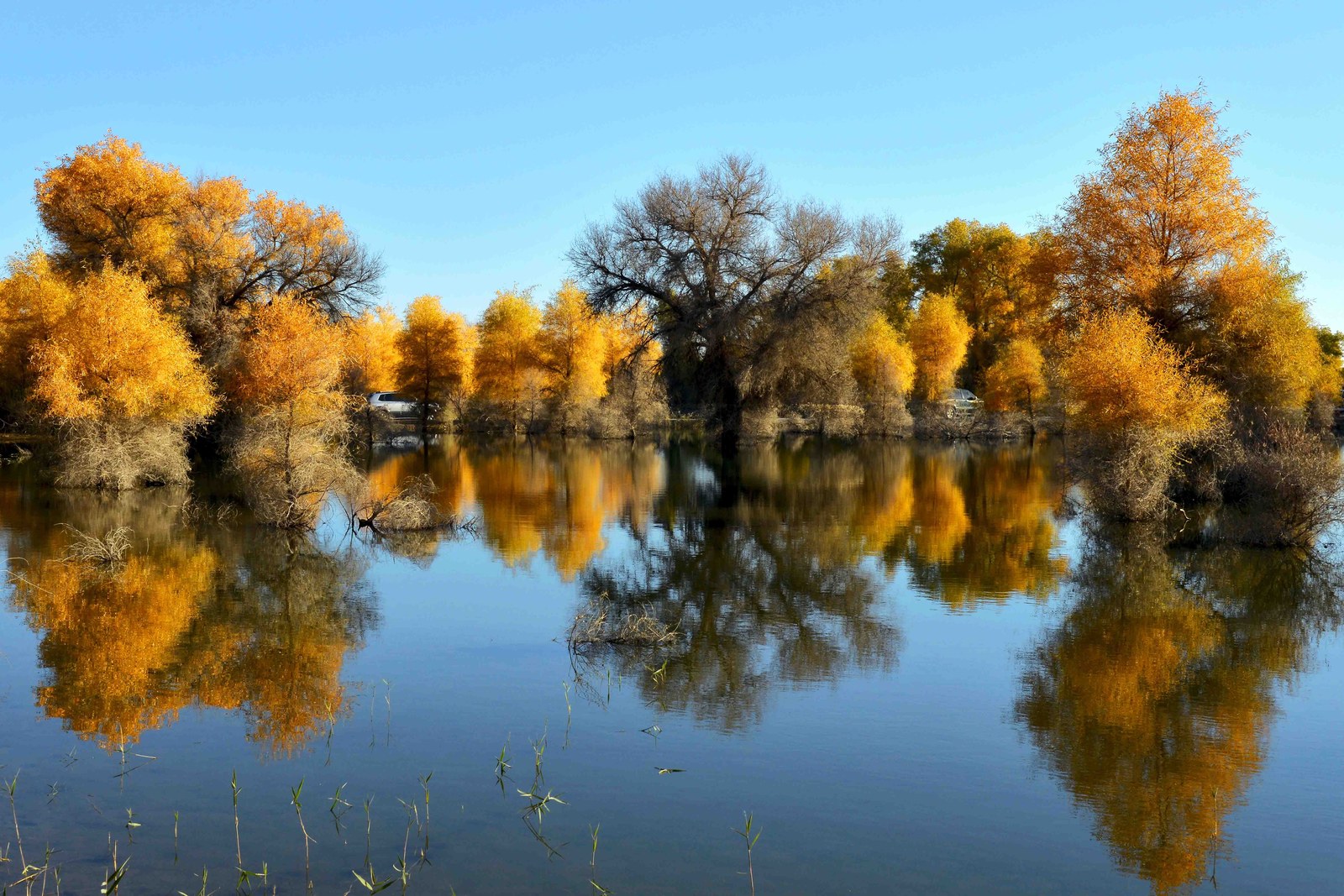
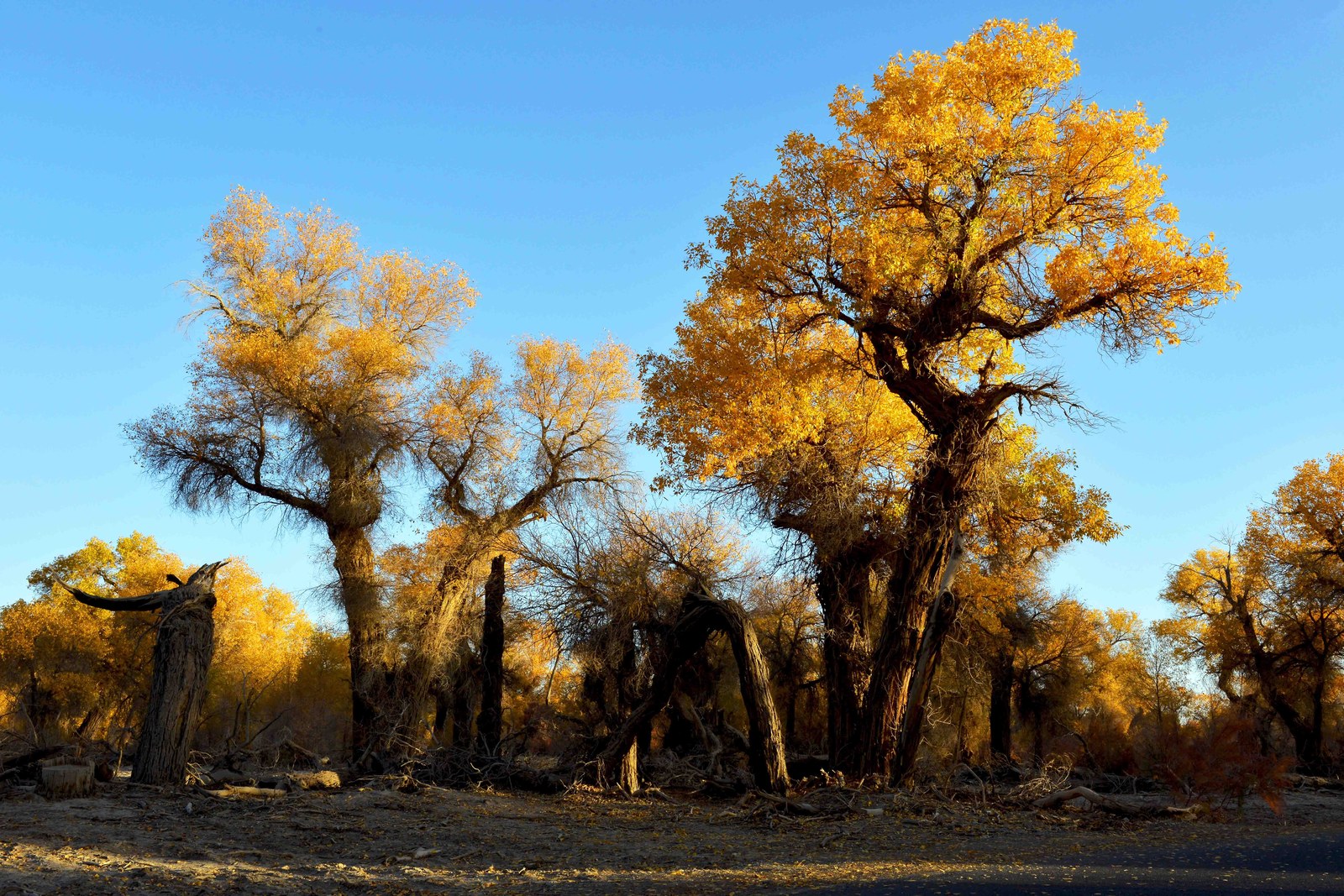
The poplar’s character is written in its shapes: in one stand, some crowns spread like parasols, some trunks twist like dragons, some half-trunks keep a stubborn green. Botanists explain the two-leaf trick – saplings wear willow-thin leaves, mature trees broad poplar ones – the tree’s drought arithmetic. Up close the bark’s cracked lattice is its ledger of wind, sand, and alkali.
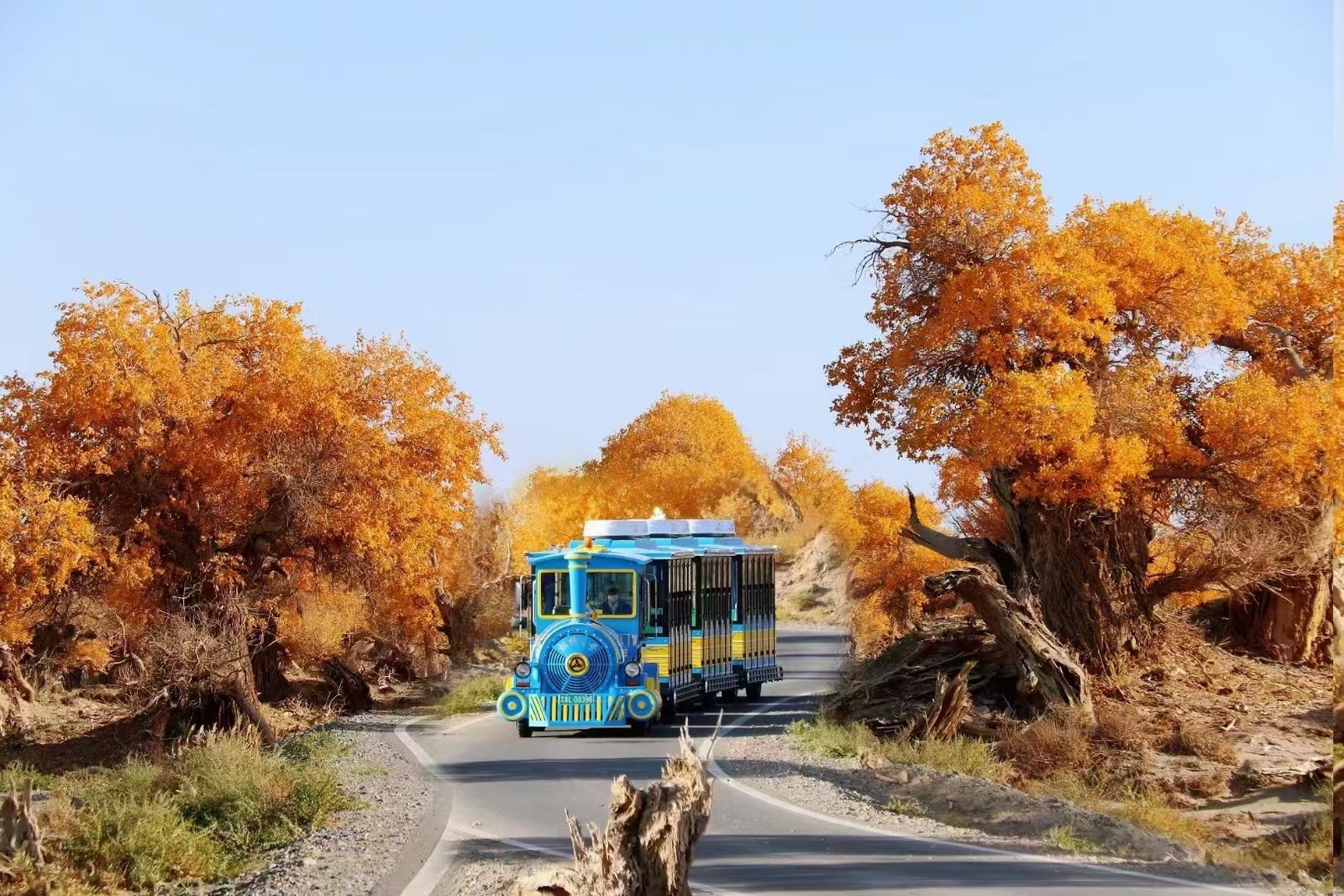
The park’s narrow-gauge train is the signature ride: from the reed station through the densest stand, autumn windows rolling with gold, short-video shooters filming from boarding to landing. Platform zones sort the trees by age, and in the millennium section the 「Poplar King」 needs several linked arms and hides a hollow tall enough to stand in.
Golden autumn is the only headline slot: early October to early November, the leaves run green to yellow to gold inside two weeks once the cold arrives, the whole stand as if set alight. The window is brutally short – a week either way shifts the color a grade. Frosty dawns are the peak: slant light through the gaps lights the leaves translucent, and no shutter rests.
The Desert Highway’s zero-kilometre marker stands south of Luntai town, and the forest is the Taklamakan crossing’s antechamber: shoot the woods all morning, plunge into the highway’s straight emptiness after lunch. Understand the poplars first and 「life-forbidden zone」 reads as respect rather than slogan.
Practicalities: park admission and the sight train price separately, with weekend queues in season – enter early; forest days swing hard, so carry windproof layers; open flame is banned and drones fly only after filing, under the height cap. From Korla it is about 180 kilometres and 2.5 hours, pairing naturally with Lop Nor Village as a poplar-theme day.
The Tarim’s ecology belongs in the story: upstream withdrawals once dried the lower river for decades and the poplars degraded along it; two decades of ecological water transfers have sent the river back down, and new shoots rise from dead roots. The trees’ stubbornness and the human repair play out together here – behind the scenery runs a long rescue.
Autumn color comes in layers: riverside trees, water-rich, turn early and drop early; high-ground trees hold gold another week on deeper roots. Veterans shoot the gradient in three days – waterline, interior, high ground – to collect the whole turn. Day visitors should ride the train deep first and shoot back toward the gate, since the light only gets more golden.
Luntai itself carries history: the Han dynasty’s protectorate seat Wulei stood here, and the county’s name has run unbroken through Chinese poetry since. The town museum is small but lucid on the garrison-farming frontier story – an hour inside thickens everything you see under the trees.
The Tarim river bridge is the panorama position: from the deck the gold bands follow the riverbed to the horizon, backlit water glittering at dusk. There is a proper viewing platform – navigate to legal parking and never stop on the approach spans, truck traffic is real.
Wild poplars outside the park gate hold their own mood: drive the old river channels and pull in anywhere to walk unfenced, wilder-shaped stands with no railings. Park only on hard shoulders, never crush saplings, and pack out every scrap – a forest that stands three thousand years does so because each visitor touches it less.
Practicalities
Beyond the woods, the same 巴音郭楞蒙古自治州 Bāyīnguōléng Měnggǔ Zìzhìzhōu Bayingolin Mongol Autonomous Prefecture holds more: 博斯腾湖 Bósīténg Hú Bosten Lake for the reed banks, 铁门关 Tiěménguān Tiemenguan Pass for the gorge lock, 罗布人村寨 Luóbùrén Cūnzhài Lop Nor Village for the poplar fisherfolk, and 巴音布鲁克草原 Bāyīnbùlǔkè Cǎoyuán Bayanbulak Grassland for the nine-bend swans – four more doors into the same 巴音郭楞蒙古自治州 Bāyīnguōléng Měnggǔ Zìzhìzhōu Bayingolin Mongol Autonomous Prefecture. Tree sea seen, our Bazhou food map sets the table at the forest’s edge.
Practicalities
Words and Names
flowcloud would say the Luntai poplars keep a three-thousand-year promise: live a thousand years standing, a thousand years fallen, and a thousand years even after that, refusing to rot. All checked November 2026.
Getting there: The poplar forest park sits about twenty-five kilometres south of Luntai county town on the Tarim’s northern rim, under two hours from Korla by expressway then county road; October’s golden fortnight draws the crowds, so enter at opening time, and the inner shuttle stops at the dead-tree railway and the river-view towers. All checked November 2026.