
The Fisherfolk at the Tarim’s Tail: Where Lop Nor Descendants Keep Desert and Poplar as Neighbors
胡杨深处有人家,卡盆载月渡流沙 Húyáng shēnchù yǒu rénjiā, kǎpén zài yuè dù liúshā – Among the poplars live fishing folk; the dugout canoe ferries the moon across the drifting sand
罗布人村寨 Luóbùrén Cūnzhài Lop Nor Village stands on the Tarim’s north bank about 35 kilometres south-west of Yuli county town, a folk-park rebuild around the descendants of the Lop Nor people. The Lop people lived by water and by fish alone – no grain, no herds, one dugout poplar canoe (卡盆, kǎpén) as the whole estate. The village moves their old houses, tackle, and beliefs into the poplar woods intact: the most direct window in southern Xinjiang onto an oasis fishing-hunting civilization.
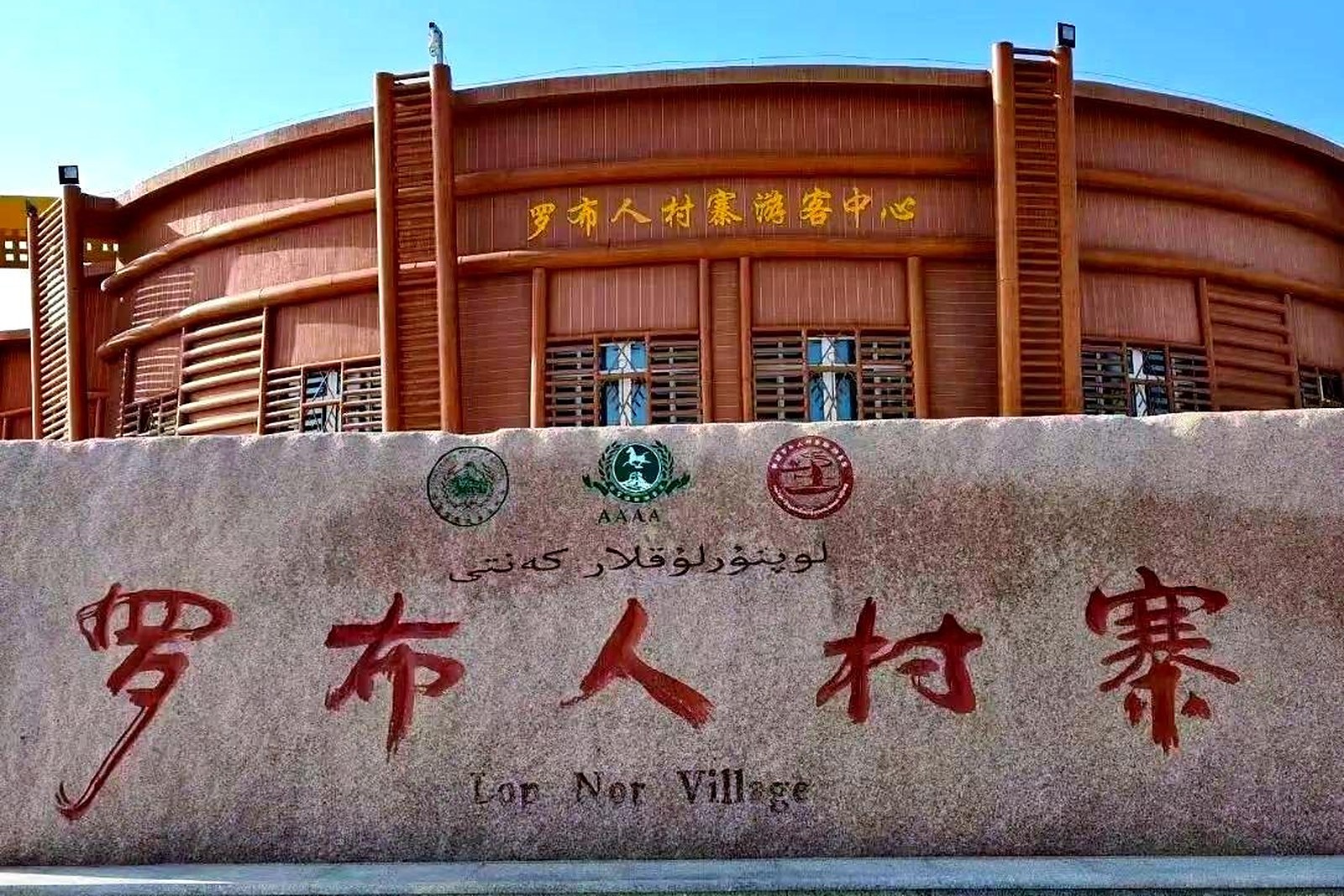
The red-character stele at the gate sets the tone, and inside three lines thread the park: the water line along the old Tarim channel past timber houses and plank bridges, the sand line up the back dunes for the Taklamakan’s breadth, and the forest line into the poplar stand after thousand-year rings. None is long – half a day on foot plus shuttle covers all three, at a slacker pace than most southern-Xinjiang parks.
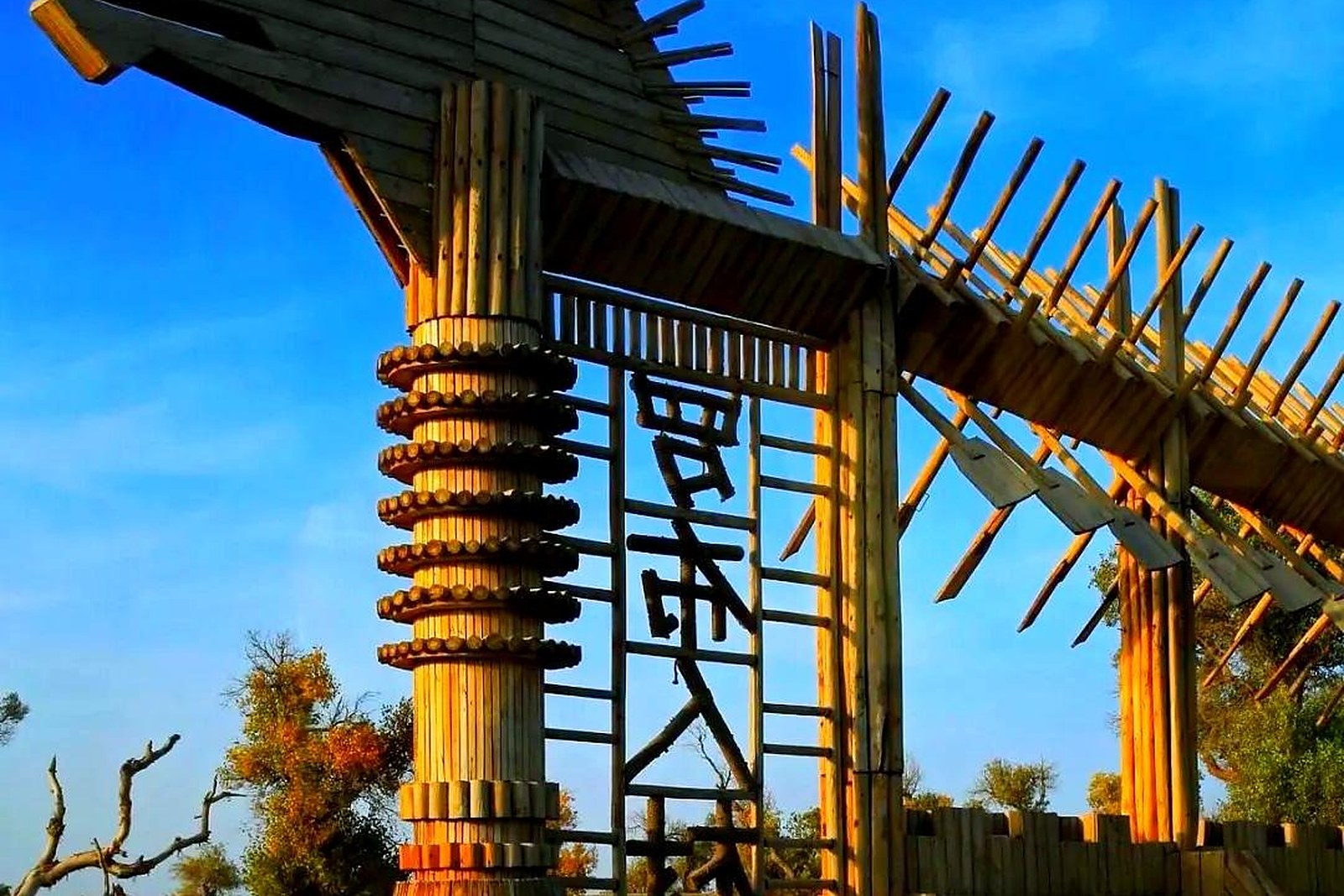
Abudan is the core quarter: a timber arch names the old fishing village, song and dance open in rotation on the open ground, and elders in the tea shed retell their ancestors’ downstream migration in imperfect Mandarin. With luck an old man demonstrates traditional fishing from a kaben canoe, moving so slowly the shutters cannot hurry him.
Lop food runs its own school: whole fish skewered on red-willow branches and turned slowly by the fire, no salt, no spice, fish oil crackling into the flames, the aroma crossing half the village. With fresh naan and tea it is their 「half fish, half naan」 – and the park’s fisher tables serve exactly this, pond-raised Tarim fish over a master’s fire, worth scheduling an empty meal around.
The dunes behind the village are the high point: climb the crest and the north side weaves poplar and channels into a green net while the south side runs Taklamakan gold, two colors shaking hands at your feet. At sunset the sand warms and camel silhouettes cross the ridge – no shutter rate feels sufficient.
Practicalities: combined admission and shuttle is moderate, half a day fits; June dust storms come occasionally, so check weather; camel rides and sand buggies are extra – ask prices before mounting. From Yuli county town the drive is about 40 minutes, paved throughout.
The poplar is the co-star: 「live a thousand years standing, stand a thousand years fallen, lie a thousand years unrotted」 – the three-thousand-year legend maps onto trees all around the park, the living holding gold crowns, the dead stretching bone-white limbs, the fallen still breaking waves at the water’s edge. Photographers can collect all three states in one morning.
The Lop longevity tales travel far – centenarians spearing fish – retold a generation at a time. Science credits clean water, fish, and labor; villagers just say 「the water is sweet and the heart is wide」. Sit in the tea shed and hear it once, and you leave feeling you might live longer yourself.
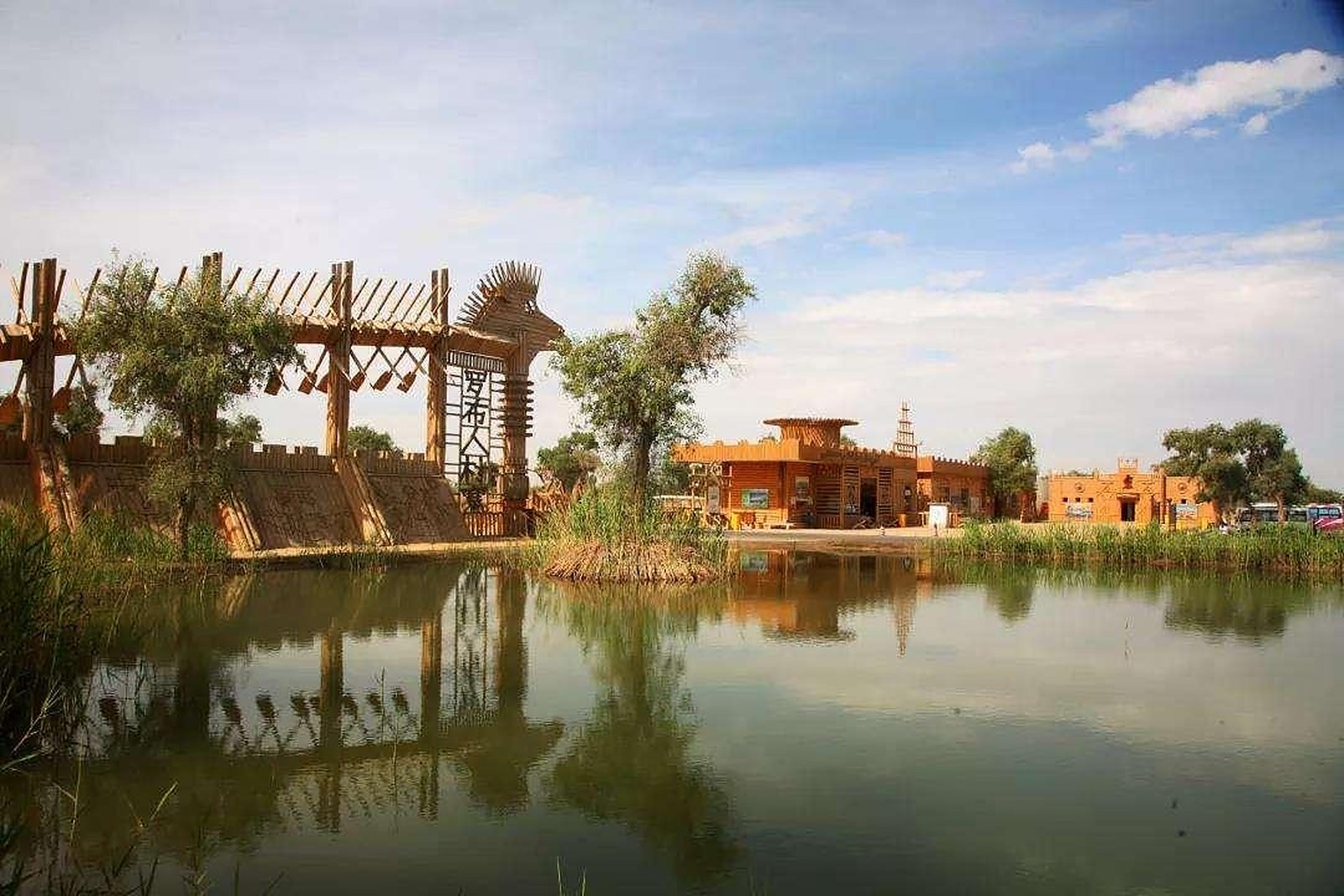
The craft workshops earn a stop: Lop elders weave nets from red-willow twigs, tie reeds into roofing, and carve kaben canoes, and visitors may join a stretch. Fifteen centimetres of netting will tire your hands – the phrase 「one canoe, one lifetime」 turns out to be arithmetic, half a year’s work per boat.
Yuli’s own night market completes the day: on the way back into town turn into the market street, grilled-fish stalls in a line, red-willow fires brighter than the signage. The park shows the fishing folklore, the county night market serves the fishing everyday – together they join this people’s past to its present.
The folk songs deserve a listen: gentle melodies in Lop dialect, mostly about water and fish. After the show ask an elder to gloss the words in Mandarin – where the river goes, how the boat swings – a herding region’s grandeur traded for a fisher tribe’s long patience, instantly recognizable.
Autumn is the park’s best light: poplars fully gold, the Tarim dropping, golden flats surfacing between channels, canoes beached like still lifes. Crowds halve versus summer, rooms and tickets soften, and quiet-seekers should aim for late October.
Practicalities
Beyond the village, the same 巴音郭楞蒙古自治州 Bāyīnguōléng Měnggǔ Zìzhìzhōu Bayingolin Mongol Autonomous Prefecture holds more: 博斯腾湖 Bósīténg Hú Bosten Lake for the reed banks, 铁门关 Tiěménguān Tiemenguan Pass for the gorge lock, 巴音布鲁克草原 Bāyīnbùlǔkè Cǎoyuán Bayanbulak Grassland for the nine-bend swans, and 轮台胡杨林 Lúntái Húyánglín Luntai Poplar Forest for the golden sea – four more doors into the same 巴音郭楞蒙古自治州 Bāyīnguōléng Měnggǔ Zìzhìzhōu Bayingolin Mongol Autonomous Prefecture. Fisherfolk seen, our Bazhou food map rows on to the river catch.
Practicalities
Words and Names
flowcloud would say Lop Nor Village keeps an old deal alive: the river feeds the fish, the fish feed the people, and the poplars stand guard over the whole arrangement. All checked November 2026.
Getting there: The village gate is about thirty-five kilometres south-west of Yuli county town and eighty-five from Korla, mostly on flat paved road through poplar windbreaks; self-drive is easiest, seasonal tourist buses leave Korla in the morning, and the last ferry and camel lines wind down before dusk – allow a full half day inside. All checked November 2026.