
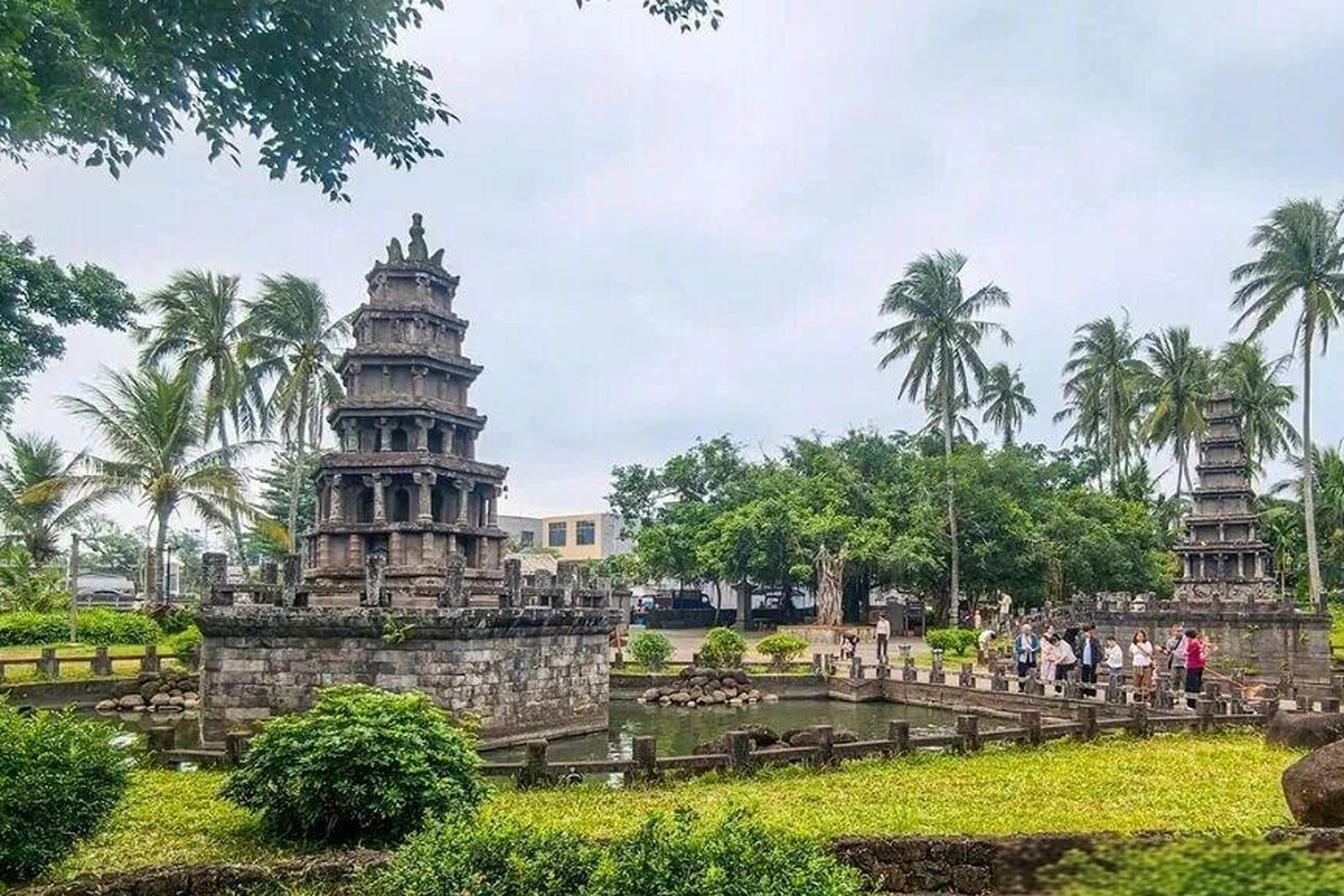
美榔双塔 měi láng shuāng tǎ are two stone towers standing twenty metres apart in a pond in a village in 澄迈县 Chéng mài xiàn, and there is nothing else quite like them on 海南岛 Hǎi nán dǎo. They are older than most of what survives on this island, they are cut and fitted without a drop of mortar, and they were paid for by a father for his two daughters – which is why everyone here calls them 姐妹塔 jiě mèi tǎ, the sister pagodas, and why the official name is 美亭美榔姐妹塔. The pair stand in 美榔村 měi láng cūn, in the 美亭 měi tíng country of 金江镇 jīn jiāng zhèn, about fifteen kilometres out of the county town on the road towards 永发镇 yǒng fā zhèn.
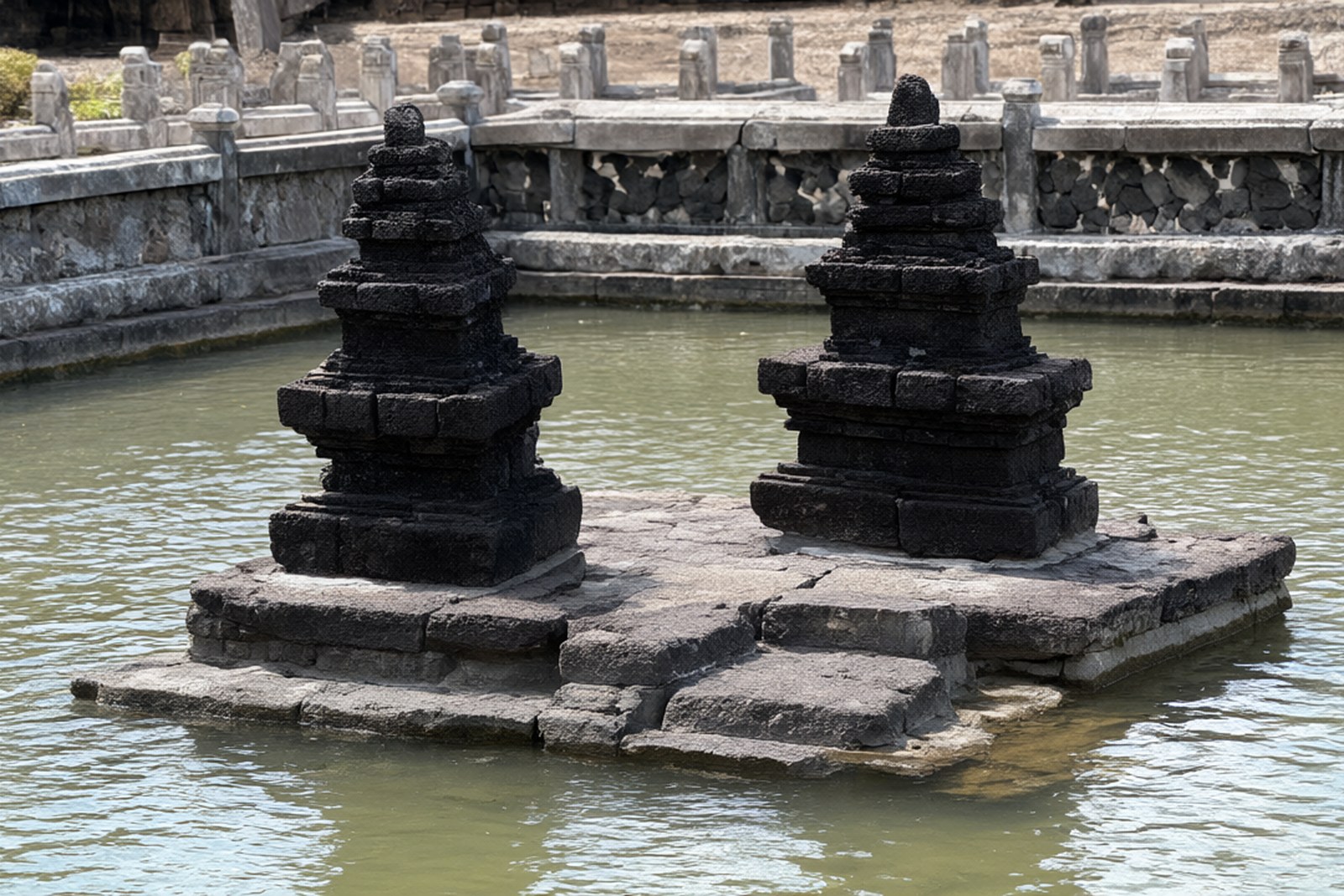
They are Yuan work, and the story is written down. The 正德琼台志 Zhèng dé Qióng tái zhì, a Ming gazetteer of 1506 to 1521, records that a local man named 陈道叙 Chén Dào xù built them in memory of two daughters who had taken up the Buddhist life, and the account has never been seriously disputed because the two towers are so obviously a pair of portraits. The southern one, the 姐塔 jiě tǎ, the elder sister’s tower, faces north-west from the south-east corner: it is hexagonal, six storeys and 13.06 metres high, on a double-tier base with a perimeter of 31.4 metres, and it is built as a hollow chambered tower imitating timber construction, with columns under the eaves of the lower three storeys, half-round pilasters carved on the faces above, and figures of civil officials and generals standing on each of the six sides. The reason the village gives for that is a family story rather than an architectural one: the elder daughter went back to lay life and married, so her tower honours the world, and the figures on it are officials rather than saints. The northern one, the 妹塔 mèi tǎ, the younger sister’s, faces west from the east: square, seven storeys and 13.67 metres, taller than her sister’s despite the smaller plan, standing on a 须弥座 xū mí zuò, a Sumeru pedestal, with guardian figures carrying the tower at the four corners and Buddhist reliefs, lions, elephants and single-horned beasts carved across its walls and its inner chamber. The younger daughter stayed a nun, and her tower is the one full of Buddhas.
Old as they are, they were not built as ruins: the pair stand on a raised platform built inside a pond, which is why their bases are so tall, and the platform is joined to the towers by cantilevered beams with a railing running all the way round the water. The stone is local 马鞍山 mǎ ān shān volcanic rock, cut into blocks and fitted with 榫眼凹凸相接 sǔn yǎn āo tū xiāng jiē, tenon into mortise, dry, with no mortar anywhere in either tower – which is the detail that impresses engineers and is also the reason the towers are still standing seven hundred years later while the timber halls that once stood beside them are not. The site was listed as a 全国重点文物保护单位 quán guó zhòng diǎn wén wù bǎo hù dān wèi, a Major Historical and Cultural Site Protected at the National Level, in 1996, and the study of the pair is one of the pillars of what is known about Buddhist architecture in Song and Yuan 海南.
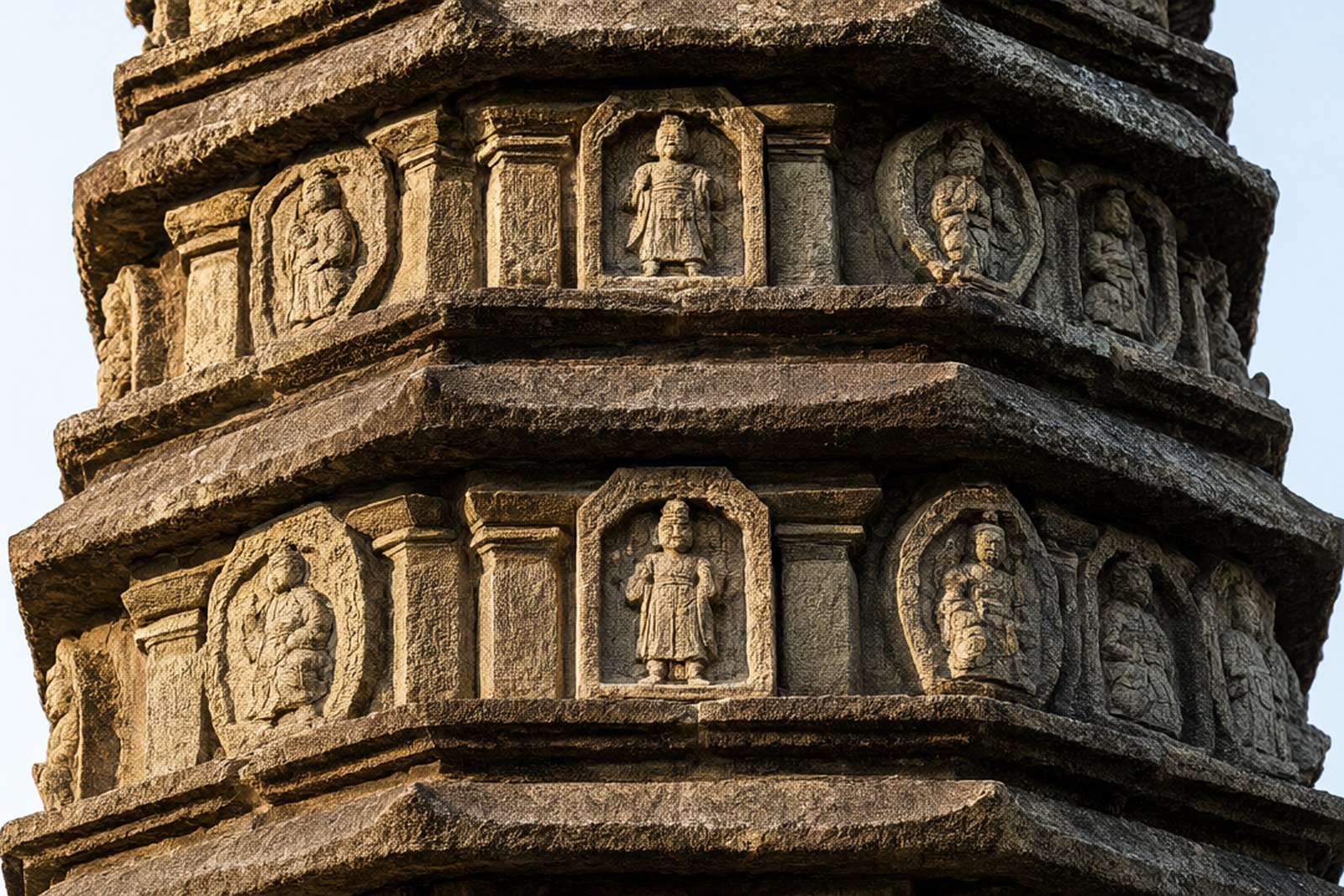
What makes the place worth an hour rather than ten minutes is that almost nobody else is there. There is no ticket office, no gate, no interpretation centre and no closing time: the towers stand at the end of a village lane with a small free car park beside them, and you walk up to them the way you would walk up to anything else in the village. The best light is early, when the water below the platform is still and the reliefs on the 妹塔 read as clearly as they ever will, and the last hour before dark, when the basalt goes black and the figures on the 姐塔 turn into silhouettes against the sky. Between those two hours the county’s own advice is to stay off the site in the middle of the day, which is sensible advice about light and heat rather than about crowds.
Practicalities
Tickets. There is no ticket and no charge of any kind: the pagodas stand in a village, the car park beside the lane is free and small, and the county lists the site as free to enter. Anybody offering to sell you an entrance ticket is not selling one.
Opening hours. The site is open at all hours and has no gate to close. The good light is from about nine to eleven in the morning, when the sun is off the water and the reliefs are legible, and after five in the afternoon, when the light comes in low across the fields; the middle of the day is hot, bright and flat.
Getting there. The pagodas are in 美榔村 měi láng cūn, in the 美亭 měi tíng area of 金江镇, 澄迈县, about fifteen kilometres from the county town and roughly sixty kilometres, or an hour, from 海口市 Hǎi kǒu shì by way of the 西线高速 Xī xiàn gāo sù and then county roads through 美亭 towards 永发镇. The last stretch is a village lane, and the car park at the end of it holds a dozen cars, so it is a drive-in site rather than a public-transport one.
Closing day. There is no closing day, no weekly rest day and no seasonal closure; the site is unstaffed and open continuously. Heavy rain can leave the platform and the lane around the pond slippery, which is the only thing that ever keeps anyone out.
flowcloud would say that the best stonework on the island was paid for by a man who wanted his two daughters remembered, that one tower is full of soldiers because a daughter came home and the other is full of Buddhas because she did not, and that the village has never bothered to put up a ticket office because it has never occurred to anyone here that the pair are not simply part of the lane.
Getting there: 美榔村 is in 金江镇, 澄迈县, fifteen kilometres from the county town at 金江镇 jīn jiāng zhèn on the road east towards 永发镇 yǒng fā zhèn, and about an hour from 海口市 by the 西线高速 and county roads. Drive or take a taxi from the county town – there is no station closer than the coast – park in the free village car park, and go down the lane on foot.