
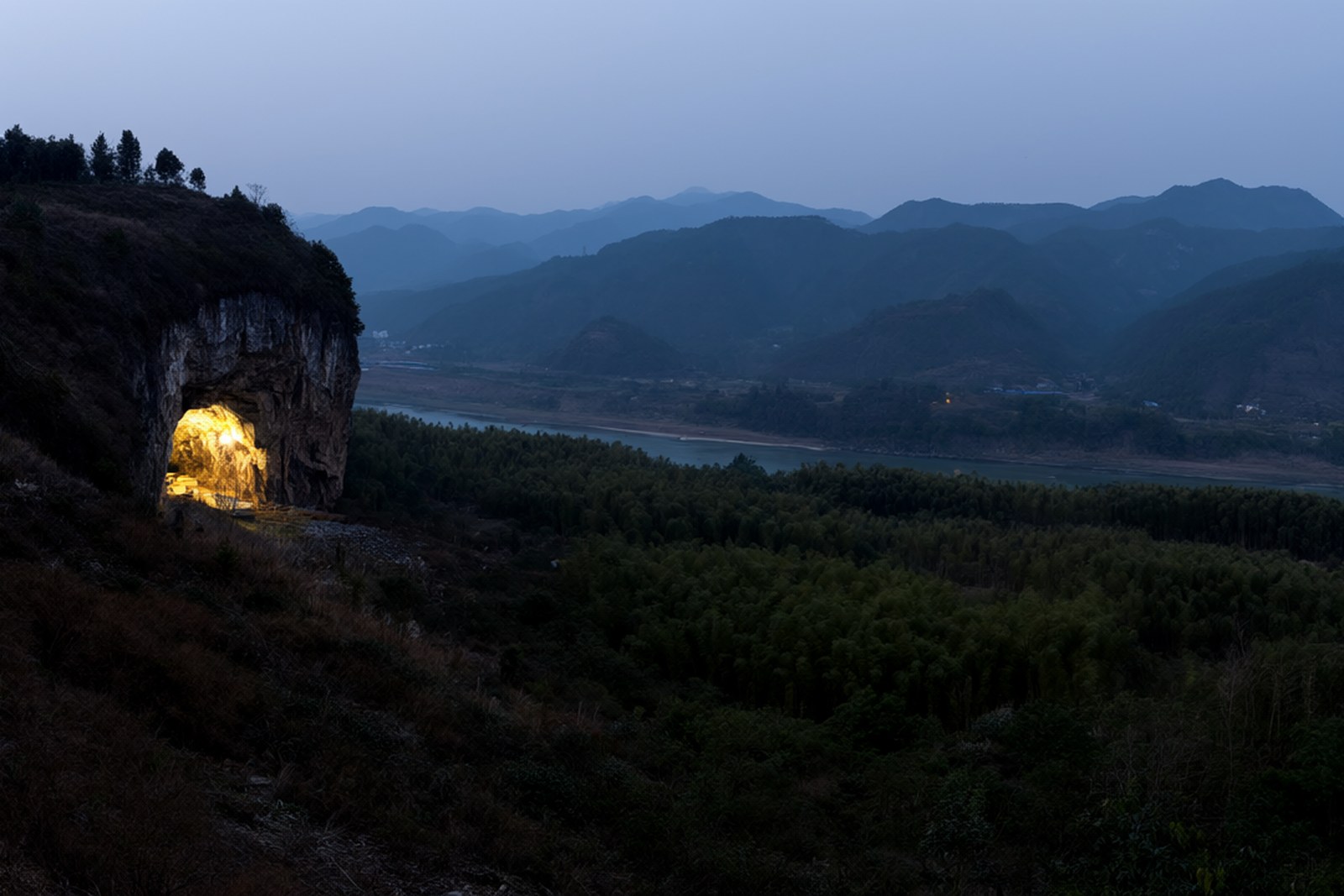
梅山龙宫 méi shān lóng gōng is a cave with nine floors and more than ten thousand separate chambers in it, cut through the limestone under 高桥村 gāo qiáo cūn, a village of 油溪乡 yóu xī xiāng in 新化县 xīn huà xiàn, on the west bank of the 资水 zī shuǐ in the 雪峰山 xuě fēng shān. The name begins as a legend: the Yellow Emperor climbed 熊山 and turned the nine peaks of 九龙峰 into nine green dragons, which swam down into the 资水, liked the look of the 油溪 inlet and stayed in the rock. 新化 was 梅山 in the old books, so the cave became 梅山龙宫. The figures are almost as strange: of 2,870-odd metres of mapped passage, 1,896 are developed for visitors, 466 of those metres are underground river covered by boat, and the developed floor area is 58,600 square metres. It is a national 4A attraction, and in 2005 it joined the national scenic-area list as half of the 紫鹊界梯田梅山龙宫风景名胜区.
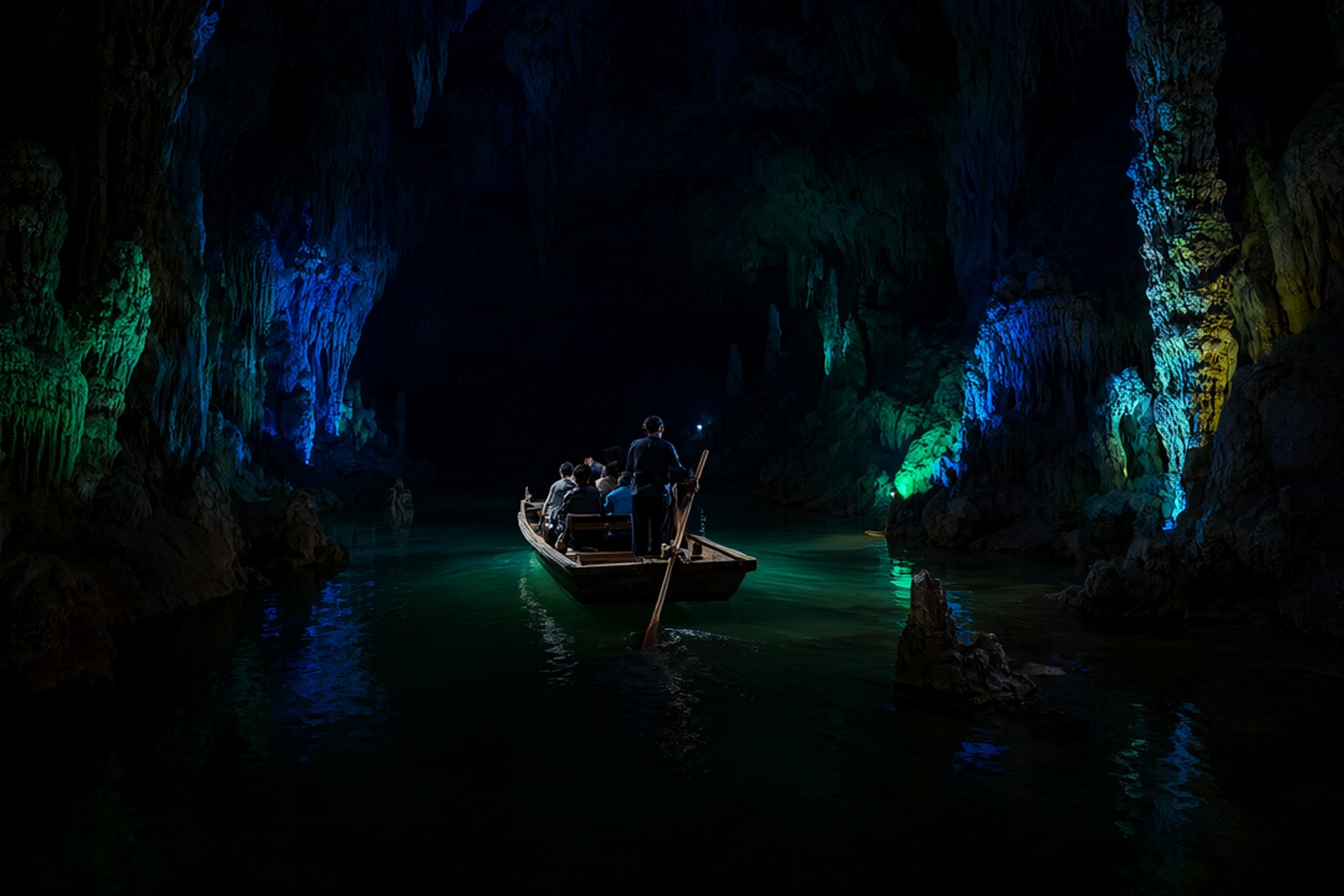
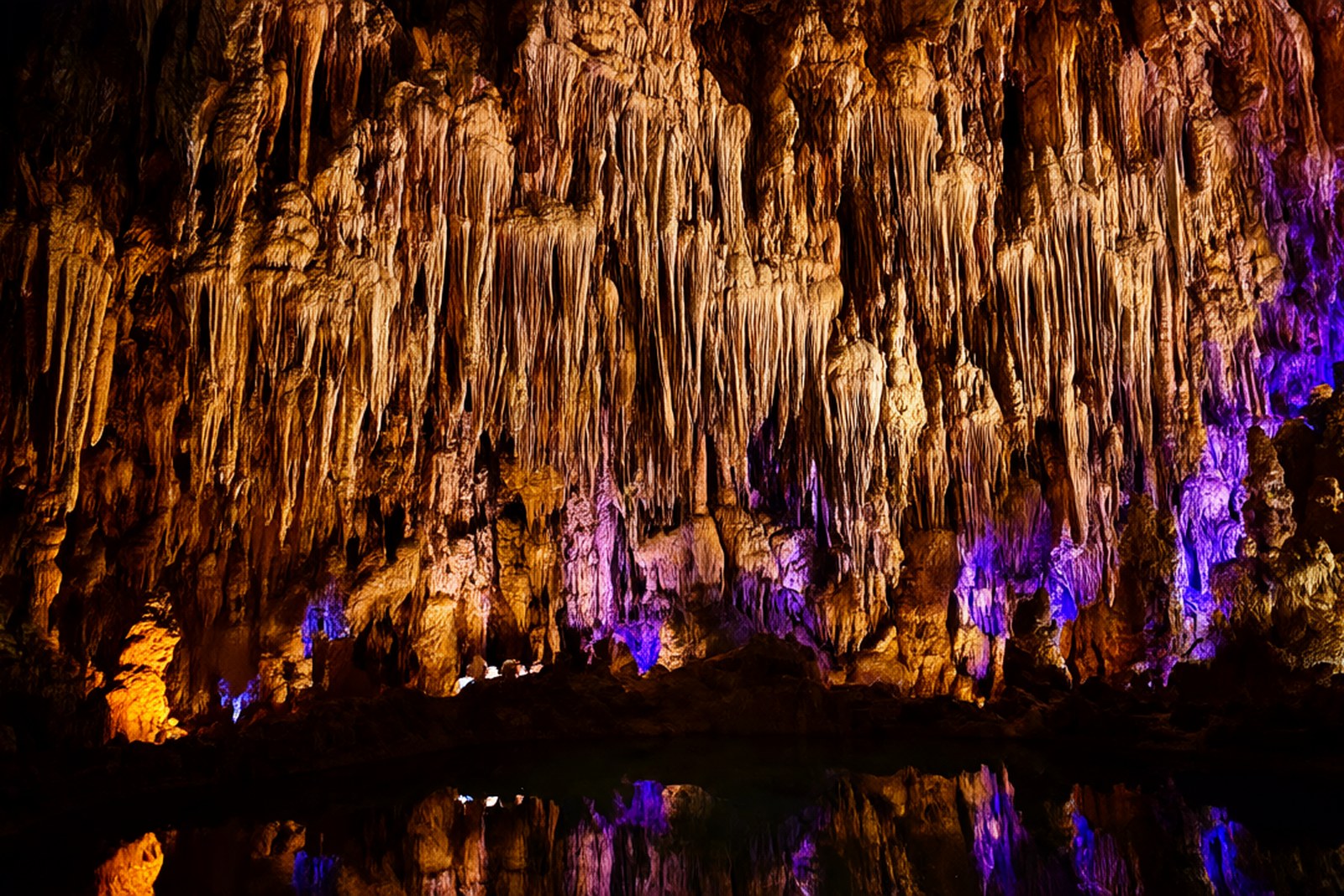
The six zones the guides name – 龙宫迎宾, 碧水莲宫, 玉皇天宫, 龙宫仙苑, 龙宫风情 and 龙凤呈祥 – describe how the cave is stacked rather than where it goes: this is a storey structure, so the dry route and the river run past each other at different levels and a walk inside reads as a sequence of halls with water under the floor. Four things in it are genuinely odd. 峡谷云天 is a chamber eighty metres tall where the roof and the river answer each other. 哪吒出世 is a great natural lotus of stalactite split down the middle, with a red-stained body of stone where the god is supposed to be. 水中金山 is a wall of 鹅管 é guǎn, the millimetre-wide hollow straws that every cave grows first, hanging over a still pool. And 天宫雾淞 is a white deposit laid down not by gravity but by capillary action, which is why it looks like frost on a window. In 玉皇天宫 a bell-shaped stalactite, the 平安钟, holds a 基尼斯 jī ní sī record as the largest of its shape.
A visit takes about two hours and begins on the water before it begins in the cave. The car park is free and large, a boat carries you across to the far bank and an electric shuttle runs the last stretch to the cave mouth, both of them included in the ticket: the 油溪 gorge and the 藏龙谷 valley between the two mountains are part of the scenic area, and it is the hill, the valley and the river together that earned the place a 双遗产 listing as a natural and cultural site. Inside, the route runs dry-footed on walkways and wet on the river, and the boat is the part children remember. The temperature holds at about eighteen degrees all year, so a light layer is worth carrying, and the paraphernalia has followed the 4A grade, down to a small dinosaur park at the gate.
It is 新化’s second headline act after the 紫鹊界 zǐ què jiè terraces at 水车镇, and the two are usually done on the same trip, one underground and one on a hillside. It is also the bigger and more official of the two caves in this prefecture: the other is 波月洞 at 冷水江市, smaller, closer to its city and famous for quite another reason, and anybody with time for both will find they share nothing but the rock. The best months are the shoulder ones, April to June and September to November, when the valley between the car park and the cave mouth is worth the walk; July and August fill the site with groups escaping the heat. Winter is quiet, and a cave has no season, so beyond the odd maintenance morning there is no closing day to plan around.
Practicalities
Tickets. Around ninety-eight yuan for an adult and around forty-nine at the concession rate, which covers children over 1.4 metres, full-time students and the sixty-to-sixty-four bracket; the under-1.3-metres and the over-seventies go free. The underground boat is included in the full ticket and can also be bought on its own, and this is a state-listed scenic area rather than a free cave, so there is no way round the gate.
Opening hours. The cave opens at 8.30 in the morning and the gates shut at five, with last entry about half past four; the county’s literature advertises a half-past-six close in the high season, so treat the closing time as something to confirm at the gate. Two hours is enough for the loop and an hour and a half is not, because the boat and the shuttle run to a headcount rather than to a timetable.
Getting there. The cave is at 高桥村 in 油溪乡, 新化县, on the west bank of the 资水 about forty minutes from 新化县城 xīn huà xiàn chéng, the county town: 娄怀高速 lóu huái gāo sù to the 新化 exit, then S217 and county road X035 down to 油溪乡. By rail the Shanghai-Kunming high-speed line stops at 新化南站 xīn huà nán zhàn and the ordinary line at 新化站, and from either the last leg is a bus from the county’s east bus station or a taxi. Parking is free and takes coaches.
Closing day. There is no weekly closing day and no seasonal closure; the cave opens every day of the year and only loses the odd morning to maintenance in the slow weeks of winter. A typhoon remnant bringing heavy rain to the 雪峰山 can shut it for a day or two, which is rare this far inland but not unknown, so telephone if you are driving a long way to reach it.
flowcloud would say that the county put a dinosaur park at the gate of a cave that spent half a million years balancing its own roof, and that both are honest in their way – but that the thing worth the drive is the 466 metres of dark water you cross by boat with the ceiling lit above you like a street at night.
Getting there: 梅山龙宫 is at 高桥村 in 油溪乡, 新化县, 娄底市, on the west bank of the 资水 in the 雪峰山; leave 娄怀高速 lóu huái gāo sù at the 新化 exit and follow S217 then X035 to 油溪乡, about forty minutes from the county town and roughly two hours from 长沙 cháng shā. 新化南站 on the Shanghai-Kunming high-speed line is the nearest railhead, with buses from the county’s east bus station for the last stretch, and the car park at the site is free and large.