
Muse Lake Mù sè hú lies in the southwest of 屯昌县 Tún chāng xiàn, Tunchang county, in Fengmu town Fēng mù zhèn, about twenty-five kilometres from the county town along the old central highway everyone still calls the G224. Tunchang is one of the few counties in Hainan with no coastline: it is inland, ringed by low hills and reservoirs instead of surf, and its best-known scenery is therefore fresh water rather than a beach. Muse Lake is not a natural lake. It is the Muse Reservoir, cut across Qingti Creek, a second-order tributary of the Dabian River and so eventually of the Wanquan River, which reaches the sea on the far side of the island. Work began in April 1958 and finished in October 1969, with a pause of more than four years in the middle, which makes the lake both a landscape and a document of the great water-building years.
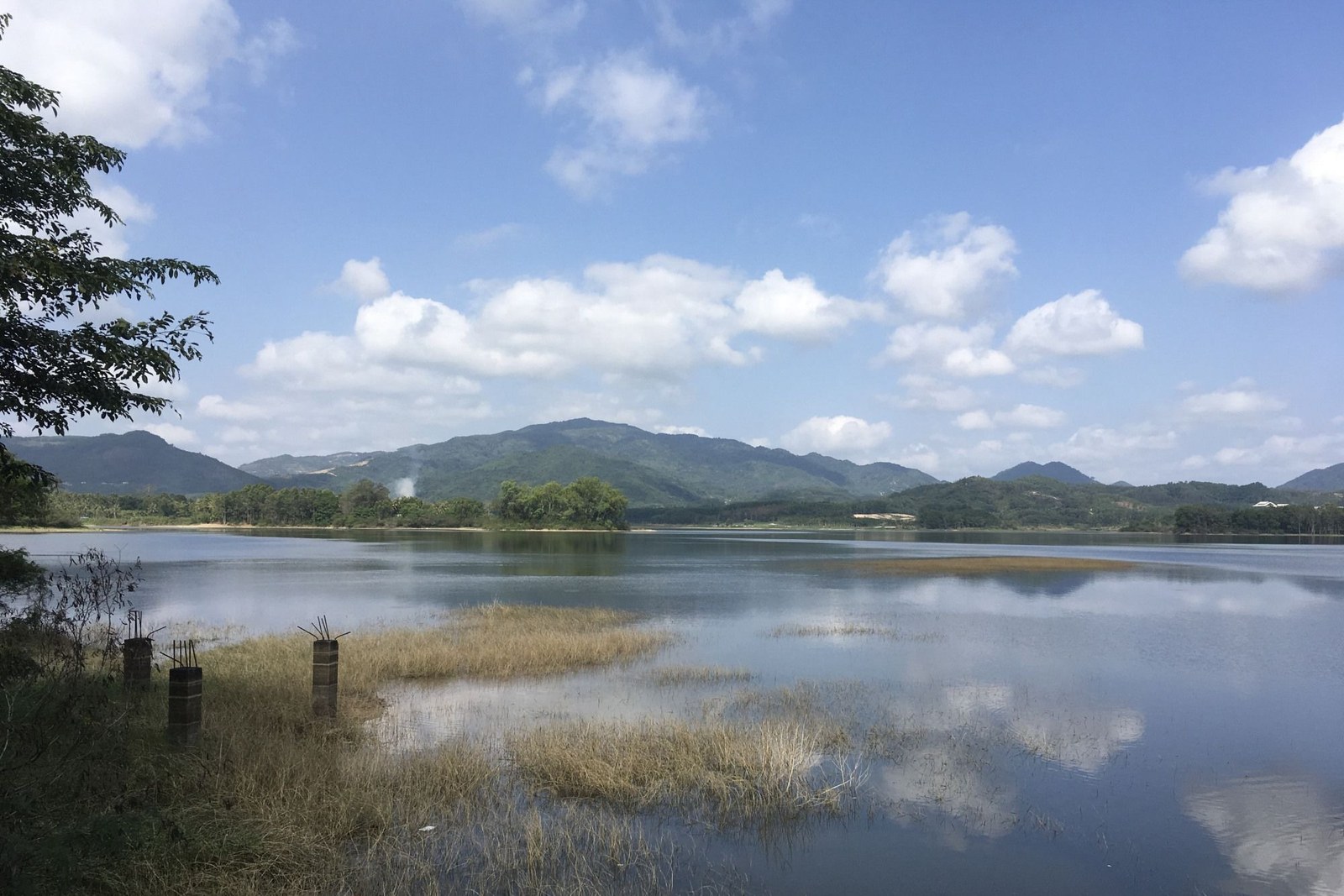
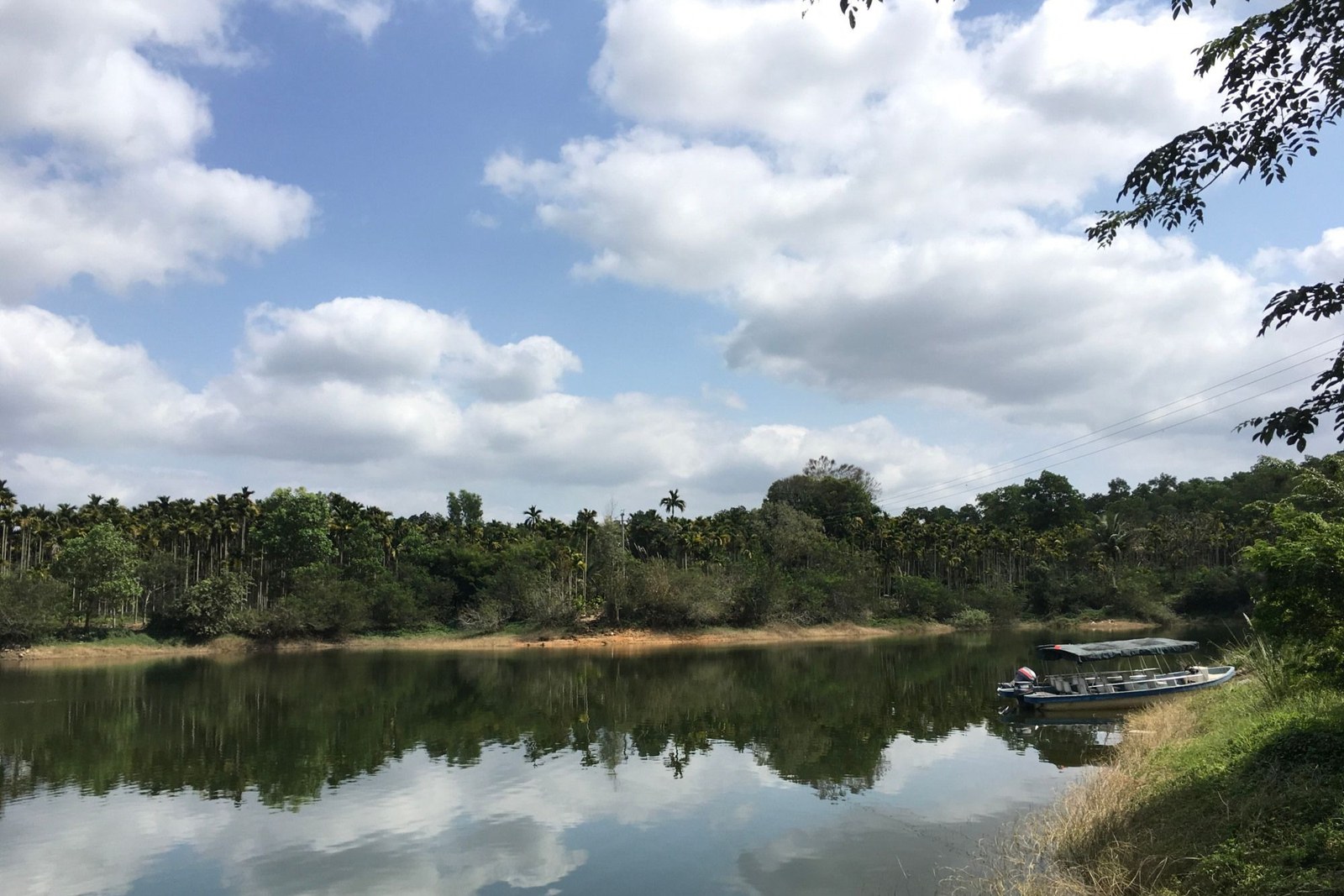
Two lakes, not one, form the core of the area, and running them together is the commonest mistake visitors make. Leigongtan Lake Léi gōng tān hú, Thunder God Shoal Lake, stands within about two kilometres of Muse Lake, with a surface of roughly 1.6 square kilometres against about three for Muse, and the difference in level between them is ninety-two metres, so the two reservoirs step down the valley like a staircase. In the gap a waterfall runs all year, loud enough that the noise gave the lower lake its name: 雷公滩, the shoal of the thunder god. The county’s own water files hold the hardest figures. Muse Reservoir gathers a catchment of 30.84 square kilometres, 12.54 of which drain to the Leigongtan dam above it; it holds 24.5 million cubic metres at full supply; its main dam crest runs 484 metres, with one auxiliary dam of 314; the power station has three turbines and 500 kilowatts; and the irrigation design reaches 51,100 mu of fields in four towns.
The lake itself is usually given as about three square kilometres of open water, the figure used by Hainan Daily and by the standard geography of the island. A much larger number, 5.7 square kilometres, circulates online and traces to a machine-written round-up that no official source supports, so it should be discarded. The protected area is even less settled, and the honest way to state it is as a range with the authority attached. The provincial government’s approval of September 2025 fixes the scenic area at 37.71 square kilometres, the highest authority available; the county’s 2018 paper said 37.02, Hainan Daily said 36 in 2014, an economic daily said 36.8 in 2012, and the encyclopaedia entry still prints 28. In 2022 the province added 1.91 per cent to the area and brought in new features including Jizui Ridge and Shuangfeng Ridge.
The deer are the other half of the visit, and they live on a peninsula. The Fengmu Deer Farm Fēng mù lù chǎng was founded in the spring of 1963 on a neck of land with water on three sides, with a brief that sounds strange now and made sense then: to protect, breed and hunt, in that order, turning wild Hainan sambar from the mountains into a managed herd for medicine and meat. The founding party numbered fifteen or sixteen people and owned not a single deer. A capture team went into the ranges of Baisha county and came back empty-handed, so the farm began buying animals from people in the hills instead, and by 1972 it had bought 237 wild sambar. In November 1971 thirty-one sika deer arrived from Jilin in the far northeast and bred successfully. The latest official headcount, given to Xinhua in September 2026, is 217 sika deer, 66 sambar and 16 macaques.
What has changed is the shore around the deer. A long retaining wall along the dyke has been painted in bands of colour, the rainbow dyke, now the most photographed thing in the county; a branch of a local coffee chain serves at the water’s edge; and a rural resort at Dakuai village opened for trial operation on 30 December 2023 with a farm carnival park and a lakeside camp. Provincial paddleboard gatherings have been held here since 2021, and since 2023 the Fengmu bitter melon festival has used the lake as its venue. Two older stories belong to the water. One explains the deer farm as a response to mushrooms on the hills, which drew the deer down until villagers led them home and a flute called them back. The other is 东坡石, Dongpo Stone, which local telling ties to the Song poet Su Dongpo; no gazetteer supports the inscription, so enjoy it as folklore.
Practicalities
Tickets. There is no admission charge. The scenic area is listed as free to enter by every official account, and the deer farm, the one enclosed part of it, costs nothing to walk into; commercial extras are priced separately, with a bag of feed for the deer quoted at about twenty yuan. A rumour of a thirty to fifty yuan gate price traces to a machine-written summary rather than to the county, so treat ticketing as free but changeable and read the board at the entrance.
Opening hours. The lake, the dyke and the shore road are open all day, every day, and there is no gate to close. The deer farm keeps shorter hours and is the only part with a timetable: sources give 08:00 to 17:00, with one variant of 08:00 to 17:30. No official posting from the county tourism office could be found for either figure, so arrive in the morning, when the animals are active and the mist is still on the water.
Closing day. No closing day is reported for any part of the Muse Lake area, and none exists in the ordinary sense, because the lake is a reservoir with a public road along it and the farm’s rest day, if it has one, is not published. The one thing that closes the place is weather: the shore road and the dyke are exposed, and the county sits in a basin where rain arrives quickly.
Getting there. The scenic area lies beside the old central highway at roughly the 110 to 112 kilometre mark, about twenty to twenty-seven kilometres southwest of Tunchang town depending on the source, with twenty-five kilometres the sensible planning figure. Coaches between Haikou and the island interior stop at Fengmu town, and the documented advice is to get off there and continue by local transport; no reliable timetable for those connections could be found, so ask at the stop. By car from the county town, allow about half an hour.
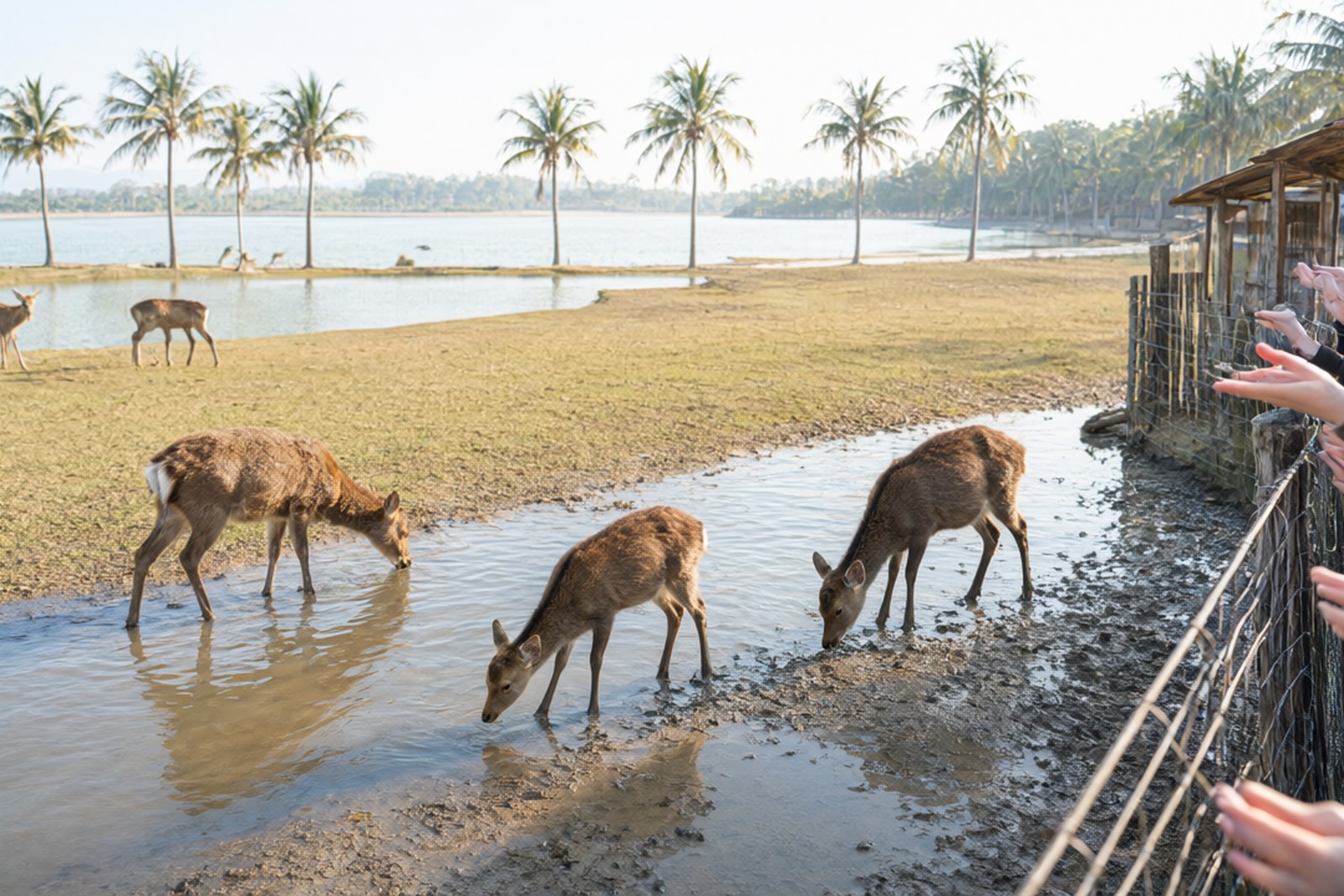
The best two hours here are the first two, before the sun is high. The hills hold their mist, the painted dyke makes a hard bright line across a soft grey lake, and the deer come down to the shallows on their peninsula to feed with the water behind them. There is nothing to do at Muse Lake except look at it, and that is the point. It is a reservoir built by hand in the 1950s and 1960s, repainted in the 2020s, and still doing the job its engineers gave it, which is to hold water for the fields of four towns.
Getting there: Muse Lake and Leigongtan Lake lie in Fengmu town about 25 km southwest of Tunchang town, beside the old central highway near the 110 to 112 km mark; coaches toward the island interior stop at Fengmu, the lake and dyke are free and always open, the deer farm keeps 08:00 to 17:00 hours, and no official ticket price or timetable is published.