
The Badge on the Square: Yancheng’s New Fourth Army Memorial
铁军东进大江东,一馆军徽映碧空 Tiějūn dōngjìn dàjiāng dōng, yī guǎn jūnhuī yìng bìkōng – The Iron Army marched east across the river; one hall’s badge emblem reflects against the blue sky
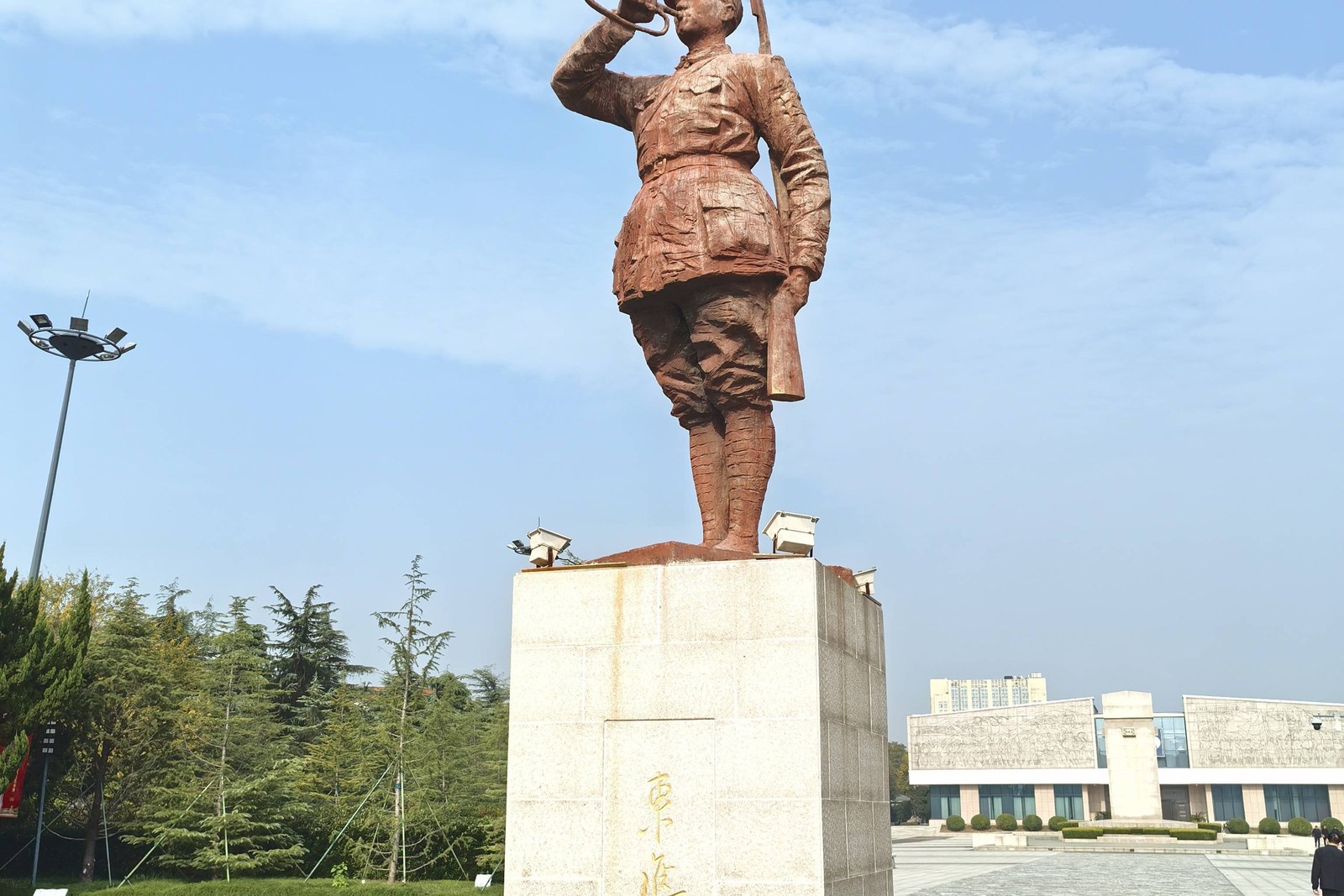
正文:新四军纪念馆 Xīnsìjūn Jìniànguǎn the New Fourth Army Memorial stands on Jianjun Square at the centre of Yancheng – the national memorial to the force that regrouped in this city in 1941 after the Wannan Incident and carried the war in the river provinces through the rest of the war years. The main hall is built in the shape of the N4A cap badge, its granite walls carved with relief panels, and around it the square assembles the set pieces: the bugler statue with the bugle lifted, the group sculptures of commanders, and the flag line where official ceremonies still gather. Inside, exhibition halls run the army’s whole story – the formation, the southern campaigns, the rebuilding in Yancheng – with weapons, documents, uniforms and photographs in dense chronological order.
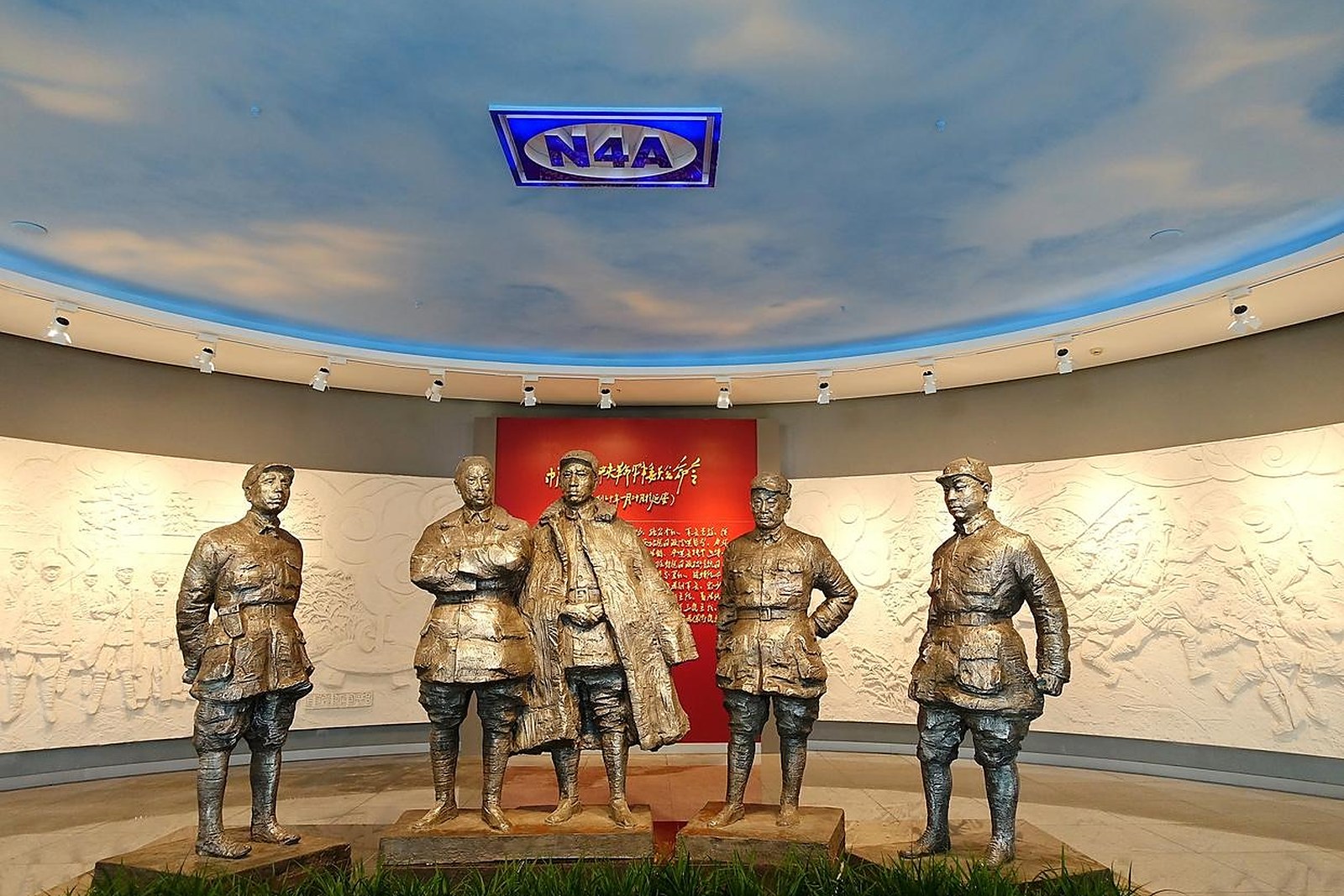
The main building reads first. The badge-shaped facade with its carved reliefs faces the square, the “N4A” characters set high above the entrance, and the interior rotunda opens on the bronze group statue of the commanders beneath a ceiling emblem. It is a building designed to be read from across the plaza, and the scale holds up close.
The exhibition halls carry the weight. Galleries follow the army’s campaigns through the Yangtze delta, the underground printing and hospital networks, and the civilian networks that moved messages and wounded men along the water towns; the exhibits label their units and dates with precision, and English panels are minimal – the objects and the layout tell the sequence regardless of language.
Around the square the story steps outside: the bugler statue that has become the city’s shorthand, the relief walls along the plaza edge, and across town the reconstructed Army Headquarters at Taishan Temple, where the rebuilt command worked in 1941-42. Entry is free, weekdays are quiet, and the memorial pairs naturally with the city’s water street and food lanes for an afternoon that balances squares and sides.
Practicalities
Beyond the halls, the same 盐城市 Yánchéng Shì Yancheng City keeps more doors on the map: 丹顶鹤保护区 Dāndǐnghè Bǎohùqū the crane reserve, 大丰麋鹿保护区 Dàfēng Mílù Bǎohùqū the elk reserve, 条子泥 Tiáozǐní Tiaozini’s heritage flats, or 荷兰花海 Hélán Huāhǎi Holland Flower Sea’s spring colour – four more doors into the same 盐城市 Yánchéng Shì Yancheng City. Once the galleries are walked, our Yancheng food map fills the day.
Practicalities
Words and Names
flowcloud would say the memorial keeps its subject at street scale: a badge you can walk into, a bugle you can stand beside, and a city that remembers which winter the army rebuilt here. All checked November 2026.
Getting there: The memorial stands on Jianjun Square in central Yancheng, two stops from the railway station by bus and walkable from downtown hotels; entry is free with ID and the halls close around late afternoon, so give the main building two hours and add the former headquarters sites across the city if time allows. All checked November 2026.