
Nanshan Cultural Tourism Zone
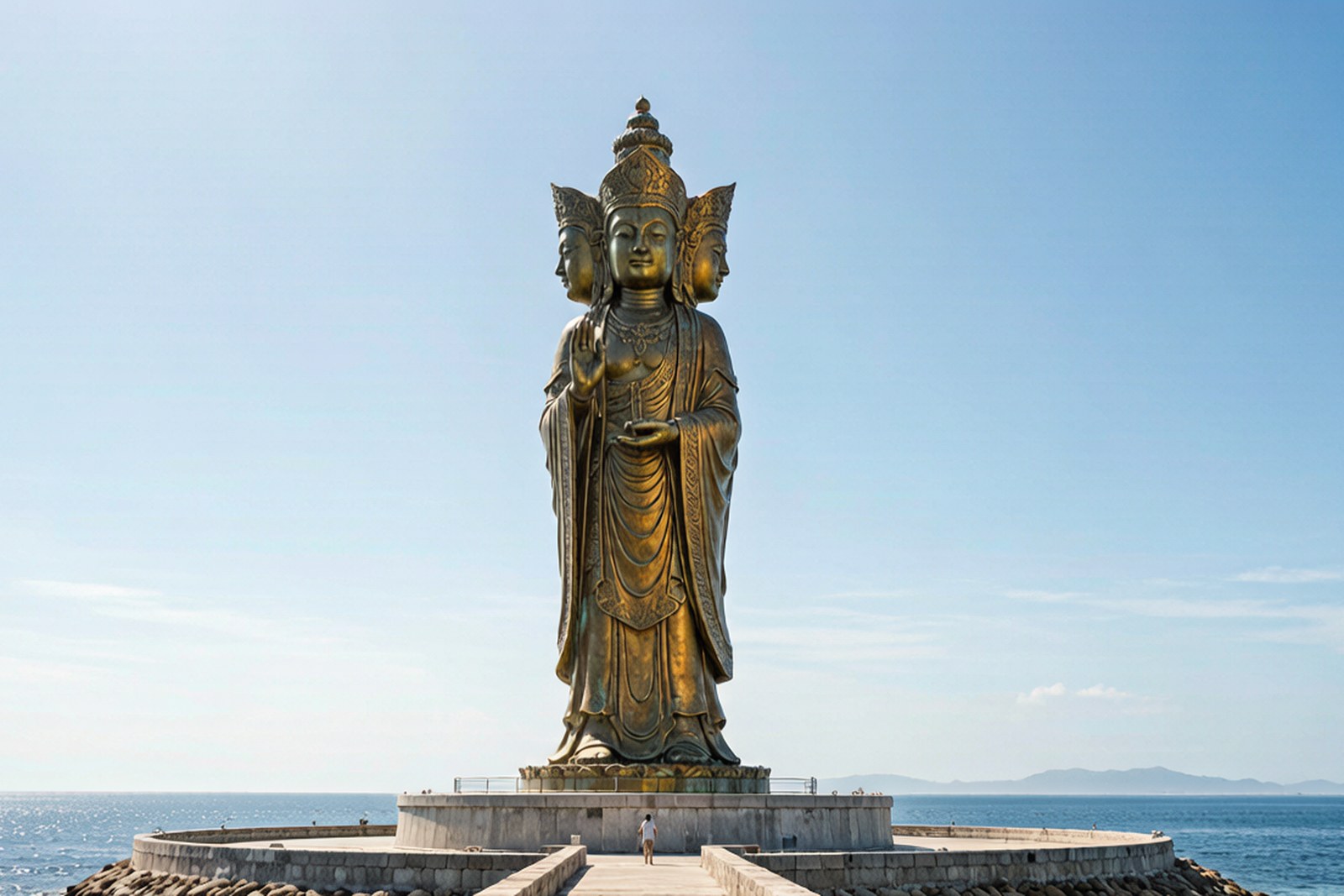
Standing at the foot of it, you have to tip your head all the way back. The statue is a hundred and eight metres tall — the height of a thirty-storey building — cast in bronze and finished in gold, standing on its own artificial island in the sea, and she is looking north across the water toward the mainland.
This is 南山海上观音 (the Nanshan Sea Guanyin), and it is the reason 南山文化旅游区 exists. The park around it — a national 5A scenic area — was laid out from scratch starting in 1995 around a single idea from the old phrase 寿比南山, “may you live as long as the Southern Mountain”, a blessing that every Chinese person has heard and that Sanya has spent thirty years monetising very effectively.
The Three Sides of the Figure
The 海上观音 is the anchor, and it is worth understanding before you go, because the detail is the interesting part.
She has three faces, turned to three different directions, and each holds a different implement: one holds a 经箧 (jīng qiè, a sutra box), one a 莲花 (lián huā, lotus), and one a 念珠 (niàn zhū, prayer beads). The reading is traditional — the three represent wisdom, peace and compassion — and the statue is positioned so that each face looks toward a different shore. From the causeway that leads out to the island you see her full height; from the beach you see her from below, with the sea breaking at the base.
The figure was completed in 2005. The base is a hall you can walk through, and the whole thing stands on a man-made island connected to the shore by a bridge, so the approach is a walk out over the water with the statue getting larger the whole way. Whatever you think about monumental religious sculpture, the scale works; it is genuinely impressive in the way the designers intended.
The Rest of the Park
The statue is one component of a large site, and the park is laid out over several square kilometres of coast between the mountain and the sea. The 观光列车 (sightseeing train) loops the whole thing with six stops, and you want it, because the distances are real.
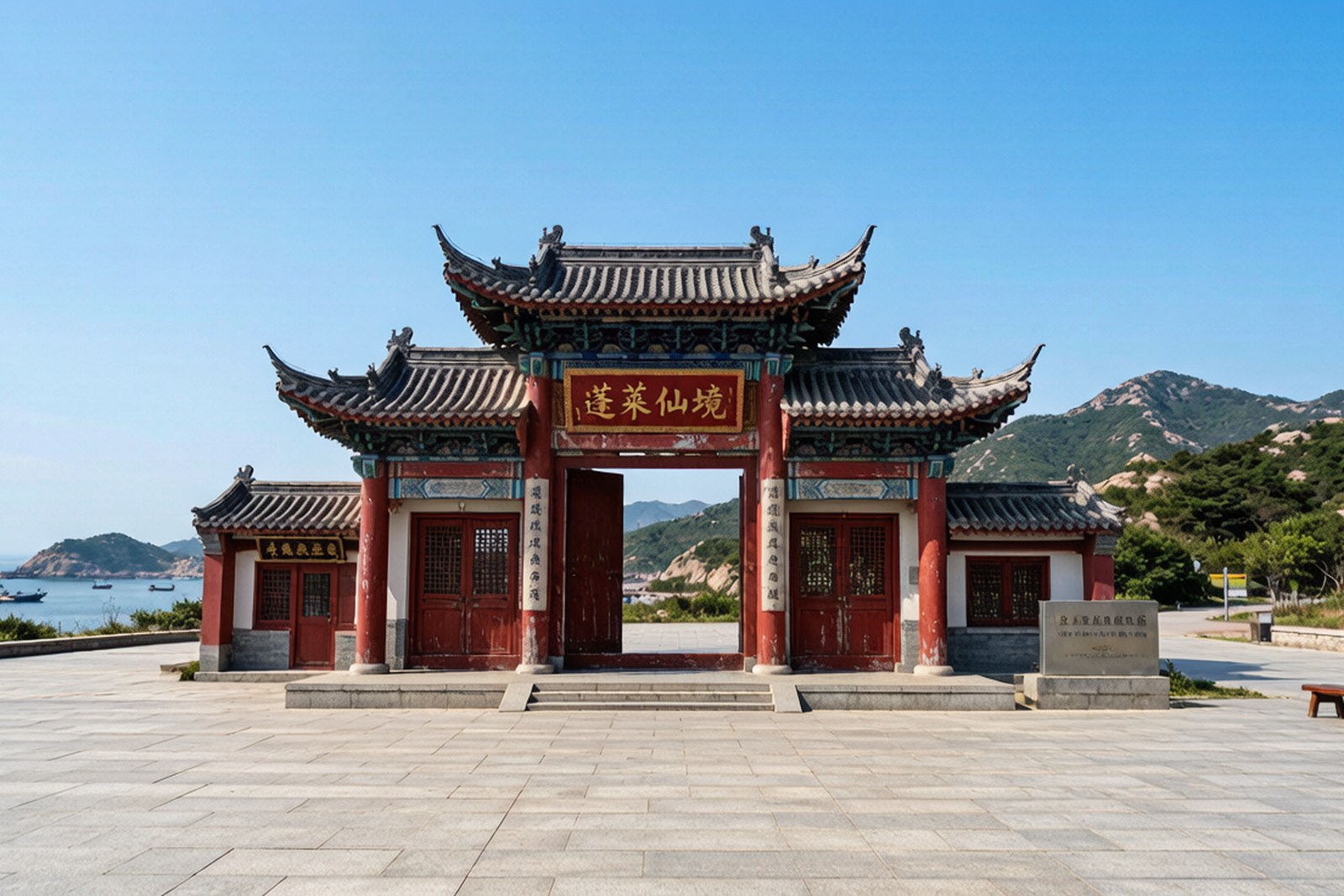
- 不二法门 (Bù’èr Fǎmén) — the “Gate of Non-Duality”, the formal entrance, built in a Southern-Dynasties style
- 南山寺 (Nanshan Temple) — a large reconstructed temple complex in the classical manner, one of the biggest of its kind in the south; the 金玉观音 hall here is a separate ticketed attraction
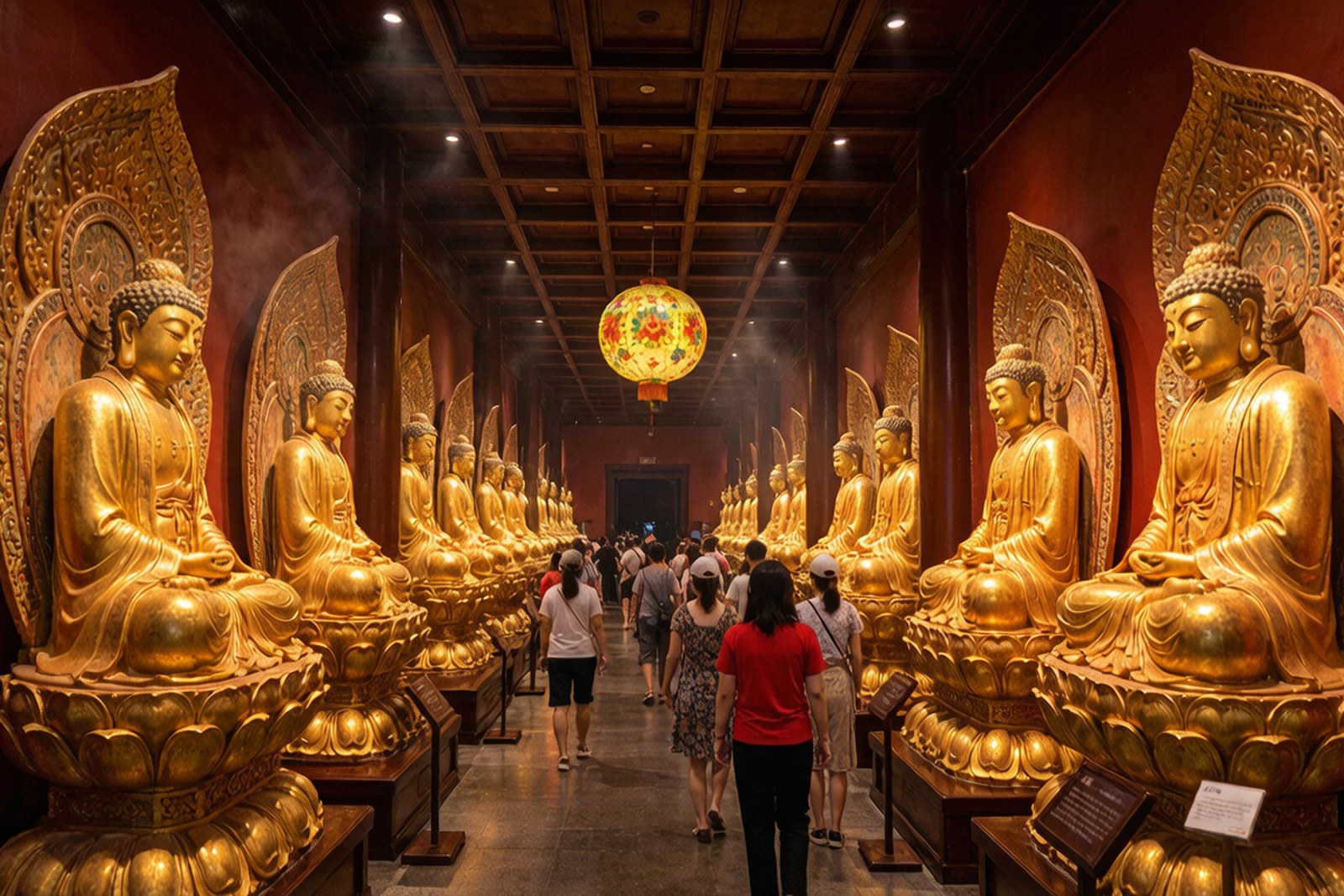
- 三十三观音堂 — thirty-three Guanyin figures in a long hall, impressive as an ensemble
- 长寿谷 (Longevity Valley) — a wooded valley with the 百岁村 and its theme of long life; this is the 寿比南山 idiom made physical
- 小月湾 / the sea frontage — a stretch of coast with the park’s own beach
A half-day gets you the statue and the temple. A full day gets you the loop.
Practicalities
Tickets. Adult ¥129 in peak season (1 October – 30 April) and ¥108 in low season (1 May – 30 September) for the park entry. The sightseeing train is ticketed separately at around ¥15–25. What most people actually buy is a bundle:
- 门票+观光列车票 (adult): ¥138 — park entry plus the train, by far the most common purchase
- 门票+观光列车+景前区接驳车往返: ¥153 — adds the shuttle from the outer car park
- 门票+观光列车+素斋 set meals: ¥146–206 — adds a Buddhist-vegetarian meal at 素缘餐吧 or 缘起楼
- 门票+观光列车+如愿南山 performance: ¥198–292 depending on seat
- Children 6–18 half price; students in full-time education pay peak ¥64 / low ¥54; 60–65 seniors peak ¥105 / low ¥86; 65–70 seniors peak ¥64 / low ¥54; 70 and over, children under 6, disabled visitors, serving military, journalists and holders of certain religious credentials go free. Since 5 March 2026 these are the published rates. Book through the 海南南山文化旅游 WeChat service account or any major OTA; the official ticket line is 0898-88837985.
Do you need to book? Yes — entry is by reservation through the 海南南山文化旅游 official WeChat account or an authorised platform, and you must present your own ID card at the gate. Same-day booking is usually possible outside holidays, but do not assume it in the peak weeks. Bring the physical ID; this is a real-name system.
Opening hours. Tickets sold and entry from 08:00–17:00; the park closes at 18:00. Indoor attractions close after 17:00. Come early — the statue gets a queue by mid-morning, and the light on the sea side is better before noon anyway.
Getting there. Address: 崖州区南山村, about 40 km west of Sanya city on the coastal road toward 崖州. No metro in Sanya. Options: bus 16, 25 or 29 from the city to the 南山寺 stop (cheap, slow, around 90 minutes); the 南山 tourist line; or a taxi / ride-hail at roughly ¥100–150 each way from the city centre, around 45 minutes. The 环岛高速 is the fast route if you drive; the outer car park is large and the shuttle to the gate is included in some tickets. Many visitors come from 崖州湾 hotels, which are much closer.
One warning about the day. This is a religious site as well as an attraction, and it is busy. Dress with shoulders and knees covered — it is not strictly enforced but it is the local standard and you will feel conspicuous otherwise. Do not photograph the temple interiors where notices forbid it. And do not plan this as a two-hour stop: the statue alone, at a walk, is an hour from the gate, and the train queue in high season can cost you another.
Combine with: 大小洞天 (Daxiaodongtian), the other big 5A scenic area in 崖州, twenty minutes down the coast, which pairs an old Taoist cave site with a coastal walk. The two together make a full day west of the city.
flowcloud would say that a hundred and eight metres of bronze looking out to sea is a very large way of saying take care of yourself, and that the walk out to her is better than the photograph, because the photograph cannot show you how small you feel on the bridge.
Getting there: 南山文化旅游区 (Nanshan Cultural Tourism Zone), 崖州区南山村, Sanya. Entry by reservation through the official WeChat account, with ID at the gate. Tickets ¥129 peak (1 Oct–30 Apr) / ¥108 low (1 May–30 Sep); the usual ticket + train bundle is ¥138; concessions for children, students, seniors and the military. 08:00–17:00 entry, indoor halls close after 17:00. Roughly 40 km west of Sanya city — bus 16/25/29 or taxi ¥100–150, about 45 minutes. Allow at least half a day.