
You walk in under a gate that is far too large, and the scale does not let up. 南岳大庙 Nányuè Dàmiào, the Grand Temple of the Southern Sacred Mountain, is laid out along a single axis through four courtyards and nine successive halls, and the sequence is deliberate: gate, then courtyard, then a hall, then another courtyard, each one raising the pitch until the great hall at the centre of the complex. The architecture is imperial — yellow glazed roof tiles, a raised processional way, stone lions, gates with the proportions of a palace — and that is not an accident of taste. This is the largest and most complete palace-style temple complex in southern China, and it was built to be read as one.
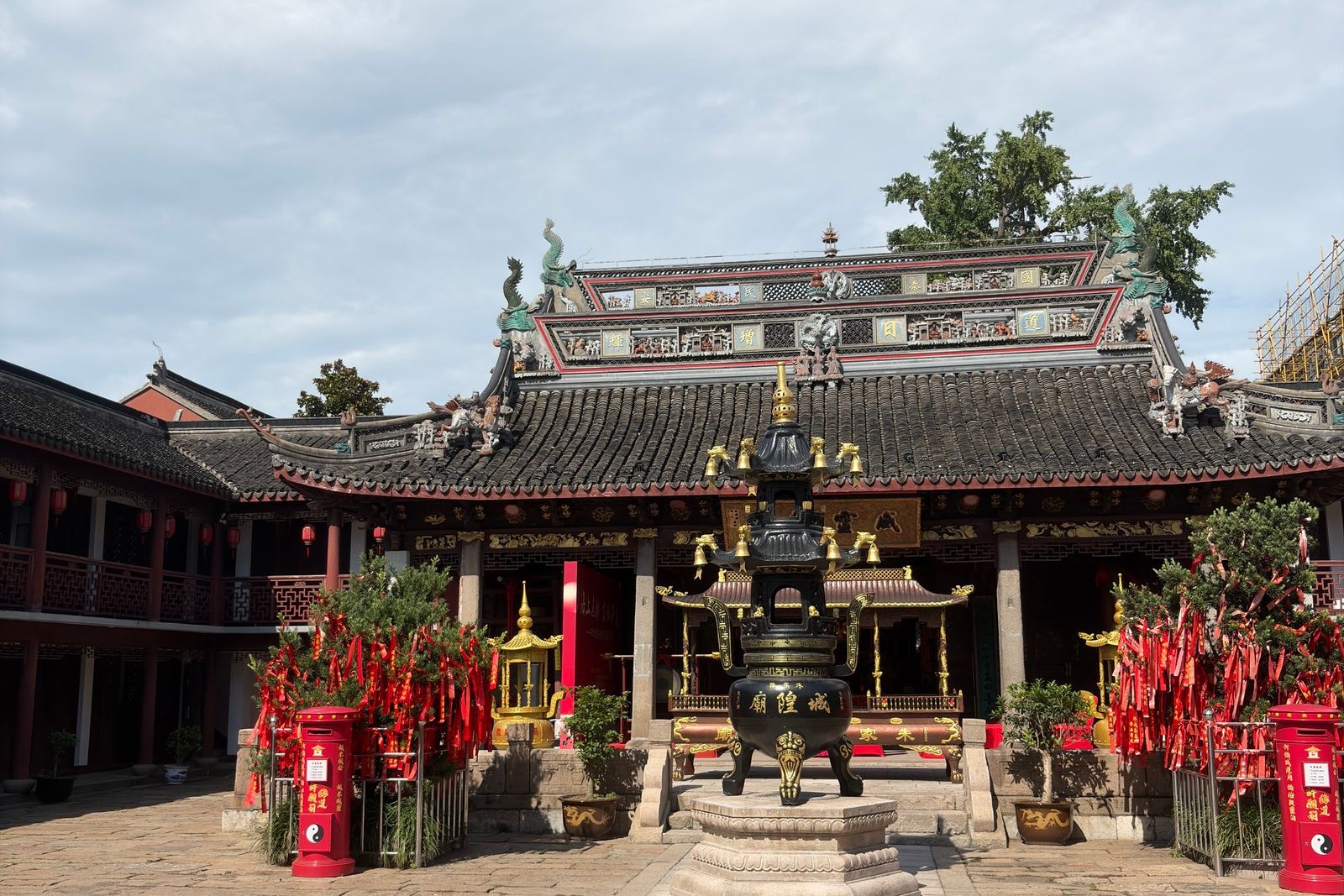
What makes it genuinely unusual is who is inside. The Grand Temple is shared, and has been for centuries. On the west side of the axis there are eight Buddhist halls staffed by monks; on the east side, eight Taoist halls staffed by priests; the central halls are administered in turn. Nowhere else in China is a major temple divided this cleanly between two religions under one roof, and the arrangement is the reason the place is often called 江南第一庙 Jiāngnán dì-yī miào, the first temple of the south, and 南国故宫 nánguó Gùgōng, the Forbidden City of the south. The central object of worship is 南岳圣帝 Nányuè Shèngdì, the Sacred Emperor of the Southern Mountain, identified with 祝融 Zhùróng, the fire god — which is why the peak above the temple carries his name and why the mountain is associated both with fire and, through the 寿佛 Shòufó, the Buddha of Longevity, with long life.
Practicalities
Tickets. A single unified admission price of ¥58 applies. Peak and off-peak pricing for the temple was abolished in 2025, so there is no longer a cheaper winter rate; the change was made by the provincial pricing authority and the flat figure is what you will pay. Admission to the temple does not include the mountain itself, which is ticketed separately at ¥110 in the warm months and ¥80 from November to April. Children under fourteen and adults over sixty-five enter free with ID, and half-price admission applies to students and to people aged between sixty and sixty-five. The temple’s own incense is bought outside the gates, not inside.
Opening hours. The temple opens at 08:00 and closes at 17:30. Those hours are fixed and the gate is shut firmly at the end of the day, so an evening visit is not possible. Pilgrims arrive from first light and the courtyard is at its fullest in the first two hours; the last ninety minutes before closing are much quieter and the light on the yellow roofs is better.
Closing day. There is no closing day. The temple is open every day of the year, including Lunar New Year’s Eve, which is the single busiest night of its calendar and the one occasion on which the usual timings are suspended.
Getting there. The temple stands at the northern end of the main street of 南岳镇 Nányuè Zhèn in 衡山县 Héngshān Xiàn, a few minutes’ walk from the town’s guesthouses and about ten minutes from the 游客中心 yóukè zhōngxīn, the visitor centre where buses and the cable car up the mountain begin. The nearest high-speed station is 衡山西站 Héngshān Xī Zhàn, roughly fifteen minutes away by shuttle bus at around ¥6 or ¥20 to ¥30 by taxi. By road, Nanyue is about two hours from 长沙 Chángshā and forty minutes from 衡阳市 Héngyáng Shì. Booking to 衡阳东站 Héngyáng Dōng Zhàn is the standard error; it is far away and awkward.
flowcloud would say that the Grand Temple is worth an hour even for people with no interest in religion, because the plan of the place — one axis, nine halls, two faiths — is a better argument about how China works than most books manage.
Getting there: come early and walk the axis in order, west side first, because the Buddhist halls are quieter than the central processional way and the sequence only makes sense one way. Look for the seventy-two stone pillars of the main hall, one for each peak of the mountain, and for the two matching sets of side halls, and allow two hours if you want to see both. Bring small change for incense and leave your shoes on the approach rather than the hall floors; the 进香 jìnxāng crowd, especially in the seventh and eighth lunar months, is enormous and the temple is at its most interesting and least comfortable then.