
The Tower of a Hundred Thousand Buddhas: Palcho Monastery
十万佛塔层层龛,一塔收尽三派天 Shíwàn Fó Tǎ céngcéng kān, yī tǎ shōu jìn sān pài tiān – The stupa of a hundred thousand Buddhas, niche upon niche; one tower gathers three schools under one sky
白居寺 Báijū Sì Palcho Monastery, on the northern edge of Gyangtse in 西藏自治区日喀则市 Xīzàng Zìzhìqū Rìkāzé Shì Shigatse, is best known for the Kumbum – the nine-story stupa formally called the Great Stupa of One Hundred Thousand Buddhas, begun in the early fifteenth century under a prince of Gyantse together with the First Panchen Lama. The monastery is rare in another way: its halls have belonged at once to the Gelug, Sakya and older schools of Tibetan Buddhism, and the murals carry the brushwork of all three.
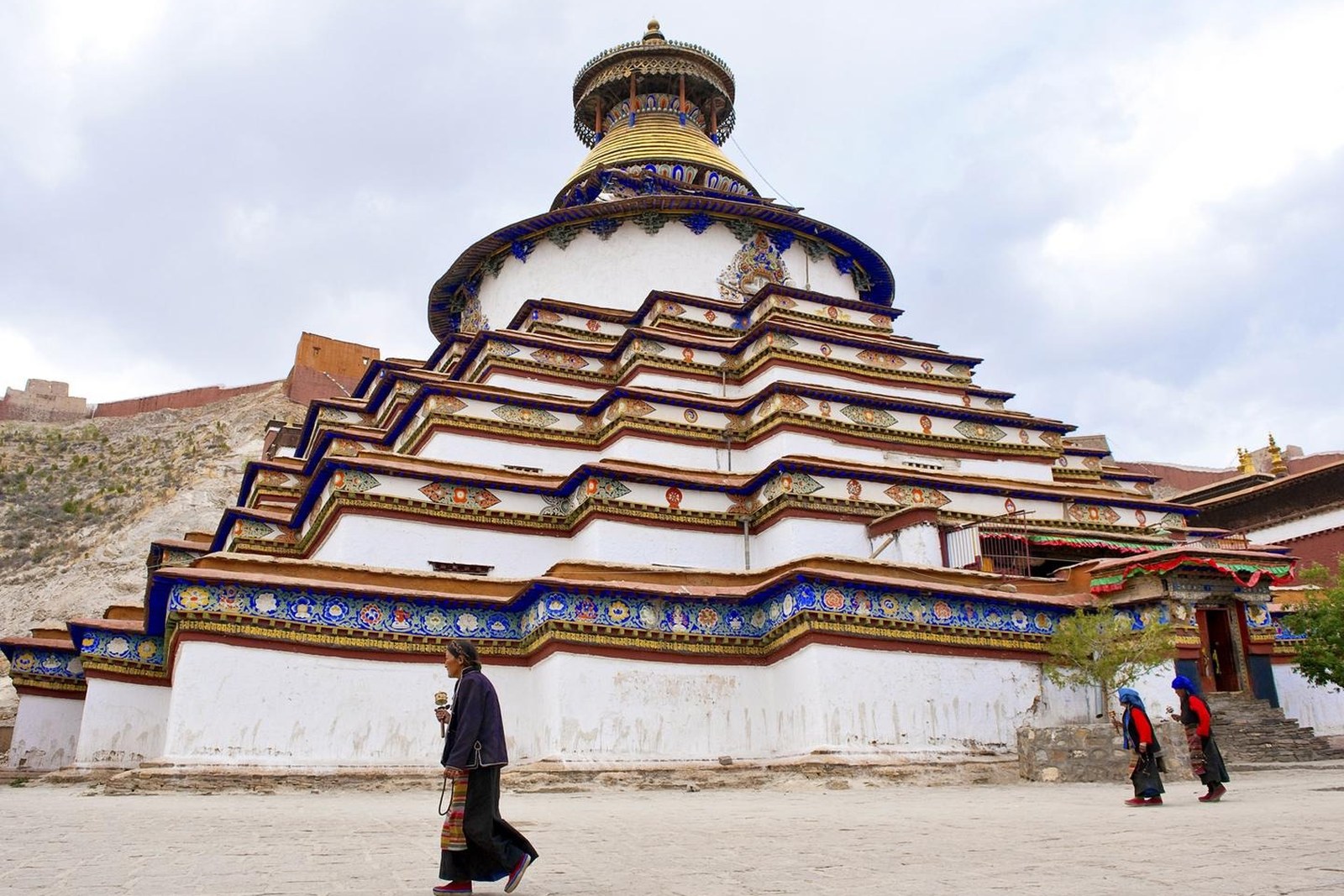
The Kumbum itself is the reason pilgrims circle it. Rising in tapering white tiers from a broad mandala base, the tower stacks 108 gates and around 77 chapels up its circumference – each chamber a small dark jewel box of murals and clay sculptures, the Buddhas, bodhisattvas and protectors of the whole pantheon in miniature. The outer passage spirals upward past chapel after chapel, and the top platform breaks into open air with the golden canopy of the stupa overhead and the whole Nyang valley spread out below.
The halls at the tower’s foot repay the hour. The assembly hall keeps early fifteenth-century paint in deep reds and blues, the inner chapels hold seated images whose faces were last renewed centuries ago, and the courtyard columns carry the soot of six hundred years of butter lamps. Compared with the great monasteries of Lhasa and Shigatse, Palcho is intimate – a handful of visitors, a caretaker’s murmured introductions, and the sound of the Kumbum’s prayer flags overhead.
What Palcho means is written on the town around it. Gyangtse grew rich on the wool and trade road south of the Tsangpo, and the monastery, the fortress rock and the old merchants’ houses still form one tight composition – the Kumbum’s white bulk and the dzong’s grey walls visible together from the barley fields outside town. Between the two monuments the old lanes keep the texture of a Himalayan trading town that has outlasted empires, and an evening walk between the two closes the day perfectly.
Practicalities
- The Kumbum’s upper galleries close earlier than the halls – arrive before mid-afternoon to climb.
- A small camera fee applies inside the compound; flash is refused in the chapel interiors.
- The stupa’s passage stairs are steep and low-ceilinged – backpacks come off and shoulders turn sideways at the upper tiers.
- Pair the visit with the dzong climb the same morning; the two monuments frame each other.
Words and Names
白居寺 Báijū Sì Palcho Monastery; 吉祥多门塔 Jíxiáng Duōmén Tǎ the “many-gated auspicious stupa,” the Kumbum’s formal name; 十万佛塔 Shíwàn Fó Tǎ the stupa of a hundred thousand Buddhas; 江孜 Jiāngzī Gyangtse, the old wool-trade town; 转塔 zhuǎn tǎ circling the stupa, the pilgrim’s rite; 壁画 bìhuà the murals, Palcho’s painted treasury. Beyond the stupa, the same 西藏自治区日喀则市 Xīzàng Zìzhìqū Rìkāzé Shì Shigatse keeps more places worth the detour: 扎什伦布寺 Zhàshílúnbù Sì the Panchen Lamas’ seat in Shigatse, 江孜宗山古堡 Jiāngzī Zōngshān Gǔbǎo the fortress above this same town, 萨迦寺 Sàjiā Sì the library monastery to the west, or 珠峰大本营 Zhūmùlǎngmǎ Dàběnyíng the camp under Everest – four more doors into the same Shigatse. Once the tower is behind you, our Shigatse food map fills the table.
flowcloud would say the Kumbum is a mandala you can walk into: nine stories of chapels stacked like a prayer, and every turn of the spiral stair opens another room of six-hundred-year-old color. All checked November 2026.
Getting there: From Shigatse, the road southeast to Gyantse takes about 1.5 hours by car or tour bus; buses leave the Shigatse bus station most mornings. The Kumbum’s top galleries close earlier than the halls – arrive before mid-afternoon. All checked November 2026.