
蟠龙洞 Pán lóng dòng lies inside 狮子山 Shī zi shān, the Lion Hill, about three kilometres north of the centre of 云浮市 Yún fú shì, at 蟠龙路 75 号 Pán lóng lù, in 云城区 Yún chéng qū. The name means the coiling dragon cave and it is a description of the passage rather than of anything inside: the route winds, doubles back and opens out in a way that the local accounts consistently call 迂回曲折,形若蛟龙 yū huí qū zhé, xíng ruò jiāo lóng, winding and turning until it is shaped like a dragon. The cave is a 喀斯特溶洞 kā sī tè róng dòng, a karst cave – but the geological note that makes 蟠龙洞 different from almost every other show cave in Guangdong is what the water was cutting through. It is not limestone in the ordinary sense; the local description has the groundwater working through fissures in 大理岩 dà lǐ yán, marble, and it is classified as a 次生溶洞 cì shēng róng dòng, a secondary cave, meaning that the void was opened inside rock that had already been altered and hardened rather than being dissolved out of a soft marine bed in the first place. The figure in every local account for how long that took is about 1.7 billion years, which is the scenic area’s own framing and is best read as “a very long time in a very hard rock” rather than as a date anyone has measured on the cave itself. What is documented is the modern history, and it is short. In early November 1983 the cave was found, not by geologists or by a survey, but by local 采石民工 cǎi shí mín gōng, quarry labourers, working the stone of 狮子山 – which is exactly what one would expect in a city whose entire economy is built on stone. It opened to visitors in 1985, and in May 1993 the provincial government approved it as a 省级风景名胜区 shěng jí fēng jǐng míng shèng qū, a provincial scenic area, in document 粤府〔1993〕66 号. It is now rated 3A.
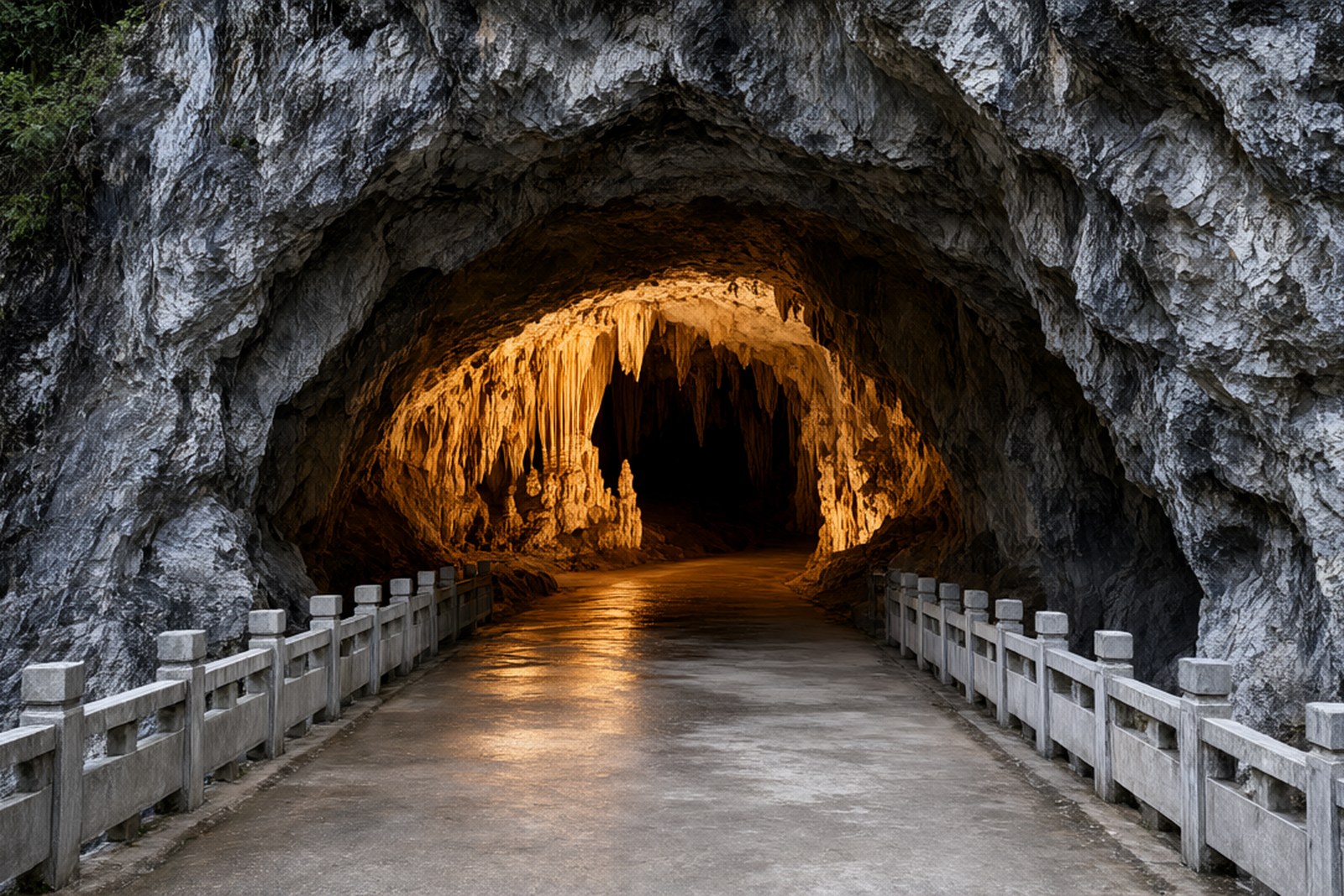
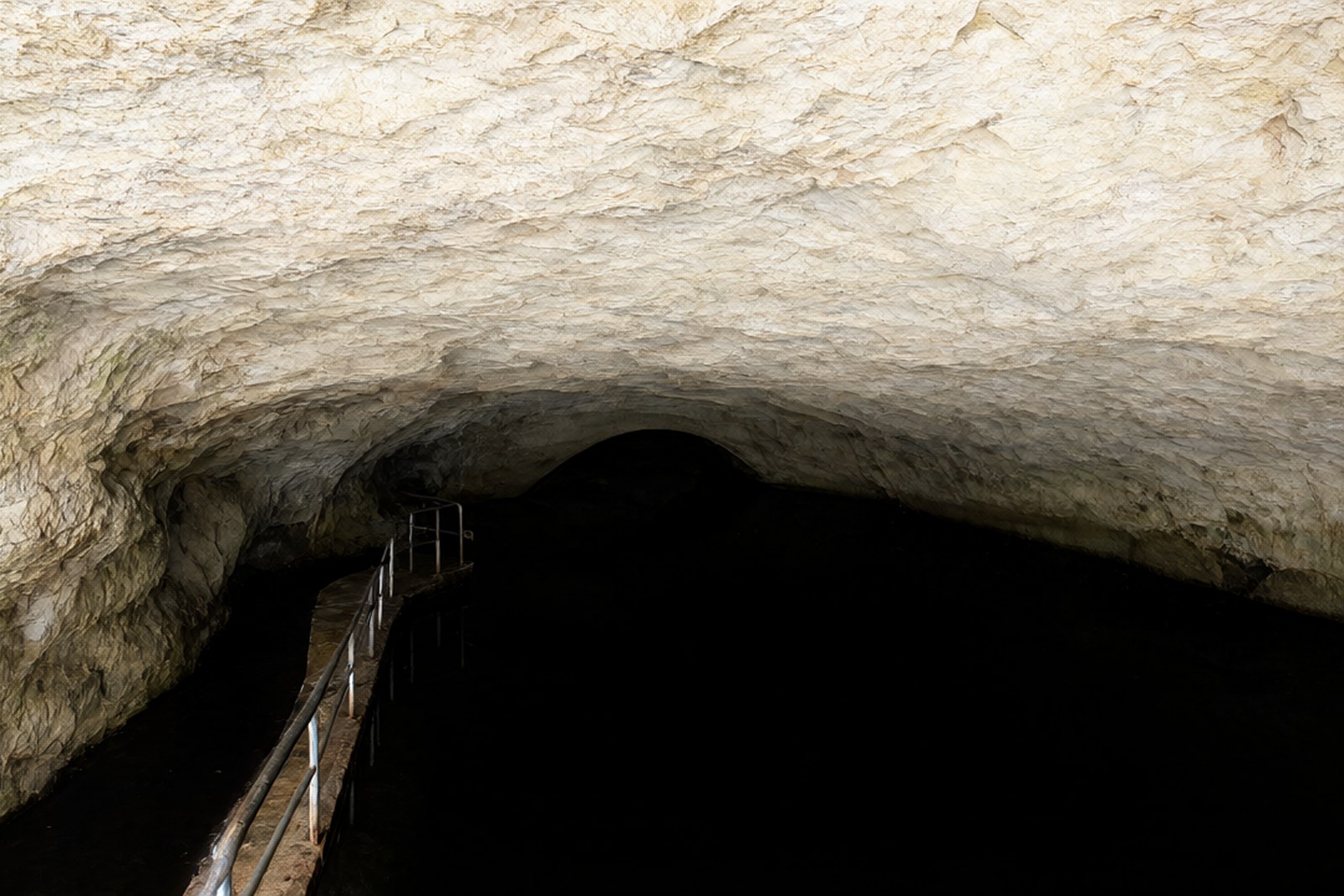
The cave is counted in three levels, and the names are as good as the geology. The upper level is 天堂通天洞 Tiān táng tōng tiān dòng, the heaven-reaching cave; the middle is 九龙长廊 Jiǔ lóng cháng láng, the corridor of the nine dragons; the lower is 龙泉地下河 Lóng quán dì xià hé, the dragon spring underground river. They connect, and the walking route through them is 528 metres – which is the number to hold on to, because it is the whole of the visit and it takes about forty minutes at an unhurried pace. The lower level is the one with water, and the water does something unusual. The 落水洞 luò shuǐ dòng, the sink hole, drops 21 metres to the underground river, and at the section called 群龙布阵 Qún lóng bù zhèn, the ranks of dragons, the path spirals down to it. The river runs 560 metres with a channel 8 to 10 metres wide and a roof anywhere from 10 to 30 metres above the water, and it is fed not by a stream but by an 间歇泉 jiān xiē quán, an intermittent spring: the water arrives in a surge, the surface rolls and the sound comes up the passage as a low roar while the current scours the gravel banks, and then after a few minutes it drains back quietly into its hole and the level drops. The local figure for the cycle is roughly every ten minutes. It is the most alive thing in the cave and the reason to stand at 群龙布阵 for two cycles rather than one, because the first one surprises you and the second one you can watch properly. The spring runs all year, the water is drinkable where it is clear, and the 龙母 Lóng mǔ in the names – the dragon mother of the West River delta’s own mythology – is the thread that ties the 58 named scenes together.
The 58 scenes jǐng, the view-stops the route is signposted with, are counted that way and given those names by the scenic area; the research for this article located four of them and no complete list, so the four are the ones worth mentioning. 神龟朝圣 shén guī cháo shèng, the sacred turtle on pilgrimage, is a stalagmite mass read as a turtle with its head lifted. 龙母浴池 Lóng mǔ yù chí, the dragon mother’s bathing pool, is the rimmed basin in the rock. 天书神笔 tiān shū shén bǐ, the heavenly book and the divine brush, is a pair of forms read as an open volume and the brush beside it. 玉壁雄关 yù bì xióng guān, the jade wall and the great pass, is a sheer curtain of flowstone closing a corridor. The whole set is tied to a local cycle of tales about 龙母智斗赖布衣 Lóng mǔ zhì dòu Lài bù yī, the dragon mother outwitting 赖布衣 Lài bù yī, the itinerant geomancer of south China’s folklore; the report is explicit that this is legend rather than record, and it is written here in the same register – a local tradition says so, and nobody claims it as history.
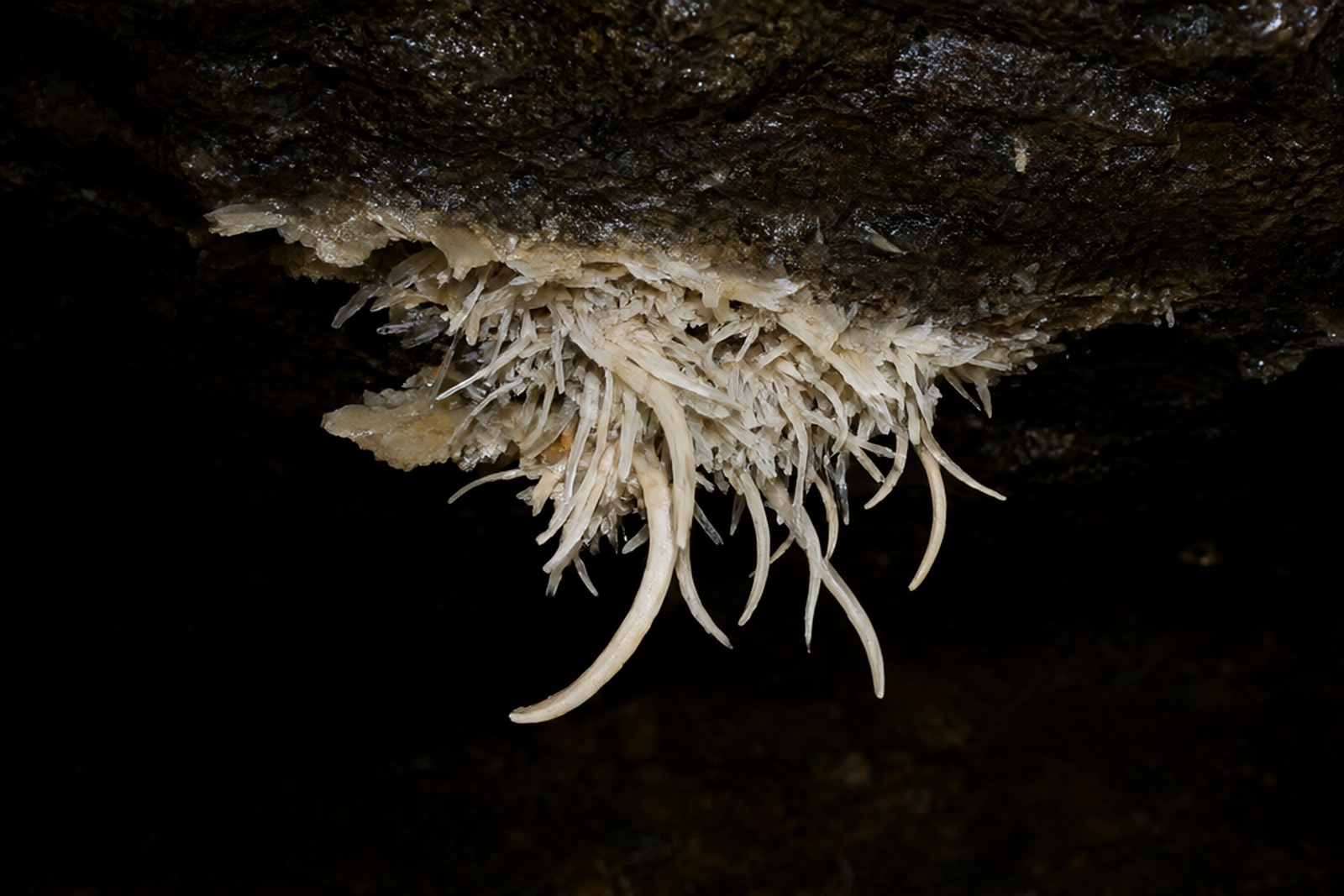
The reason people have heard of 蟠龙洞 at all is the 石花 shí huā, the stone flowers, also called 宝石花 bǎo shí huā, gem flowers, and the thing that makes them a genuine oddity rather than a marketing one is easy to state. Ordinary cave formations grow downward under gravity, or upward from the floor, because they are built by water running off a surface. The flowers at 蟠龙洞 do neither. They are composed of 方解石 fāng jiě shí, calcite, 文石 wén shí, aragonite, and 卷曲石 juǎn qū shí, helictites – the last being the form that twists and curls sideways in defiance of the direction water is supposed to fall – and they grow outward from the rock face in every direction at once, opening in clusters along the wall and the ceiling. The Chinese description of it is 不按重力方向生长 bù àn zhòng lì fāng xiàng shēng zhǎng, growing without regard to the direction of gravity, and 见气成石 jiàn qì chéng shí, which is the poetic way of saying that the mineral seems to crystallise out of the air itself. The mechanism is understood in general terms – it is the fine control of capillary water movement and evaporation through tiny pores in the rock, which is also why helictites are rare – but the effect in front of you is a white star of thin blades standing out of a wall like frost that has decided to become permanent. The figures attached to them are, again, the scenic area’s: that the flowers began forming about 350,000 years ago and are still growing at a rate nobody can see, and that the phenomenon exists in only three countries in the world – China, the United States and Turkey – of which 蟠龙洞 is China’s example. The last of those is the claim to carry carefully. What is certain is that helictites and anthodite-type flowers are genuinely rare, that the site is unusual in the density and size of them, and that a Chinese cave is one of the places where they occur in quantity. The 1987 line – that the cave was selected as one of the 世界十大洞穴奇景 shì jiè shí dà dòng xué qí jǐng, the world’s ten great cave wonders – appears in the local materials without a naming body attached to it, which is exactly the kind of claim the report asks to be attributed rather than asserted. So: the local materials say it. The flowers do not need the badge.
The second formation of the same kind is the 玉罗伞帐 yù luó sǎn zhàng, the jade gauze parasol canopy, which is a curtain of flowstone hanging with a fold structure fine enough that the local descriptions compare it to the gathered silk of a state canopy. It is pale, with a cream-to-yellow tone rather than the pure white of the flowers, and the sculpted lines of its folds are the thing people photograph. One detail is interesting for the way it has been reported: the canopy is said to have formed in part about 24,200 years ago, which is not a contradiction of the 350,000-year figure for the flowers but a date for a different object in the same cave – the flowers at 35万年前 sān shí wǔ wàn nián qián and the canopy at 2.42万年前 liǎng wàn sì qiān èr bǎi nián qián are two numbers measuring two things, and a piece that swaps them will be wrong twice. The canopy’s own claim is that its origin is not settled, 成因至今仍是一个谜 chéng yīn zhì jīn réng shì yī gè mí, a puzzle to this day – which is more modest and more interesting than the superlatives, and truer to how the hydrology of a curtain like this is actually reconstructed. Around the cave the city has built the usual support: 蟠龙天湖 Pán lóng tiān hú, the lake, laid out after 1993, and the 蟠龙柱 Pán lóng zhù, the dragon pillar, and the 蟠龙桥 Pán lóng qiáo, the bridge, outside. The cave is listed inside a longer local route, the 龙之旅 lóng zhī lǚ, the dragon tour, which strings it to the 龙山温泉 Lóng shān wēn quán hot springs at 新兴县 and to 聚龙洞 Jù lóng dòng and 龙龛岩 Lóng kān yán at 罗定市, then out to 肇庆 Zhào qìng and the 德庆 Dé qìng temple of the dragon mother, which is where the 龙母 in the names at last becomes the actual subject rather than a decorative motif. In 2019 the cave was reworked as the district’s local tourism landmark, which is the present condition of it – a 40-minute underground walk with one genuinely world-class mineral display, at the edge of a city built on stone.
Practicalities
Tickets. 30 yuan for an adult, which makes it one of the cheaper things in Yunfu; concessions exist at the gate and there is no booking system worth using. The on-site extras are the lake and the outside landscaping, which are free. The cave’s one limitation is physical rather than financial – there are stairs and wet sections and the corridor of the nine dragons is narrow in places – so anyone who does not want the descent to the underground river can take the middle level and come back out the same way, which is still most of the formations.
Opening hours. 08:30 to 17:30 daily, all year, with the last entry late enough for a full walk-through if you are in by about five. The cave holds a steady temperature and the wet season is the good one for the underground river, because the intermittent spring is livelier after rain; the trade-off is that the paths are wetter and the railings are not something to lean on. The 30 to 40 minutes on the route is the visit; an hour in the cave plus the lake outside is a comfortable half-day.
Getting there. The cave is on 蟠龙路 75 号 Pán lóng lù in 云城区 Yún chéng qū, about three kilometres north of the centre of 云浮市 and reachable on city buses 1, 5, 18 and 22 – the cheapest and, given how ordinary the road is, the simplest option. The city is on the 广茂 Guǎng mào railway and has a 云浮东站 Yún fú dōng zhàn on the high-speed network, with the cave a taxi ride from either; by road it is just off the Guangzhou-Wuzhou corridor that runs past the stone yards, and a driver coming from 广州 Guǎng zhōu can be at the cave in under two hours.
Closing day. Open daily, no weekly closure. The cave is occasionally shut for a day or a part of a day for lighting work or after heavy rain, and because the announcement is made at the ticket window rather than online, the safe routine is to go in the morning and to treat the 蟠龙天湖 outside as the fallback. The one hard rule is a rule rather than a closure: formations are not to be touched, because the flowers are capillary-grown and a finger on a helictite does damage that will not repair inside a human lifetime.
flowcloud would say that the case for 蟠龙洞 is not the badge it claims from 1987 but the fact that it settled a question the visitor can test on the spot – that water and mineral will do what they like if the pore spaces are small enough – and that a cave found by quarrymen in 1983, in a city whose whole trade is cutting stone, is a nicer piece of local irony than any ten-great-caves list, even if the list happens to be the reason the tour buses come.
Getting there: 蟠龙洞 is at 蟠龙路 75 号 Pán lóng lù, 云城区 Yún chéng qū, 云浮市 Yún fú shì, about three kilometres north of the city centre inside 狮子山 Shī zi shān, reached on city buses 1, 5, 18 and 22 from the streets around the station or by taxi from 云浮东站 Yún fú dōng zhàn on the high-speed line; by road it is a short turn off the main Guangzhou-Wuzhou corridor past the stone yards, under two hours from 广州 Guǎng zhōu, and the 龙山温泉 Lóng shān wēn quán springs at 新兴县 and the caves at 罗定市 are the natural second and third stops on the local 龙之旅 lóng zhī lǚ route.