
The gate tower stands at the end of a street of ordinary low houses, and it is much larger than you expect: a red wall rising three storeys with a grey tiled roof edged in green glazed tile, and a stone arch at the base wide enough for a lorry. A few steps inside is the middle of the old town, where the main street crosses itself and four gate towers sit at the four ends of the arms. There is a well in the paving, a shrine in the gate above you with incense still in it, and a woman crossing with vegetables. Six hundred and forty years ago this was a military outpost on the edge of the Ming empire, built to hold this stretch of coast against pirates, and the shape of it has not changed at all. This is 平海古城 Pínghǎi Gǔchéng, Pinghai Ancient City, in 惠东县 Huìdōng Xiàn, and it is the best-preserved walled garrison town in Lingnan.
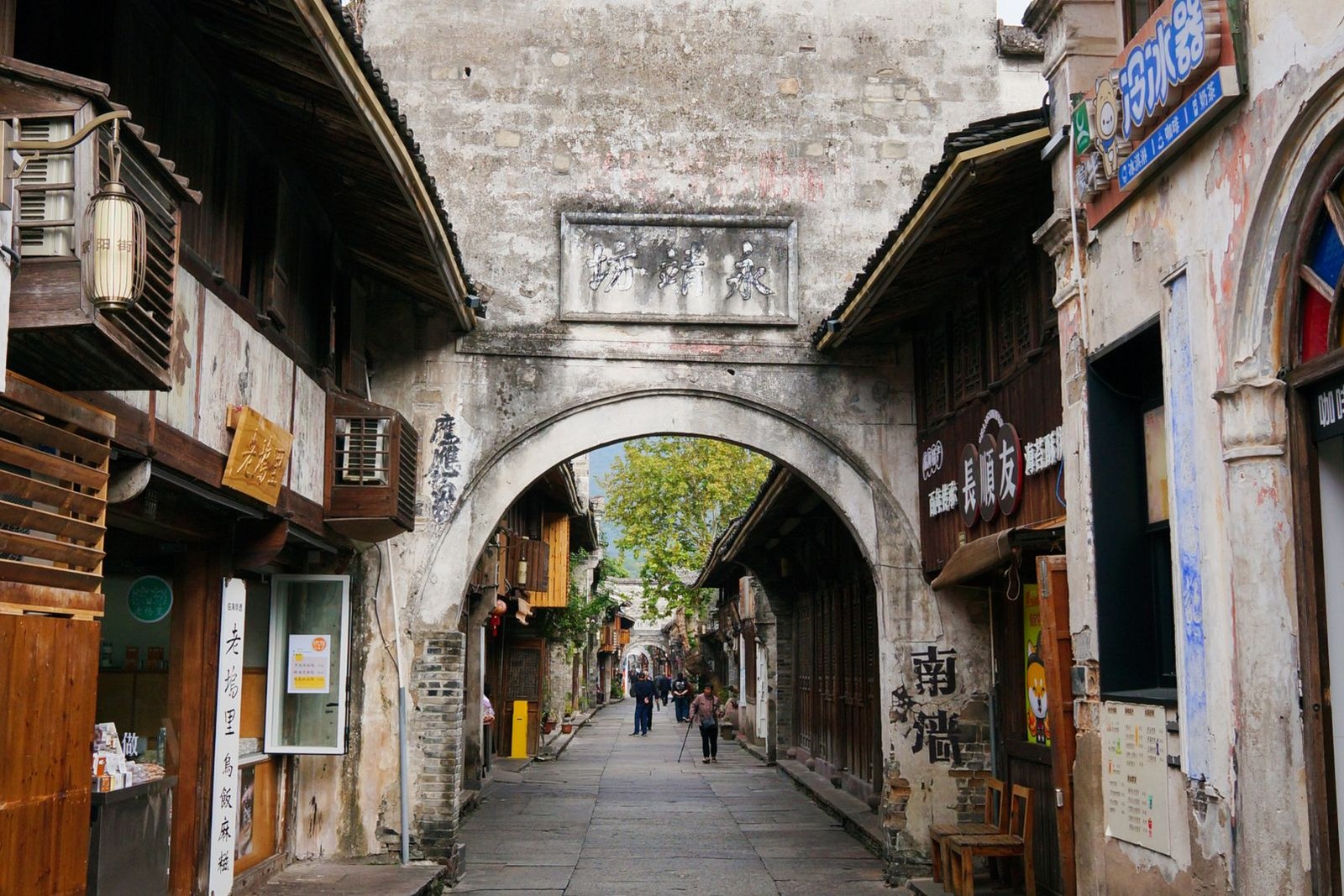
The town was ordered built in 1385, the eighteenth year of the Hongwu reign, on the instructions of the founding emperor, by the provincial military commissioner 花茂 Huā Mào together with a hereditary chiliarch named 杨勋 Yáng Xūn, as a 守御千户所 shǒuyù qiānhù suǒ, a defence command of a thousand households. It took nine years and was finished in 1394. From the air the plan read as a bell with a swallow-tail rim, which is why locals still call the place 钟城 Zhōngchéng, the bell city, and the layout is a simple grid: four gates in the four faces of the wall, walls inside connecting them into a cross, and the town divided by that cross into four quarters which were themselves subdivided — one for offices, one for the families of the garrison, and so on. The wall itself has gone, dismantled long ago, but all four gate towers survive with their arched stone openings and their 歇山顶 xiēshāndǐng roofs, decorated with grey plasterwork, brick carving and painted panels. The west gate carries a shrine to the 华光大帝 Huáguāng Dàdì, and every gate has its deity, which is how the buildings were protected from being pulled down.
What to See
Walk in through any gate and go to the crossing at the centre, where all four towers are visible at once and where the town opens up in every direction. The 十字街 shízì jiē, the cross street, is where the old buildings are: Qing and Ming houses, the 曾氏宗祠 Zēng shì zōngcí, the clan hall of the Zeng family, the shrine of 谭仙圣庙 Tánxiān Shèngmiào, and the 七星井 qīxīng jǐng, the seven wells that supplied the garrison and are now a protected relic. Several of the houses have carved brickwork in their courtyards and painted beams inside, and the doorways carry the mirrors and bagua charms that southern Chinese householders still put up against bad luck. What makes Pinghai unusual among old towns is that it has not been emptied or turned into a souvenir street. People still live in the houses, the market still runs, and the local arts are still practised: 惠东渔歌 Huìdōng yúgē, the Huidong fishing songs, are national-level intangible heritage, and so are the 舞鲤鱼 wǔ lǐyú, the carp dance, and the 凤舞 fèng wǔ, the phoenix dance. Every few years the town holds a large festival with dragon, lion, phoenix and carp processions, and the temple at the centre holds a 打醮 dǎjiào rite in the ninth lunar month once every three years. The inhabitants speak 军声 jūn shēng, the soldiers’ speech, a dialect descended from the garrison’s original garrison tongue, which is not mutually intelligible with the surrounding Hakka and Cantonese.
Practicalities
Tickets. The old town is free. There is no gate, no ticket and nothing to buy except food, and the towers can be climbed without charge. Combined with the fact that it sits a few minutes from the twin bays of 双月湾 Shuāngyuè Wān, this makes it the cheapest half-day in the county.
Opening hours. The streets are public and always open, and the town is at its quietest and best in the early morning and again in the late afternoon, when the light comes along the cross street and the lanes fill with cooking smoke. The four gate towers are best treated as daytime sights; nobody closes them, but they are unlit at night.
Closing day. There is no closing day. The town works all year, though the peninsular coast around it empties from November to March and the summer months bring the crowds down to the beaches. The temple festivals and the 打醮 dǎjiào rites happen on the lunar calendar, and if you happen to arrive during one you will not be able to move for processions.
Getting there. Pinghai is at the south-eastern end of the 稔平半岛 Rěnpíng Bàndǎo in 惠东县 Huìdōng Xiàn, roughly 40 minutes by car from 惠东 Huìdōng town and a few minutes from the beach resorts. There are buses from Huidong to 平海镇 Pínghǎi Zhèn, and high-speed rail to 惠东站 Huìdōng Zhàn puts you within a taxi ride. Coming from 深圳 Shēnzhèn the drive is about two hours and from 广州 Guǎngzhōu about three. Parking is on the edge of the old town rather than inside it.
flowcloud would say that Pinghai is worth more than the fifteen minutes most beach visitors give it, because it is the only surviving Ming garrison town of its kind in the region and there is nothing to see at a beach that you cannot see from a photograph.
Getting there: come in the morning, before the beach traffic starts, and walk in through the west gate so that the cross street opens up in front of you. Allow two hours for the streets and the houses, climb at least one tower, and ask for the 七星井 qīxīng jǐng rather than assuming you will find it. Eat in the town rather than at the beach — the 平海马蹄糕 Pínghǎi mǎtí gāo, water-chestnut cake, is the local thing to buy — and then drive the twenty minutes to the 双月湾 Shuāngyuè Wān viewpoint at 大星山 Dàxīng Shān, which is the one view in Huizhou that lives up to its own publicity.