
Seven Star Crags (Zhaoqing)
You come out of the south gate and the first thing that happens is that the city stops. One moment you are on a road with bus stops and apartment blocks; the next there is water in front of you — a wide, still lake — and standing in it, straight up out of the surface, are seven limestone peaks, green to the waterline and pale grey where the rock shows through. The reflections are almost better than the peaks. On a windless morning the whole range sits upside down in the lake, and the line between the two is the only thing telling you which way is up.
七星岩 (Qīxīngyán) — Seven Star Crags — is the reason people go to 肇庆 Zhàoqìng, a city most travellers pass through on the way to somewhere else. The name comes from the arrangement: seven crags, laid out roughly the way the seven stars of the Big Dipper fall across the sky, floating on a lake that was itself shaped by hand over centuries. It has been called 岭南第一奇观 — the finest wonder of the Lingnan south — for a very long time, and it is one of the few Chinese scenic sites where that kind of claim holds up on arrival.
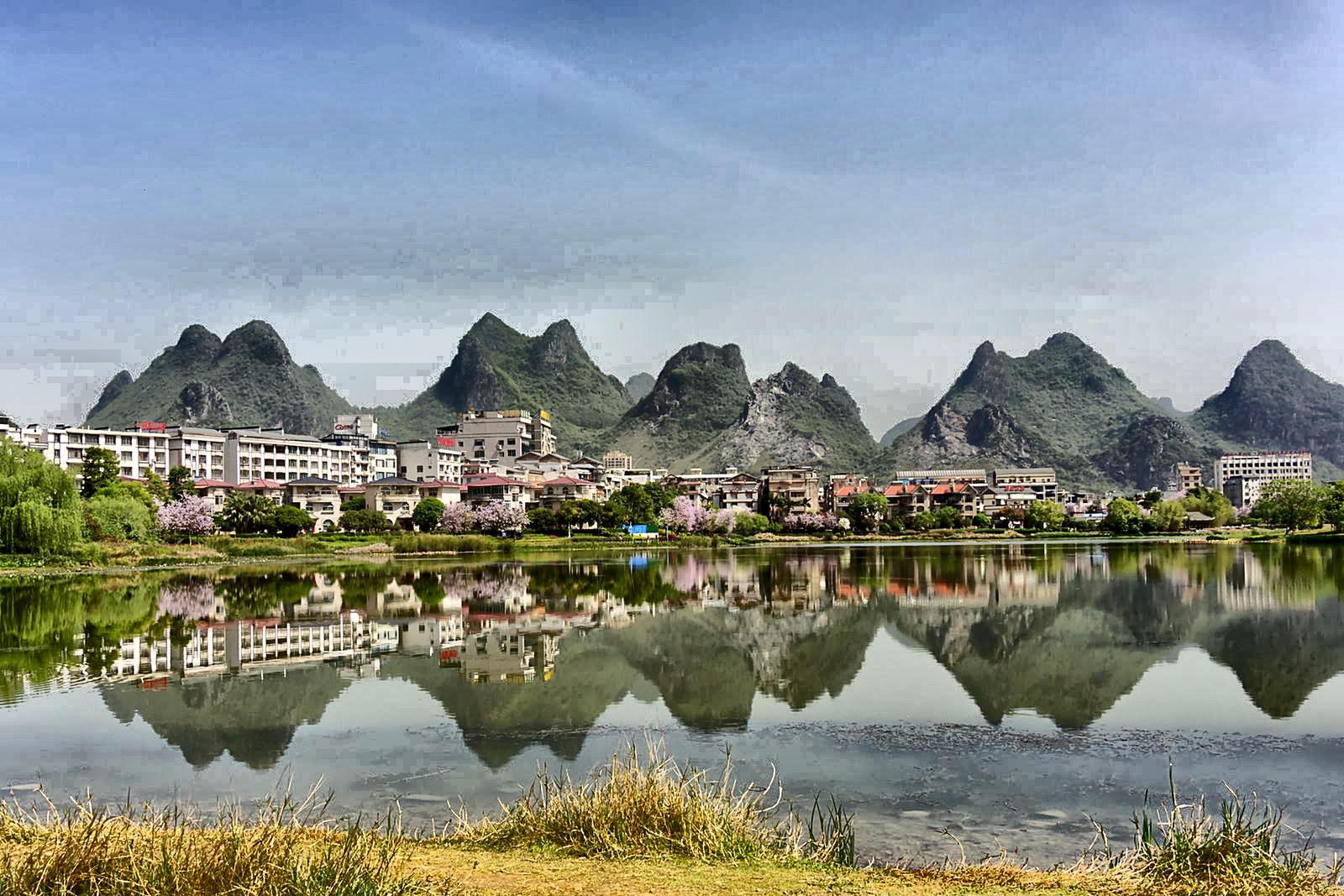
Seven Rocks in a Man-Made Lake
The crags are karst — the same soft, water-soluble limestone that makes the towers of Guilin and the peaks of Yangshuo, and the same deep geological story. This whole corner of Guangdong and Guangxi was seabed a few hundred million years ago. The limestone built up from shells and coral, was lifted, and then spent an unimaginably long time being dissolved by slightly acidic rainwater along its cracks and joints. What is left is the skeleton: steep, rounded, improbably sheer peaks, standing in flat ground, riddled with caves.
The seven here are named individually and locals will use the names without explaining them:
阆风岩 (Làngfēng Crag), the easternmost, and 玉屏岩 (Yùpíng Crag) next to it — the two easiest to climb.
石室岩 (Shíshì Crag), the one with the great cave and the most carved rock.
天柱岩 (Tiānzhù Crag) — “Heavenly Pillar” — the highest of the seven at roughly 117 metres, and the one everybody climbs for the view.
蟾蜍岩 (Chánchú Crag) — “Toad Crag” — and 仙掌岩 (Xiānzhǎng Crag) — “Immortal’s Palm” — to the west.
阿坡岩 (Āpō Crag), out on its own in the northern lake, with 双源洞 (Shuāngyuán Cave) at its foot.
What people rarely realise is that most of the lake is not natural. 星湖 Xīnghú, Star Lake, is a reservoir and scenic water body whose present shape is largely the work of 20th-century dredging and damming, and before that of centuries of dykes and fishponds. The mountains are geology; the water is engineering. Somehow that makes it better rather than worse — the composition was deliberate.
Getting Up the Rock
The classic climb is 天柱岩, and it takes about twenty minutes of stone steps through trees, with handrails, and it is not difficult.
You come out on top with the whole 星湖 laid out underneath: the other six crags standing in their own reflections, the lake edge with its causeways, the city running away to the east, and on a clear day the green hills beyond. There is a small pavilion up there where people sit for a long time without saying much.
Below that, at the base of 石室岩, is 龙岩洞 (Lóngyán Cave) — a big, walkable limestone cave with stalactites, lit in the slightly theatrical colours Chinese caves are always lit in, boardwalked, cool, and worth the twenty minutes. It has been a tourist attraction for well over a thousand years, which is itself a strange thing to stand inside and consider.
Also at the base of 石室岩: the 千年诗廊 (Qiānnián Shīláng), the Thousand-Year Poetry Corridor — more than 500 carvings cut directly into the cliff face and the cave walls, dating from the Tang and Song dynasties onward. This is the densest concentration of cliff inscriptions in Guangdong, and some of it is genuinely famous — Li Bai’s and Li Beihai’s hands are claimed here, and the 端州 stone-carving tradition behind it is the same one that produced 端砚 Duānyàn, the inkstones that were sent to emperors as tribute.
The Water Side
The other half of the site is the lake, and you should not skip it in favour of the mountains.
竹排 (zhúpái, bamboo raft) trips run from the 桂苑 wharf near the south gate — a flat raft with a low chair on it, poled slowly between the crags, roughly ¥45 and about 40 minutes. It is the single best thing here, and it is the reason to arrive by the south gate rather than the west. From water level the peaks stop being scenery and become something you are moving between; you can see the caves’ mouths right down at the waterline, the hanging gardens on the cliff faces, and the cormorants.
Bicycles can be rented around the lake — roughly ¥20 an hour for a single, ¥30 for a tandem — and the 5 km ring road around 星湖 is flat, shaded, and one of the pleasantest rides in the province. Go in the last hour before closing and you get the low light across the water with almost nobody on the path.
The 落羽杉 (luòyǔshān, bald cypress) grove at the north gate turns rust-red sometime around December and January and stands in shallow water on a boardwalk — it is the one thing here that genuinely photographs better than it walks.
Bird Island. Near the north-west, in the wetland section, are 丹顶鹤生态园 (red-crowned crane park) and the flamingo island, part of the 星湖国家湿地公园. There are more birds than you would expect this close to a city.
Practicalities
Tickets. Adults ¥70, and this is one of the genuinely good deals in Chinese tourism: the ticket is valid for three days with unlimited re-entry, so you can do the crags one morning and the lake the next. Students, children and seniors half price at ¥35. A combined 星湖 ticket covering 七星岩, 鼎湖山 and the 星湖湿地公园 runs around ¥140 and is the right purchase if you are staying two days. The bamboo raft (¥45) and the bike rental are separate. There is also an annual pass at around ¥100 for residents and regulars.
Do you need to book? Not strictly — you can buy at the gate. But the official WeChat account 微星湖 sells timed entry tickets online and lets you scan straight in, which saves the queue on weekends. For the big national holidays (Spring Festival, May Day, October) book online a few days ahead, because Zhaoqing fills up with day-trippers from Guangzhou and Foshan.
Opening hours. 08:00 to 18:00, with last entry around 17:30. Note that some sources list the park as open until later — the gates and the lake paths stay open, but the ticket check and the rafts stop in the late afternoon. No closing day — it is open every day of the year.
Which gate. There are four entrances (east, south, west, north) and choosing the right one saves you an hour of walking.
- South gate is the one for a first visit: 桂苑 wharf, the 七星桥 bridge and 水月宫 are right there.
- West gate puts you closest to 天柱岩 and 石室岩 if your whole intention is to climb.
- East gate has the 星湖博物馆, the nature trail and the flat lakefront walk — best with children.
- North gate is the quiet one, for the cypress grove and photography.
Getting there. Zhaoqing is a straightforward run from Guangzhou.
- By high-speed rail: Guangzhou to 肇庆东站 (Zhaoqing East) in about 40 to 60 minutes. From the station, bus K02 or 205 goes to the 七星岩北门 (north gate); bus K01 or 204 goes to 七星岩牌坊东 near the city centre.
- By car: about 1.5 hours from Guangzhou or Foshan, roughly 2.5 from Shenzhen. Navigate to 七星岩北门 or 东门 — the north gate car park is the most convenient.
- In town: buses 1, 12, 13, 19 and 20, plus the 星湖旅游观光专线 sightseeing loop, all connect the rail stations and city centre to the gates. Taxis from 肇庆东站 take about 20 minutes.
How long. Half a day if you do one crag and the raft; a full day if you climb, do the cave, the poetry corridor and the lake. Two days with 鼎湖山 is the way most people do it, and the combined ticket expects that.
What to wear. Trainers or light hiking shoes — the stone steps are worn smooth and get slippery when wet. Sun protection, because the lake road has long unshaded stretches, and mosquito repellent in the wet months. Bring water; the stalls inside are limited and overpriced.
What to eat nearby. 肇庆裹蒸粽 (guǒzhēngzòng) — a big pyramid of glutinous rice, green beans and pork, wrapped in lotus leaves and boiled for hours — is the city’s signature and you should buy one at a street stall on the way out. 竹篙粉 (zhúgāofěn, bamboo-pole rice noodles) dressed with soy and sesame is the local breakfast. And 西江河鲜, the river fish and shellfish from the Xi River that runs past the city, is what everyone eats in the evening.
Getting there: 七星岩 (Qīxīngyán, Seven Star Crags), 星湖风景名胜区, 端州区七星路1号, 肇庆 (Zhàoqìng), Guangdong. Guangzhou to 肇庆东站 in about 40–60 minutes by high-speed rail, then bus K02/205 to the north gate or K01/204 to the city centre; about 1.5 hours by car from Guangzhou. Ticket ¥70 for adults, valid three days with unlimited re-entry; about ¥140 for the combined 星湖 pass covering 七星岩, 鼎湖山 and the wetland park; bamboo raft about ¥45; bike rental about ¥20/hour. Open 08:00–18:00 daily, last entry about 17:30, no closing day. Climb 天柱岩 for the panorama, take the raft from the south gate, and go to 石室岩 for the cave and the 千年诗廊 inscriptions. Allow half a day at minimum, a full day comfortably. Book online via the 微星湖 WeChat account on public holidays.