
The river here is wide, slow and unremarkable, and the story attached to it is one of the founding stories of Chinese literature. 汨罗江 Mǐluó Jiāng runs past 汨罗市 Mìluó Shì on its way to Dongting Lake, and on its north bank stands 屈子祠 Qūzǐ Cí, the temple to 屈原 Qū Yuán, the minister and poet of the state of Chu who is said to have waded into a river in 278 BC when his kingdom fell, and who is remembered every year with dragon boats and zongzi. The temple is not large. What makes it worth the journey is that it is not a reconstruction of a legend but a shrine that has been maintained for a very long time, in a place that the tradition names specifically.
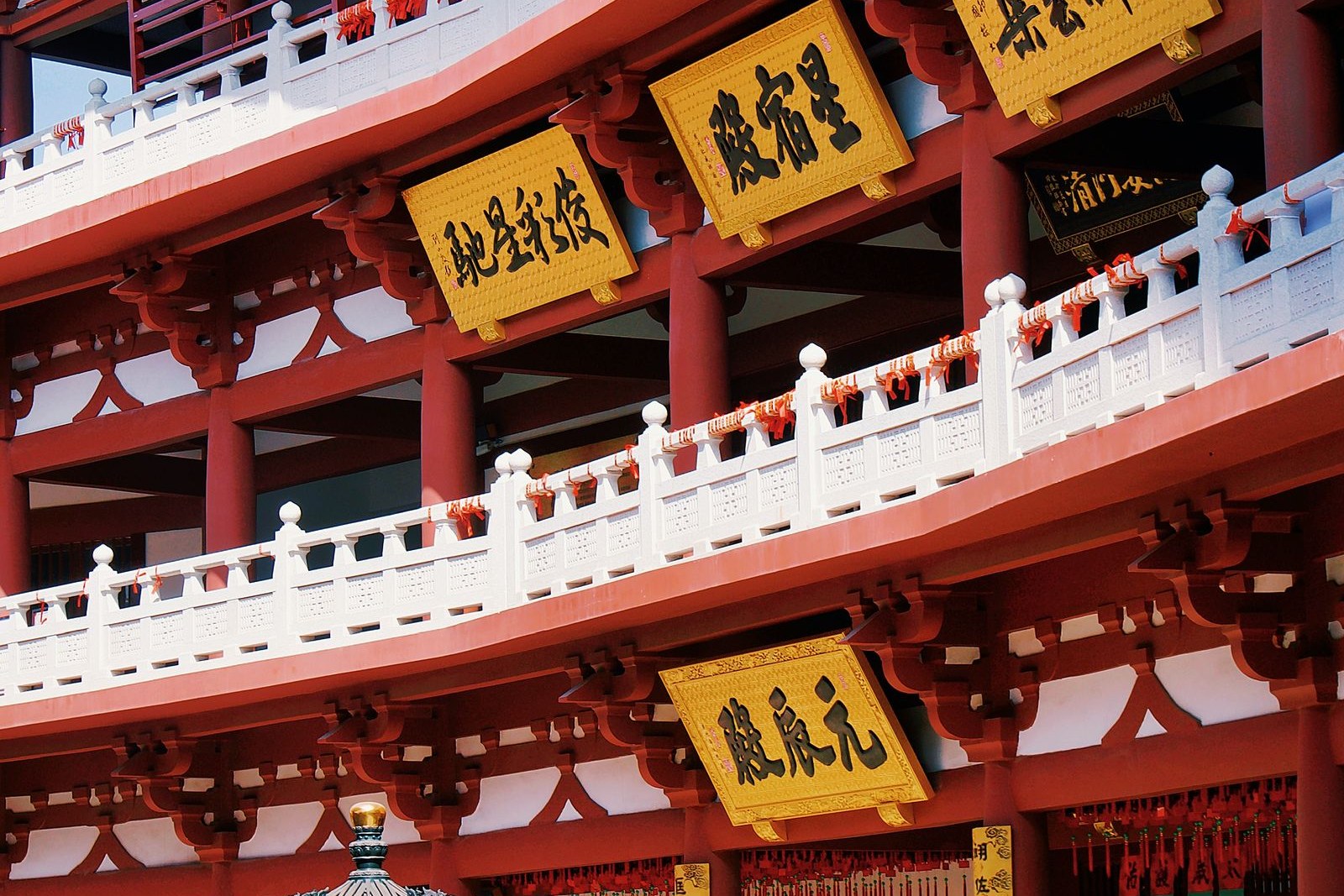
The site on 玉笥山 Yùsì Shān, Jade Box Mountain, above the river is the one the tradition identifies, and a shrine has stood on it since the Han dynasty; the building you walk into now is mostly a Qing reconstruction, with a 1754 gate and a series of halls behind it. Inside are the expected things done very well: a statue of the poet in his long robe, stone steles carved with 离骚 Lísāo and other sections of the 楚辞 Chǔcí, the Songs of Chu, and a garden of inscribed stones contributed by calligraphers over the last century. Behind the temple, up a path, is 屈原墓 Qū Yuán Mù, the tomb: twelve mounds in a row, because the story says that the poet’s head was recovered and that decoy graves were dug to protect it. Further along the bank are 独醒亭 Dúxǐng Tíng, the Pavilion of the Only Sober Man, and 骚坛 Sāotán, the altar of the poem.
The Day, and the Season
The ordinary visit is a quiet one: an hour or two, mostly outdoors, with the river in view and very few people about. The exception is 端午节 Duānwǔ Jié, the Dragon Boat Festival, on the fifth day of the fifth lunar month, which is the reason the city exists in the national imagination. On that day the river fills with crews, the banks fill with spectators, and the whole apparatus — the drums, the teams from villages upstream and downstream, the throwing of zongzi into the water — is enacted at the place the story names. It is crowded, hot and loud, and it is the single best reason to plan a trip here around a date.
Practicalities
Tickets. Temple admission is modest, in the region of ¥30, and the tomb and the riverside pavilions are covered by the same ticket or are free to walk to. Prices are set locally and change; check at the gate.
Opening hours. The temple opens around 08:00 and closes between 17:00 and 17:30. The riverbank and the tomb path have no gate and can be walked at any hour, which is worth knowing because the light on the water in the last hour is the best of the day.
Closing day. There is no closing day. The temple is open daily, and during the Dragon Boat Festival the surrounding area operates on a special schedule with the roads closed to private cars.
Getting there. 汨罗 Mìluó is on the ordinary and high-speed rail lines between 长沙 Chángshā and 岳阳 Yuèyáng; 汨罗东站 Mìluó Dōng Zhàn is the high-speed station, and the temple is a short taxi ride from either. From 岳阳市 Yuèyáng Shì the drive is under an hour. The temple is on the north bank of the river, on the opposite side from the town centre.
flowcloud would say that a visit here is mostly an argument with arithmetic, since a man who died two thousand years ago is still the reason a river has a festival, and one of the twelve mounds has to be right.
Getting there: go on an ordinary day if you want the temple to yourself and during the Dragon Boat Festival if you want the river to be the point. Walk the steles slowly, then take the path to the tomb, then sit by the water for the last of the light, and if you can, come on a weekday morning when the only sound is the river working its way toward Dongting.