
Randeng Temple Pagoda: The Ancient Pagoda Reaching the Clouds, the Three-Religion Temples and the Canal’s End Marker of Tongzhou District, Beijing
无恙蒲帆新雨后,一支塔影认通州。Wú yàng púfān xīn yǔ hòu, yī zhī tǎ yǐng rèn Tōngzhōu – The cattail sails stand whole after new rain; a single pagoda shadow and you know Tongzhou.
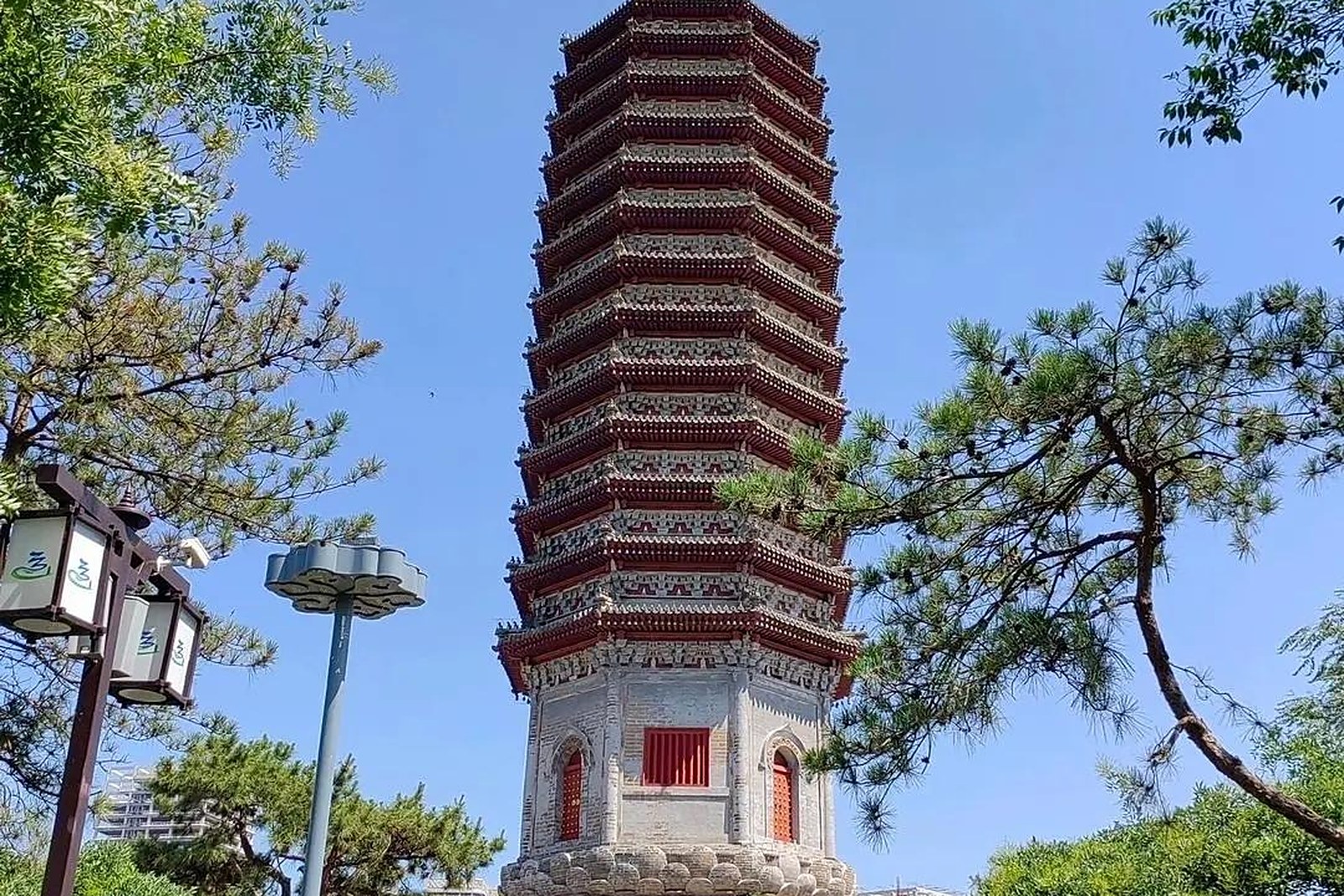
燃灯佛舍利塔 Rándēng Fó Shèlì Tǎ the Randeng Buddha Relic Pagoda — 燃灯塔 Rándēng Tǎ for short — is not one old tower among many — it is, plainly put, the exclamation mark at the end of the Grand Canal: an octagonal, thirteen-storey, dense-eaved solid brick tower of about fifty-six metres rising by the old north wall of 通州 Tōngzhōu town, where barges out of the south sighted it as the final proof that Beijing was reached, and poets turned it into a proverb — 一支塔影认通州 yī zhī tǎ yǐng rèn Tōngzhōu, “one pagoda shadow and you know Tongzhou” — naming it first of the old 通州八景 Tōngzhōu bā jǐng Tongzhou Eight Scenes as 古塔凌云 Gǔtǎ Língyún, the Ancient Pagoda Reaching the Clouds. Tradition dates its founding to the Northern Zhou, with a Tang-dynasty rebuilding in 633 supervised, so the record says, by the general 尉迟敬德 Yùchí Jìngdé, and a Liao-dynasty reconstruction on the old base; the 1679 earthquake threw it down, and the 1690s rebuilding raised the present tower as a Qing copy of the Liao design — heavily repaired again after the 1976 Tangshan earthquake. It stands among the 三庙一塔 sān miào yī tǎ “three temples and a pagoda” complex, where the Confucian 文庙 Wén Miào, the Buddhist 佑胜教寺 Yòushèng Jiàosì and the Daoist 紫清宫 Zǐqīng Gōng cluster about its foot. What you actually visit is a tall brick spire in a small compound of three faiths, minutes from the canal.
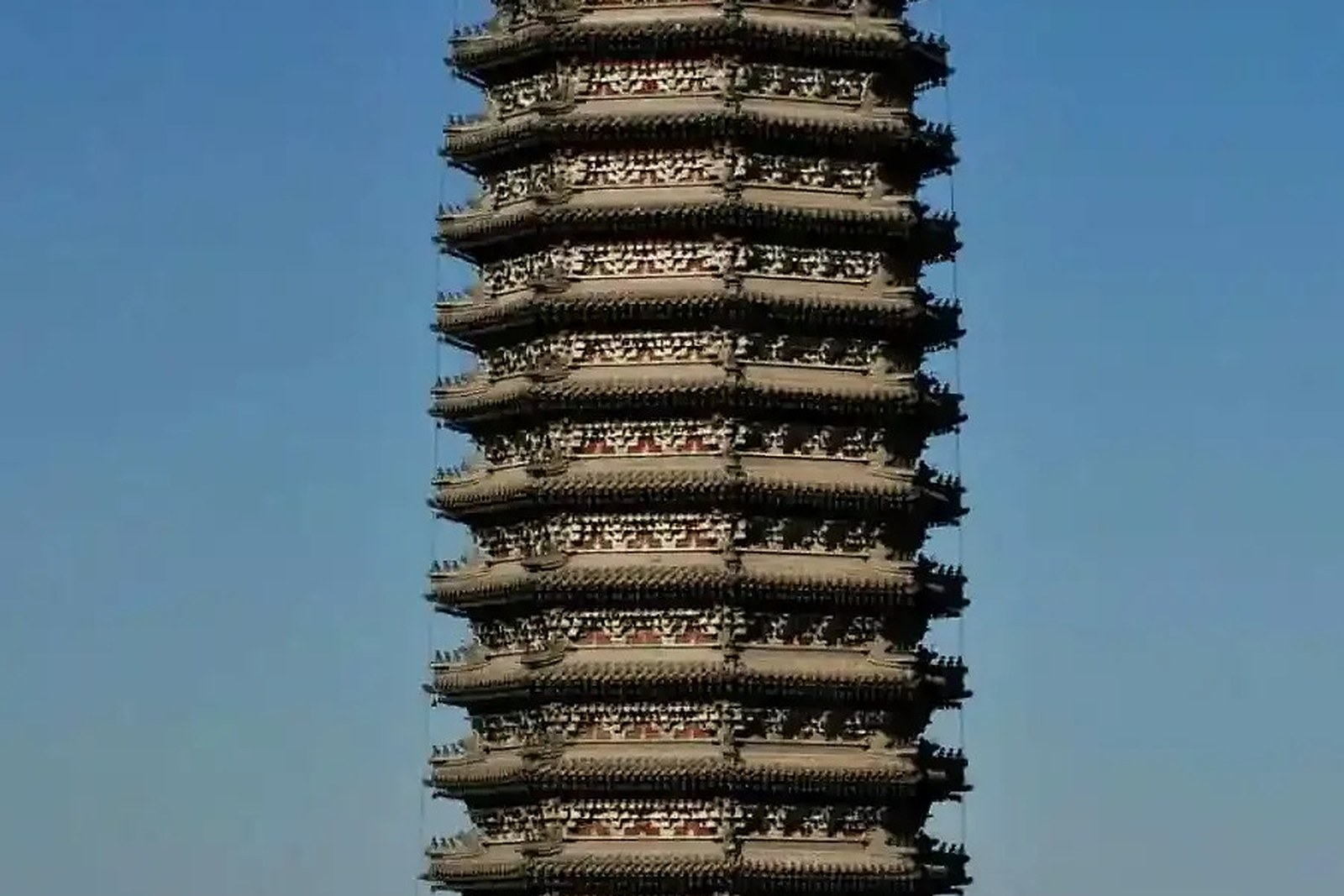
Call it honestly: a sight of an hour or two, best folded into an old-town walk. The complex has passed through sweeping restoration in recent years, and access has run on reservation through official channels, with hours that follow the museum-calendar pattern of closing days and seasonal shifts (worth confirming the details for current admission, booking rules and opening hours). The pagoda is solid — you circle it, you do not climb it — and the pleasure is in the close looking: the brick-carved images by the hundred on the sumeru base, the leaning steel-blue eaves, and above all the bells. Every rafter-end carries one — more than two thousand bronze wind-bells in total, each cast with the name and prayer of a donor — and on a windy day the compound hums like a struck bowl. Combine it with the neighbouring 西海子公园 Xīhǎizǐ Gōngyuán West Sea Park and the canal banks, and give the whole ensemble a morning.
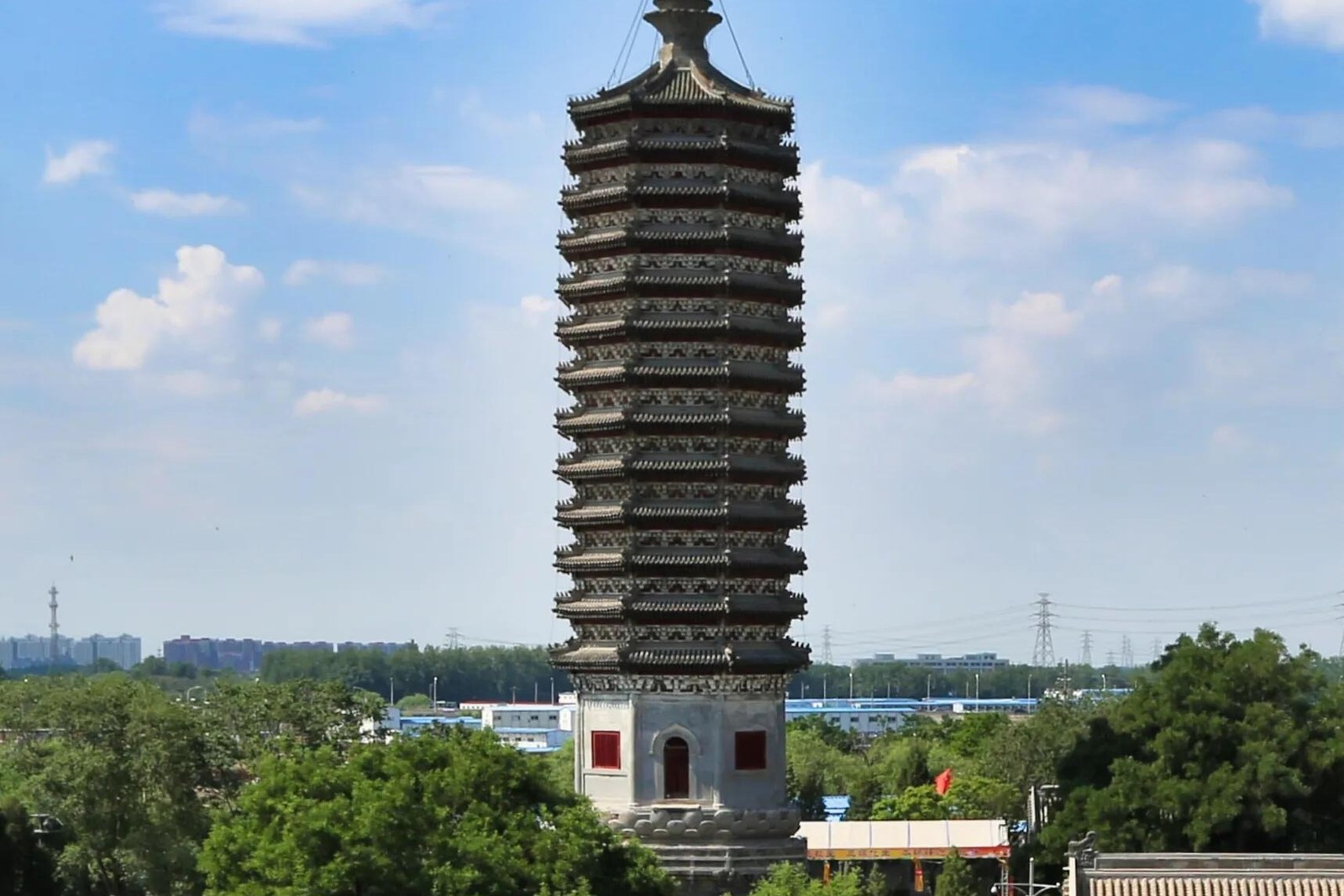
The honest star is the tower’s own detail work — the ranked brick figures, the carved lantern-like niches, and the bell-hung eaves against the sky — not any exhibit hall. Counted among the four great pagodas of the whole canal route, alongside the towers at Linqing, Yangzhou and Hangzhou, it is the eldest of the family, and its silhouette was copied in 1924 for the Boya Pagoda on Peking University’s Weiming Lake — the little sibling, as locals say (worth confirming the details for which halls of the restored complex are open on your day). What gets oversold is the relic romance: the Relic of the Lamp-Lighting Buddha belongs to the tower’s sealed inner chambers, the subject of records and legends rather than a showcase, and the visit is about silhouette and sound, not treasure-hunting. What repays the effort is small and strange: a hardy elm — the 塔榆 tǎ yú, “pagoda elm” — that sprouted on the tower’s topmost course and lived there for nearly three centuries before gardeners moved it to the ground in 1987. Come for the layering of the place: temple court, then brick detail, then the bell-hung top against the clouds.
The self-aware postscript: I circled the tower reading the bronze bells, each engraved with a stranger’s name and wish, while a groundskeeper swept the same leaves he had surely swept that morning, and when I remarked on the wind he said, “the bells are the congregation now — they chant whenever it blows”. That is the visit in miniature. 燃灯佛舍利塔 Rándēng Fó Shèlì Tǎ suits whoever treats it as a slow brick-reading hour first and a photo of the canal second — court, tower, park, river — and exhausts anyone expecting a climbable monument with a viewing deck. Everything else on this Tongzhou list lies within an easy radius: the riverside woods of 大运河森林公园 Dàyùnhé Sēnlín Gōngyuán up the 北运河 Běi Yùnhé, the big-ticket rides of 北京环球度假区 Běijīng Huánqiú Dùjiàqū, the reclaimed grounds of 城市绿心森林公园 Chéngshì Lǜxīn Sēnlín Gōngyuán, and the studio lanes of 宋庄艺术区 Sòngzhuāng Yìshùqū — all in the same 通州区 Tōngzhōu Qū whose skyline the old tower still leads.
Practicalities
- Rating: ★★★★★ — the exclamation mark at the canal’s end and first of the old Tongzhou Eight Scenes; the two-thousand-odd donor-cast wind bells and the pagoda-top elm story outrank the checklist tick; go on a breezy weekday and listen.
- Tickets: Access through the restored 三庙一塔 sān miào yī tǎ complex has run on reservation through official channels, with terms adjusted as restoration phases completed; the neighbouring 西海子公园 Xīhǎizǐ Gōngyuán is free (worth confirming the details for current admission, booking and closing days).
- Address: 燃灯佛舍利塔 Rándēng Fó Shèlì Tǎ, 三庙一塔 sān miào yī tǎ complex, 大成街 Dàchéng Jiē, old-town 通州区 Tōngzhōu Qū, Beijing — beside 西海子公园 Xīhǎizǐ Gōngyuán and the North Canal banks.
- Time needed: An hour or two for the pagoda and the three-temple courts; half a morning adding 西海子公园 Xīhǎizǐ Gōngyuán and the riverside walk.
Words and Names
燃灯佛舍利塔 Rándēng Fó Shèlì Tǎ Randeng Buddha Relic Pagoda · the canal-end tower of the old Tongzhou skyline 古塔凌云 Gǔtǎ Língyún Ancient Pagoda Reaching the Clouds · first of the old Tongzhou Eight Scenes 三庙一塔 sān miào yī tǎ three temples and a pagoda · the Confucian, Buddhist and Daoist compound about the tower 文庙 Wén Miào Confucian Temple · the old prefectural school at the complex, founded in 1298 佑胜教寺 Yòushèng Jiàosì Yousheng Temple · the Buddhist shrine of the Lamp-Lighting Buddha 紫清宫 Zǐqīng Gōng Ziqing Palace · the Daoist housefolk call the Red-Child Temple 塔榆 tǎ yú pagoda elm · the tree that lived nearly three centuries on the tower’s top 西海子公园 Xīhǎizǐ Gōngyuán West Sea Park · the lakeside park beside the tower
flowcloud would say that 燃灯佛舍利塔 Rándēng Fó Shèlì Tǎ is the full stop at the end of the Grand Canal — Northern Zhou in founding legend, Tang-rebuilt and Liao-reconstructed, raised again as a Qing copy of the Liao design after the 1679 earthquake, about fifty-six metres of octagonal thirteen-storey brick hung with more than two thousand donor-engraved wind bells, first of the old 古塔凌云 Gǔtǎ Língyún scenes, with the 三庙一塔 sān miào yī tǎ three-religion compound and the transplanted 塔榆 tǎ yú at its foot — and that the honest move is a breezy weekday morning with the reservation booked ahead, because admission, booking rules and restoration openings all shift (worth confirming the details), the relic legends are the faith half and the singing bells are the real half, and the tower repays whoever circles it slowly while losing anyone expecting a staircase and a view. All checked October 2026.
Getting there: Metro Line 6 to 通州北关 Tōngzhōu Běiguān station puts you a short bus or taxi ride south of the old town, and buses from central Tongzhou run to the 大成街 Dàchéng Jiē side streets; self-drive follows the 京通快速路 Jīngtōng kuàisù lù expressway into Tongzhou and parks at the old-town lots near 西海子公园 Xīhǎizǐ Gōngyuán (worth confirming the details for current metro-bus connections and parking). All checked October 2026.