
Samye Monastery — the First Monastery and Its Perfect Mandala
三界圆满一寺藏,四塔分色护中央 Sān jiè yuánmǎn yī sì cáng, sì tǎ fēn sè hù zhōngyāng – One monastery holds the three worlds complete; four stupas in four colors guard the center
桑耶寺 Sāngyē Sì Samye Monastery is where Tibetan Buddhism took institutional shape. Founded in the eighth century under 赤松德赞 Chìsōng Dézàn Trisong Detsen – with the tantrist 莲花生 Liánhuāshēng Padmasambhava and the abbot Shantarakshita doing the founding work – it is counted as the plateau’s first monastery with ordained monks, and its layout is a map of the Buddhist universe laid out on the plain of the 扎囊县 Zhānáng Xiàn Zhanang riverbank.
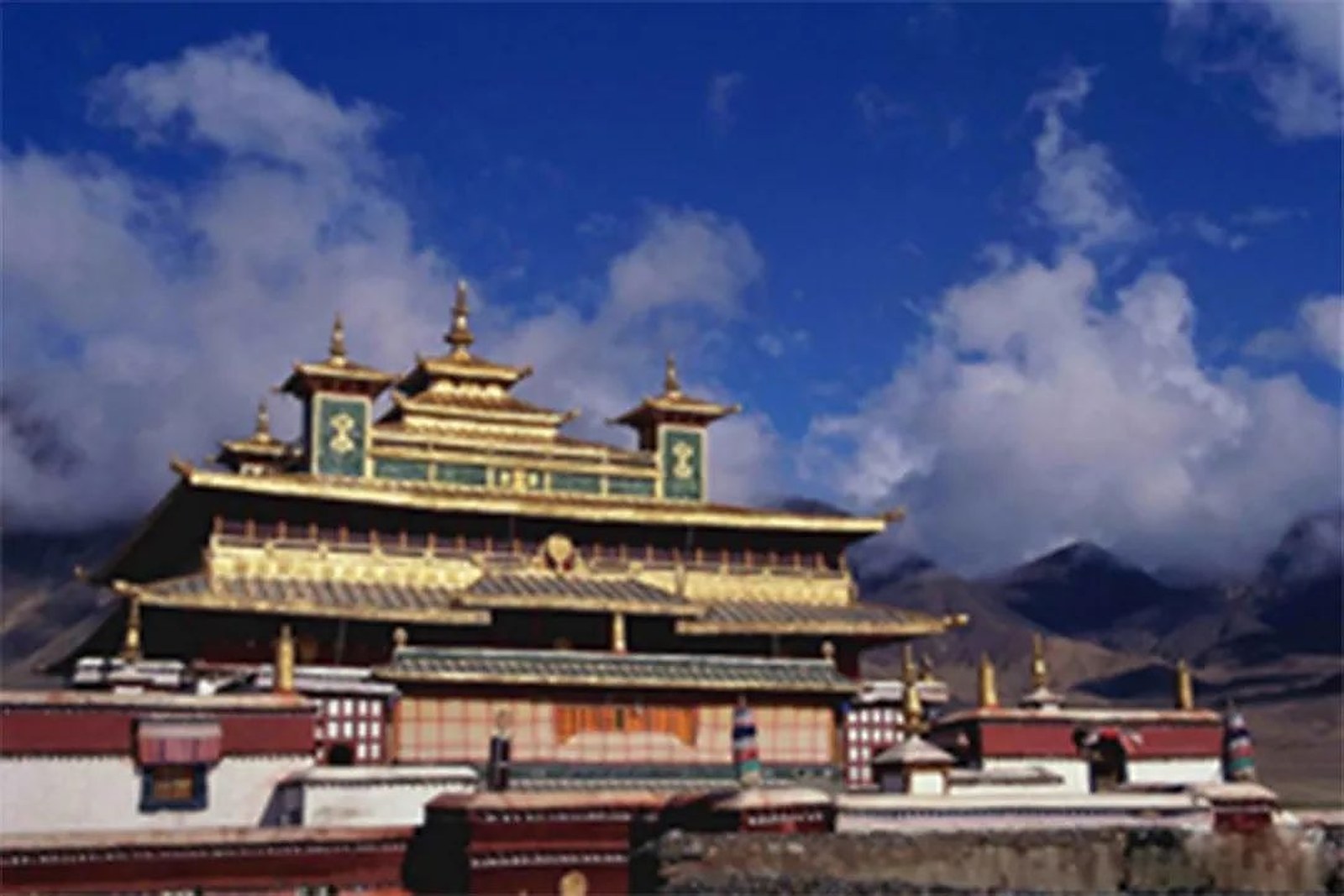
The center is the 乌孜大殿 Wūzī Dàdiàn Utse hall, a building of three stories that tradition says embodies Tibetan, Chinese and Indian styles in its three levels – one temple teaching three architectural grammars. Around it the ground is laid out as a mandala: four great stupas in white, red, black and green at the cardinal points, smaller chapels between them, and a circular wall studded with minor shrines closing the sacred plan off from the fields.
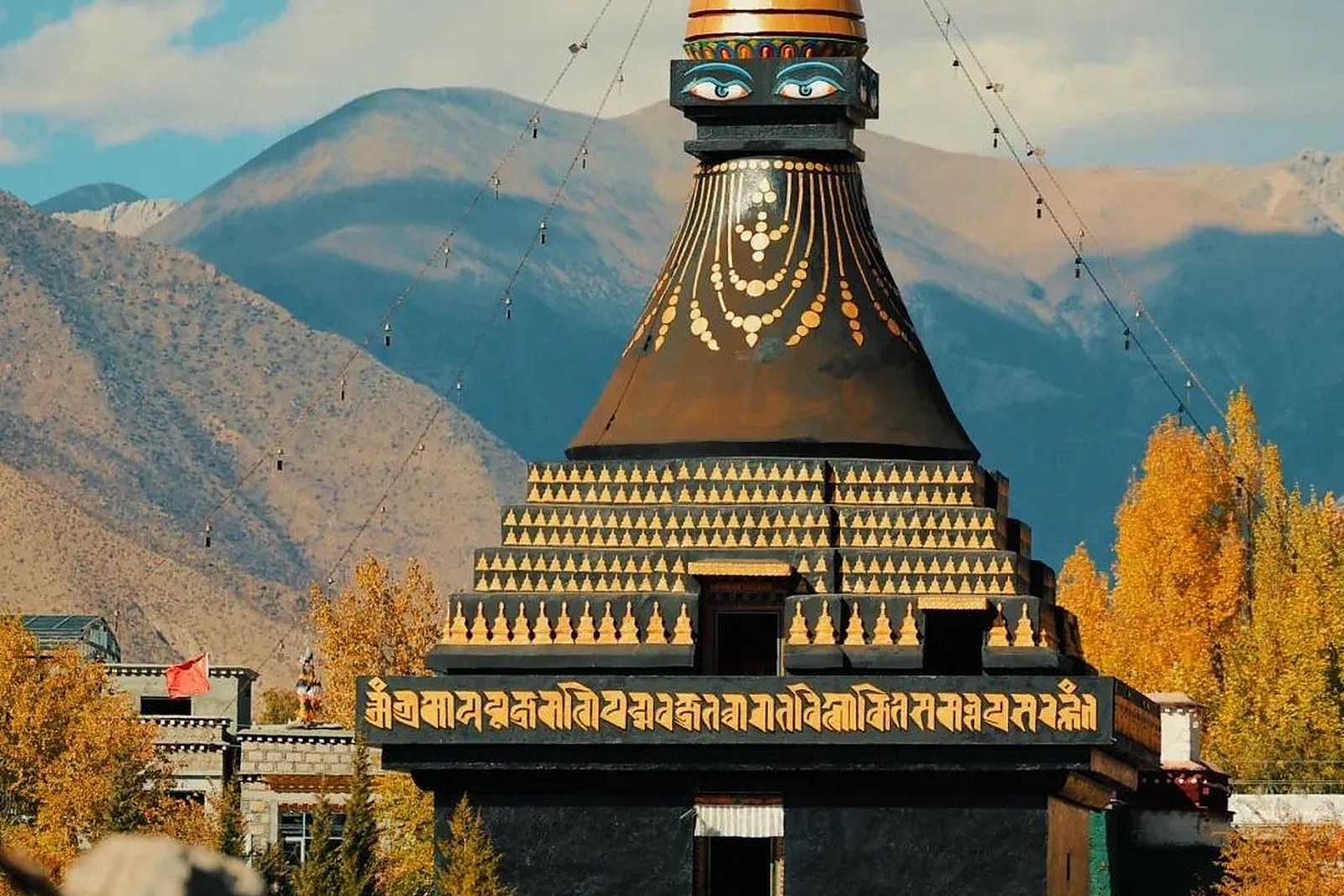
Walking the circuit is the pleasure here. Pilgrims keep the sun on their right shoulder along the wall road; travelers drift from stupa to stupa and notice that each has its own mood – the white one pristine against blue sky, the black one brooding, the green one half-lost in prayer flags. In the courtyards monks debate in the afternoons, and the smell of juniper smoke from the offering fires drifts across the sand.
Samye rewards a full day rather than a stop. The town outside the wall exists for the monastery – pilgrim guesthouses, tea shops, a slow rhythm that starts with horns before dawn – and the low Hepo Ri hill behind the compound gives the classic rooftop view: the whole mandala printed on the plain, mountains closing the circle. Stay the night if you can; the monastery at first light, before the day buses arrive, is a different country.
Practicalities
- Samye lies across the Yarlung Tsangpo from Zetang – by road over the bridge or by the traditional ferry in season – roughly two hours door to gate.
- The circuit wall, the four stupas and the Utse hall take most of a day; photography inside the chapels is restricted, so check each hall’s rules.
- Pilgrim guesthouses and small hotels line the town outside the wall; an overnight doubles what the mandala gives you.
- Mornings bring the deepest light on the stupas and the fewest tour groups; afternoons bring monk debates in the courtyard.
Words and Names
桑耶寺 Sāngyē Sì Samye Monastery, the plateau’s first monastic foundation; 乌孜大殿 Wūzī Dàdiàn the Utse central hall, three floors in three styles; 四色塔 sì sè tǎ the four great stupas in white, red, black and green; 曼荼罗 màntúluó mandala, the cosmic diagram the whole compound lays out; 赤松德赞 Chìsōng Dézàn Trisong Detsen, the eighth-century king who founded it. Beyond the monastery, the same 山南市 Shānnán Shì Shannan keeps more places worth the detour: 雍布拉康 Yōngbùlākāng the first palace above the barley fields, 羊卓雍措 Yángzhuó Yōngcuò the holy lake of the coral-blue fingers, 拉姆拉措 Lāmǔlācuò the oracle lake under the ridges, or 藏王墓 Zàngwáng Mù the royal mounds of the valley – four more doors into the same Shannan. Once the mandala circuit is behind you, our Shannan food map fills the table.
flowcloud would say Samye is the plateau’s oldest floor plan – a universe drawn once, in stupas, and still standing to scale. All checked November 2026.
Getting there: From Tsetang the road runs east about thirty kilometers to the river crossing and north bank approach to Samye in Dranang county – roughly one and a half hours by car. Come early to walk the kora in cool light. All checked November 2026.