
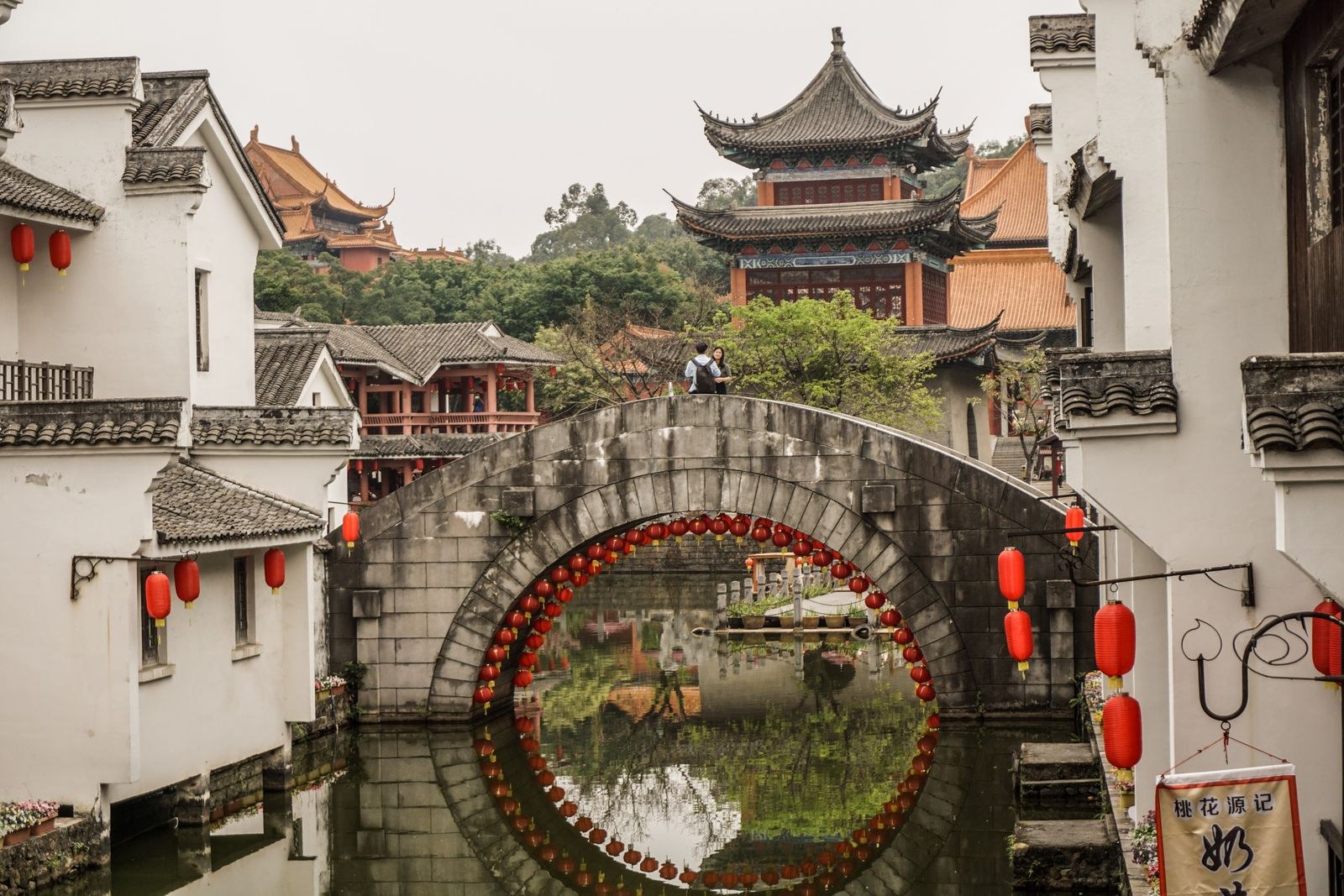
The village has one street and the river is the street. 上甘棠 Shànggāntáng was founded in the Tang, in the ninth century, by a family called 周 Zhōu who came south from the central plains and never left, and it has been lived in continuously since — the same surname, the same site, a hundred and twenty generations. What you walk into is a settlement of a couple of thousand people arranged along the 谢沐河 Xièmù Hé, a shallow river that the village uses as a working surface: water buffalo standing in it, vegetables being washed in it, ducks, a small stone weir, children. Above it are whitewashed walls, black tile roofs, and a river of stone steps.
The famous object is the bridge. 步瀛桥 Bùyíng Qiáo is a single-arch stone bridge over the river at the village entrance, built in 1126 — the first year of the Jingkang era, which is the year the Northern Song fell — and it has been in use ever since, which makes it one of the oldest working bridges in Hunan. It is small, plain, and worn shiny in the middle, and it is the reason photographers come. Behind it, at the top of the village, is a three-storey 文昌阁 Wénchānggé, a Ming tower built so that the family’s sons would pass the imperial examinations, which, judging by the number of inscribed honours on the walls, they did with some regularity.
The other thing worth the walk is 月陂亭 Yuèbēitíng, a low cliff by the river downstream, carved with twenty-four inscriptions spanning several dynasties — one of them, unusually, listing the family’s genealogy and its rules, which makes it a stone archive of the clan. And the village’s lane system retains its Ming drainage: stone channels under the paving that still take the water away, an engineering detail the interpretive signage will mention and you will then notice everywhere.
This is not a restored attraction and it is not abandoned; it is a poor village in a beautiful valley where people live in the buildings that everyone else photographs, and the etiquette is the ordinary one — do not walk into courtyards, ask before photographing people, and buy something. The 香芋 xiāngyù and 香柚 xiāngyòu grown in this county are the local cash crops, and the taro in particular is genuinely excellent.
Practicalities
Tickets. Around ¥40–60 for the village conservation area, which covers the bridge, the tower and the inscribed cliff. Some entrances are unstaffed and free out of season.
Opening hours. Roughly 08:00–17:30, though the village is inhabited and you can walk the lanes at any hour.
Closing day. No closing day. The village is a living settlement, not a ticketed park, and there is no day when it shuts.
Getting there. No railway. From 江永县 Jiāngyǒng Xiàn county town it is about 25 kilometres and 40 minutes by road, taxi ¥60–90; from 永州 Yǒngzhōu it is around three hours. Most visitors reach it as part of a driving loop through southern Hunan, usually paired with the 女书 nǚshū villages twenty minutes away.
What People Get Wrong
They come for the bridge, take the photograph, and leave. The bridge is one object; the reason the place is unusual is that it is a working village of Tang foundation with an intact clan archive, a Ming drainage system and a thousand-year habit of the same family living on the same ground. Walk the whole length of the riverbank, both directions.
Getting there
By car from 江永 Jiāngyǒng or as part of a loop from 永州 Yǒngzhōu through 江华 Jiānghuá. Half a day is enough for the village and the cliff; a full day if you add the 女书 nǚshū museum and 普美村 Pǔměi Cūn. Eat a farmhouse lunch and buy taro.
flowcloud would say that a family who came south in the ninth century and were still there in the twenty-first, on the same riverbank, with their examinations carved on the wall and their genealogy on a cliff, have demonstrated a definition of permanence that most civilisations only talk about.
Getting there: 上甘棠村 (Shànggāntáng Cūn), 江永县 (Jiāngyǒng Xiàn), 永州市 (Yǒngzhōushì), 湖南 (Húnán). Open daily roughly 08:00–17:30, no closing day; entry ¥40–60. 25 km and ¥60–90 by taxi from 江永 (Jiāngyǒng) county town. Walk the riverbank both ways, see 步瀛桥 (Bùyíng Qiáo) and 月陂亭 (Yuèbēitíng), and buy the local taro.