
Three Thousand Years of Gold: Shayar’s Desert Poplar Sea Along the Middle Tarim River
一河秋水千树金,胡杨站成三千年 Yī hé qiūshuǐ qiān shù jīn, húyáng zhàn chéng sān qiānnián – A river of autumn water and a thousand golden trees; poplars stand as if for three thousand years
正文:沙雅胡杨林 Shāyǎ Húyánglín the Shayar Populus euphratica forest lines both banks of the middle Tarim river inside Shayar county, 阿克苏地区 Ākèsū Dìqū Aksu Prefecture – one of the largest contiguous natural desert-poplar forests in China, with the county’s poplar acreage approaching two million mu. “Living a thousand years without dying, dead a thousand years without falling, fallen a thousand years without rotting” – the poplar’s three millennia are not legend here but daily sight: living crowns spread gold overhead, standing dead trunks gleam silver-white as bone, and fallen trunks weather on the sand into sculptures; all three states often share a single river bend.
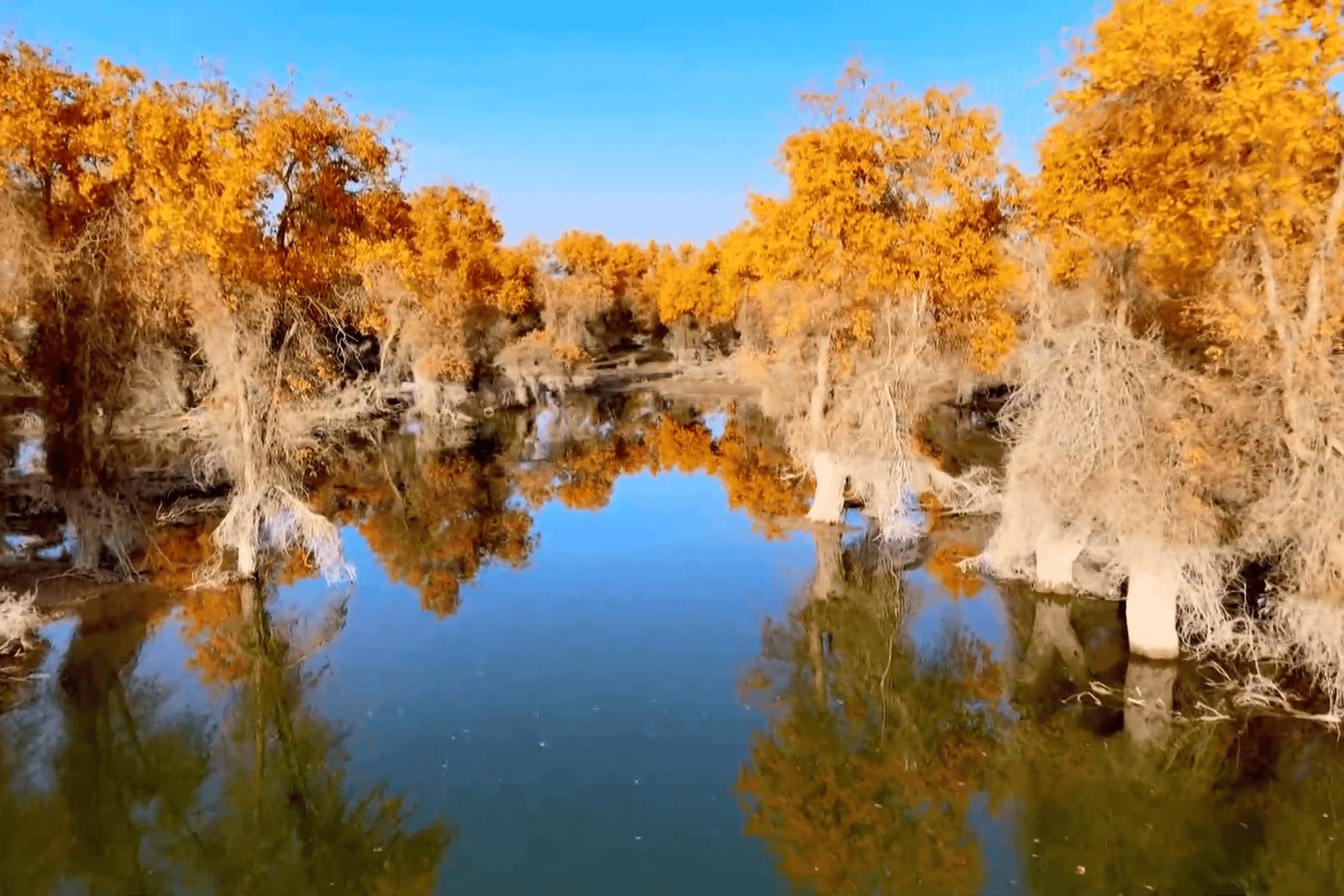
Shayar’s selling point is the word “wild”: unlike landscaped park plantings, these poplars grow along the Tarim’s natural channels, their density set by the water, and by boat or along the boardwalks you can read the complete desert riparian forest ecosystem of poplar, red willow, reed and apocynum. The Sun Island stretch is the classic frame: the river bends in a gentle arc, golden trees circle a pool of still water, and the reflection doubles the autumn. Come on a windless early morning and the surface holds the entire gold like a mirror.
October is Shayar’s golden month: for the two weeks around Frost Descent the leaves run green to yellow to burning gold-red, the colour peak lasts barely ten-odd days, and the whole county gets its liveliest window of the year. During the Poplar Festival there is folk song and dance, camel racing and long-distance running; herders move their yurts to the forest edge and visitors eat fresh-roasted lamb and fish stewed with river water. Those who come off-peak need not mourn – after the leaves drop in November the bare trunks look even more rugged, and shooting silhouettes is another style entirely.
The poplar’s survival craft deserves its own chapter: the roots drive down more than ten metres to find water, and each leaf changes shape three times in a lifetime – slender as willow on a sapling, broad as poplar on a mature tree, curved and oval returning on old branches, which is why the tree is also called the “three-leaf tree.” Scientists found that when the lower Tarim ran dry, the poplars amputated to survive, sacrificing branches on one side to save the taproot; once ecological water was released back down the channel, withered limbs flushed green again within two years. Once you read that survival logic, every crooked tree in the forest becomes an inspirational film.
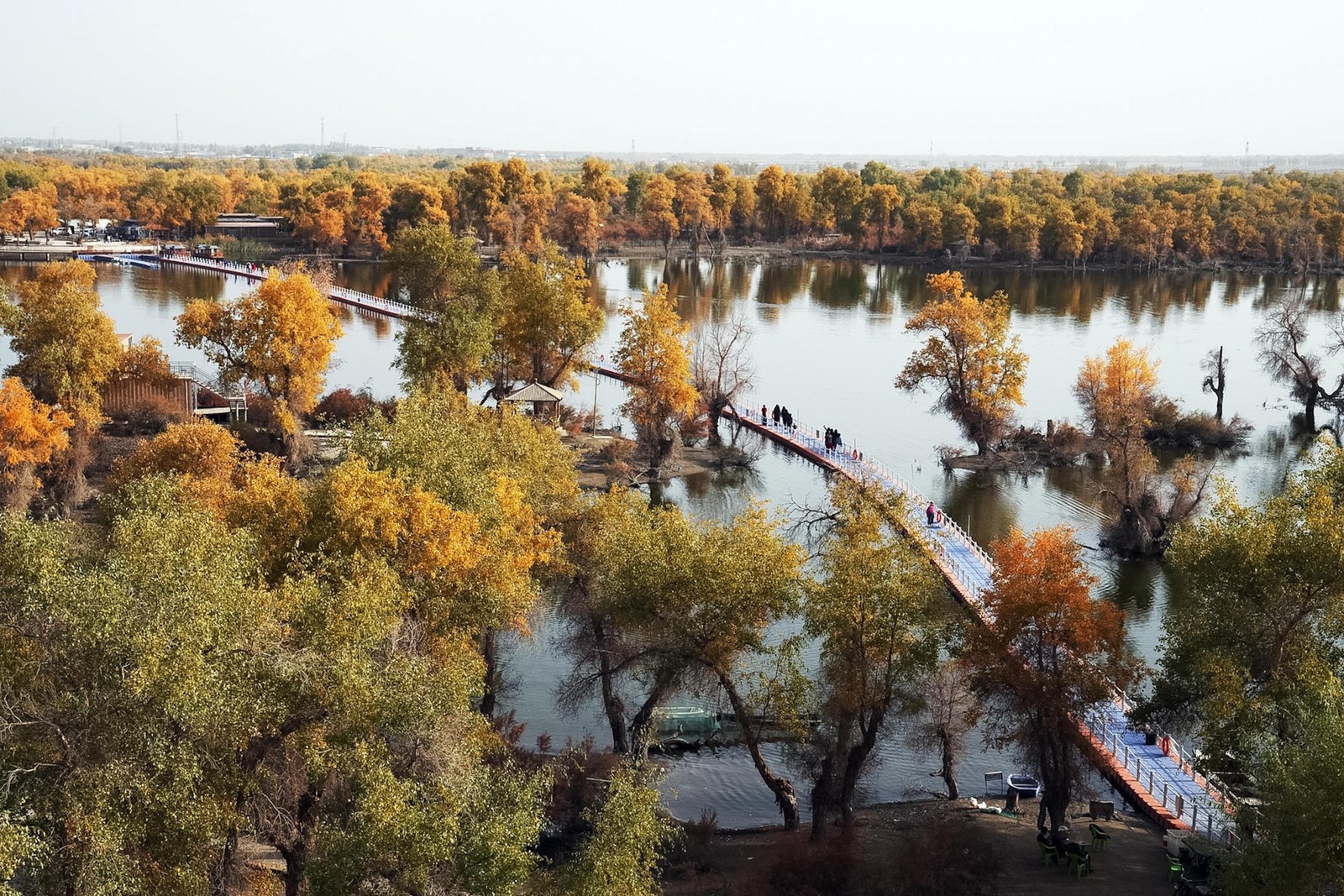
The Tarim river itself is the lead actor: China’s longest inland river slows its pace here, and side channels and oxbow lakes cut the forest into islands. The riverside viewing platforms and boardwalks form the skeleton of a walking visit, and renting a site bicycle or taking the ferry across gives you the forest from a new angle. The waterbirds in the reed beds are unafraid of people – egrets, cormorants and flocks of wild ducks treat the river bends as a canteen, and the strike rate for telephoto lenses here is extremely high.
Practicalities: the poplar forest park ticket runs around fifty yuan with the sightseeing vehicle and boat charged separately, and the core loop takes about two hours on foot; for going deep into the forest hire a local guide – phone signal is patchy in the sands and solo trekking through wild woodland is not recommended. Shayar county town lies thirty to forty kilometres from the forest with more honest food and lodging than the site, and in autumn the county night market also sells just-picked Korla pears and local grapes.
The photography tactics are concrete: reach your position half an hour before sunrise and wait for the backlight – golden leaves turn translucent against it and the whole tree looks like a lit candle; shoot the river-bend panorama in frontlight at sunset, when the saturation of gold and blue sky peaks together. A drone is a magic tool here – from the air the textures of channel and forest read like an oil painting of the earth – but controls apply during the Poplar Festival, so ask the site management office before launching.
Shayar’s poplar story has a human chapter too: the herding families along the river have grazed their flocks among these trees for generations – poplar leaves are the sheep’s winter fodder reserve and dead branches are their heating fuel, so what locals feel for the poplar cannot be summed up as “scenery.” Forest rangers walk tens of kilometres a patrol, guarding against illegal felling and fire; behind one season of gold stands year-round watching.
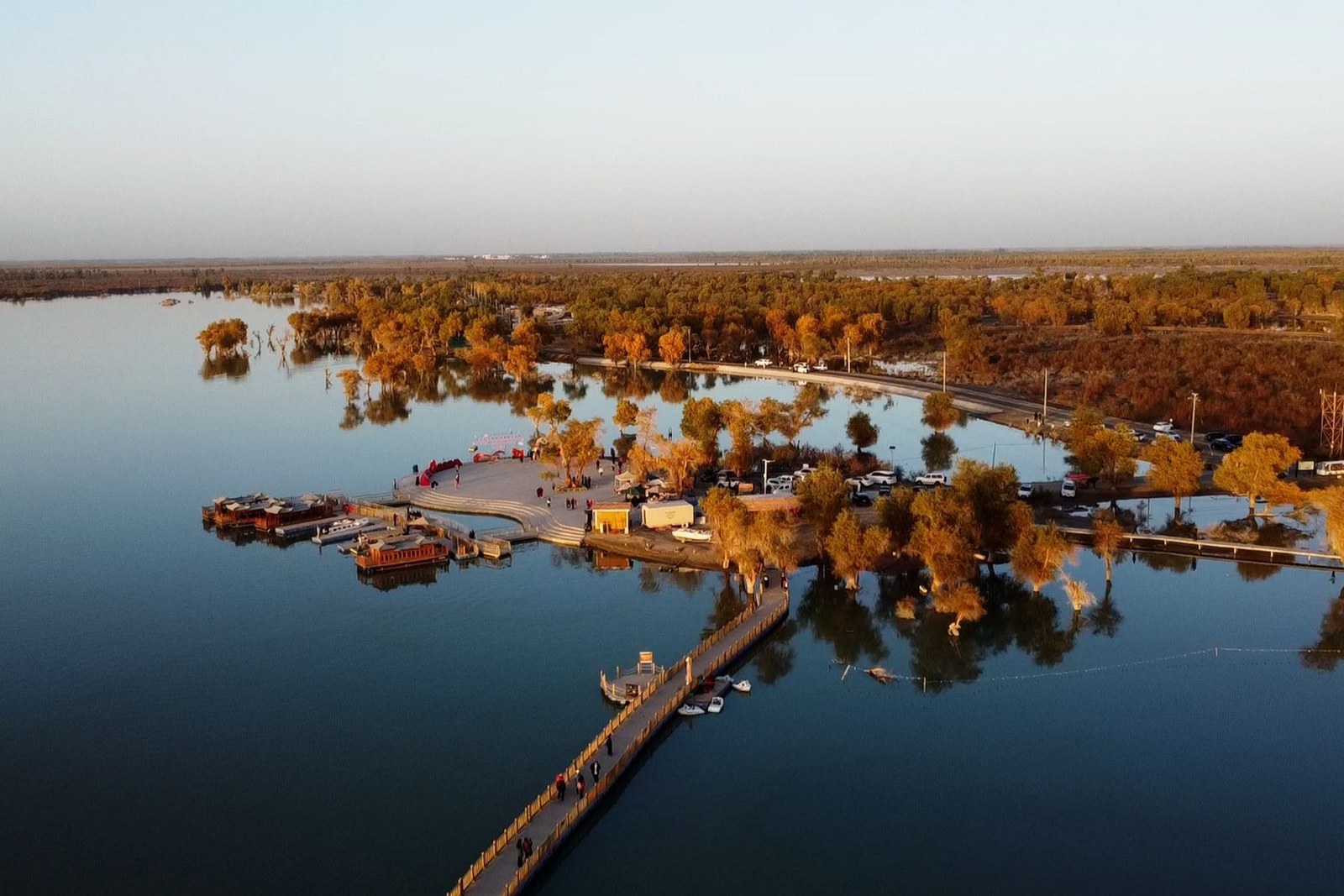
Before leaving the forest, do not miss the Tarim sunset: the sun drops toward the desert-side horizon, the whole river melts into molten gold, rows of poplar silhouettes stand in the light, and when the wind stirs the reed flowers fly – the picture should be titled “Xinjiang’s autumn ran out of all its colours.” Bring a thick coat; the riverside evening wind cools shockingly fast, and beauty and cold always arrive together.
The best viewing window runs from mid-October into early November – golden crowns against the blue water of the Tarim for the three most photogenic weeks of the year. A sightseeing shuttle strings the viewpoints together, and you can rent an electric cart on site to stop and shoot at will. The boardwalk section through the woods is best for a slow stroll: sand and fallen leaves underfoot, gnarled branches overhead, and when sunlight leaks through the leaf gaps the whole forest seems to glow.
Photographers should come at both ends of the day: in the early morning mist slides along the river and the poplars loom in and out of it; at sunset, shooting into the light, the golden leaves go semi-transparent. Drone flyers should register in advance – airspace over the shoals is managed more strictly than expected. Shayar county town sits some twenty-odd kilometres from the site with easy food and lodging; in the evening try the county night market’s red-willow skewers with figs picked that same afternoon – the most local way to close this route.
Practicalities
After the gold, the same 阿克苏地区 Ākèsū Dìqū Aksu Prefecture keeps more places worth the detour: 克孜尔千佛洞 Kèzī’ěr Qiānfódòng Kizil Thousand-Buddha Caves for the thousand-year murals, 天山神秘大峡谷 Tiānshān Shénmì Dàxiágǔ Kuqa Grand Canyon for the red one-line sky, 库车老城 Kùchē Lǎochéng Kuqa Old Town for the painted-gate lanes, or 天山托木尔大峡谷 Tiānshān Tuōmù’ěr Dàxiágǔ Wensu Grand Canyon for the danxia wonders – four more doors into the same 阿克苏地区 Ākèsū Dìqū Aksu Prefecture. Once the sea of trees is walked, our Aksu food map fills the day.
Practicalities
Words and Names
flowcloud would say Shayar’s poplars are the desert’s memoir: gold for the living, silver for the fallen, and a river that reads every page twice a day. All checked November 2026.
Getting there: The forest reserve lies about twenty-five kilometres southwest of Shaya county town; the scenic gate handles tickets, shuttle buses loop the main lookouts, and October weekends fill the car park by mid-morning – buses run Aksu to Shaya hourly, then the last stretch is a flat fifteen-minute cab ride. All checked November 2026.