
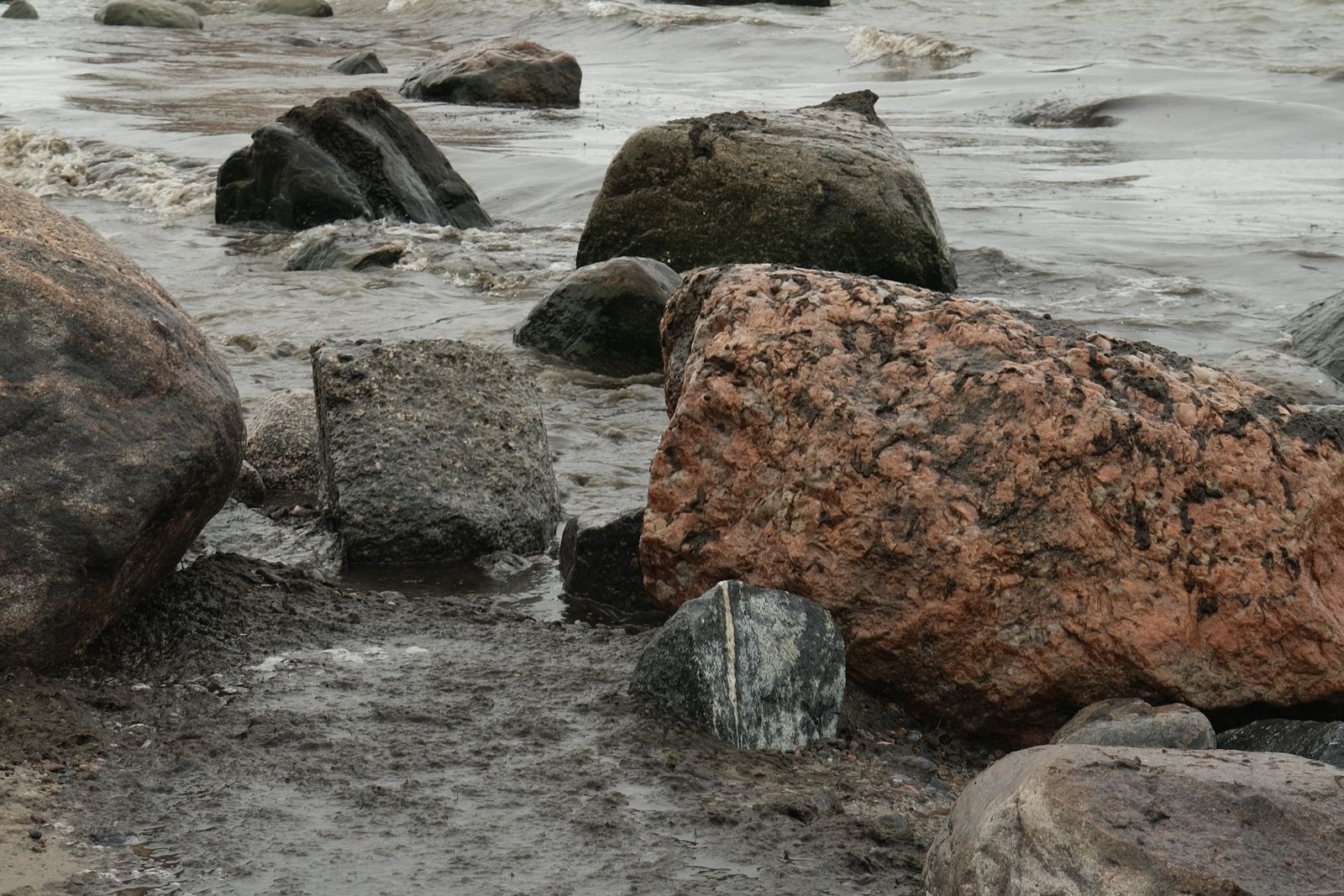
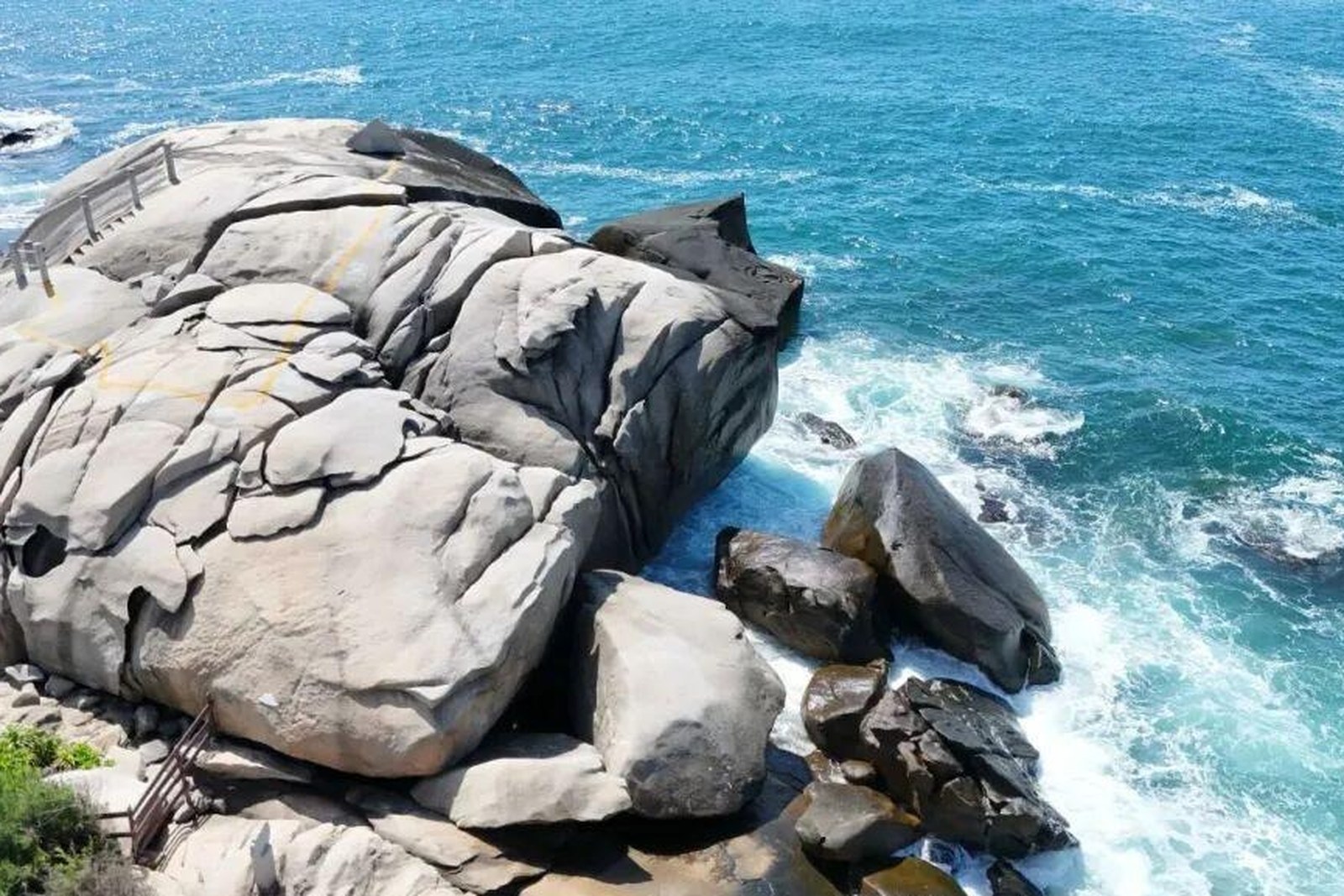
The coast here is not a beach. It is a shore of enormous rounded grey boulders, some of them the size of a house, piled and balanced and half-submerged, with the sea going about its business between them and throwing spray ten metres up a wall of stone every few seconds. You do not walk along it so much as pick your way across it, and the sound never stops — a low hydraulic boom from the swell hitting a cave under you, then a hiss as the water retreats through the gaps. 石头公园 Shítou Gōngyuán has the most boring name available in Chinese, “Stone Park”, and one of the best forty minutes you can spend on Hainan.
It sits at the foot of 铜鼓岭 Tónggǔlǐng, the hill at the north-eastern tip of 文昌 Wénchāng, in 海南 Hǎinán, a few minutes from the rocket launch site at 龙楼镇 Lónglóuzhèn and about an hour and a half by road from 海口 Hǎikǒu. It is free to enter, it has a small car park and a couple of stalls selling coconuts and roasted sweet potato, and on most weekday mornings the only other people there are a handful of fishermen with long rods and one man who has come to sit on a rock and look at the water.
How a Coast Gets Like This
Two things made this landscape, and they happened in the right order.
The first was underground. The rock is granite — an intrusive igneous rock that cooled slowly from a mass of magma below the surface. When granite cools it does so in three roughly perpendicular sets of fractures, and weathering works into those fractures from the outside in, rounding off the corners and turning what was a block into a ball. That process, called spheroidal weathering, is why granite landscapes all over the world end up looking like a heap of giant eggs. Here, it had millions of years to do its work while the rock was still buried.
The second was the sea. As sea levels settled and the coast retreated, the rounded boulders were exposed to the surf, which cuts at the base of a rock face until it undermines it and everything above falls over. That is why the stones here are not just round but balanced — tilted, stacked, propped, leaning on each other in arrangements that look precarious and have been stable for a very long time. Geologists call the result a granite marine-erosion landscape, and 海南 Hǎinán has one of the best examples of it in China right at this spot.
The colour changes through the day. Granite is a pale grey, so in the flat light of noon the whole shore looks washed and dusty; in the last hour before sunset the surfaces take on the pink of the sky and the wet lower rocks go almost black, and the effect is worth rearranging your day for.
Walking It Properly
There is a paved path and a viewing platform for people who want the photograph without the scrambling, and there is the shore itself for everybody else.
Wear something with grip. The rock is smooth and the spray keeps the lower surfaces wet, and the seawater-corroded granite here has a fine sandy surface that behaves like ice in the wrong shoes. Trainers with tread are fine. Hotel slippers are not, and I watched a man learn this the hard way while his wife filmed it.
Go left rather than right. From the car park, the seaward route to the south is the flatter, more open section and the one most visitors take. The northern route towards the headland under 铜鼓岭 Tónggǔlǐng is steeper and wilder and gets you out of sight of the car park within ten minutes, which is the whole point.
Watch the swell before you commit to a rock. The sets here come in groups, and the seventh wave in a set is a real thing. If the last one came up to your boot, the next one will be higher.
Do not go out on the outer rocks at high tide or in a strong onshore wind. There is no lifeguard, no fence and no phone signal in the gullies. This is a wild coast that happens to be easy to reach, and it has taken people.
Nearby
铜鼓岭 Tónggǔlǐng, the hill directly above, is the area’s other obvious stop — a shuttle and a walkway to a summit viewpoint over the whole coast, with the two launch towers of the 文昌航天发射场 Wénchāng Hángtiān Fāshèchǎng visible to the south-west. Do the hill in the morning and the rocks in the afternoon, or the reverse, and you will have had the best day available in northern Hainan.
淇水湾 Qíshuǐwān, a proper sandy beach, is a few kilometres away and is where everybody goes on a launch day. And 龙楼镇 Lónglóuzhèn, the launch town, is ten minutes inland with guesthouses, seafood restaurants and a rooftop culture that exists for one reason.
Practicalities
Tickets: Free. There is no admission charge for the shore or the viewing platform. The car park takes a small fee of a few yuan.
Opening hours: Open all day, every day — it is a stretch of coast rather than a gated attraction. The light is best from about five in the afternoon until sunset, and the worst at noon in summer, when the rock reflects the heat back at you and there is no shade at all.
Closing day: None. There is no closure, which also means there is nobody to tell you the tide has turned.
Getting there: 石头公园 (Shítou Gōngyuán) is at the foot of 铜鼓岭 (Tónggǔlǐng) in 龙楼镇 (Lónglóuzhèn), 文昌 (Wénchāng), north-east 海南 (Hǎinán). 文昌 has a station on the island’s east high-speed rail loop — about twenty minutes from 海口美兰 (Hǎikǒu Měilán) airport — and from there it is forty minutes by taxi to 龙楼; from the town the park is a five-minute drive or a half-hour walk with the sea on your left. By car, follow the coastal road out of 文城 (Wénchéng) and turn off at the sign for 铜鼓岭. Bring water, sun cream and shoes with grip; there is nowhere to buy anything beyond the coconut stalls at the entrance. flowcloud would say that a free shore of enormous stones at the end of a fishing road, which nobody has felt the need to improve, is worth more than any ticketed scenic area on the same island. Go in the late afternoon, walk north rather than south, and stay for the light on the wet rock.