
The buildings are ordinary and the history is enormous, which is the wrong way round from most old towns. 松口 Sōngkǒu is a town on the 梅江 Méi Jiāng in 梅县区 Méixiàn Qū, about an hour downstream of 梅州市, and from the eighteenth century until steamships replaced the river trade it was the port from which Hakka emigrants left for 南洋 Nányáng, Southeast Asia. The men who went away sent money back, and the money built the town you can still walk through: a street of arcaded shopfronts, 骑楼 qílóu, with a covered walkway over the pavement, a row of stone wharves down at the water, a hotel from the 1930s with its concrete balconies intact, and a pagoda on the hill above the bend to guide the boats. Nobody restored it into a theme park. Some of it is occupied, some is shuttered, and the emptiness is the most eloquent thing about it.
Start at the water. The 火船码头 huǒchuán mǎtóu, the steamboat wharf, is a flight of stone steps down to the river with a marker on the bank, and the steps are the single most loaded object in the town: this is where a young man with a cloth bundle said goodbye to his family, and, in a great many cases, never came back, because the fare home cost more than he would earn in a decade. Of the Hakka diaspora across Southeast Asia, a large proportion traces to this corner of Guangdong, and 松口 was one of its principal doors. The river is wide here, the water is brown-green, and the far bank is bamboo and farmland; the scale is calm and entirely at odds with what happened on the steps.
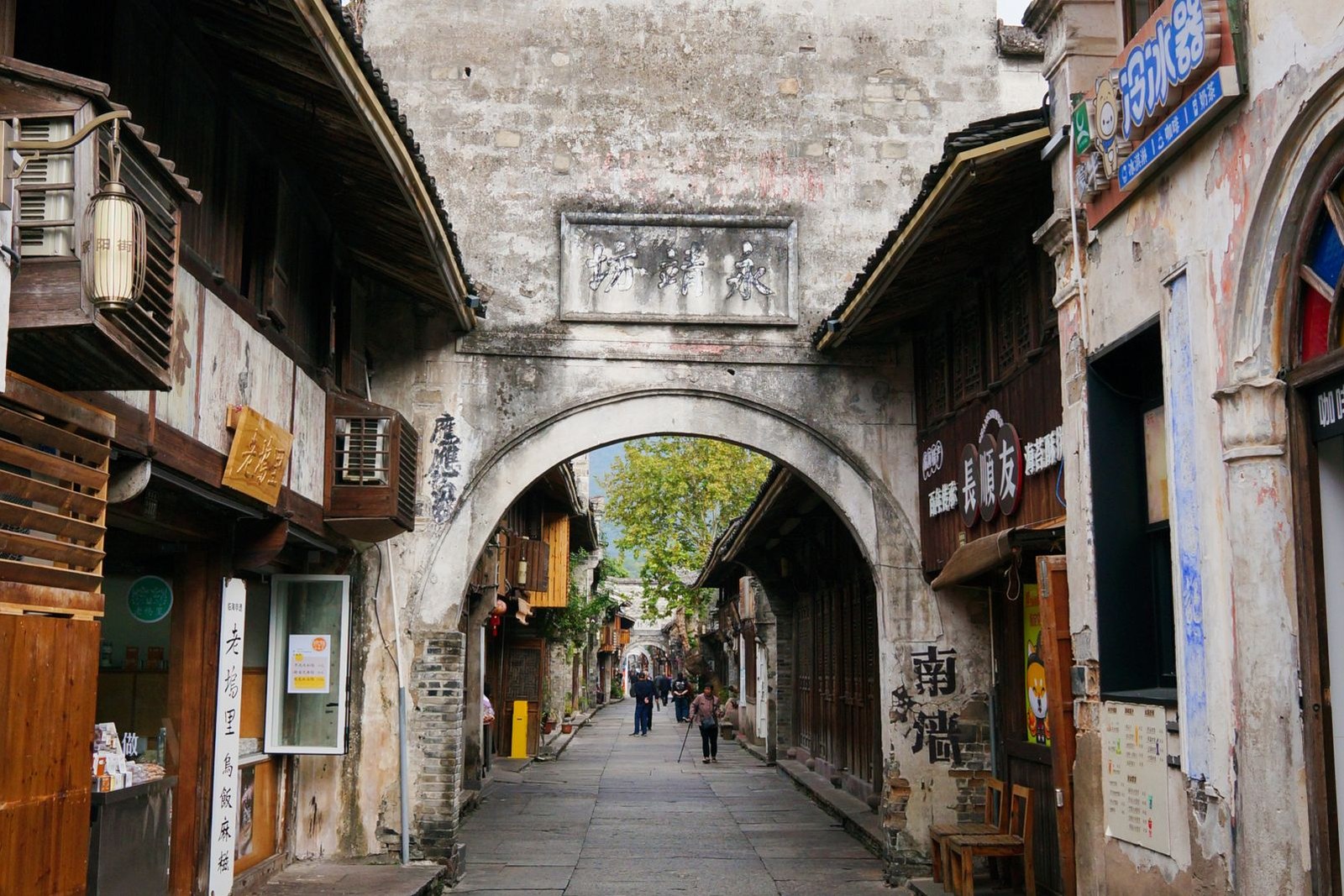
The street above the wharves is the reason to give the town half a day rather than an hour. It is a single long row of two-storey shophouses with the arcade over the pavement, built in a mixture of grey brick and concrete, with worn thresholds and hand-painted signs fading into the plaster. At the top of the street is the gate through which the merchants passed, and behind it the 松江大酒店 Sōngjiāng Dà Jiǔdiàn, a three-storey 1930s hotel with balconies and a flat roof, now empty, which is the best surviving piece of the town’s commercial confidence. Above the bend, the 元魁塔 Yuánkuí Tǎ stands on its own hill; it is a slender brick pagoda of seven storeys, built as a 文峰塔 wénfēng tǎ, a literary pagoda, intended to encourage examination success and used as a landmark by river pilots. The climb to it takes twenty minutes and gives the only view of the whole town.
Practicalities
Tickets. The town itself is free to walk. The 元魁塔 Yuánkuí Tǎ and a couple of the restored houses charge a small fee, usually ¥10 to ¥20, collected at the door.
Opening hours. The street is open all day, and it is at its best in the early morning and the last hour of light. The pagoda and the small paid houses keep roughly 08:30 to 17:00. There is very little in the way of cafés, so bring water.
Getting there. 松口 Sōngkǒu is in 梅县区 Méixiàn Qū, about an hour by road from 梅州市 Méizhōu Shì and roughly forty minutes from 梅州西站 Méizhōu Xī Zhàn on the 梅汕 Méi-Shàn high-speed line. Buses run from the 梅州 terminal to 松口 several times a day and take a little over an hour. The town is on the north bank of the 梅江; the wharf and the old street are within a few minutes of the bus stop on foot.
Closing day. No closing day for the street, which is a living road rather than a site. The pagoda is sometimes locked on weekdays in the off season, so ask locally before making the climb.
The Door the Hakka Left By
It is worth being precise about what 松口 was. 梅州 is described as the 世界客都 shìjiè Kèdū, the world Hakka capital, and the claim rests on migration rather than on buildings: from here and from the surrounding counties, Hakka families moved south and west over several centuries, and from the nineteenth century onward they moved overseas, to 印尼 Yìnní, 马来亚 Mǎláiyà, 泰国 Tàiguó and 新加坡 Xīnjiāpō. The river port was where the overland journey ended and the sea journey began. What remains is not a grand monument but the infrastructure of that movement: wharves, a hotel, a merchants’ street, a pagoda to guide boats and encourage scholars, and a great many ordinary houses paid for with remittances.
That is also why the town looks the way it does. The arcade, 骑楼, is a tropical form, imported from the ports of Southeast Asia and used all along the coast of Guangdong and 福建 Fújiàn; it gives shade and shelter from rain over the pavement, and its presence here, a hundred kilometres inland on a river, is the architectural signature of families who had lived in 南洋 and come home with money and a preference. Look at the upper storeys for the concrete balustrades and the occasional European detail, which are the same instinct at work.
Words and Names
松口 Sōngkǒu is the town, from 松 sōng and 口 kǒu, mouth or opening; 梅江 Méi Jiāng is the Mei river; 梅县区 Méixiàn Qū is the district. 火船码头 huǒchuán mǎtóu is the steamboat wharf, 火船 huǒchuán being the old word for a steam vessel. 骑楼 qílóu is the arcaded shophouse, 南洋 Nányáng the South Seas and by extension Southeast Asia, and 世界客都 shìjiè Kèdū the world Hakka capital. 元魁塔 Yuánkuí Tǎ is the pagoda, and 文峰塔 wénfēng tǎ the class of literary pagoda it belongs to.
flowcloud would say that 松口 is the rare historic town where the most important object is a flight of steps, and that the correct thing to do there is stand at the bottom of them for a minute rather than photograph the shopfronts.
Getting there: by road or county bus to 松口 Sōngkǒu in 梅县区 Méixiàn Qū, about an hour from 梅州市 Méizhōu Shì and forty minutes from 梅州西站 Méizhōu Xī Zhàn; the old street and the river wharves are walkable from the bus stop. Go early or late in the day, walk the wharf steps first and the arcade street second, then climb to the 元魁塔 Yuánkuí Tǎ for the only view over the whole town.