
翠亨村 Cuì hēng cūn stands against green hills on the west shore of the Pearl River estuary, in 南朗街道 of 中山市 Zhōngshān shì, about twenty kilometres from the city centre, ninety from Guangzhou and thirty from Macau, Shenzhen and Hong Kong across the water. A Cai family founded it in the Kangxi years as 蔡坑 Cài kēng; in the early Daoguang years the name became Cuiheng, “green and prosperous”, the dialect having slurred the first character and the second sounding luckier. Its famous son was born here on 12 November 1866, in a room of about thirty-two square metres on the right side of the courtyard; the martyrs 杨殷 Yáng Yīn and 陆皓东 Lù Hàodōng came from the same lanes. The 孙中山故居纪念馆 was founded in November 1956 and runs under three names – the residence museum, the city’s folk museum and the Sun Yat-sen research institute – over some 200,000 square metres of ground, about 140,000 of it open to the public.
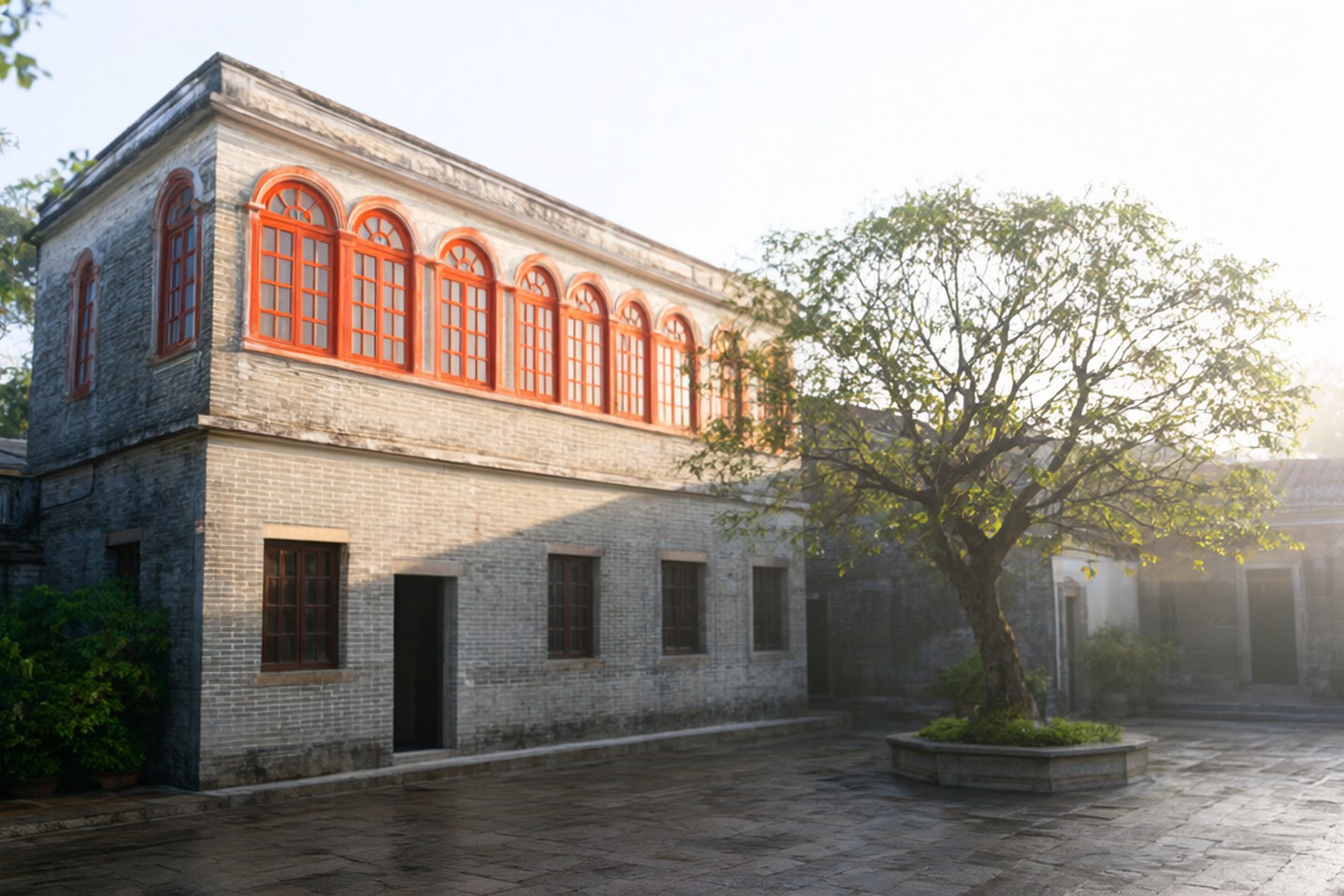
The house is the reason most people come, and its story is a family one. In 1892 孙眉 Sūn Méi, the elder brother who had made his money in Honolulu, sent money home and the younger brother, Sun Yat-sen himself, directed the building of a new main house on the base of the 1885 dwelling: a two-storey brick-and-timber block of 500 square metres’ footprint and 340 of floor space, western on the outside – seven ochre-red arches run across the upper storey – and Chinese in its inner plan. Over the door hangs a plaque in the hand of 宋庆龄 Sòng Qìnglíng; the couplet is in Sun’s own, and in the courtyard grows the sour tamarind he planted in 1883 from Honolulu seed. He lived here from 1892 to 1895, drafting his letter of advice to Li Hongzhang in the winter of 1893 and talking over the plans of 1895 with Lu Haodong; after stepping down as provisional president he came home in May 1912 for three days.
The designations have stacked up around it. The house itself was designated a Major Historical and Cultural Site Protected at the National Level in January 1988, in the State Council’s third batch; the museum is a national first-class museum and a patriotic-education demonstration base. The bigger honour came in 2016: the Sun Yat-sen’s Hometown tourism area took its 5A rating on 4 November 2016 – Zhongshan’s first 5A, the twelfth in Guangdong, the first in the province branded on culture rather than scenery. The zone covers 3.15 square kilometres and gathers five core sights: this museum, the village, the film city next door, the Xinhai Revolution memorial park and 犁头尖山 Lí tóu jiān shān, where the family graves of the grandfather, the father and the elder brother sit under the trees. Cuiheng is on the national list of historical and cultural villages.
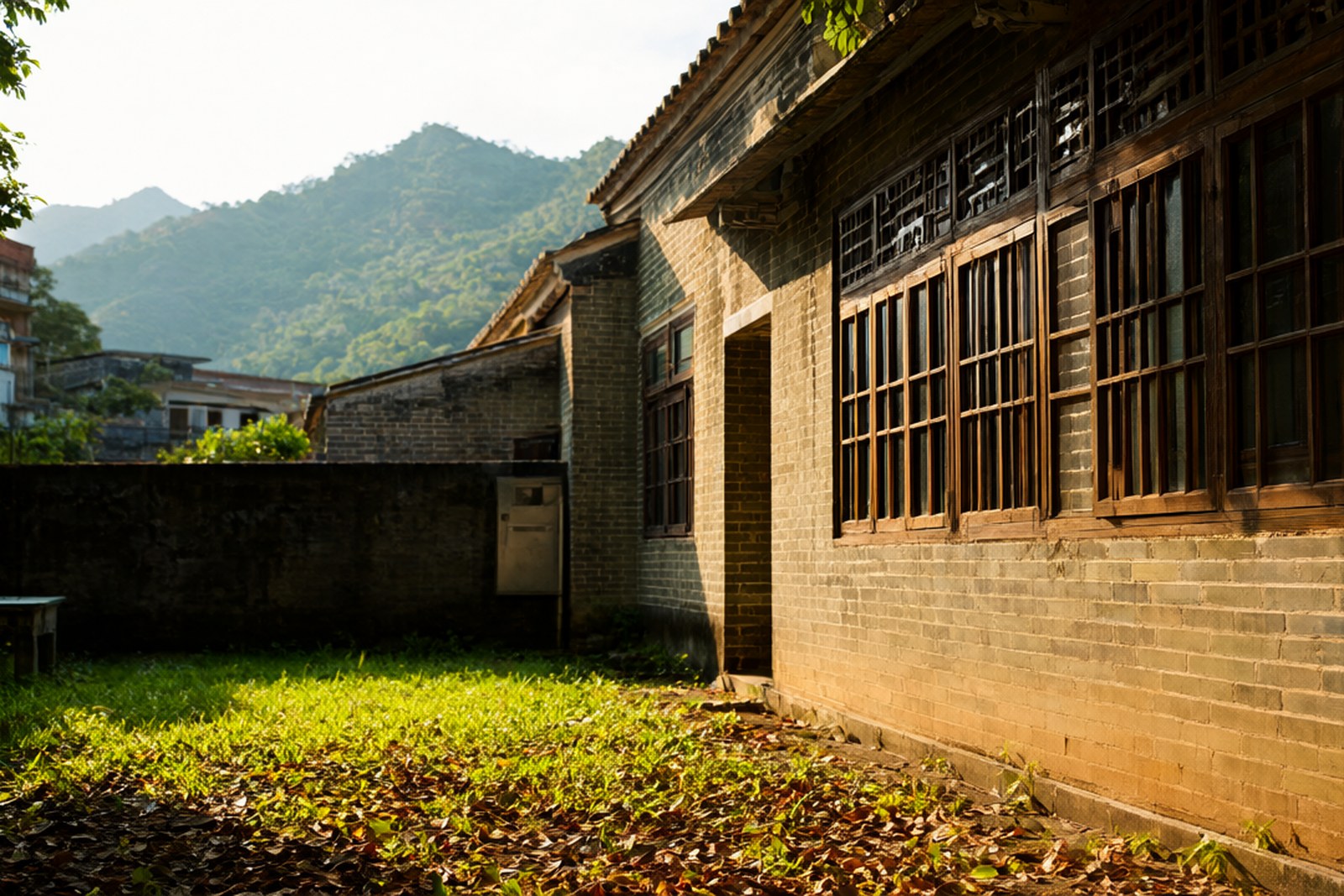
Inside the halls the theme is the man and the environment that made him. The displays split five ways – Sun Yat-sen’s memorial exhibition, the residence of Yang Yin, a quarter of Cuiheng-style dwellings, farming culture and the city’s intangible heritage – and the permanent show, “A Great Forerunner of China’s Democratic Revolution”, walks its subject along five roads, seeking, republic, struggle, cooperation and inheritance, with bilingual labels. Among the exhibits sits a kerosene lamp the seventeen-year-old carried home from Honolulu in 1883. The visitor ledger is the payoff: 5.10 million came in 2024, the third-highest attendance of any museum in Guangdong, and more than 14 million over the past five years, about 140,000 of them from outside the mainland, over 100,000 from Hong Kong, Macau, Taiwan and overseas.
Give the visit two to three hours and let the village do half the work – the dwellings quarter is where the photographs happen, and the fields behind it still go under crops. Entry costs nothing, the gates open every day of the year, and the crossing from Shenzhen has collapsed to about an hour since the Shenzhen-Zhongshan Link opened in June 2024 and lands, conveniently, in this corner of the city.
Practicalities
Tickets. Free. The rule to trust is the museum’s own from February 2025: no reservation required, walk in through security – at capacity peak the museum divides and limits the flow. Priority entry serves over-65s, infants with up to two accompanying adults, serving and disabled veterans and disabled visitors. Older guides mentioning QR-code real-name booking describe pandemic-era rules. Checked September 2026; the museum’s official WeChat account carries updates and the audio guide.
Opening hours. 09:00 to 17:30 daily, last entry 17:00. Statutory holidays and golden weeks keep the same hours; Saturdays and Sundays from May to September stretch to 18:00, last entry 17:30. The desk answers on 0760-28158366.
Closing day. No closing day exists – the museum opens every day of the year. The thing to plan around is the crowd: on public holidays the coaches arrive mid-morning, so come at opening and walk the village quarter last.
Getting there. Buses 082, 215, 218, K26 and K28 stop at the Sun Yat-sen’s Former Residence (Yang Yin’s Former Residence) stop. Intercity rail: the Guangzhou-Zhuhai line to 南朗站 Nán lǎng zhàn, then a local bus. From Shenzhen the Shenzhen-Zhongshan Link puts the Cuiheng exit within about an hour; from Guangzhou allow some ninety kilometres. Cars use the tourism area’s underground car park or the marked kerbside spaces behind the film city’s back gate on Heping Street.
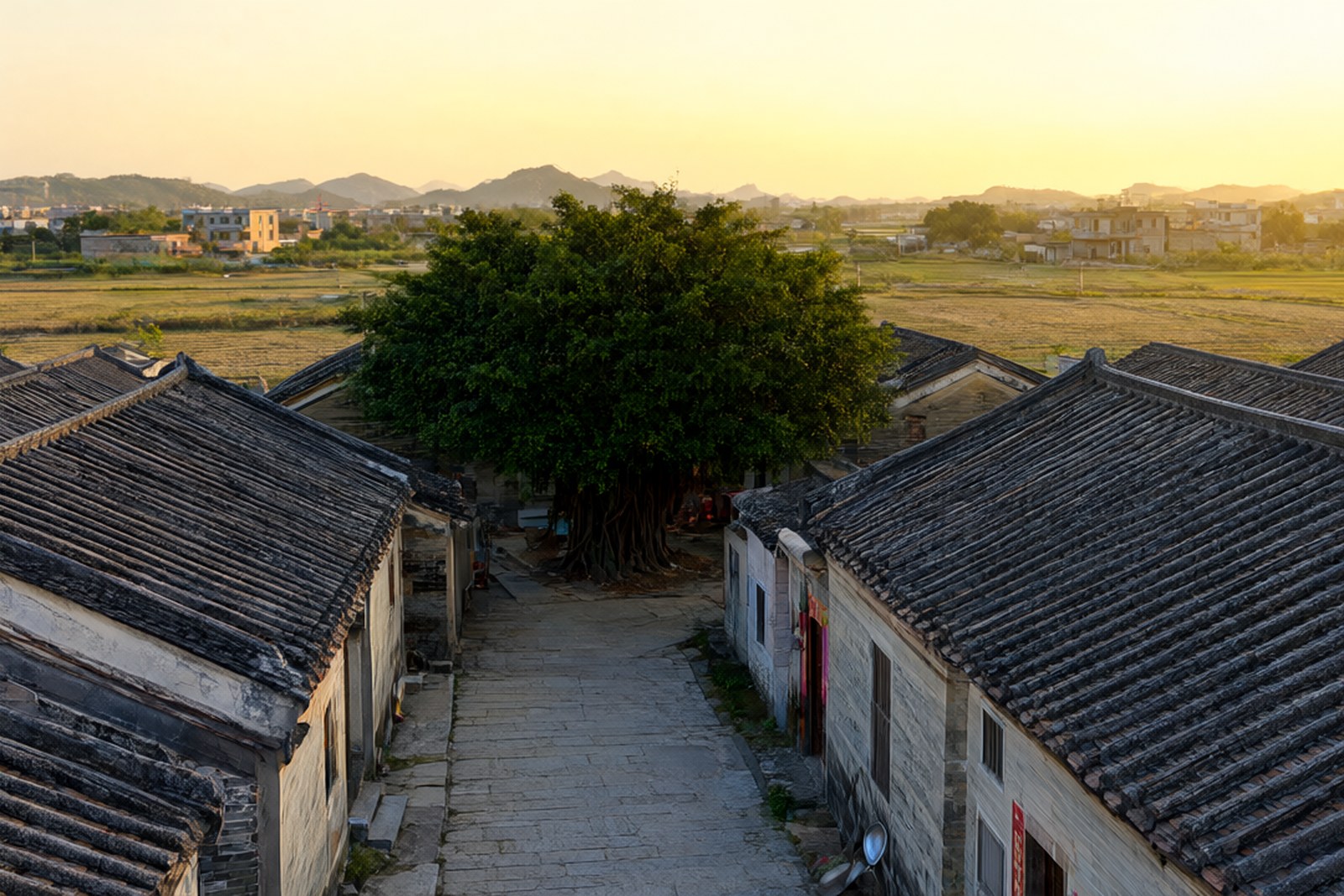
flowcloud would say that the house works on visitors because it was never built to work on them: a brother’s remittance money, a young radical’s fancy for red arches, a tree grown from a handful of seed – and that a village which absorbs five million pilgrims a year and still shows you where the crops grow has managed the hardest thing a birthplace can manage, which is to stay inhabited.
Getting there: 翠亨村 lies in 南朗街道 of 中山市, Guangdong, about 20 km from the city centre and 90 km from Guangzhou, signposted off the Cuiheng exit beside the Shenzhen-Zhongshan Link; the museum at 93 Cuiheng Avenue is free with no reservation required as of 2025, opens 09:00 to 17:30 with last entry at 17:00 and has no closing day; buses 082, 215, 218, K26 and K28 serve the gate, intercity trains stop at Nanlang station, and parking sits in the tourism area’s underground garage – checked September 2026 and all subject to change.