
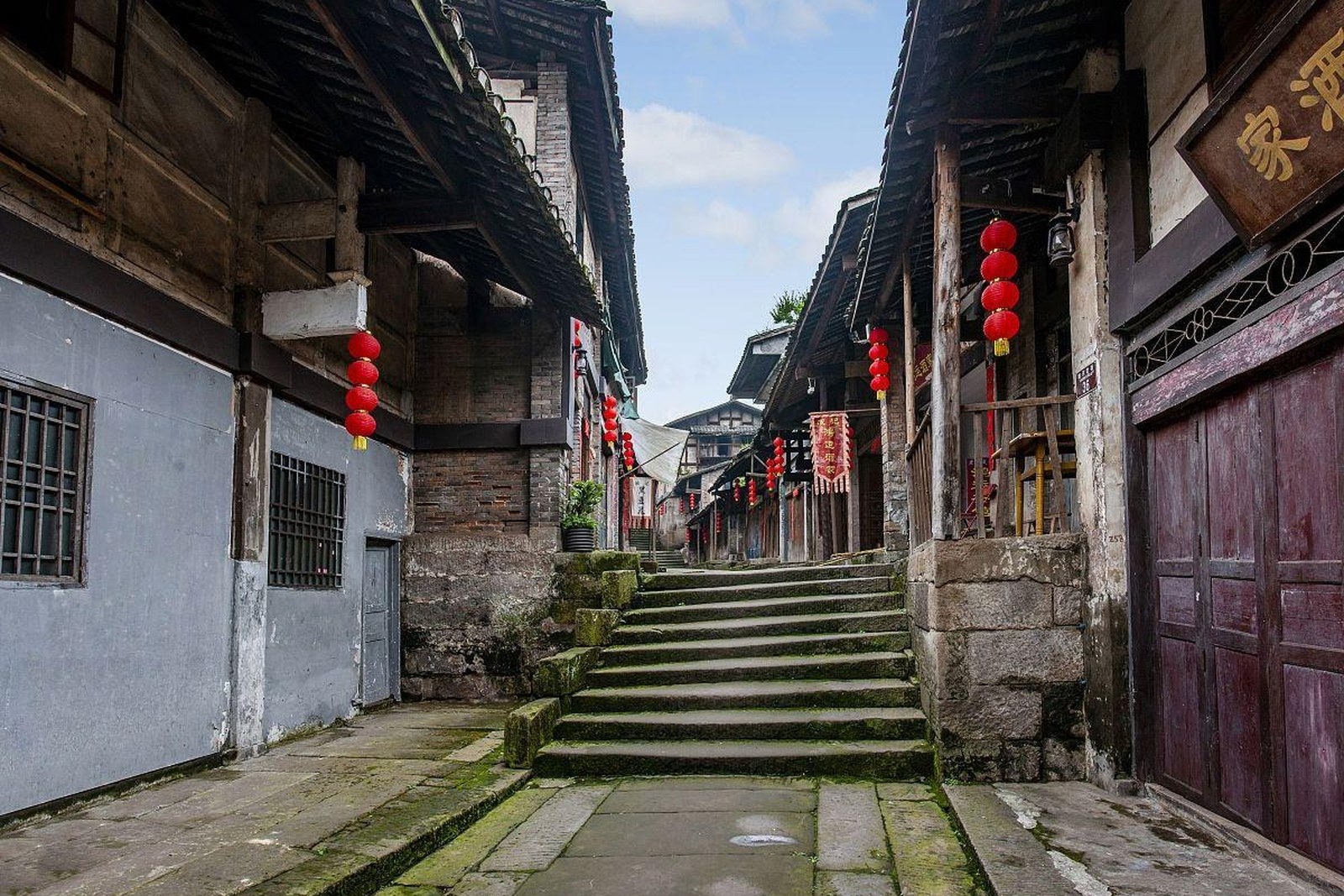
塘河古镇 Tánghé Gǔzhèn, Tanghe Ancient Town, sits between its two rivers in the south of 江津区 Jiāngjīn Qū, Jiangjin District, and it has the luck of a townscape that survived the twentieth century whole: Ming-Qing wooden arcades running street after street, stone stair-lanes climbing the hill between courtyard houses and ancestral halls, and temple stages still standing where the river traders built them. That completeness is why the costume-drama crews keep arriving – Tanghe has stood in for old Sichuan in a shelf of productions – and the town leans into the trade without rebuilding itself for it. This page is the fabric and the rivers, because the fabric is the attraction.
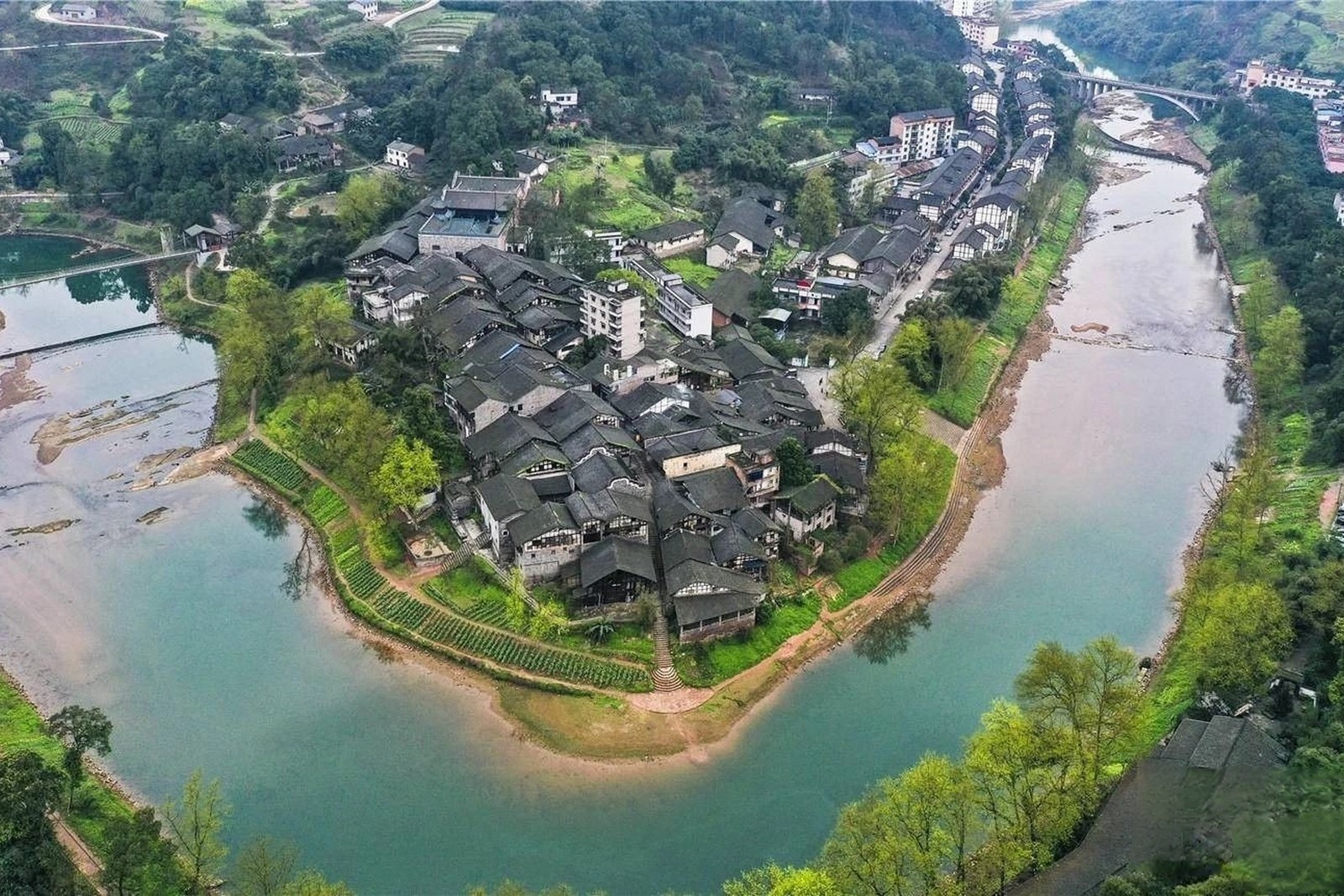
The rivers made the town and the layout still explains them. Tanghe sits where two watercourses meet, and the town grew up the slope from the confluence – wharf and water stairs at the bottom, arcaded trade streets on the first terrace, courtyard houses and ancestral halls on the terraces above, and the stone stair-lanes stitching the levels together the way the porters’ legs built them. Walking it is a vertical read of a river town’s order: goods at the water, trade in the arcades, family pride on the hill. The Ming-Qing fabric holds through every level, which is the town’s luck and the reason it reads whole where other river towns read in fragments.
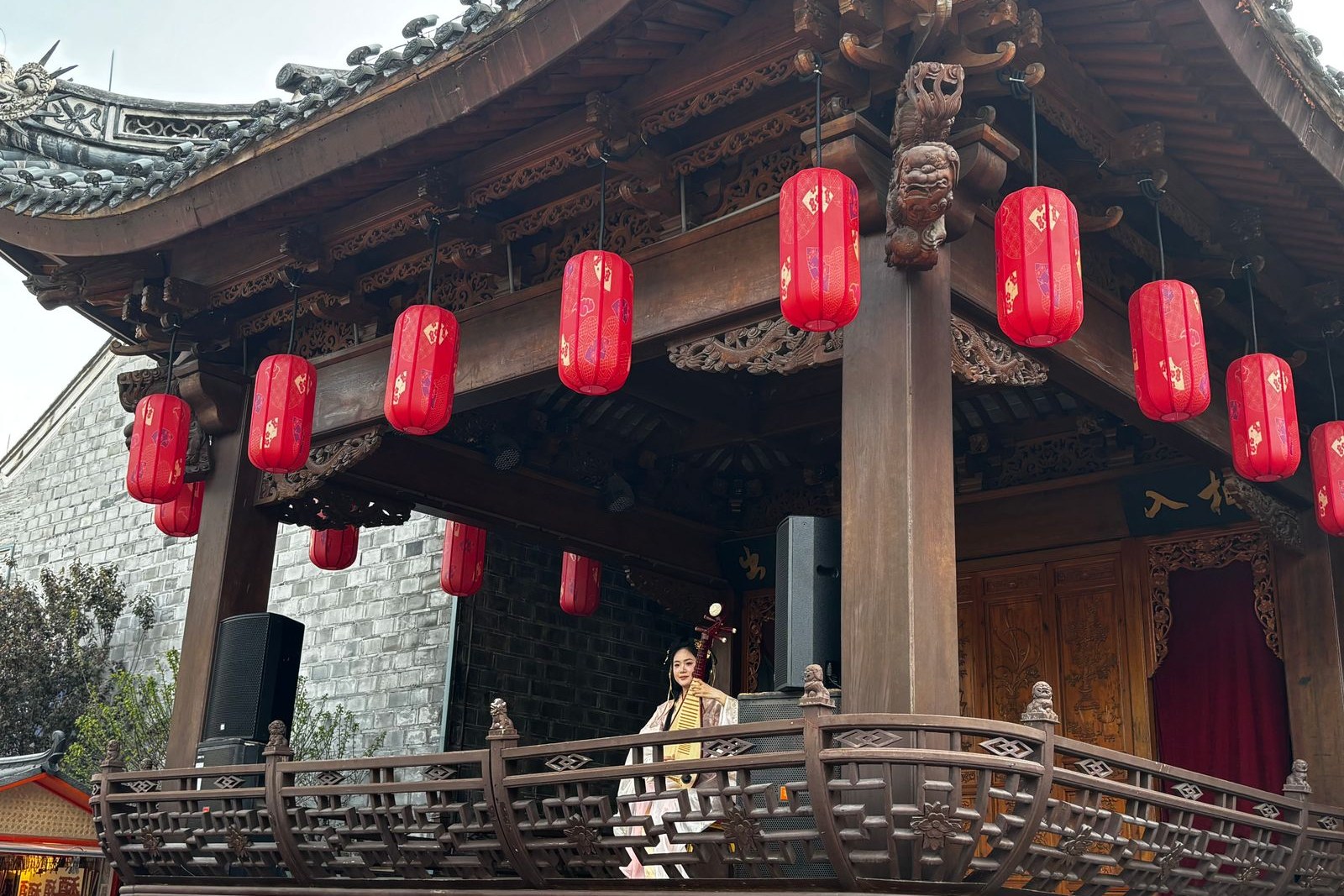
The film trade is the town’s modern economy and its honest certificate. The crews come for exactly what the visitor comes for – intact arcades, real stone stairs, ancestral halls that need no set dressing – and Tanghe has played old Sichuan in a run of costume productions without ever becoming a theme park of itself; the streets are quiet between shoots, which is precisely when to come. The stages in the temple courtyards still stand where the river traders built them for the opera seasons, and the town’s own festivals still use them. A visitor who wants the film-set romance should come for the fabric first: the productions shoot here because nothing needed building, and that is the whole point.
What the record supports is the town, the two-river confluence setting, the Ming-Qing wooden arcades, the stone stair-lanes, the courtyard houses, the ancestral halls, the temple stages, and the costume-drama filming trade; what it does not support is any ticket figure, any production list by name, any courtyard-by-courtyard opening claim, or any hours table, and none is invented here. The town charges little and pretends nothing; the fabric is free to walk, and the productions come and go on calendars the town does not post – which is the honest shape of the fact and the one the page keeps.
Tanghe’s place in the batch is the quiet specialist. Baisha is the port with the schools and the cameras; Zhongshan is the salt street with the river inns; Tanghe is the intact one – smaller, quieter, the town a visitor has to mean to reach, down the southern roads past Baisha and toward the Zhongshan side of the district. The classic day runs Baisha in the morning and Tanghe after lunch, the port and the confluence town in one loop of the district’s south; the classic overnight is back in the old towns, because Tanghe itself keeps few beds and does not pretend otherwise.
Words and Names
塘河古镇 Tánghé Gǔzhèn, Tanghe Ancient Town, between two rivers in southern 江津区 Jiāngjīn Qū, Jiangjin District: an intact Ming-Qing townscape of wooden arcaded streets, stone stair-lanes climbing between courtyard houses and ancestral halls, and temple stages by the water, complete enough that costume-drama crews use it to stand in for old Sichuan. The town grew up the slope from the river confluence – wharf at the bottom, trade streets on the terraces, family halls above – and it is quiet between film shoots. No ticket figure, production list or hours table is on the record consulted, and none is invented here.
What the Locals Know
The local knowledge is the between-shoots calendar and the vertical route. The town is itself when the crews are not there – the arcades empty, the stairs swept, the temple stages open – and the teahouse will tell a visitor whether a production is in town, which is the only schedule the town keeps. Walk it downhill from the upper courtyards to the confluence, the way the water runs; sit out the last hour on the wharf stairs where the two rivers meet, because the confluence is the town’s best free seat and the locals’ too. The food is the district’s own river-and-smoke kitchen, and the honest day pairs the town with Baisha across the hills. What the record does not carry is any shoot schedule worth printing, and the page declines one.
Practicalities
Tickets: None – the town’s fabric is free to walk, and no gate or street ticket is on the record consulted; the page’s earlier phrase holds, the town charges little and pretends nothing. The costs a visitor meets are a teahouse seat and a river-fish lunch, and no figure for either is on the record consulted, so none is invented here.
Opening hours: All day as the working norm – the arcades and the stair-lanes are the town’s own footpaths, the temple courtyards open onto them through the daylight, and the confluence wharf keeps no clock at all. No posted hours table is on the record consulted; the honest day is the downhill one, courtyards to confluence, with the last hour on the wharf stairs where the two rivers meet.
Closing day: None posted – an inhabited old town of this size does not close its weeks, and no published closing day is on the record consulted. Film-shoot days rearrange a lane or a courtyard for the duration and hand it back after, which is a production calendar rather than a closing one, and the between-shoots quiet is when the town is most itself.
Getting there: The town sits at a river confluence in southern 江津区 Jiāngjīn Qū, Jiangjin District – reached by the southern roads past Baisha, which makes the two-old-town day the natural shape, and onward toward the Zhongshan side of the district; self-drive is the working option, no timetable, fare or through-service is on the record consulted, and none is invented here.
flowcloud would say that Tanghe Ancient Town is the district’s intact one – Ming-Qing arcades, stone stair-lanes and ancestral halls running whole between two rivers in the south of 江津区 Jiangjin District, quiet between the costume-drama shoots that use it for old Sichuan – and that the correct visit is a between-shoots afternoon walked downhill from the courtyards to the confluence, because the fabric is the attraction and it charges little for it. All checked October 2026.