
滩头镇 Tān tóu zhèn is a small town in the east of 隆回县 Lónghuí xiàn, 邵阳市 Shàoyáng shì, on the old road between the prefecture and the county town, and it has been a paper town for four hundred years. Its three products are sold together as the 滩头三绝 Tān tóu sān jué, the three marvels of Tantou, and they are the woodblock New Year print, the coloured paper, and the scented powder paper that the coloured paper was made for. The coloured paper went to the imperial court as tribute in the Qianlong reign, the bamboo stock it is made from is cut on the surrounding hills, and the print is the reason to come: this is the only town in Hunan where the New Year picture is still cut, printed and finished entirely by hand, and it is counted among the four great print towns of the country.
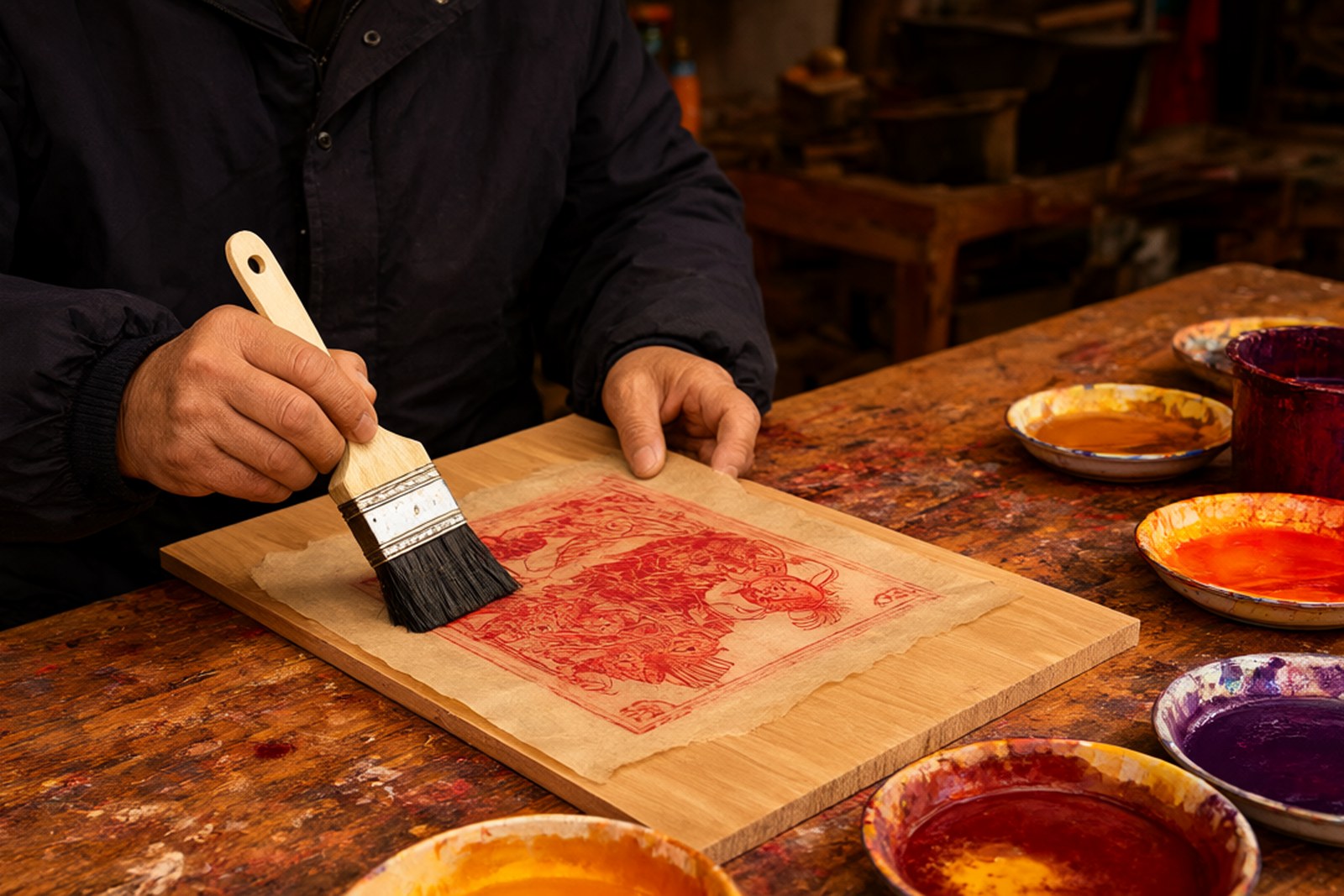
What makes 滩头 different from the other print towns is that nothing is brought in. The paper is made here, by hand, from 楠竹 nán zhú, the local bamboo, in a craft that the State Council listed as a national intangible heritage in its own right in December 2014. The blocks are cut here from local pear wood. The colours are mixed here from vegetable and mineral dyes rather than bought as ink, which is why a 滩头 print looks softer and more translucent than the commercial sort and why 冯骥才 Féng Jìcái, who came to look, said simply that the prints of 滩头 are as bright as flowers. The whole process is twenty-odd steps, and the two that matter most are on the press: the print goes through seven separate pressings, one for each colour, and then through seven hand-paintings. The outline of every face on every sheet is painted in by hand on top of the printed body, so no two finished prints are exactly alike, and the effect the paper and the manner together produce is a slight relief, as though the figure had been pressed out rather than laid on.
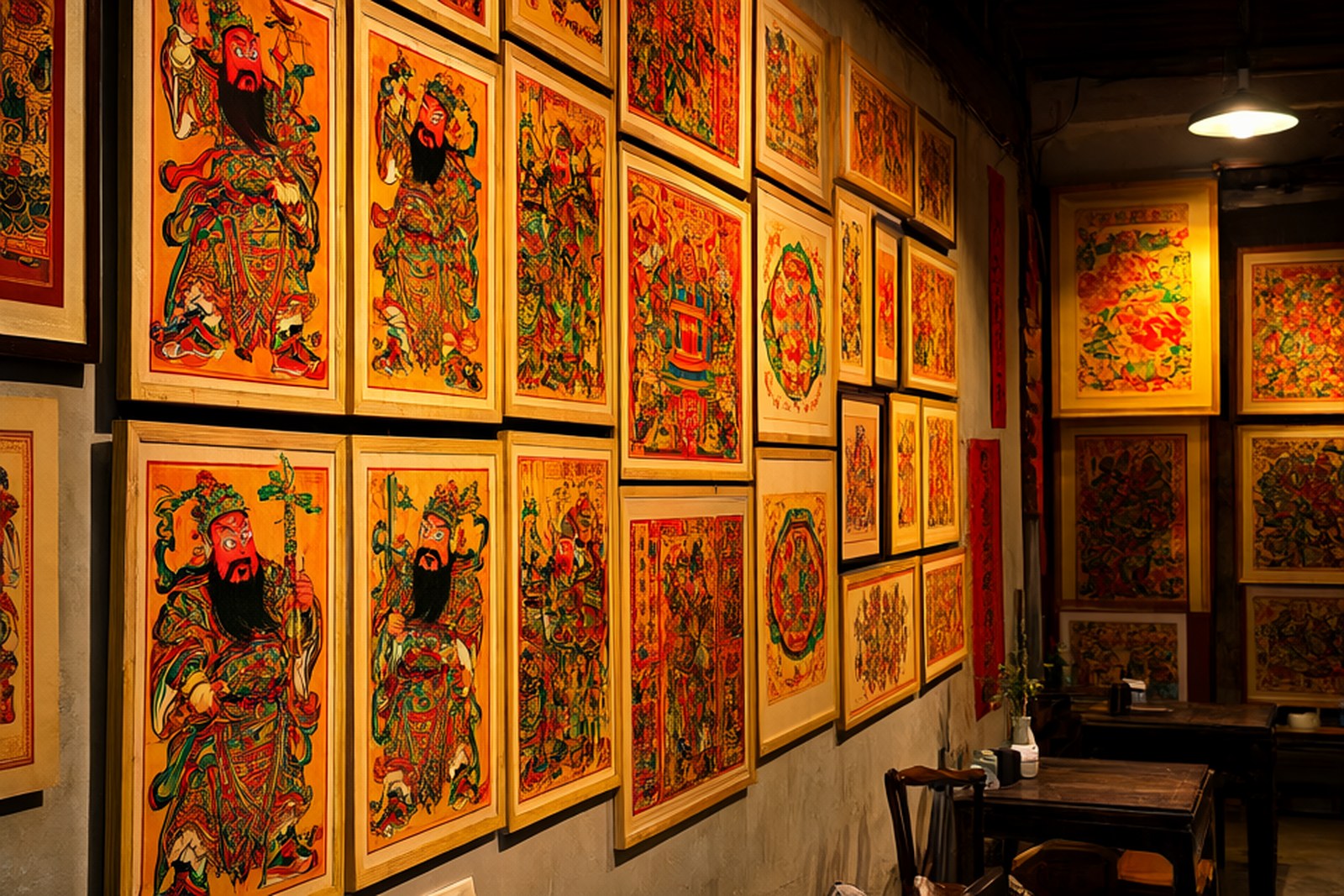
The town’s standing is not a recent claim. In 1994 the Ministry of Culture’s exhibition of the finest folk art in China gave 滩头年画 a silver medal; in 2003 it took a gold at the traditional crafts exhibition in Beijing; and in June 2006 it was entered in the first batch of national intangible cultural heritage. Its reputation travelled early and far, on paper as well as in reputation: the prints went out in the Republican years to 云南, 贵州 and 四川 and down the rivers towards Southeast Asia, and two of them went into museums abroad. One is the 老鼠娶亲 Lǎo shǔ qǔ qīn, the Mouse Wedding, a procession of mice carrying a bride in a sedan chair with a cat sitting up at the end of the line, which 鲁迅 Lǔ Xùn described in 朝花夕拾, called 可爱极了 in so many words, and kept; a copy of it is in the British Museum. The other is the door-god pair of 秦叔宝 Qín Shūbǎo and 尉迟恭 Yùchí Gōng, which is still what most households in the town paste up.
The prints come in three families, and knowing them makes the shop shelves legible. The first is the 神像, the gods: door gods, the god of wealth, the kitchen god, pasted on the outside and inside of a house to keep the year in order. The second is 吉祥如意, the auspicious designs, of which the 和气致祥 with its round-faced figure is the best known and the most reproduced. The third is the 戏文故事, scenes from opera and legend, and the figures of pretty women and plump babies that go with them. At its height the town supported scores of workshops and more than sixty designs; twenty-odd designs survive, and the number of workshops is now in the single figures. The best-known maker of the last generation was 高腊梅 Gāo Làméi, who cut twenty-nine versions in her lifetime, one of them the Mouse Wedding that made the print famous; among the people running it today is 尹冬香 Yǐn Dōngxiāng, working with her daughter 肖扬 Xiāo Yáng at one of the surviving houses. The county has been formally named a home of modern folk woodcut art, and there is a museum and a study centre, but the point of coming is the workshops, which are houses with a press in the back room and paper drying on the courtyard wall.
滩头 itself is worth an hour of walking. It was founded in the Sui and is one of the seventy-two old towns the province counts, strung along the water where the bamboo came down and the paper went out, with the old dyeing and paper houses still standing in the lanes. The coloured paper and the powder paper are made in the same street, and on a working day in the month before the New Year the whole town smells of dye and wet pulp. The rest of 隆回 is close: 司门前镇 and the childhood home of the reformer 魏源 Wèi Yuán, kept as a museum and the first national patriotic education base in the city, are an hour and a half west; the 花瑶 villages of 虎形山 are three hours north-west; the honeysuckle terraces towards 小沙江 are in flower in June; and the town is an easy day out from 邵阳市. Come between the middle of the twelfth lunar month and the New Year itself if you want to see the presses actually running.
Practicalities
Tickets. There is no admission; 滩头 is a town and not a park. If a workshop demonstrates the whole process for you, the polite thing is to buy something, which starts at about ¥20 or ¥30 for a small print and runs to a few hundred for a large hand-finished one.
Opening hours. The workshops are family businesses and keep their own hours, generally 08:30 to 17:30 with a break at lunch, and they are busiest from the twelfth lunar month onward. The museum and study centre keep 09:00 to 17:00 and are usually closed on Mondays. Ring ahead if you are coming a long way, since a demonstration takes most of a morning.
Getting there. 滩头 is about thirty minutes by road from 隆回县城 桃花坪 and an hour and a half from 邵阳市. 隆回站 Lónghuí zhàn on the 怀邵衡 high-speed line is the nearest station, with about thirty minutes of road left at the end, and 邵阳武冈机场 Wǔgāng jī chǎng is roughly an hour and a half. From 长沙 it is about three hours by car. There is no transport inside the old town worth using, and the lanes are narrow.
Closing day. There is no closing day for the town and no fixed weekly closure for the workshops, since they close when the family has something else to do; the museum closes on Mondays. The one annual rhythm that matters is the run-up to the New Year, when production is at its peak, and the quiet of the months immediately after it.
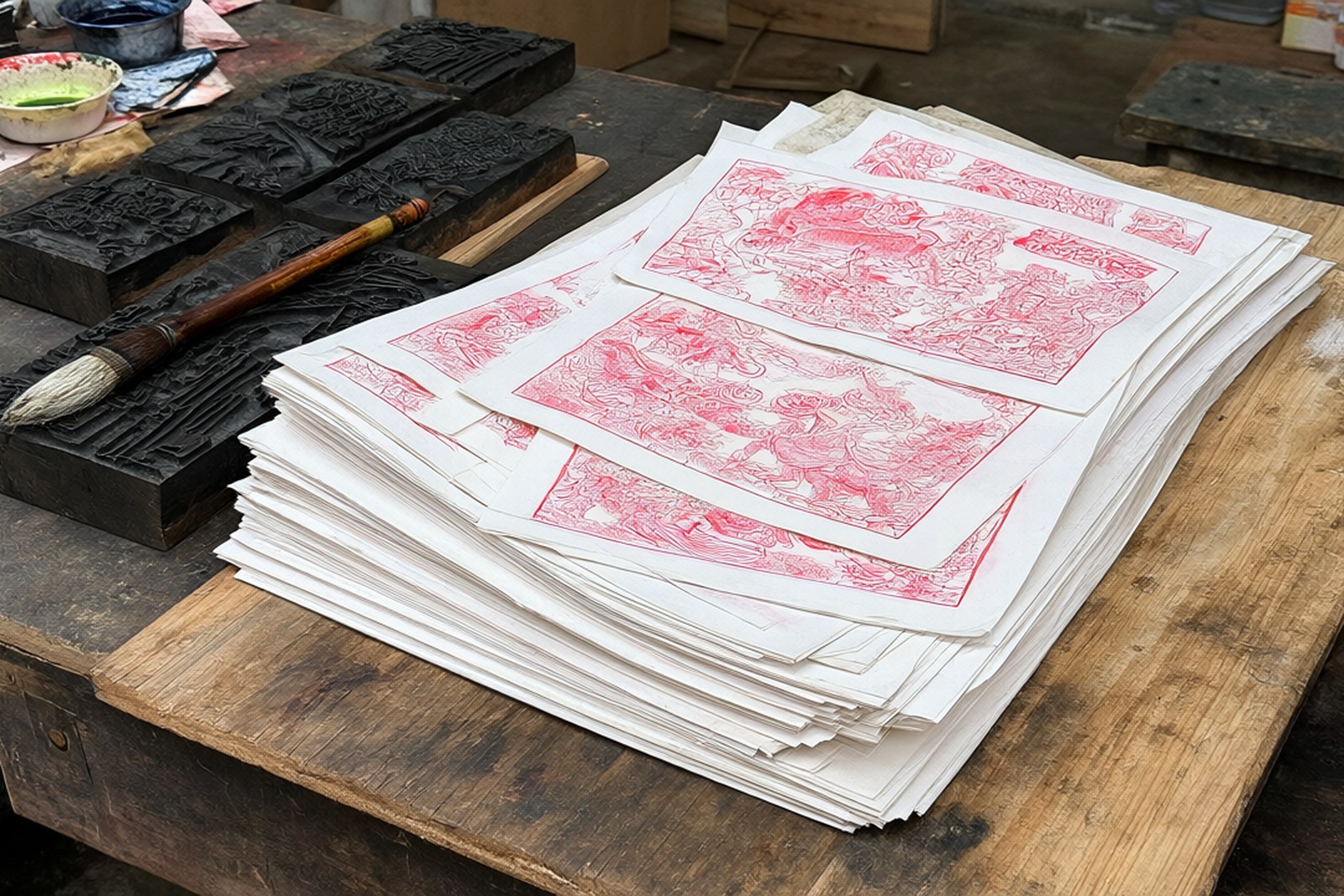
flowcloud would say that a town which makes its own paper from its own bamboo, colours its own ink from its own flowers, prints seven times and then paints every face in by hand, and does all of it within a few hundred metres, has kept the whole of an art rather than the visible part of one.
Getting there: the workshops of 滩头镇 are in the old town centre, 隆回县, 邵阳市, about thirty minutes by road from 隆回县城 and an hour and a half from 邵阳市; 隆回站 on the 怀邵衡 line is the nearest railway, with half an hour of road at the end of it.