
The Seat of the Panchen Lamas: Tashilhunpo Monastery
尼色山下金顶寺,一墙红白锁经年 Nísè Shān xià jīndǐng sì, yī qiáng hóngbái suǒ jīngnián – A gold-roofed monastery below Niseri Hill; one wall of red and white locks in the years
扎什伦布寺 Zhàshílúnbù Sì Tashilhunpo Monastery spreads across the lower slopes of Niseri Hill on the northern edge of 西藏自治区日喀则市 Xīzàng Zìzhìqū Rìkāzé Shì Shigatse, its gold-roofed halls and whitewashed living quarters stacked like a small walled town. Founded in 1447 by Gendun Drub, later counted as the First Dalai Lama, it grew into the great Gelug monastery of Tsang and the traditional seat of the Panchen Lama, and its name – “all fortune and happiness gathered” – still sets the tone for the city below it.
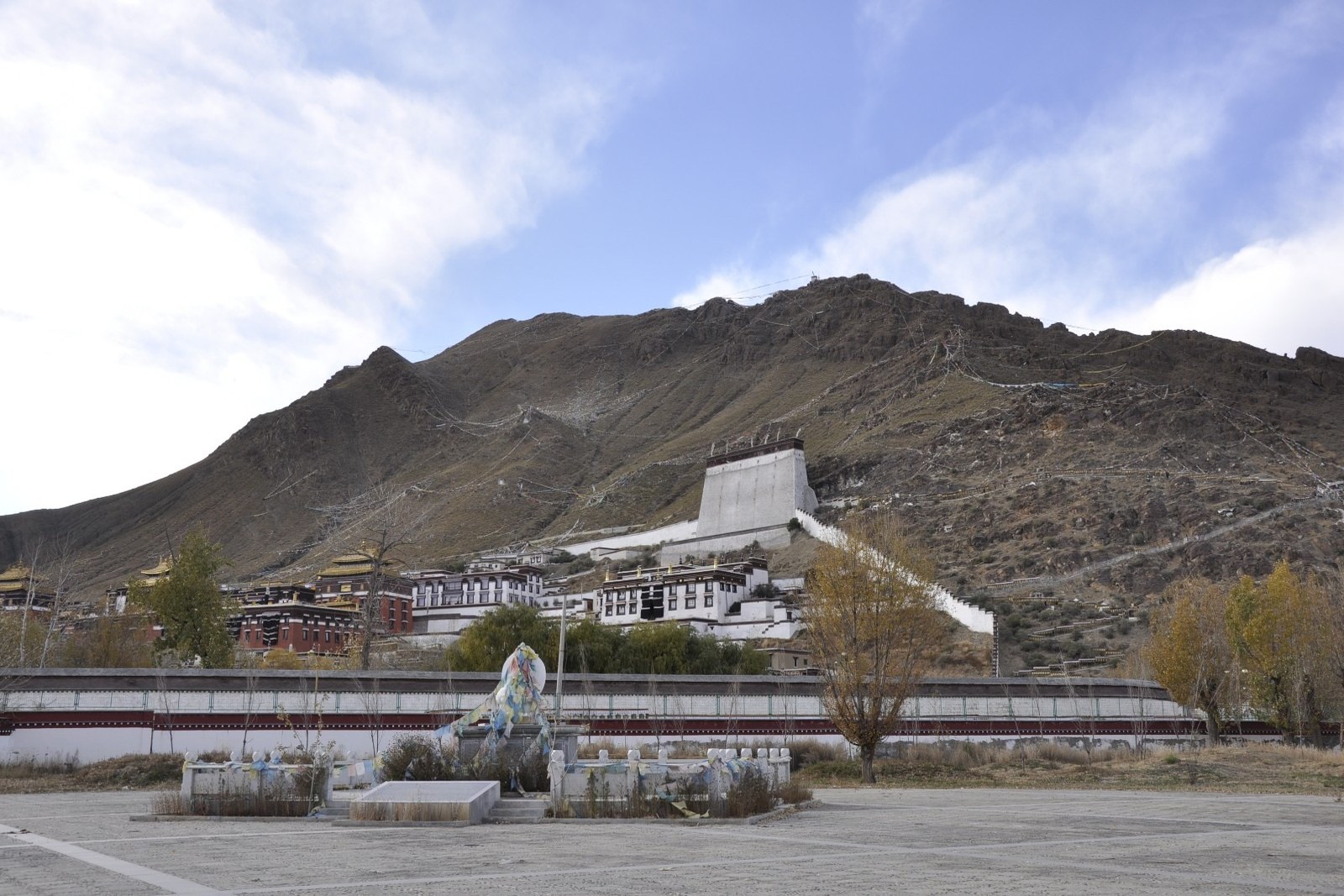
The visit runs uphill through the monastery’s own geography. The Great Assembly Hall opens first, its dark timber columns lit by butter lamps and its courtyard polished by centuries of prostrations; above it stand the chapels of the past Panchen Lamas, stupa tombs sheathed in gold and silver, and the Maitreya Chapel, where a colossal gilded future Buddha – cast in the early twentieth century and among the largest indoor statues of its kind – gazes down a stair-stepped hall. The kora path rings the whole complex beneath steep red walls, past the tall white exhibition terrace where giant thangkas unfurl on festival mornings.
Tashilhunpo is a working monastery, not a museum. Monks cross the lanes between debating sessions, novice cooks haul water past the kitchens, and pilgrims from the villages of Tsang walk the circuit with hand-milled flour and bricks of tea as offerings. Mid-morning light floods the gold roofs; late afternoon sends long shadows across the flagstones, and either hour rewards the slow walker who stays for the rhythm rather than the checklist.
What the monastery means is written on the city around it. Shigatse grew up as Tashilhunpo’s service town – the market lanes, the old government quarter and the pilgrim guesthouses all face the hill – and the monastery still anchors the city’s festival calendar, from the thangka unfolding of summer to the New Year rites. Whatever else the journey includes, this is the building Shigatse points at, and the first morning light on its gold roofs explains the city better than any plaque.
Practicalities
- Entry is ticketed at the main gate; the kora and the exterior lanes are free, and the full circuit plus halls takes half a day.
- The site sits at about 3,800 meters – climb the chapel stairs slowly and keep water handy.
- Photography rules are strict inside the chapels; ask before raising the camera and keep it away from the butter lamps.
- Festival mornings, when the giant thangka unfurls at the eastern terrace, are extraordinary but crowded – arrive before dawn with the pilgrims.
Words and Names
扎什伦布寺 Zhàshílúnbù Sì Tashilhunpo, “the mountain of all fortune”; 尼色日山 Nísèrì Shān Niseri Hill, the monastery’s backdrop; 强巴佛 Qiángbā Fó Maitreya, the future Buddha of the great chapel; 班禅额尔德尼 Bānchán É’ěrdéní the Panchen Lama, the monastery’s traditional abbot; 转经道 zhuǎnjīng dào the kora, the pilgrim circuit; 展佛台 zhǎnfó tái the thangka-unfolding terrace. Beyond the monastery, the same 西藏自治区日喀则市 Xīzàng Zìzhìqū Rìkāzé Shì Shigatse keeps more places worth the detour: 白居寺 Báijū Sì the Kumbum stupa at Gyangtse, 江孜宗山古堡 Jiāngzī Zōngshān Gǔbǎo the fortress rock above the old town, 萨迦寺 Sàjiā Sì the striped-wall seat of the Sakya school, or 珠峰大本营 Zhūmùlǎngmǎ Dàběnyíng the camp under the world’s highest peak – four more doors into the same Shigatse. Once the monastery is behind you, our Shigatse food map fills the table.
flowcloud would say Tashilhunpo is Shigatse’s north star: every lane in the city bends toward its hill, and an hour on the kora explains the town better than any guidebook. All checked November 2026.
Getting there: By rail: the Lhasa-Shigatse railway reaches Shigatse station in about 2.5-3 hours, then a 15-minute taxi to the monastery gate. By road: the expressway from Lhasa takes around 5 hours. The monastery opens mid-morning; allow half a day including the kora. All checked November 2026.