
The Iron Gate of the Silk Road: Where the Peacock River Cuts the Last Lock of the Middle Route
一关锁尽千山路,孔雀河边落日圆 Yī guān suǒ jìn qiān shān lù, Kǒngquè hé biān luòrì yuán – One pass locks a thousand miles of road; the sun sets full over the Peacock River
铁门关 Tiěménguān Tiemenguan sits eight kilometres north of Korla in the Peacock river gorge, a stone gate formed where Mabu cliff and Huola mountain face off. The ancients judged it 「two banks like doors, one road between」, and a Silk Road middle-route caravan that cleared this gate had truly entered the Tarim basin. It ranks among China’s twenty-six famous passes alongside Shanhaiguan and Jiayuguan – the westernmost of the list, hence 「the last pass under heaven」.
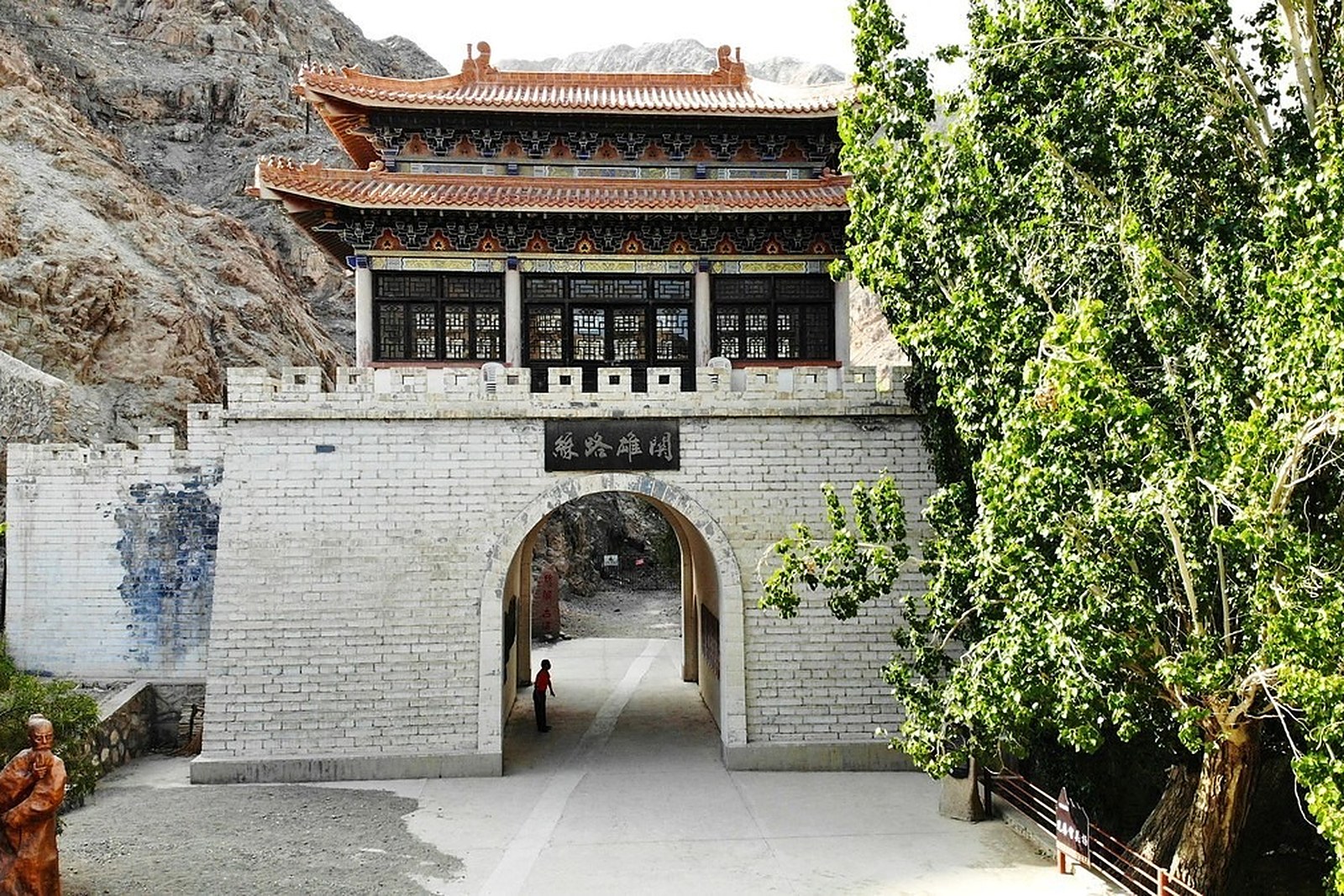
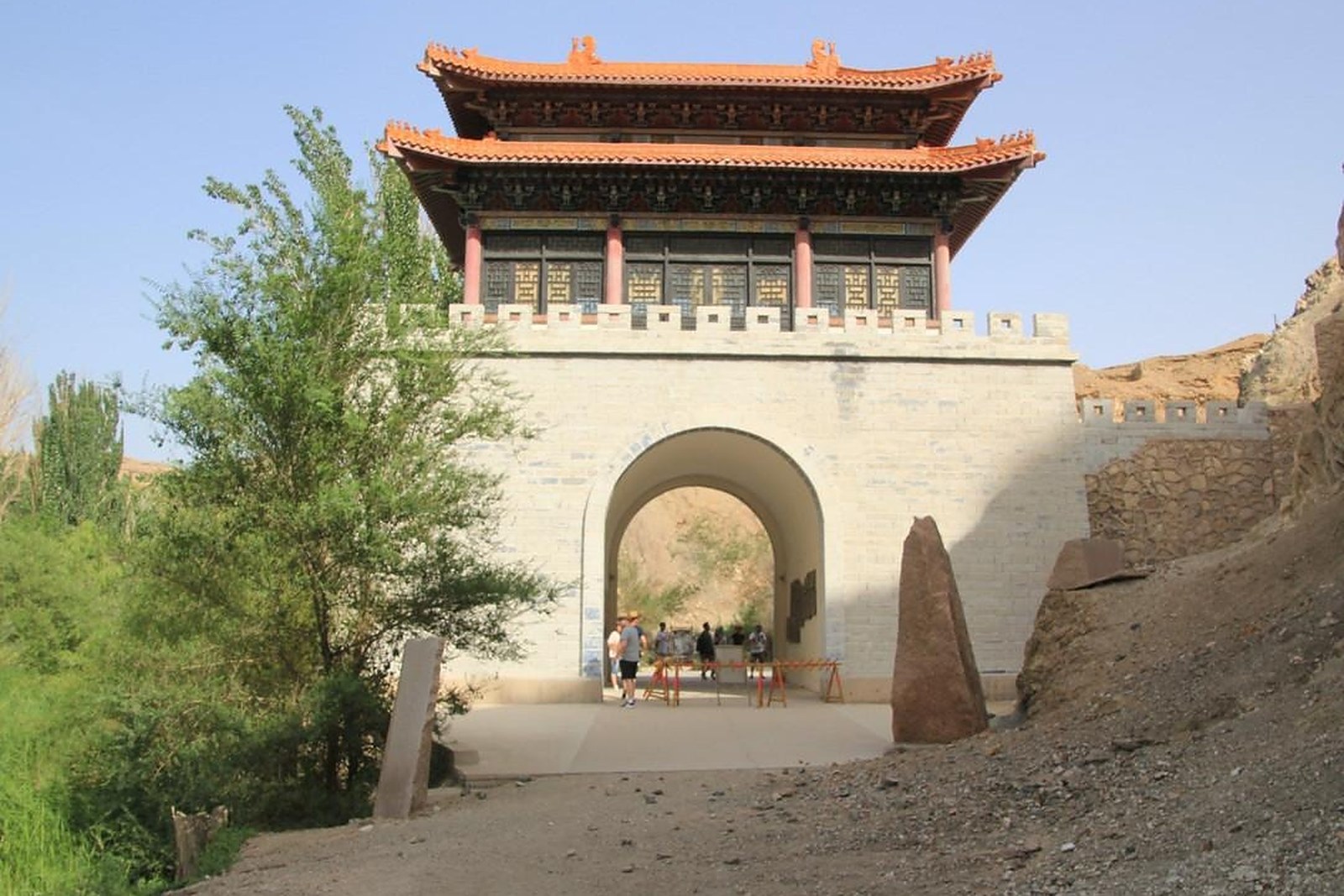
The gate tower today is a later rebuild: flying eaves and red pillars between the rock walls, the three characters 「铁门关」 over the arch in steady brush. From the top the Peacock river bends a jade curve through the gorge, walls rising sheer on both sides – and the choice of the toll point explains itself, since no caravan could pass unwatched. On the slopes behind stand weathered inscriptions and beacon-tower ruins, the characters faint but the position still locking the ancient road’s line.
A walkway follows the river the length of the gorge, about an hour end to end: the water runs the grey-green of glacier melt and polishes the walls bright. Summer in the gorge runs several degrees cooler than the city – Korla’s back-garden retreat – and in autumn the poplar and mountain apricot turn yellow in the crevices, doubled in the river, every frame a postcard.
The pass’s stories stack in layers: the Tang frontier poet Cen Shen passed here and left the famous line 「铁关天西涯,极目少行客」 – the Iron Gate at sky’s western edge, hardly a traveler in sight. Folklore adds Princess Ridge: Zohra the princess and Tahir the shepherd fled for love, were caught at the gate, and died together; their joint tomb stands on the ridge today, a local shrine to love. A pass holding both official steel and folk devotion – that is why it moves visitors more than most ruins.
The modern era left its own note: the Peacock river’s first hydro plant stood at the gorge mouth and lit Korla’s first electric lamps. From the tower, watching the river generate power and split into irrigation canals, you understand why Korla calls it the mother river – the pears’ sweetness, the cotton’s white, and the city’s lights all trace back to this gorge.
Practicalities: admission is friendly, the walkway is gentle enough for elders and children, and the midday sun in the gorge is fierce – hats and water mandatory. Twenty minutes by taxi from town, and it pairs naturally into a half-day with the Korla city river sights.
South of the gate the city and oasis open out: straight on into Korla for a pear feast, west to Bosten Lake’s reed banks, south-east to Lop Nor Village. Ancients read trade routes from this gate; moderns read scenery, with far more choices.
The stelae and pavilions in front of the gate reward a slow read: the rededication inscriptions record the pass’s changing jobs – garrison, post road, power station, scenic area – and half a history of Xinjiang transport lies written in sequence.
The cliff walls still show the sockets of ancient plank-road beams, where garrison and couriers once climbed; the modern path strings them as an open-air lesson, and old photographs on the boards make the overlap of old and new routes obvious. Parents can run this stretch as a treasure hunt – children’s feet move twice as fast as in any city park.
Korla’s attachment to the Peacock river shows in riverside life: tai chi at dawn, an accordion band in the pavilion at dusk, the water flowing on through the city parks. The pass and the riverside parks are one water’s upstream and downstream – walk both and 「one river rears a city」 is no longer a slogan.
Geology adds its own exhibit: the walls fold and fault like a layered cake twisted by a giant hand. Even without the vocabulary, the grain of ages bent by water leaves its mark – hundreds of thousands of years written into one bend.
Four seasons each earn a visit: apricot pink in spring, cool green shade in summer, gold against red walls in autumn, and after snow the whitest, most ancient-looking roof – a winter morning here is usually yours alone.
Practicalities
Past the gate, the same 巴音郭楞蒙古自治州 Bāyīnguōléng Měnggǔ Zìzhìzhōu Bayingolin Mongol Autonomous Prefecture holds more: 博斯腾湖 Bósīténg Hú Bosten Lake for the reed banks, 罗布人村寨 Luóbùrén Cūnzhài Lop Nor Village for the poplar fisherfolk, 巴音布鲁克草原 Bāyīnbùlǔkè Cǎoyuán Bayanbulak Grassland for the nine-bend swans, and 轮台胡杨林 Lúntái Húyánglín Luntai Poplar Forest for the golden sea – four more doors into the same 巴音郭楞蒙古自治州 Bāyīnguōléng Měnggǔ Zìzhìzhōu Bayingolin Mongol Autonomous Prefecture. Gate tower seen, our Bazhou food map picks up the cookfires beyond it.
Practicalities
Words and Names
flowcloud would say Tiemenguan is where the road holds its breath: cliffs squeeze the sky, the river keeps the time, and every visitor walks out feeling a little more ancient. All checked November 2026.
Getting there: The pass sits roughly eight kilometres north of central Korla up the Peacock River gorge, an easy fifteen-minute taxi ride or city bus to the gate; the scenic area combines the gorge walk, the ancient pass marker and the reservoir above, so wear proper shoes for the stepped paths – late afternoon light is kindest to the iron-grey cliffs. All checked November 2026.