
Junpo Jūn pō is the temple feast season of northern Hainan, and in 屯昌县 Tún chāng xiàn it is a long one. The county has sixty-nine places that hold a 军坡, most of them stacked between the second and third lunar months, opening at Xinxing town’s Yunwo site in the first month and closing at Ji’an on the twelfth of the sixth. One county source puts the earliest on the seventh day of the first month; the Hainan Daily’s own table of seven dates has the Yunwo observance at Muitou village on the tenth, so even the opening date is argued over, which is the general condition of folk calendars. The form of the day is consistent: villagers carry a deity out of its temple in a palanquin, in a procession that imitates an ancient army on the march, while lion and tiger dancers, martial artists, an eight-instrument band and a Qiong opera stage work the street.
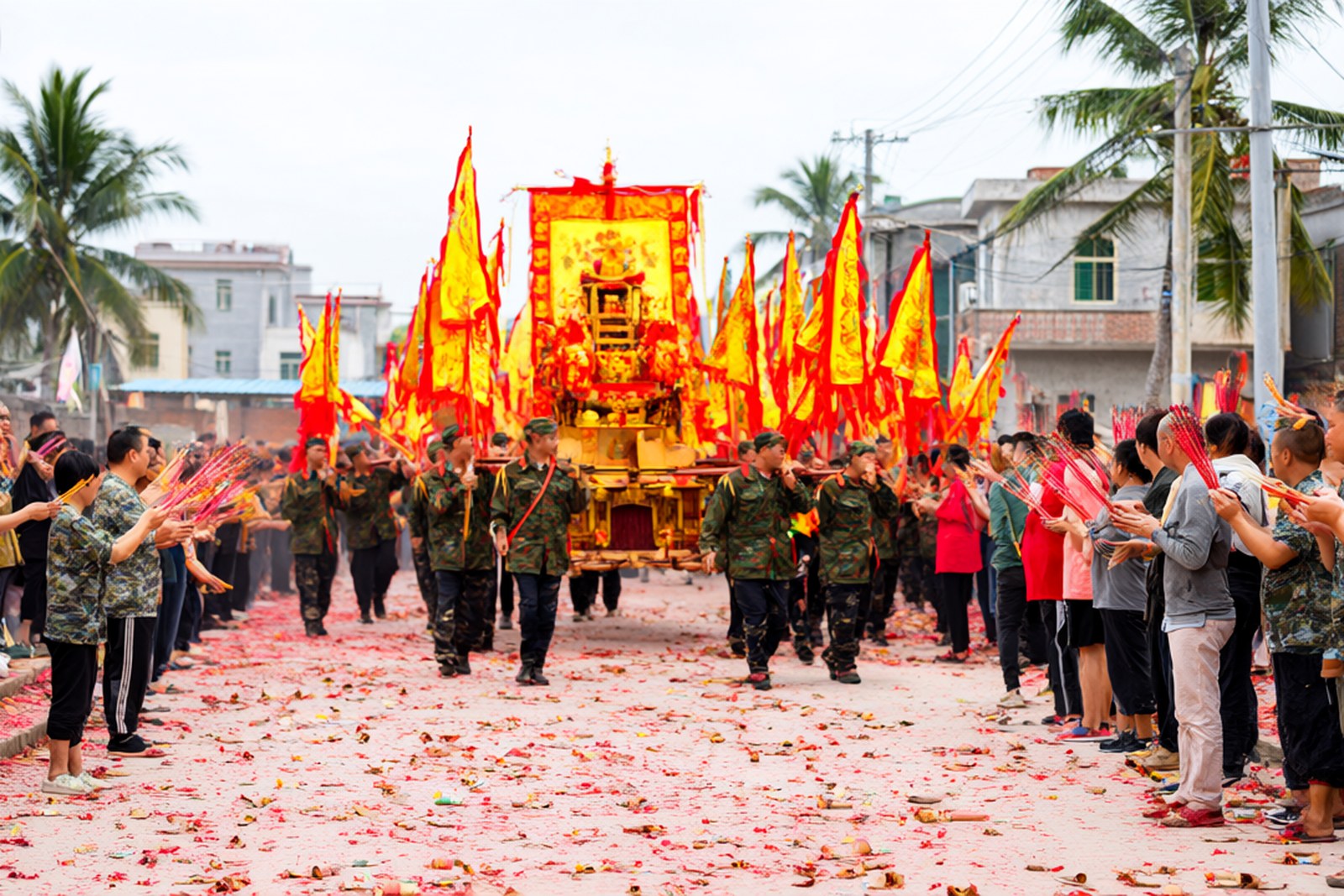
The woman at the centre of all this is Xian Furen Xiǎn fū rén, a sixth-century leader of the Li peoples of Lingnan who memorialised the Liang court to re-establish the prefecture of Yazhou and brought Hainan back under a central administration more than five hundred years after the Han had let it go, and who is said to have led her people into the island five times. By 2022 Hainan counted 471 temples to her. Junpo is described as the temple fair of the Central Plains carried south, with her worship as its core, and its origins are placed in the Tang, more than thirteen hundred years ago. The repertory during the festival runs from 装军, the drilled parade of a mock army, to fire-walking, knife-ladder climbing and spirit-medium rituals. The paperwork is easy to get wrong: the national-level item for this belief system, registered as 民间信俗 with Xian Furen as its subject, was proclaimed in 2014 with Ding’an county as the applicant. Tunchang holds a provincial listing for its Junpo festival, not the national one.
The dance that belongs to the season is 盅盘舞 zhōng pán wǔ, the cup-and-plate dance, and it is easy to recognise once seen. Three performers carry the whole thing: the sheng, or male lead, holds chopsticks and strikes a porcelain plate; the dan, the female lead, holds stacked porcelain cups in each hand and claps them together above and below; the chou, the clown, waves a coloured fan. The props are cups, plates, chopsticks and spoons, and because the accompaniment comes from eight instruments the form is also called the eight-tone dance, and elsewhere the congratulation dance. It began at the end of the Yuan and the beginning of the Ming and was performed only during the Junpo days that commemorate Xian Furen, the ninth to the twelfth of the second lunar month; other accounts give it six hundred years of continuous practice. The instruments are the descendants of Chaozhou music carried into Hainan in the Tang and flourishing in the Ming and Qing, and the tunes have names like Making Merry at Junpo and Celebrating a Good Harvest. Here the record needs care, because the provincial list of 2005 names the item as the Wenchang cup-and-plate dance with the Wenchang culture centre as applicant, while Tunchang officialdom and several provincial outlets claim it equally firmly.
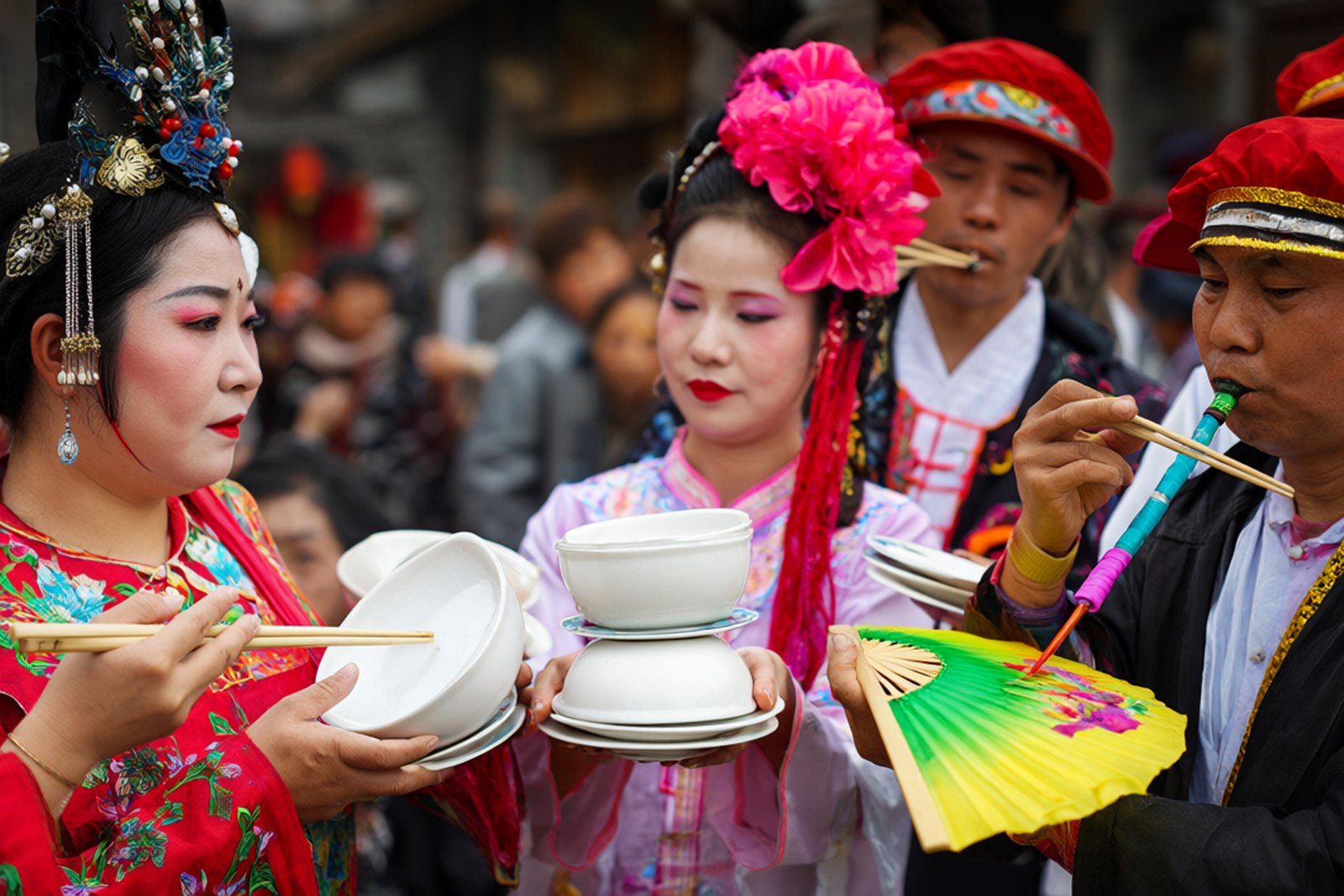
That claim has a face. Li Xiaoru Lǐ Xiào rú began learning the cup-and-plate dance at twelve and is now close to eighty, a national model worker who has spent decades as the county’s unofficial rural planner and is credited with organising more than three hundred ecologically improved villages since 1995. He leads the heritage performance troupe, teaches for nothing, and trains the teachers who take the dance into schools, where it is now an after-school art subject at one or two periods a week with a textbook written for the purpose; in 2025 more than fifteen hundred pupils from twenty-six schools performed it together. The second strand of the county’s folk heritage is a martial art, and it is the best documented thing in this article. 坡陈五形桩 Pō chén wǔ xíng zhuāng, the Pochen five-form stance, belongs to Pochen village in Xinxing town, a settlement of about four hundred people. The boxing took its present form in the last years of the Xianfeng reign, around 1860, which makes it more than a century and a half old and seven generations deep, and it is a southern Shaolin style whose routines are built from five animal forms.
The county’s honours in this line are worth setting down with their years. Pochen village was given a plaque as a hometown of martial arts by the Hainan administrative region in 1986; it won the group first prize at the first Hainan provincial wushu competition in 2013, with individual placings of first, second and third, and a first prize for a special style at the national wushu games in 2014. The five-form stance entered Hainan’s sixth batch of provincial intangible heritage in 2023, and in 2025 it was chosen as an outstanding folk sports project in the national sports culture awards presented at the Suzhou expo, the only Hainan entry so honoured. Oral history says the Xu family settled here a hundred and more years ago, was small enough to be pushed around by neighbouring villages, and took up boxing to defend itself when a teacher named Xu Lehua came over from Wenchang. Tunchang is called a national hometown of martial arts, but the only award with a documented year and issuer is the 1986 plaque to the village, so treat the larger title as reputation rather than record.
Practicalities
Tickets. Neither the Junpo festival nor the martial-arts village charges admission. Junpo is a public religious and community event, held in streets and in people’s homes, and the performance troupes are paid by the village that books them rather than by an audience at a door. Pochen village is a working settlement with its own square and hall, open to visitors at no charge. The county’s intangible heritage exhibition hall, which opened free to the public in December 2025, is free as well.
Opening hours. There is no opening time for a festival, and the practical calendar is the lunar one: sixty-nine Junpo observances spread from the first month to the sixth, most of them in the second and third. If you want the dance, the exhibition hall is the only fixed venue and no reliable source publishes its daily hours, so ask in the county town. Pochen village is best visited in the late afternoon, when the light goes gold on the square and the villagers train; nobody publishes a schedule for that either, so simply turn up toward the end of the day.
Closing day. No closing day is reported for any of these traditions, and the question almost answers itself: there is no venue with a door, no box office and no resident company performing nightly. Junpo moves from village to village with the lunar calendar, the exhibition hall keeps whatever hours the county sets, and the martial-arts square is open ground. The reverse of a closing day is the practical problem: on most ordinary weekdays in most of the sixty-nine places, nothing at all is happening.
Getting there. This is a county-wide tradition rather than a site, so plan by town. Tunchang is about forty minutes from Haikou on the central expressway, and Pochen village is in Xinxing town in the north of the county, reached by car with no published bus route and no official car park. The exhibition hall is in the county town of Tunchang, and the best-known Junpo observances are at Shengde Niangniang in the county town and at Fengmu. Coaches run from Haikou to Tunchang frequently, but nothing official is published about which village celebrates on which date beyond the lunar rule and the documented opening and closing sites.
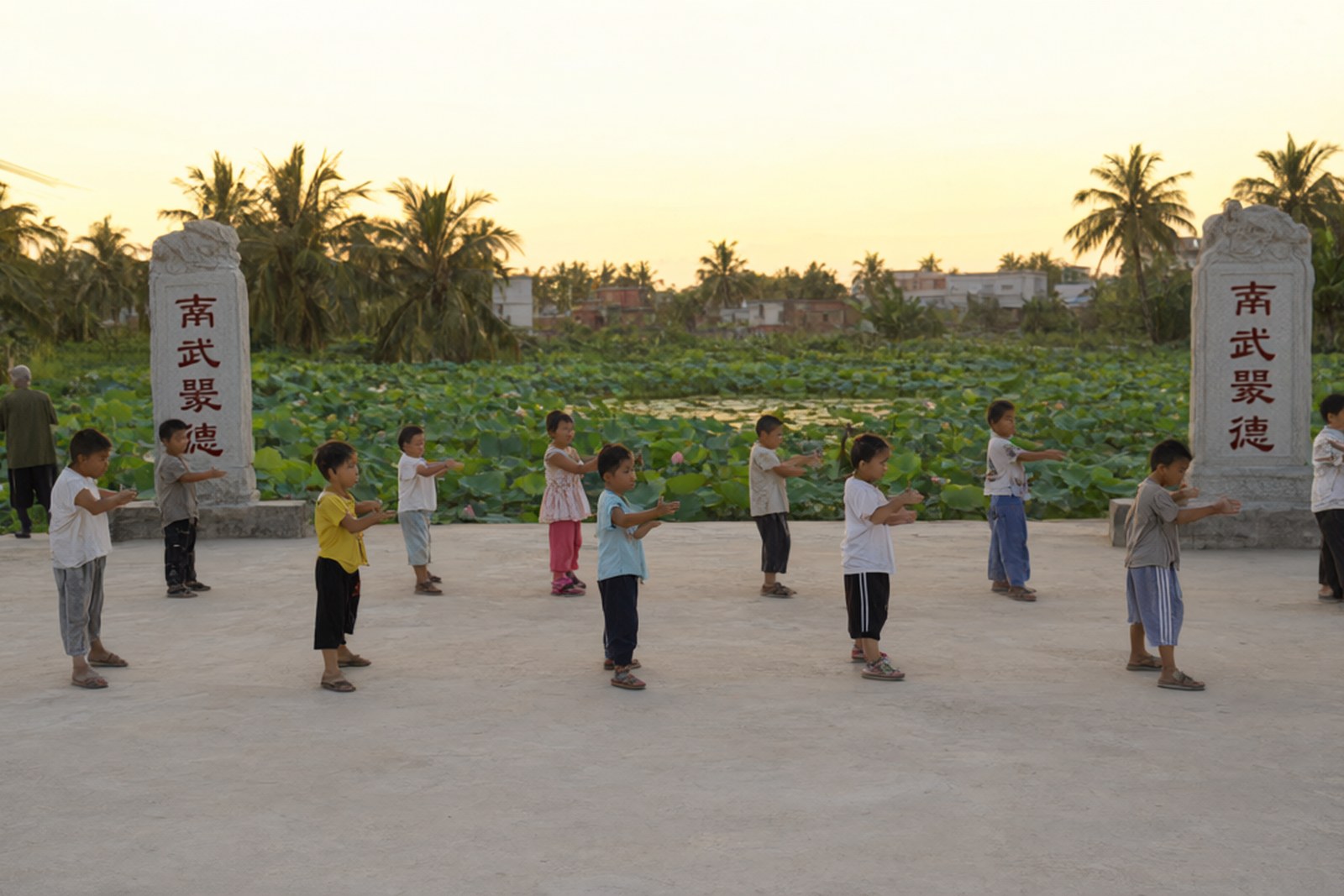
If you can only do one of these three, choose the one with a schedule you can predict, and that is the martial-arts village. Drive north to Pochen in the late afternoon, watch the children and the grandparents go through the same five forms on the same square, and you have seen something that has been handed down through seven generations in a settlement of four hundred people, which is a harder thing to keep alive than any festival. If you can manage a Junpo date, go for the procession and stay for the meal, because the eating is the ceremony and the invitation is the point. And if you are in the county town on an ordinary day, the heritage hall will show you the cups, the crystal and the incense in one room.
Getting there: The Junpo calendar covers 69 sites across Tunchang county from the first to the sixth lunar month, with the best-known observances at Shengde Niangniang in the county town and at Fengmu; Pochen village is in Xinxing town north of the county seat and is reached by car, the heritage exhibition hall is in Tunchang town and opened free in December 2025, no ticket is charged at any of them, and no daily hours or festival timetable is officially published.