
Tunchang Oil Painting, Hainan’s Answer to Dafen
The oil painting street of Tunchang Yóu huà bù xíng jiē runs along Xingye Road in 屯城镇 Tún chéng zhèn, the county town of 屯昌县 Tún chāng xiàn, and it is the only large-scale professional oil painting quarter in Hainan. It is a short street of about two dozen shophouses, each one part studio, part workshop and part showroom, with canvases stacked against the walls and drying on the pavement. What makes the place unusual is the arrangement rather than the art. This is an inland county in the middle of the island with no coast, no port and no art academy, and the painters in these rooms are mostly farmers and the children of farmers who learned to paint in a village school founded for exactly that purpose.
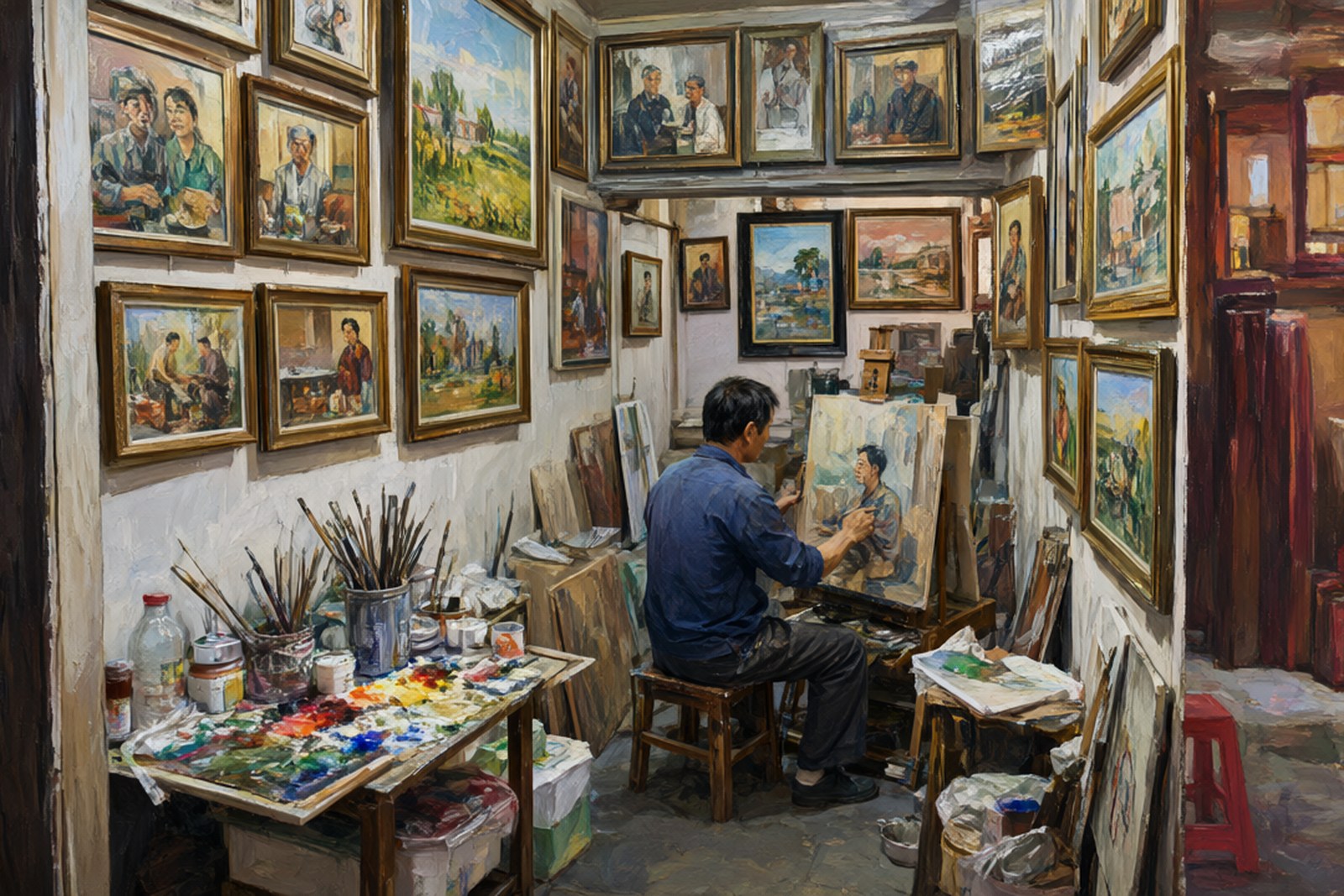
The story begins with one man and one decision. Chen Youjun Chén Yǒu jùn was a self-taught painter from a farming family who noticed that village children liked to draw and that their families could not afford to send them anywhere to learn. In 1984 he opened the Yanpuxuan Fine Arts School Yán pú xuān měishù xuéxiào, which gave local teenagers a one to two year course in oil painting, and it is the single institution behind everything that followed. The official figure for how many people it trained is more than six thousand, a number repeated by the county government, People’s Daily, Hainan Daily and the national workers’ newspaper; reporting in 2011 used five thousand, which is simply an earlier count of the same thing. Most graduates went away to Shenzhen, Xiamen and Kunshan, the mainland cities where commercial oil painting is concentrated, carrying a recognisable house style with them.
The institutional layer came a quarter of a century later. In September 2009 the county formally established its oil painting village, built on a pairing of school and production base. In September 2010 it issued an industry development plan, and in January 2011 the street itself opened on Xingye Road, about ten kilometres from the village where most of the painters come from. The county classified oil painting as a priority cultural reform project that year and backed it with rent reductions, low-rent housing and grants; the 2010 plan paid painters an annual subsidy of 15,000 to 40,000 yuan depending on grade. The figures for the street now are about twenty-four shopfronts, the number used by People’s Daily in 2022, with one 2013 report saying twenty-three; the headcount is looser still, with 48 resident painters and 30 workshop hands in one account and more than 150 painters in another.
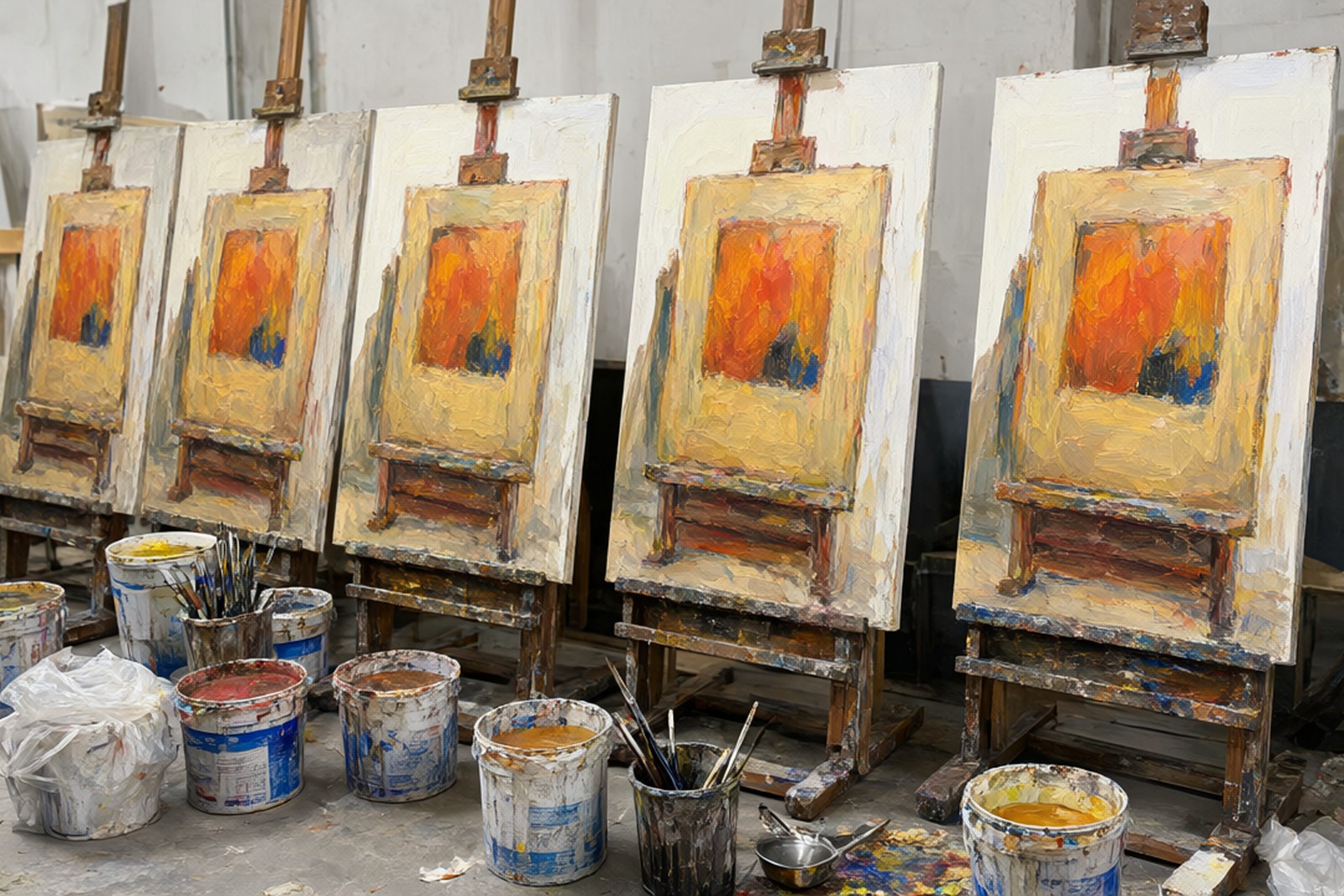
The money is the part that surprises people. In 2013 the street took more than 38,000 orders from home and abroad and turned over close to seven million yuan, itself an increase of nearly a million on 2012; the 2011 figure was more than 30,000 paintings for nearly three million yuan; and the 2022 and 2023 accounts settle at roughly seven million a year, or six million at their best. The customers are hotels, coffee shops and western restaurants in Beijing, Shanghai, Shenzhen and Xiamen, together with a substantial export trade to Europe and the United States, and almost all of it is commercial copying and standardised production. That is the Dafen comparison. What has changed since 2022 is the direction of travel: the provincial literary federation has described a move toward mid-range and higher original work with lower-end painting as the supporting trade, and toward tropical and marine subjects.
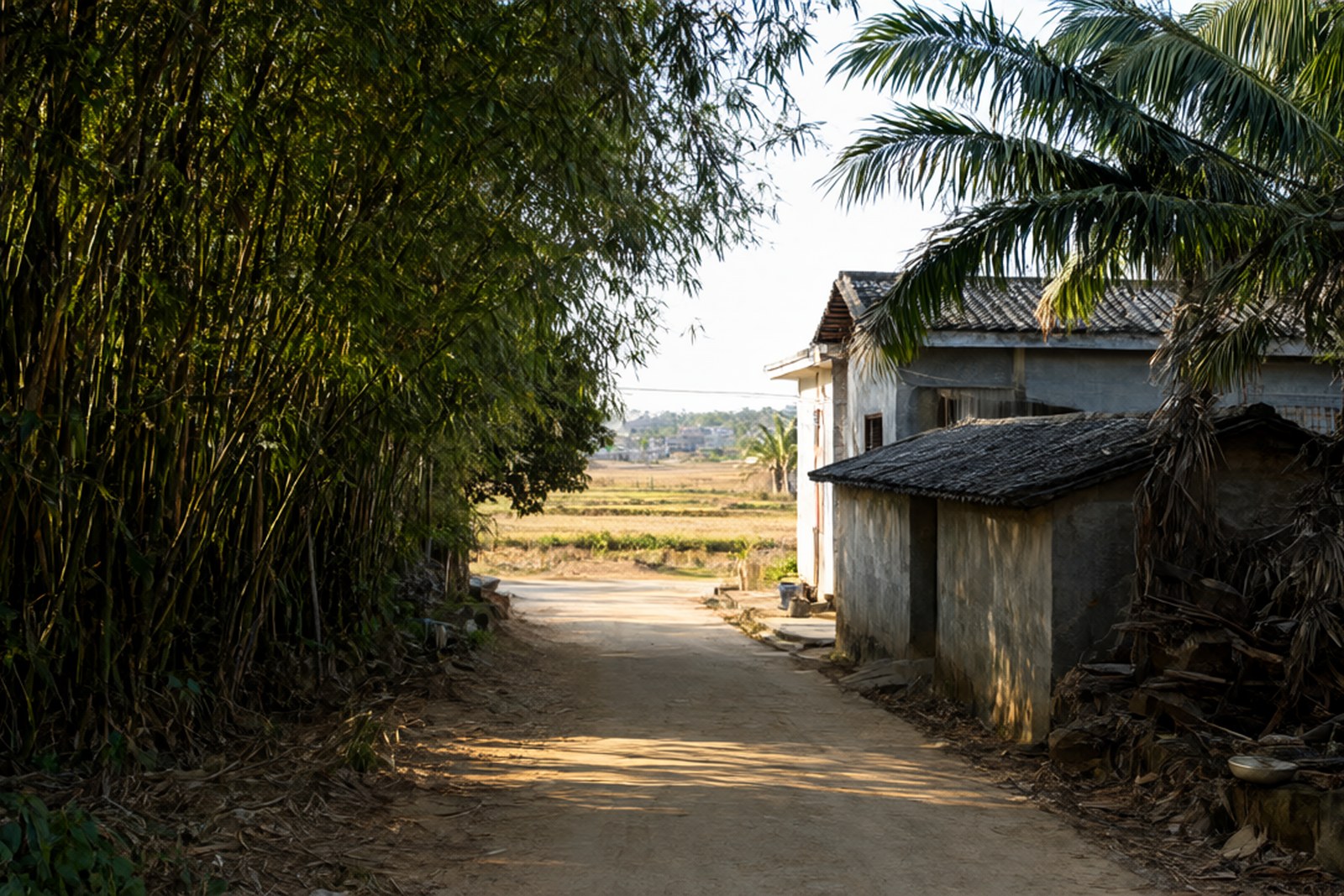
The pressure on all of it is the school. With Yanpuxuan closed and no replacement training mechanism in place, the youngest painters on the street are now around thirty, and the county’s own discussions acknowledge a coming gap in the skills pipeline. In September 2022 the provincial propaganda department, the development and reform commission, the natural resources department, the tourism and culture department and two universities met to look at training, employment and marketing for Tunchang painting. Ten kilometres away in Nanlü town, the village of 咸六村 Xián liù cūn, also written Xianlu, is where the whole thing started, and it carries the nickname oil painting hometown: a village painting society called 六禾画社 runs classes and small exhibitions from a rural café, close to a hundred farmer-painters live and work in the lanes, and the village was named a national forest village on 31 December 2019.
Practicalities
Tickets. There is no ticket. The oil painting street is a public road with studios either side, and entry to it costs nothing; the village at Xianliu is an ordinary working village with a painting society, not a gated attraction. No official price is published for either, and there is no booking system, so anything you are asked to pay is a price for a picture or a lesson rather than for admission.
Opening hours. No official hours are published, and no reliable source gives the opening times of individual studios. In practice the street behaves like a row of small businesses: shutters up in the morning, quiet in the middle of the day, and busiest in the late afternoon and early evening, when the light along the shopfronts is best for looking at what is stacked inside. The painting village at Xianliu holds its classes and small exhibitions mostly in holiday periods.
Closing day. No closing day is reported, because there is no single venue to close. Individual studios take their own rest days, which are not published, and a shop with a commission to finish may be working through a weekend while its neighbour is shut. The one reliable closure in the recent history of the place was not a weekly one: the school that trained everybody stopped enrolling in 2018 and closed entirely in 2020.
Getting there. The street is on Xingye Road in Tunchang town, within the county seat and walkable from the town centre. Xianliu village is in Nanlü town, roughly ten kilometres from the street, with no published bus route and no official parking; a car or a local taxi is the practical way to do both in one afternoon. Tunchang is about forty minutes from Haikou on the central expressway, and the county publishes self-drive itineraries that include the painting street alongside the fragrant-hills park and other rural sites.
If you have an hour, spend it watching a hand, not a wall. The interesting thing on Xingye Road is not the finished picture but the fact that a person who could be out in a field with a hoe is instead holding a brush in a rented shophouse, working from a photograph, matching a colour and shipping the result to a restaurant eight hundred kilometres away. That is the whole county in one room: a place with no coast and no tourist season that turned a village teacher’s evening class into an export trade and then, when the class closed, had to work out how to keep going. Buy something small, ask what the painter specialises in, and then drive the ten kilometres to Xianliu and see the bamboo and betel palms the canvases keep copying.
Getting there: The oil painting street is on Xingye Road in Tunchang town, walkable from the county seat, and the Xianliu oil painting village is about 10 km away in Nanlü town; there is no ticket, no published opening time for the studios, no bus route or official parking for the village, and Tunchang is roughly 40 minutes from Haikou on the central expressway.