
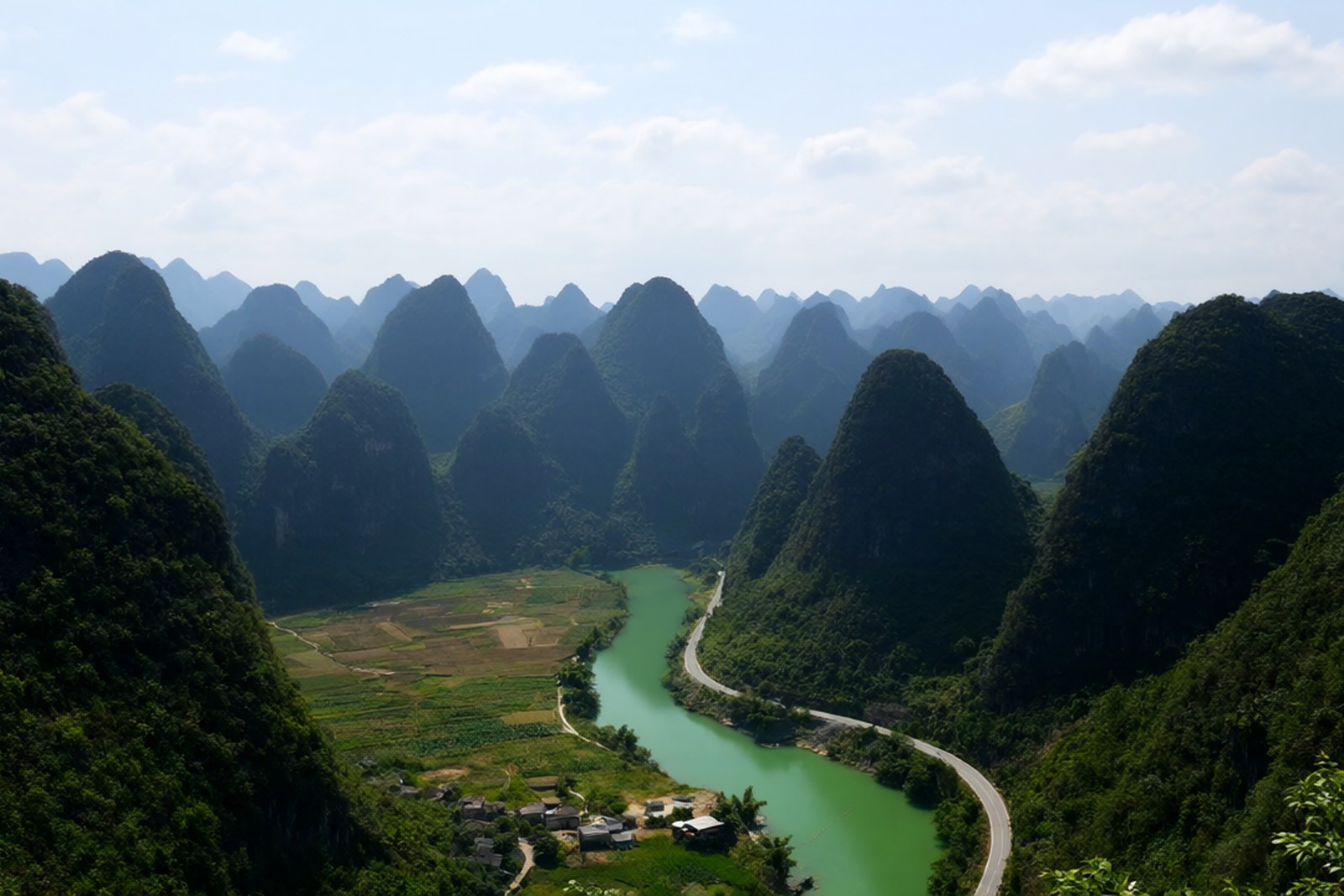
王下乡 Wáng xià xiāng is the remotest township of 昌江黎族自治县, tucked into the ranges of the southeast where the Bawangling massif folds around a canyon of the 南尧河 Nán yáo hé and karst peaks stand wall to wall. Chinese media have dubbed it the Shangri-La of Hainan – a journalists’ phrase rather than any awarded title, though the local slogan, deep in the mountains hides Wangxia, does its best. It is a purely Li township, and getting there is half the story: half an hour from the county town to the Bawangling forest town, then 26 km of winding mountain road down into the canyon, and no hotel of size at the end of it.
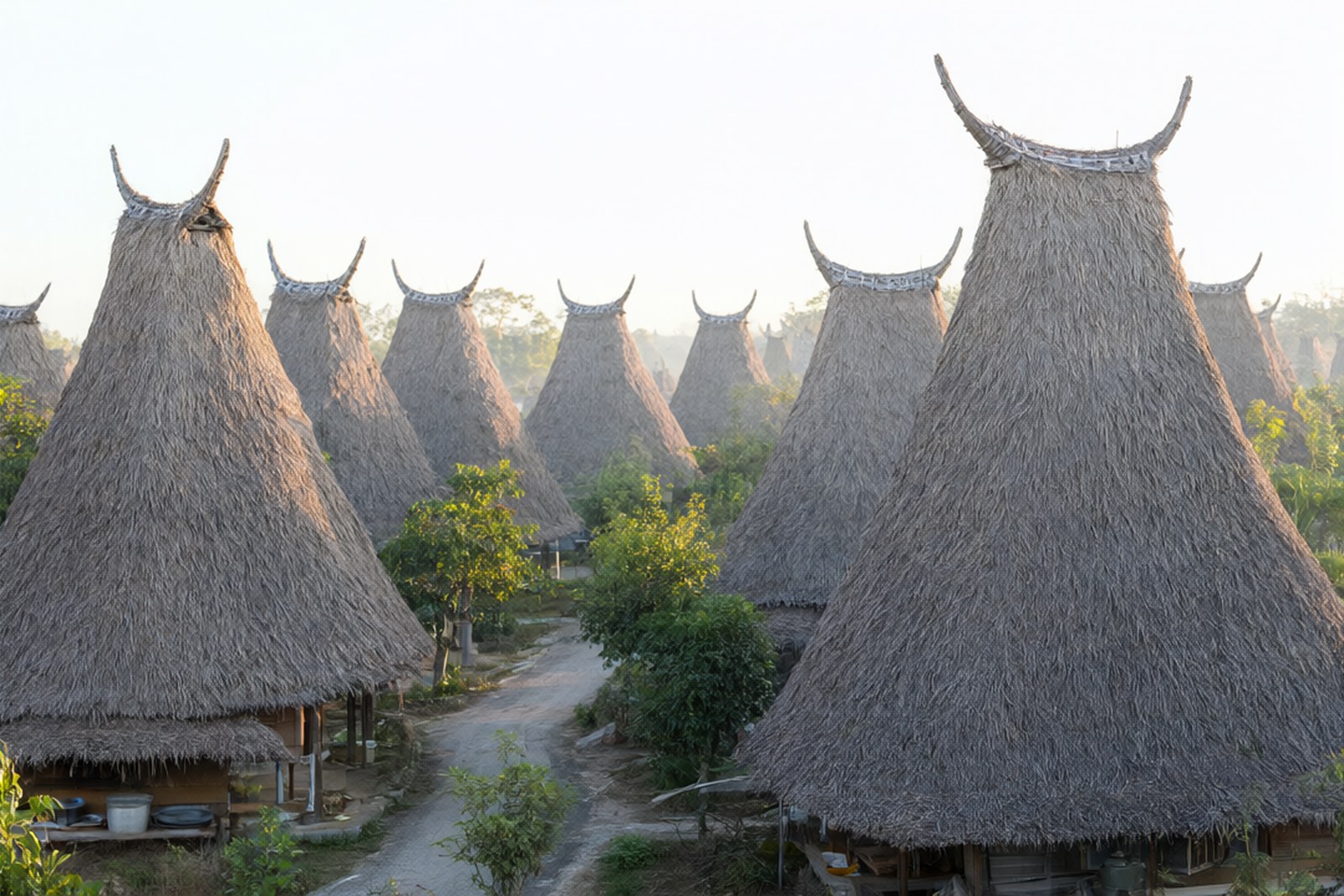
The built attraction is 黎花里 Lí huā lǐ, the three-village line laid out after 2019 and opened in full at a ceremony at 明望坡 on 10 February 2026. 黎花一里, poetry and pictures, is 三派村 Sān pài cūn, whose house walls carry murals of the Li trades – pottery, weaving, rice-pounding, brewing – so densely that official media call the village a flowing museum of Li culture. 黎花二里, time, is 洪水村 Hóng shuǐ cūn, a cluster of boat-shaped thatched houses, the hull-upturned roof form the Li have built for centuries; tourism platforms count 153 of them and call the village the island’s best preserved, a platform figure, while the official phrasing is a living fossil of Li dwelling culture, and a sound-and-light night walk now runs through the lanes. 黎花三里, wine and song, is 浪论村 Làng lùn cūn, where villagers run their own song-and-dance troupe and guesthouse nights come with loom lessons, pottery, shanlan wine and the bamboo-pole dance.
One clarification belongs early. The celebrated boat-shaped houses of 白查村 belong to Dongfang city, one county over, and their building technique entered the national intangible-heritage list in 2008 with Baicha as the main site; Hongshui is Changjiang’s own settlement of the same type, and conflating the two is the commonest error in second-hand write-ups. What Changjiang does hold is a share of a bigger inheritance: the Li textile crafts were inscribed by UNESCO on the urgent-safeguarding list in 2009 and moved to the Representative List in 2024, a Hainan-wide craft for which the county is one transmission place, shown at the Sanpai visitor centre, at the weaving point in Qicha and at the pottery house in Shilu.
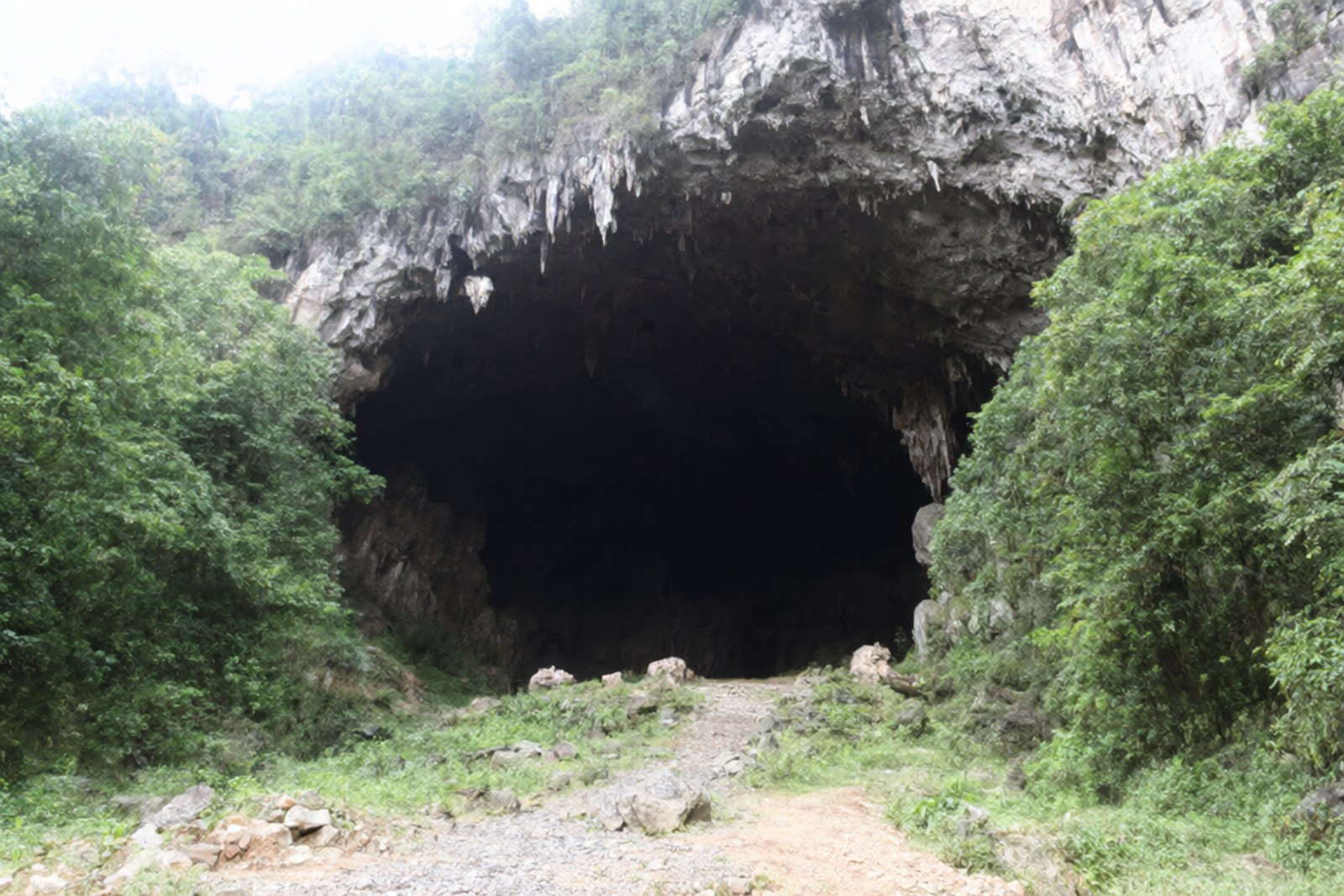
The caves are the other reason to make the drive. 皇帝洞 Huáng dì dòng, the Emperor’s Cave, opens above the Nanrao river east of 牙迫村, its mouth some 27 metres above the water, the passage running more than 120 metres over about 5,700 square metres – county publicity says it could hold ten thousand people, a telling phrase with no survey behind it. Archaeology made it serious: a Neolithic-to-Bronze-Age cave site whose stone knives and axes date back about 6,540 years; in 2025 the provincial archaeology institute with the Minzu University of China and the palaeovertebrate institute began excavation, and the lower chamber yielded animal bones and stone artifacts much like those of Luobidong in Sanya, plus teeth of a suspected large ape which, if confirmed, would put the deposit no later than the late Pleistocene. The dig was still running in 2025 – the story is being revised while you read it.
钱铁洞 Qián tiě dòng, by 钱铁村 on the flank of Qiantie hill, is older still: a mouth facing east, about 12 metres high, 20 wide and 60 deep, two chambers on roughly 1,200 square metres, holding late-Palaeolithic stone tools about 20,000 years old – contemporaneous with the Upper Cave at Zhoukoudian. A joint trial dig in February 2012 brought up more than 160 pieces, cores, flakes, scrapers and choppers among them; the province listed it as a protected site on 24 November 2015; rock paintings turned up in January 2022, and in February 2025 the China Rock Art Society recorded a suspected child’s handprint. In 七叉镇 the county adds 信冲洞 Xìn chōng dòng, a mid-Pleistocene fossil site with reported giant-ape teeth, protected at national level from 2013; the drive in along the Nanrao, under the karst walls promoted as the ten-li gallery, is itself the first sight.
Practicalities
Tickets. Both caves are free – the platform listings carry zero-yuan entries, and there is no operator, no gate and no lighting at either. The Liyuali villages cost nothing to walk. Checked on 30 September 2026; the practical budget is for a car, a guide and a guesthouse rather than admission.
Opening hours. No hours are published, because there is nothing to open: these are raw sites reached by open road and visited in daylight. Take a headlamp into either cave – the floors are uneven and neither has fitted lighting – and stay out of both after heavy rain, when the river rises and the cave mouths can flood.
Closing day. No closing day is reported and none exists in the ordinary sense. What closes the road is weather in the wet months, and what fills the villages is the calendar: the county schedules Li song-and-dance and heritage displays at the Sanpai visitor centre and a living-culture display in the Hongshui thatched-house cluster through late February and March, the time to want the villages performing rather than sleeping.
Getting there. From 石碌镇 drive to the Bawangling forest town, about half an hour, then 26 km of mountain road through the ten-li gallery into the township. The workable day run is the gallery road, the Emperor’s Cave, Qiantie village, then the three Liyuali villages; two days in February, when the kapok and the displays are on. Stay at Bawangling town, back in the county town, or in village guesthouses – the one at Lenglun village is confirmed operating.
flowcloud would say that a township with no hotel, no ticket window and a twenty-thousand-year-old tool kit lying in a hillside has nothing to sell you but access, and that the twenty-six kilometres of mountain road are not an obstacle to the visit but the visit itself – the canyon, the caves and the murals arrive in exactly that order.
Getting there: 王下乡 lies in the southeast of 昌江黎族自治县 in the Bawangling ranges, about half an hour’s drive from 石碌镇 to the forest town and then 26 km of mountain road, best driven privately or by chartered car; the Emperor’s Cave and Qiantie Cave and the three Liyuali villages are free and unstaffed with no closing day and no published hours, the 2026 heritage displays run at Sanpai and Hongshui through February and March, and the township has no hotel of scale, with beds at Bawangling town, the county town or village guesthouses.